
AI Recommendation: Boosting Local Visibility Online
Learn what AI recommendation is, how it works, key types, practical applications for local businesses, risks, and impactful optimization strategies.
Jan 23, 2026

AI Recommendation: Boosting Local Visibility Online
Every local business owner knows how challenging it can be to stand out when customers are searching for options nearby. Digital platforms like ChatGPT and Gemini rely on AI recommendations to decide which businesses to surface first, making your online presence more important than ever. By understanding how AI-driven recommendation systems connect shops to local customers, you can shape your visibility and attract more foot traffic through smarter data and consistent online updates.
Table of Contents
Defining AI Recommendation for Local Businesses
Types of AI Recommendation Systems Explained
How AI Recommends Local Businesses Online
Most Common AI Data Sources & Signals
Risks and Challenges for Local Visibility
Optimizing Visibility for AI-Driven Discovery
Key Takeaways
Point | Details |
|---|---|
AI Recommendations Connect Customers | AI recommendation systems analyze customer behavior to suggest relevant local businesses, enhancing visibility and foot traffic. |
Data Consistency is Crucial | Maintaining accurate and consistent information across various online platforms is vital for AI to recognize and recommend your business. |
Types of AI Systems Vary in Impact | Different AI recommendation systems (content-based, collaborative, knowledge-based) leverage various data types, so businesses should optimize for multiple approaches. |
Engagement and Content Matter | Regular updates, customer reviews, and content creation signal to AI systems that your business is active and relevant, improving recommendation likelihood. |
Defining AI Recommendation for Local Businesses
AI recommendations sound technical and complicated, but here’s what they actually do: they analyze data about customer behavior and preferences, then suggest relevant products or services that match what people are looking for. For your brick-and-mortar business, this means AI systems work behind the scenes to connect your shop with customers who want exactly what you offer. AI recommendation systems use methods ranging from analyzing customer behavior patterns to advanced machine learning models that predict what potential customers need. The goal is straightforward: increase your visibility so the right people discover your business when they search online.
Here’s how this works in practice. When someone searches for “Italian restaurants near me” in ChatGPT, Gemini, or Perplexity, these AI platforms need reliable information to recommend local businesses. They don’t just pull recommendations from thin air. They scan your online presence, check your business listings, review your content, and analyze whether you’re trustworthy and relevant. If your business profile is incomplete, your citations are inconsistent, or your information contradicts itself across different platforms, AI systems deprioritize you or skip you entirely. But when your online data is structured, consistent, and authoritative, AI search engines recognize you as a credible recommendation candidate. This is where AI recommendations directly impact your foot traffic and revenue.
AI recommendation approaches for local businesses essentially work by creating a digital fingerprint of your business that AI can trust and reference. Your Google Business Profile becomes your primary touchpoint. Your citations across industry directories act as verification signals. Your content tells AI what you specialize in and why you matter. When all these elements align and reinforce each other, AI systems see your business as authoritative. They’re more likely to recommend you when users ask relevant questions. This isn’t guesswork or paying for placement. It’s about making your business visible to AI through clarity, consistency, and structure.
The practical reality is this: AI recommendations are reshaping how local customers find businesses. They’re moving from traditional search engine rankings to conversational search answers and personalized suggestions. A coffee shop owner in Austin can compete directly with chains if their online presence is optimized for AI visibility. A plumber in Denver can attract customers from across their service area if AI systems recognize them as trustworthy and qualified. The businesses winning this shift are the ones treating their online data like a strategic asset, not an afterthought.
Pro tip: Start by auditing your current online mentions across Google Business Profile, directory listings, and social platforms. Look for inconsistencies in your business name, address, phone number, and description—these contradictions directly harm your AI visibility, so fixing them first creates immediate improvement.
Types of AI Recommendation Systems Explained
AI recommendation systems come in different flavors, and understanding which type is working for your business visibility matters. The main types break down into distinct categories based on how they collect and process information. Content-based filtering looks at what customers are searching for and matches it to your business attributes. If someone searches “handmade leather goods,” this system checks whether your shop’s online content mentions leather goods. Collaborative filtering works differently, tracking what similar customers liked or purchased, then recommending your business based on those patterns. Hybrid systems combine both approaches for better accuracy. Then there are more specialized types that matter specifically for local businesses: knowledge-based systems and context-aware systems that factor in location, time, and specific customer needs.
Let’s break this down practically. When you operate a local brick-and-mortar shop, knowledge-based recommender systems become particularly valuable because they use explicit information about what your customers actually want and what constraints they have. A customer searching for a bakery that offers gluten-free options within walking distance isn’t just looking for any bakery. The knowledge-based approach captures these specific requirements and constraints, then matches them to businesses that genuinely meet those criteria. This is more sophisticated than simple keyword matching. It understands intent. For your business, this means if your online profile clearly states “gluten-free baked goods available” and your location is documented accurately, knowledge-based systems recognize you as a perfect match for that customer’s specific needs.
Different recommender system approaches each have distinct strengths depending on what data you have available and what you’re trying to accomplish. Content-based systems work well when you have rich, detailed information about your business. They say: “You’ve told us you offer premium coffee and offer seating areas, so we’ll recommend you to people searching for that combination.” Collaborative filtering works when you have data about customer behavior and preferences across many businesses. It says: “People who liked that Italian restaurant also loved your shop, so we’re recommending you to similar customers.” Context-aware systems layer in location, time of day, weather, and other real-world factors. These systems know that someone searching for a restaurant at 8pm on Friday night has different needs than someone searching at 2pm on Monday. Each type powers different parts of how AI search engines find and recommend your business.
Here’s what matters for your strategy: you don’t need to pick one system type and ignore the others. AI search platforms use combinations of these approaches. Your job is to feed each system the right information. For content-based systems, create detailed, accurate descriptions of what you offer. For collaborative filtering, encourage customer reviews and engagement across platforms where behavior patterns can be tracked. For knowledge-based systems, be explicit about your constraints and specialties. Include information about your hours, service area, specific expertise, and unique offerings. For context-aware systems, ensure your location data is perfect and your availability is current. The businesses that rank highest in AI recommendations are the ones that optimize for all these system types simultaneously by having complete, accurate, consistent data across all their online touchpoints.
Here’s a quick comparison of key AI recommendation system types and how they affect local business visibility:
System Type | How It Works | Local Business Benefit |
|---|---|---|
Content-based | Matches customer search to attributes | Promotes unique specialties |
Collaborative | Learns from similar user behavior | Leverages positive reviews |
Knowledge-based | Considers explicit customer needs | Surfaces relevant constraints |
Context-aware | Factors in time, location, context | Prioritizes real-time options |
Hybrid | Uses multiple methods for accuracy | Balances data and relevance |
Pro tip: Audit your business information across Google Business Profile, industry directories, and social platforms to identify which details matter most to each recommendation system type—then ensure those details are identical everywhere, which amplifies your visibility across all AI recommendation approaches.
How AI Recommends Local Businesses Online
When a customer asks ChatGPT, “Where should I get my hair cut near me?” or searches Perplexity for “best pizza in my area,” AI systems don’t just conjure recommendations from nowhere. They pull from multiple data sources simultaneously, analyzing patterns and signals to decide which businesses deserve to be recommended. AI recommendations analyze user interactions, preferences, and publicly available data like reviews, location check-ins, transaction histories, and business listings. The system weighs all this information together to understand which businesses are trustworthy, relevant, and likely to satisfy that specific customer’s needs. For a small business owner, this means every review you get, every accurate listing you maintain, and every piece of content you publish sends a signal to AI systems about whether you deserve that recommendation.
The process works in layers. First, AI systems collect data about your business from everywhere it exists online. Your Google Business Profile, your citations across directories, your social media presence, customer reviews on multiple platforms, your website content, and even mentions of your business across the internet all feed into the recommendation algorithm. Second, the system analyzes this data for consistency and authority. Are your phone number, address, and business name identical everywhere? Do customers consistently praise you for specific things? Does your online description match what you actually offer? Third, AI compares your business against competitors in your category and location. It asks: “Among all the plumbers in Denver, which ones have the strongest online presence and most trustworthy reputation signals?” Fourth, it factors in real-time context. The search happens at a specific time, in a specific location, with specific customer needs. An AI system prioritizes nearby businesses with current operating hours and relevant specialties. All these layers combined determine whether your business gets recommended.

What’s crucial here is that AI-driven tools enhance operational efficiency and market presence by leveraging the data you provide. AI systems don’t create recommendations in isolation. They respond to the quality and completeness of information available about your business. A restaurant with a fully optimized Google Business Profile, consistent citations across directories, regular fresh content, positive reviews, accurate service information, and relevant photos gets recommended far more often than a competitor with outdated information and incomplete listings. The business that invests in data consistency and accuracy literally becomes more visible to AI. This isn’t luck or complex technical wizardry. It’s a direct cause-and-effect relationship: better data equals better recommendations.
Here’s what happens when you don’t optimize for AI recommendations. A customer searches for your service, but AI systems find incomplete information about your business. Maybe your hours are wrong on one platform and missing entirely on another. Maybe your Google Business Profile hasn’t been updated in six months. Maybe your description mentions services you stopped offering two years ago. AI systems see these contradictions as red flags. They become less confident recommending you because the signals are confused or outdated. Meanwhile, your competitor who maintains clean, consistent, current information gets the recommendation instead. You lose that customer. This plays out thousands of times across countless searches. Over months and years, the gap between your visibility and your competitor’s visibility widens significantly.
The flip side is equally powerful. When you maintain excellent data consistency, AI systems develop confidence in recommending you. Every time a customer asks a relevant question, your business appears because the recommendation algorithm recognizes you as trustworthy and relevant. This doesn’t require advertising spend or gaming the system. It requires discipline in keeping your information accurate and complete everywhere your business exists online. Small businesses with proper AI optimization often punch far above their weight against larger competitors because they’ve done this work deliberately while bigger chains sometimes treat their online data as an afterthought.
Pro tip: Create a monthly calendar reminder to check your business information across five key platforms: Google Business Profile, your top three industry directories, and your website, then update any inconsistencies immediately so AI systems always reference current, accurate data about your business.
Most Common AI Data Sources & Signals
AI systems don’t make recommendations based on guesswork. They pull from a vast network of data sources, each one sending signals about your business that influence whether customers find you online. Think of these data sources as different voices speaking about your business. When all the voices say the same thing, AI systems listen closely. When they contradict each other, AI systems become skeptical. Understanding what these sources are and how they work together helps you optimize your presence strategically. AI recommendation systems integrate multimodal signals including user-item interaction histories, textual reviews, images, videos, and contextual metadata to produce nuanced recommendations by modeling both user preferences and business characteristics. This means your business information exists across multiple formats, not just text. Photos of your storefront, videos of your team, customer reviews, location data, service descriptions, and interaction patterns all feed into how AI systems evaluate you.
The most critical data sources for local business recommendations break down into specific categories. Your Google Business Profile is the primary source. This is where AI systems first look because Google has invested heavily in standardizing business information. Everything here matters: your business name, address, phone number, service area, hours, photos, description, and customer reviews. Directory citations come next. These are listings on platforms like Yelp, Apple Maps, industry-specific directories, and local business aggregators. When your information is identical across all these directories, AI systems gain confidence in your accuracy. Customer reviews and ratings function as reputation signals. A business with 4.8 stars across fifty reviews sends different signals than a business with 3.2 stars across five reviews. Website content tells AI what you specialize in and how you describe your services. Social media presence shows activity, engagement, and how recently you’ve been active. Location data from check-ins and map signals reinforces your geographic footprint. All these sources combine to create a complete picture.
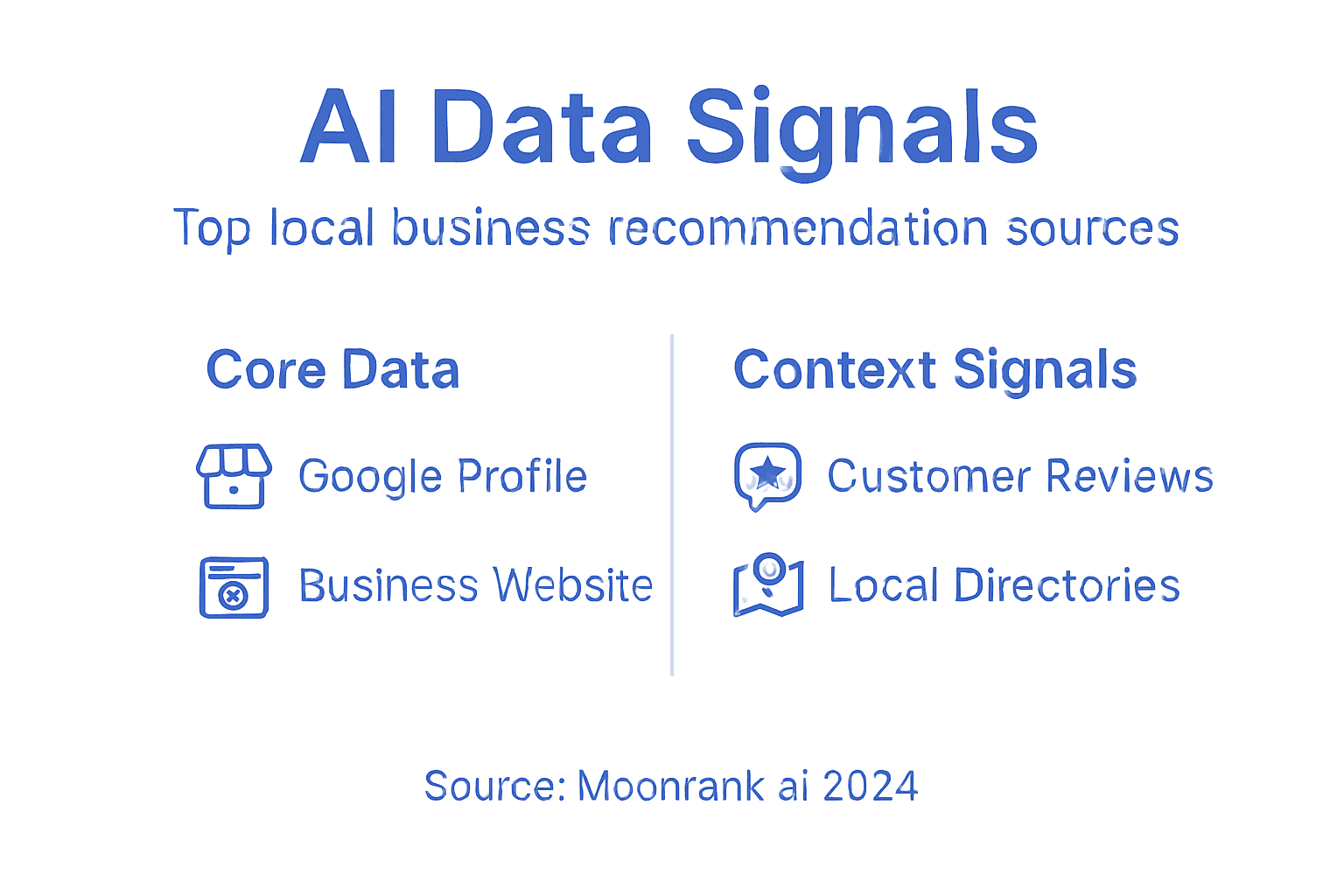
Beyond these obvious sources lie deeper contextual signals. Platforms aggregating demographic, economic, and geographic data provide AI systems with rich context about the neighborhoods where businesses operate. These sources include census data, economic activity indicators, community characteristics, and geographic information. An AI system analyzing whether to recommend your coffee shop doesn’t just look at your reviews and hours. It also considers demographic information about your neighborhood, economic trends in your area, foot traffic patterns, and whether your business aligns with what people in that location are searching for. This contextual data layer explains why a business thriving in one neighborhood might struggle in another. The same business profile with identical information performs differently depending on the community context that surrounds it.
Here’s what matters practically: you control many of these data sources directly, and you influence others indirectly. You control your Google Business Profile, your website content, and your social media presence. You influence customer reviews by providing exceptional service that motivates people to leave positive feedback. You influence directory citations by ensuring they’re complete and accurate. You influence contextual signals indirectly by operating in a neighborhood and participating in your local community. The businesses winning at AI visibility are the ones managing all these sources cohesively. They ensure their information is consistent everywhere. They encourage satisfied customers to leave reviews. They keep their profiles active with fresh photos and updates. They create website content that clearly describes their services. They monitor their reputation across all platforms. This multi-source optimization approach creates compounding visibility gains because each source reinforces the others.
There’s another layer worth understanding. AI systems weight these sources differently depending on context. When someone searches for a restaurant near them right now, real-time signals like current operating hours and recent customer reviews matter more than demographic data. When someone searches for a specialized service like a commercial accountant, website content describing your expertise matters more than neighborhood demographics. The weighting shifts based on the search intent. This is why a one-size-fits-all approach doesn’t work. Your strategy needs to cover all these data sources because you don’t know which ones will be most important for any given customer search. The comprehensive businesses that manage Google Business Profiles, citations, reviews, website content, social presence, and community visibility simultaneously end up appearing in more searches and more recommendation scenarios.
The following table summarizes the most influential data sources that AI considers when recommending local businesses:
Data Source | Example Impact on Recommendations |
|---|---|
Google Business Profile | Accurate hours boost real-time matches |
Industry Directories | Consistent info builds trust signals |
Customer Reviews | High ratings increase algorithm ranking |
Website Content | Clear services attract niche searches |
Social Media Activity | Recent posts show ongoing engagement |
Location Data | Check-ins confirm physical presence |
Community Context | Neighborhood fit influences relevance |
Pro tip: Conduct a “data audit” by checking your business information across your top five data sources, then create a spreadsheet documenting what exists, what’s missing, and what contradicts itself, then prioritize fixing the biggest gaps and inconsistencies first since these directly harm AI visibility.
Risks and Challenges for Local Visibility
Optimizing your business for AI visibility isn’t purely beneficial. Real challenges exist, and ignoring them can create problems that harm your reputation or violate customer trust. Adopting AI recommendations to boost local visibility involves risks such as data privacy concerns, biased algorithmic outputs, and resource limitations that small business owners often underestimate. When you feed customer data into systems designed to improve visibility, you’re trusting those systems to handle sensitive information responsibly. But data breaches happen. Platforms get hacked. Information intended to stay private sometimes leaks. Additionally, AI systems can produce biased recommendations that discriminate against certain businesses or communities, often unintentionally. A restaurant owner from an underrepresented background might find their business consistently deprioritized by algorithms trained on historical data that reflects past discrimination. These aren’t theoretical problems. They’re real risks that deserve your attention and careful management.
Another major challenge is the technical expertise gap. Most small business owners didn’t study machine learning or data science. Understanding how AI systems evaluate your business, what data matters most, and how to optimize for visibility requires knowledge many people don’t possess. You might think you’re optimizing correctly when you’re actually working against the algorithm. For instance, keyword stuffing your business description sounds like it should help AI understand your services, but it actually makes your business look spammy and less trustworthy. Automating content creation through AI-generated descriptions can backfire if the generated content doesn’t accurately reflect your actual business or contradicts information elsewhere. The temptation to game the system is real, and the consequences of trying can damage your credibility.
There’s also the challenge of algorithmic bias and accountability deficits that can exacerbate social inequalities. If an AI recommendation system was trained primarily on data from wealthy neighborhoods with well-funded businesses, it might consistently favor recommendations that match that pattern. Businesses in lower-income areas, minority-owned shops, or communities underrepresented in training data might get systematically overlooked, not because they’re worse but because the algorithm was never properly trained on their characteristics. This creates a visibility gap that has nothing to do with business quality. Furthermore, when algorithms make recommendations, it’s often unclear why. You might optimize everything correctly and still not appear in recommendations, with no way to understand what went wrong or how to fix it. This lack of transparency makes it difficult to adjust your strategy effectively.
Resource limitations compound these challenges. Maintaining consistent information across Google Business Profile, industry directories, citation sources, and your website requires time and attention. Small business owners already juggle operations, customer service, marketing, and finances. Adding “keep all online data synchronized” to that list feels overwhelming. Many businesses struggle to maintain even basic online presence updates, let alone implement sophisticated AI visibility strategies. Those with limited budgets can’t hire specialists to manage this work, so they either do it imperfectly themselves or ignore it entirely. This creates an unequal playing field where businesses with resources win visibility battles against smaller competitors who lack bandwidth.
There’s also a privacy consideration worth understanding. The more data you provide about your business, the more data points exist for potential misuse. Customer information, location patterns, service details, and business performance metrics all become visible to AI systems and potentially to competitors. Some of this information might be commercially sensitive. A restaurant’s customer review patterns might reveal which menu items are popular. A plumber’s service area map might show where competitors aren’t strong. This competitive information becomes visible when you optimize for AI visibility. Additionally, customers might feel uncomfortable knowing their location data and behavior patterns feed into business recommendations. Balancing transparency with privacy becomes more complex as you optimize your presence.
The competitive risk is real too. As more businesses optimize for AI visibility, the advantages diminish. If every business maintains perfect data consistency and solid reviews, then AI systems need new signals to differentiate recommendations. This could push platforms toward new ranking factors you haven’t anticipated, forcing another round of optimization. The businesses that adapted first get a temporary visibility advantage, but that advantage shrinks as competition increases. Eventually, optimization becomes table stakes rather than a competitive advantage.
Pro tip: Before implementing any AI visibility strategy, audit your current data practices for privacy risks and accuracy issues, then create a simple checklist of what data you’re sharing and why, ensuring you’re comfortable with the privacy implications before you proceed.
Optimizing Visibility for AI-Driven Discovery
Optimizing your visibility for AI-driven discovery isn’t about gaming algorithms or using trendy tactics. It’s about building a strong, consistent, data-rich foundation that AI systems can recognize and trust. Optimizing visibility in AI-driven discovery requires integrating high-quality data and fostering strategies aligned with AI capabilities. The core principle is straightforward: the better your data, the better AI systems can understand and recommend your business. Start with the basics. Your Google Business Profile must be complete and accurate. Every field matters: business name, address, phone number, service area, hours, description, categories, photos, and attributes. Don’t leave anything blank or vague. A photo of your actual storefront is better than no photo. A detailed description of what makes your business unique is better than generic industry language. Then extend this completeness to every directory where your business is listed. Ensure identical information across all platforms. When AI systems see consistent data everywhere, they gain confidence in your legitimacy.
The next layer involves creating content that AI systems can understand and users actually find helpful. Your website needs clear, specific descriptions of what you offer. Instead of saying “we provide professional services,” say “we offer certified public accounting services for small manufacturers in the food production industry.” Specificity helps AI systems match you with relevant customer searches. Your Google Business Profile description should focus on what makes you unique and why customers should choose you. Consider the customer perspective. What problems do you solve? What can customers expect when they visit? What special expertise or services do you provide? When you answer these questions clearly in your business descriptions, AI systems extract that information and use it to match you with relevant searches. Additionally, increasing visibility into AI agents involves implementing measures like real-time monitoring and activity logging to ensure transparent, accountable recommendations. This means you should monitor how your business appears across different AI platforms. Search for your business using AI search engines like ChatGPT and Perplexity. See what information they pull about you. If inaccuracies appear, trace them back to their source and correct them. This active monitoring helps you catch problems before they harm your visibility.
Customer reviews deserve strategic attention because they’re powerful signals to AI systems. Encourage satisfied customers to leave reviews by making the process easy. Send follow-up emails with direct links to your review pages. Place signs in your store directing customers to review you. Create a simple system for asking satisfied customers for feedback right after positive interactions. The goal isn’t to manipulate reviews but to make it easy for genuinely satisfied customers to share their positive experiences. Variety matters too. Collect reviews across multiple platforms: Google, Yelp, industry-specific sites, and location-based apps. AI systems weight reviews from different sources differently, so having a strong presence across multiple platforms amplifies your signals. Respond to reviews, especially negative ones, in a professional and helpful manner. Responses show that you care about customer feedback and actively manage your reputation. This engagement itself becomes a positive signal to AI systems.
Location optimization is critical but often overlooked. Make sure your address, phone number, and business hours are identical everywhere. If you serve customers across a service area, define that clearly. Don’t claim a massive service area if you actually focus on a specific neighborhood. Specificity builds credibility. Include location-specific content on your website. If you have multiple locations, create separate pages for each with unique descriptions and local details. Local schema markup on your website helps AI systems understand your location and service area. This structured data tells AI exactly where you operate and what you offer in different locations.
Content creation accelerates your progress. Regular posts on your Google Business Profile, blog articles on your website, and consistent social media updates all signal that your business is active. AI systems prioritize recent activity. A business that posted last week ranks higher than one that posted six months ago, all else being equal. You don’t need to post daily, but monthly updates across your profiles matter. Create content that answers questions your customers actually ask. A plumber might create a post about winterizing outdoor pipes before winter arrives. A bakery might share posts about ingredient sourcing or new seasonal items. This content serves dual purposes: it helps customers and shows AI systems that you’re actively engaged with your business.
Final optimization involves monitoring and adjusting. Track which search terms bring customers to your website. Use Google Search Console to see what queries you appear in. Look for gaps between what you want to rank for and what you actually rank for. If customers search for services you offer but don’t find you, that’s a signal to strengthen your content and descriptions around those topics. Review your analytics quarterly. Are customers finding you? Are they converting to actual visits? This performance data guides your next optimizations. Visibility optimization is not a one-time project. It’s an ongoing process of refinement based on data and customer behavior.
Pro tip: Create a quarterly review schedule where you audit your Google Business Profile, top three citations, website content, and recent customer reviews, then update anything that’s outdated or inaccurate while identifying one new area for optimization based on customer search patterns.
Elevate Your Local Visibility with AI-Optimized Solutions
The article highlights the growing challenge local businesses face in maintaining consistent, complete, and accurate online data to ensure AI recommendation systems like ChatGPT and Perplexity can find and trust them. Many business owners struggle with data inconsistencies, unclear profiles, and managing multiple citations across platforms all of which decrease visibility and reduce chances of being recommended to potential customers. Achieving clarity and structure in your Google Business Profile and citation listings is critical to building an authoritative digital footprint that AI acknowledges.
With Moonrank.ai, you gain a powerful ally to tackle these pain points by automating the audit and optimization of your entire online presence. Our platform helps you align and synchronize your business information across all key channels, including Google Business Profile, directory listings, and social platforms. With tailored content creation that speaks directly to AI-driven searches, you can become the trustworthy, consistent recommendation that stands out in competitive local markets. Don’t let inconsistent data hold you back from the organic growth AI-powered discovery can deliver.
Unlock the true potential of AI recommendations today by visiting Moonrank.ai. Our tools simplify building and maintaining a trusted digital footprint so your local business can compete and win across AI-driven search engines. Learn more at Moonrank.ai landing page and start transforming your AI visibility with an efficient and scalable solution.
Ready to turn AI search algorithms into your strongest local marketing partner?
Explore how you can automate your business data consistency and boost your AI-driven local visibility with Moonrank.ai now. Take action today to future-proof your presence and attract more customers organically.
Frequently Asked Questions
What are AI recommendation systems, and how do they help local businesses?
AI recommendation systems analyze customer behavior and preferences to suggest relevant products or services. For local businesses, they improve visibility by connecting shops with customers actively searching for specific offerings.
How can I optimize my Google Business Profile for AI recommendations?
Ensure your Google Business Profile is complete and accurate. Fill in all fields like business name, address, phone number, service area, hours, and add high-quality photos and a unique description to enhance visibility.
What types of AI recommendation systems should I focus on for my local business?
You should focus on content-based filtering, collaborative filtering, and knowledge-based systems, as they can enhance your online presence by addressing specific customer needs and matching them with your business characteristics.
How do customer reviews impact AI recommendations for my business?
Customer reviews serve as reputation signals that influence AI systems. High ratings and consistent positive feedback improve your credibility and increase the likelihood of being recommended to potential customers.