
AI Search Optimization Guide for Local Business Growth
Follow this ai search optimization guide to boost local business visibility with proven steps, from auditing profiles to verifying AI-driven search exposure.
Jan 23, 2026

AI Search Optimization Guide for Local Business Growth
Struggling to keep your local business visible on Google and Apple Maps can feel overwhelming, especially as AI-driven search engines transform how customers find what they need. Store owners in the retail and service sectors often face confusing inconsistencies across digital listings and reviews, risking lost foot traffic and reduced trust. By focusing on a comprehensive local SEO audit and AI-friendly online strategies, you can build a stronger digital presence that drives more organic traffic and ensures your business shows up where it matters most.
Table of Contents
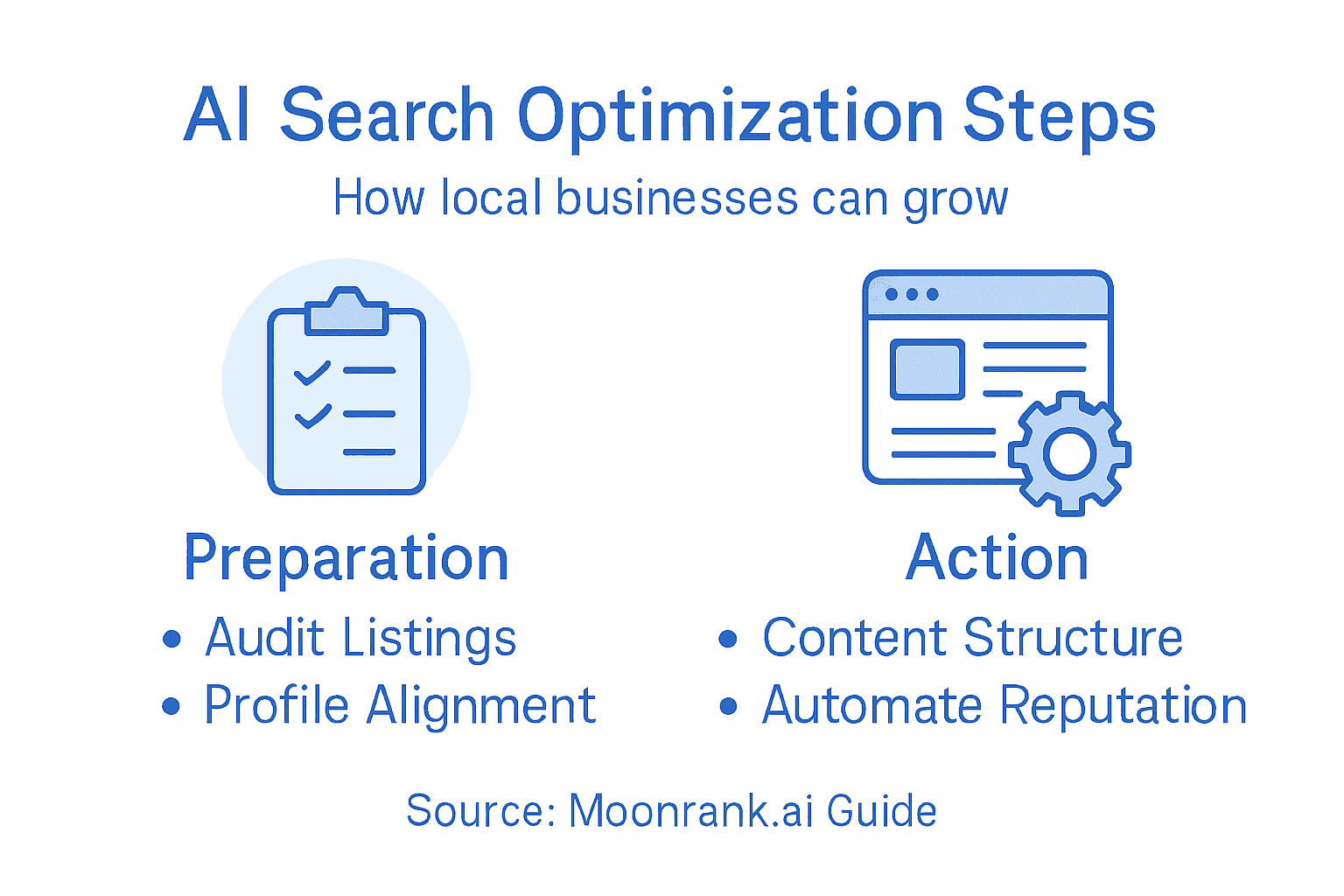
Step 1: Audit Online Presence And Local Listings
Step 2: Align Business Profiles For AI Recognition
Step 3: Structure Content For AI Search Engines
Step 4: Automate Reputation And Citation Management
Step 5: Verify Placement In AI Search Results
Quick Summary
Key Point | Explanation |
|---|---|
1. Conduct Regular Audits | Schedule quarterly online presence audits to ensure accurate business information across platforms. |
2. Optimize for AI Recognition | Use specific and structured data in your business profiles to enhance AI comprehension and visibility. |
3. Automate Reputation Management | Implement tools to monitor reviews and citations automatically, maintaining a positive online presence. |
4. Structure Content for AI | Use structured data markup for clear AI interpretation of your business services and offerings. |
5. Track AI Search Visibility | Regularly check your business’s appearance in AI search results to identify trends and optimize discoverability. |
Step 1: Audit Online Presence and Local Listings
Auditing your online presence is like performing a digital health checkup for your local business. You will systematically review and verify how your business appears across different online platforms to ensure accuracy and maximize visibility.
Start by conducting a comprehensive local SEO audit which involves examining several key digital touchpoints. First, verify your Google Business Profile details to confirm your business name, address, phone number, website, hours of operation, and category are completely accurate. Cross reference these details across multiple platforms like Yelp, Facebook, Apple Maps, and industry specific directories to eliminate any discrepancies.
Utilize specialized tools like Semrush or Moz to track your current online citations and identify where your business information appears. Analyze your online presence by checking your website performance, monitoring customer reviews, and assessing how consistently your business information is represented across different platforms. Pay special attention to your NAP (Name, Address, Phone Number) consistency, as mismatched information can negatively impact your search visibility and confuse potential customers.
Pro Tip: Schedule a quarterly online presence audit to quickly catch and correct any emerging information discrepancies before they impact your business discovery.
Here is a summary of key audit tools and their unique benefits for local businesses:
Audit Tool | Primary Purpose | Unique Benefit |
|---|---|---|
Semrush | Track online citations | Identifies citation inconsistencies |
Moz Local | Monitor business listings | Finds missing or duplicate entries |
Google Business Profile | Main listing management | Ensures accuracy across Google services |
Yelp | Review and reputation insights | Highlights customer feedback |
Apple Maps | Maps and directions accuracy | Verifies location visibility |
Step 2: Align Business Profiles for AI Recognition
Aligning your business profiles for AI recognition is crucial in ensuring your local business gets discovered accurately across emerging AI search platforms. You will strategically structure your online information to make it easily interpretable by AI algorithms.
Optimize your Google Business Profile by providing comprehensive and precise business details that AI systems can quickly parse and understand. This means going beyond basic contact information and including rich structured data such as specific service descriptions, detailed business categories, high quality images that represent your business accurately, and comprehensive operational information like seasonal hours or special service offerings.
Ensure your business profiles across different platforms maintain consistent information and use clear natural language that AI search engines can easily comprehend. Include relevant keywords that describe your business offerings specifically and authentically without overstuffing. Focus on creating structured content with clear headings, concise descriptions, and accurate location information that helps AI systems confidently recognize and recommend your business to potential customers.
Pro Tip: Update your business profile details quarterly and use precise location and service language to help AI search platforms understand your exact business offerings.
Step 3: Structure Content for AI Search Engines
Structuring your content for AI search engines is about transforming your online information into a format that artificial intelligence can easily understand and interpret. You will learn how to optimize your digital content to increase visibility and improve your chances of being recommended by AI search platforms.

Implement structured data markup to help AI search engines comprehend your content more precisely. This involves adding specific schema code to your website that provides clear context about your business services, location, hours, contact information, and unique offerings. By using structured data, you essentially create a digital language that AI systems can quickly parse and understand, making it easier for them to accurately represent your business in search results.
Focus on creating content that is clear, concise, and directly answers potential customer questions. Use natural language that describes your services, includes relevant local keywords, and provides comprehensive information about your business. Organize your content with clear headings, use descriptive alt text for images, and ensure that your website architecture allows AI search engines to easily navigate and understand the relationships between different pages and content sections.
Pro Tip: Use free schema markup generators and validate your structured data using Google’s structured data testing tool to ensure maximum AI search engine comprehension.
The following table compares structured data markup methods commonly used to optimize business visibility for AI search platforms:
Markup Type | Main Use | Helps AI With |
|---|---|---|
LocalBusiness schema | Defines contact and location info | Accurate geolocation recognition |
Service schema | Lists specific offerings | Detailed service categorization |
OpeningHours schema | Specifies business hours | Reliable operational updates |
Image schema | Tags business images | Improved visual search results |
Step 4: Automate Reputation and Citation Management
Automating your reputation and citation management is a strategic approach to maintaining a consistent and positive online presence across multiple digital platforms. You will learn how to streamline your online reputation monitoring and management to ensure accuracy and build trust with potential customers.
Set up automated monitoring tools that track your business mentions, reviews, and citations across various online directories and social media platforms. These tools can help you quickly identify and respond to customer feedback, manage your online reputation proactively, and ensure that your business information remains consistent and up to date. Look for solutions that offer real time alerts, bulk citation management, and easy review response capabilities.
Create a systematic workflow for managing online citations and reviews. This includes setting up automated notifications for new reviews, developing templates for professional responses, and establishing a regular schedule for updating your business information across different platforms. Prioritize platforms that are most relevant to your local business and industry, and develop a strategy for maintaining a positive and accurate online reputation that builds customer trust and improves your visibility in AI search results.
Pro Tip: Dedicate at least 30 minutes weekly to reviewing and responding to online citations and reviews to maintain an active and engaged online presence.
Step 5: Verify Placement in AI Search Results
Verifying your business placement in AI search results is a critical step in understanding how effectively you are being discovered and recommended by emerging artificial intelligence platforms. You will learn how to systematically check and analyze your visibility across different AI search engines.
Conduct comprehensive searches across multiple AI platforms like ChatGPT, Gemini, Perplexity, and others to see how your business appears in context. Use different query variations related to your local business services to understand the range of scenarios where you might be recommended. Pay attention to the specific language and context in which your business is mentioned, the accuracy of information presented, and whether the AI platforms are providing comprehensive and trustworthy representations of your services.
Track your AI search visibility by maintaining a documentation system that records your search appearances, noting details such as the context of mentions, frequency of recommendations, and the specific queries that trigger your business information. This systematic approach will help you understand your current AI search performance and identify areas where you can further optimize your online presence to improve discoverability and trust among potential customers.
Pro Tip: Create a monthly spreadsheet tracking your AI search appearances to systematically identify trends and improvements in your online visibility.
Take Control of Your Local Business Visibility with AI-Powered Solutions
The challenge of maintaining consistent business information, optimizing for AI recognition, and automating reputation management can feel overwhelming for local businesses aiming to grow. This article highlighted key pain points like auditing online presence, structuring content for AI search engines, and verifying placement across platforms such as ChatGPT and Gemini. If you want to transform these complex tasks into simple, automated processes, it is crucial to embrace AI-driven tools that keep your digital footprint accurate and trustworthy.
Moonrank.ai offers the perfect platform to address these issues head-on. Our tools help you audit your online mentions, align your Google Business Profile and directory listings, and create AI-friendly content that ensures your business stands out in AI search results. You no longer have to struggle with inconsistent citations or missed opportunities for AI-based discovery. Instead, use smart automation to build trust and drive organic local traffic consistently.
Ready to simplify your AI search optimization and accelerate your local business growth today
Explore how Moonrank.ai can automate your reputation and citation management. Start your journey by learning more about Google Business Profiles and how aligning your digital presence enhances AI recognition. Take the next step to position your local business for success in the AI search era now.
Frequently Asked Questions
How can I start auditing my local business’s online presence?
To begin auditing your online presence, review your business details on key platforms like Google Business Profile, Yelp, and Facebook. Ensure your business name, address, and phone number are consistent and accurate on all platforms.
What steps should I take to optimize my Google Business Profile for AI recognition?
To optimize your Google Business Profile for AI recognition, provide comprehensive business details, including specific service descriptions and high-quality images. Regularly update this information to ensure it remains accurate and helps AI platforms recommend your business effectively.
How can I structure my website content for better AI search visibility?
You can improve AI search visibility by implementing structured data markup on your website. Use specific schema code that clearly defines your services, location, and contact details to help AI interpret your content correctly.
What tools can I use to automate my reputation and citation management?
Utilize automated monitoring tools that track your business reviews and citations across various online directories. Set up real-time alerts to stay informed about mentions and updates, allowing you to respond promptly to customer feedback.
How do I verify my business’s placement in AI search results?
Verify your business’s placement in AI search results by conducting searches on multiple AI platforms using different variations of queries related to your services. Document your findings to identify trends and areas for improvement in your online visibility.