
Master the AI Search Engine Optimization Workflow for Local SEO
Discover the ai search engine optimization workflow for boosting local business visibility with step-by-step actions to audit, optimize, and verify your online presence.
Jan 23, 2026

Master the AI Search Engine Optimization Workflow for Local SEO
Struggling to stand out when customers search for your business online is frustrating for any owner or marketer. Accurate directory listings and AI-ready content have become key for retail and hospitality businesses aiming to earn trust and dominate local search. This guide walks you through auditing your online presence, aligning your data with AI standards, and building profiles that boost AI citation and visibility, so your business becomes a top recommendation in any location.
Table of Contents
Step 1: Audit Current Online Presence
Step 2: Align Business Data with AI Standards
Step 3: Optimize Profiles and Directory Listings
Step 4: Create AI-Friendly Content
Step 5: Verify Authority in AI Search Results
Quick Summary
Key Insight | Explanation |
|---|---|
1. Conduct an Online Audit | Evaluate your current online presence to identify any inconsistencies in business information across directories and platforms. |
2. Standardize Business Data | Ensure that core business details like name, address, and phone number are identical on all online platforms for better AI verification. |
3. Optimize Directory Profiles | Fully complete all directory listings with detailed descriptions and high-quality images to boost credibility and visibility. |
4. Create AI-Friendly Content | Develop clear and specific content that answers customer questions, aiding AI systems to better recognize and recommend your business. |
5. Monitor AI Search Results | Regularly check how AI platforms mention your business and correct any discrepancies to improve online authority and visibility. |
Step 1: Audit Current Online Presence
Before you can fix what’s broken, you need to know what’s actually out there. An audit of your current online presence reveals where your business appears across the internet, how consistent that information is, and whether AI search engines can find and trust you. This step forms the foundation for everything that comes after. You’re essentially taking inventory of your digital footprint so you can align it strategically.
Start by searching for your business name on Google, Bing, and other major search engines. Notice what appears in the results. Are those directory listings? Review sites? Old websites you forgot about? Write down the top ten results. Then check Google Business Profile optimization to see what information is currently displayed there. This is your control center for local search, so verify every detail: address, phone number, hours, website URL, and business category. Any inconsistencies here send confusing signals to search engines, including AI search platforms.
Next, audit your directory presence. Your business likely appears on platforms like Yelp, Apple Maps, TripAdvisor, Facebook, and industry-specific directories. The problem is that information decays over time. A phone number changes. Your address gets updated. Hours shift with the seasons. But old listings remain unchanged, creating contradictions. Search for your business on major directories and note what information appears on each one. Are your hours consistent across platforms? Does your address match everywhere? Is your phone number the same? These inconsistencies might seem minor, but they fracture your authority in the eyes of AI search engines that crawl multiple sources to verify your legitimacy.
Don’t forget about citations and mentions beyond official directories. Search your business name in quotes on Google to find where you’re mentioned across the web. Look for blog posts, press releases, local news coverage, and third-party references. These mentions contribute to your online reputation and authority. If you run a restaurant or retail store, search for your business name on social media platforms. What content are customers sharing? Are they tagging your location? This organic mention activity demonstrates trustworthiness to AI systems that analyze your digital footprint.
Document everything you find during this audit. Create a simple spreadsheet with columns for platform name, current information (address, phone, hours, website), accuracy status (correct, outdated, missing), and notes. This becomes your baseline. When you move into optimization, you’ll reference this audit constantly. You’ll know exactly where inconsistencies exist and can prioritize fixing the most damaging ones first.
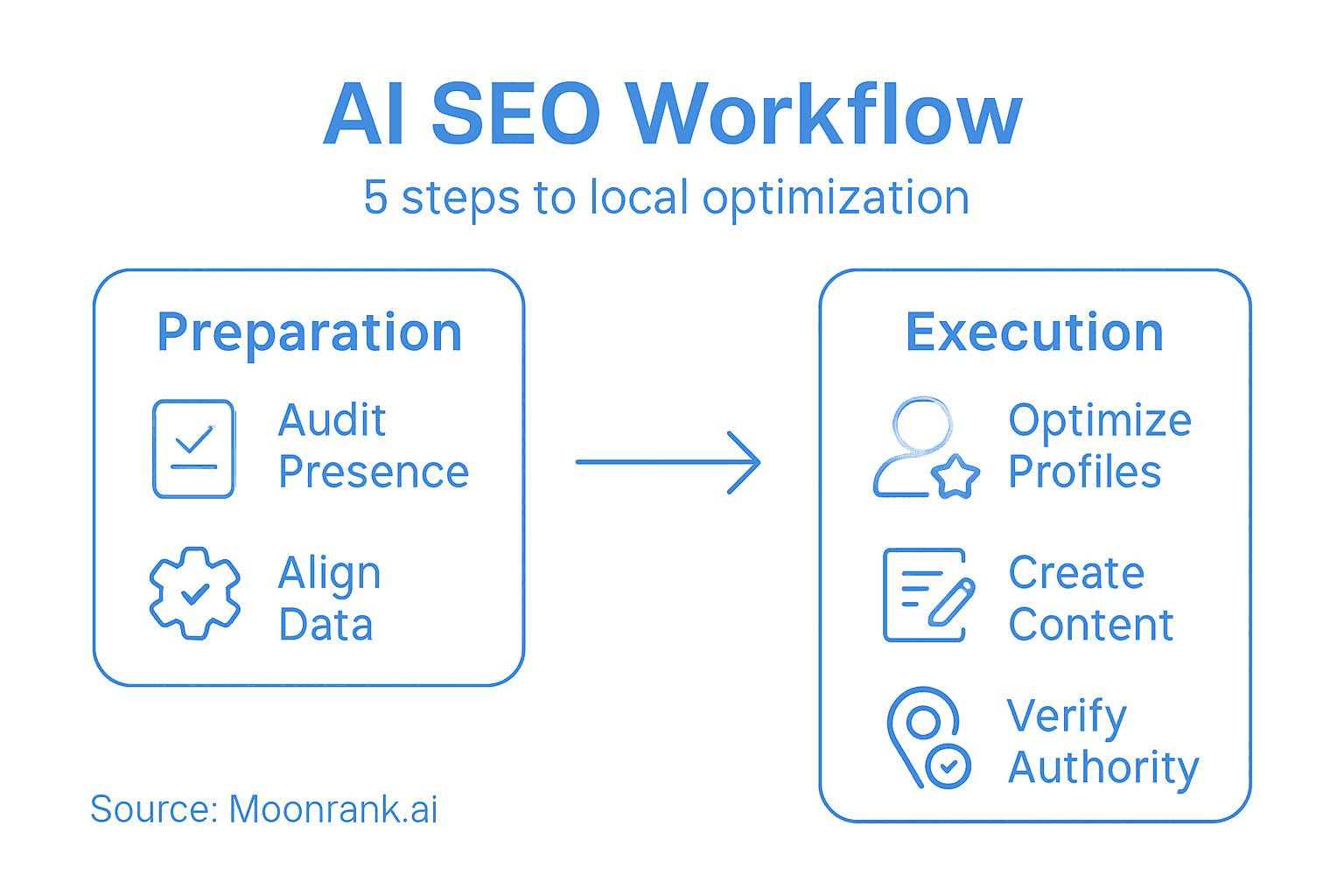
Here’s a comparison of common directory listing issues and their business impact:
Issue Type | Example Situation | Business Impact |
|---|---|---|
Outdated address | Old location still listed on Yelp | Confuses customers, lost leads |
Inconsistent hours | Different hours on Google and Facebook | Missed visits, loss of trust |
Wrong phone number | Typo on Apple Maps | Missed calls, frustrated customers |
Missing website URL | No link on TripAdvisor | Fewer direct inquiries |
Mismatched categories | “Bakery” vs “Café” across directories | Reduced AI visibility |
Pro tip: Set up Google Alerts for your business name and key competitor names to track how you’re mentioned online going forward. This automated monitoring catches new mentions, misspellings, and reputation issues before they become problems.
Step 2: Align Business Data with AI Standards
Now that you know where your business information exists online, it’s time to standardize it. Aligning your business data with AI standards means structuring your information so that AI search engines like ChatGPT, Gemini, and Perplexity can easily recognize, verify, and trust your business. This isn’t about gaming the system. It’s about speaking the language that AI understands.

Start with your core business information: name, address, phone number, and website URL. These four elements must be identical everywhere they appear. Not similar. Not almost the same. Identical. If your business name is “Maria’s Italian Restaurant” on Google Business Profile, it should be “Maria’s Italian Restaurant” on your website header, Yelp, Facebook, and every directory listing. If your address includes a suite number on one platform and omits it on another, that inconsistency confuses AI systems that cross-reference multiple sources to verify legitimacy. Choose the most accurate version and use it everywhere. This standardization process is foundational to ensuring data quality for AI systems.
Next, structure your business information using consistent formatting. Write your phone number the same way every time. Use standardized business hours format. If you operate Monday through Friday 9 AM to 6 PM, represent it consistently across all platforms. Choose a consistent format for your address (abbreviate or don’t abbreviate state names, but pick one approach). When AI crawlers analyze your digital footprint, they’re looking for patterns and consistency. Inconsistent formatting creates friction in that analysis. Your business category should also be precise and identical. If you’re a “pizza restaurant” on one platform and “Italian restaurant” on another, that variation dilutes your category authority. Pick the most specific and accurate category and use it consistently.
Then address the metadata layer. Metadata is the hidden information that search engines and AI systems read behind the scenes. Your website’s title tags, meta descriptions, and structured data markup (schema.org code) should all reflect your business accurately. If your website says you’re a boutique hotel but your Google Business Profile says hostel, that contradiction creates trust issues for AI evaluation systems. Review your website’s backend metadata to ensure it aligns with what appears on your directory listings. This means your website should clearly state what your business does, where you’re located, and how to contact you in both visible text and embedded code. Inconsistent metadata sends contradictory signals that confuse AI interpretation.
Implementing responsible AI governance practices also means keeping your information current and accurate. Set a quarterly review schedule to audit your business data across all platforms. As your business evolves, your information must evolve with it. New phone number? Update it everywhere simultaneously, not over weeks or months. Moved locations? Don’t let old addresses linger on forgotten directory listings. This ongoing alignment demonstrates that your business is actively managed and trustworthy. AI systems favor businesses with well maintained, current information because it suggests you’re legitimate and engaged.
Pro tip: Create a master spreadsheet with your standardized business information, then use it as a reference whenever you update any platform. When new directories or AI platforms request your information, copy directly from this master document to eliminate manual entry errors.
Step 3: Optimize Profiles and Directory Listings
With your business data standardized, it’s time to make each profile work harder for you. Optimizing your profiles and directory listings means filling them out completely, adding compelling details, and making it easy for both customers and AI systems to understand exactly what you offer. A half-completed profile signals neglect. A fully optimized one signals a business that takes its online presence seriously.
Begin with your Google Business Profile since it’s the most influential platform for local search. Fill out every single field available. Add a detailed business description that speaks directly to your target customer. Instead of “restaurant” write something like “Family-owned Italian restaurant specializing in handmade pasta and wood-fired pizzas, serving the downtown district for fifteen years.” This specificity helps AI systems understand your unique value proposition. Upload high-quality photos of your storefront, interior, menu items, and team. AI systems increasingly analyze images to verify business legitimacy. Add your business hours, including holiday exceptions. Include all service options you offer like dine-in, delivery, or takeout. Complete your service area if you’re a contractor or service provider. The more complete your profile, the stronger the signal to AI search engines that you’re an established, trustworthy business. Optimizing across multiple directories significantly improves your visibility and authority in local search results.
Now replicate this completeness across your other key directories. Yelp, Facebook, Apple Maps, TripAdvisor, and industry-specific directories like Houzz for contractors or OpenTable for restaurants all deserve attention. Each platform has slightly different fields, but the principle remains the same: provide comprehensive information. Add business descriptions tailored to each platform’s audience when possible. A description on Houzz might emphasize your design expertise and past projects, while your Facebook description might focus on your local community involvement and customer relationships. Photos matter on every platform. Encourage customers to leave reviews. Respond to reviews promptly and professionally, whether they’re positive or negative. This activity signals to AI systems that your business is actively managed. When AI crawlers see recent reviews, updated information, and consistent engagement across multiple platforms, they recognize a business worth recommending.
Pay special attention to your business categories and attributes. Select the most specific categories available. If you run a boutique coffee shop that also sells pastries, don’t just pick “cafe.” Select “coffee shop” and then add “bakery” as an additional category. Add attributes like “outdoor seating” or “free wifi” if they apply. These specific details help AI systems match your business to relevant search queries. If you have multiple locations, create separate profiles for each one with localized information. A chain with five shops doesn’t benefit from one generic profile. Five distinct profiles with location-specific details, reviews, and photos create more touchpoints for AI discovery.
Include your website URL prominently on every profile and make sure it’s working correctly. AI systems follow links to verify your website matches your directory information. If your website contradicts what’s in your directories, that inconsistency damages trust. Your website should have the same business name, address, phone number, and hours. Include a local phone number prominently on your website homepage. Consider adding schema markup to your website to formally communicate your business information to search engines and AI systems. This structured data helps AI interpret your information more accurately.
Pro tip: Prioritize directories where your target customer actually searches first. A dental practice should prioritize Google Business Profile and Healthgrades before less relevant directories. Use the first month to perfect your top three to five platforms, then gradually expand to secondary directories as you develop a sustainable update routine.
Step 4: Create AI-Friendly Content
Your profiles are optimized and your business data is consistent. Now comes the critical part: creating content that AI systems can understand, extract, and recommend to their users. AI-friendly content isn’t about writing for algorithms instead of people. It’s about writing clearly for people in a way that algorithms can interpret accurately. Think of it as clarity that serves everyone.
Start by understanding what AI systems are looking for when they crawl your website. They’re searching for authoritative, specific information that answers real customer questions. When someone asks ChatGPT or Gemini about the best coffee shop in your neighborhood, these AI systems scan websites looking for trustworthy, detailed answers they can cite. Your content needs to be structured so AI can easily extract relevant information. This means organizing your content with clear headings, concise paragraphs, and specific details rather than vague marketing language. Instead of “We serve great coffee,” write “We source single-origin Ethiopian Yirgacheffe beans roasted in-house within 48 hours of brewing.” Specificity is what AI systems value because it’s verifiable and citable.
Implement structured content frameworks using schema markup to formally communicate your business information to AI systems. Schema markup is code embedded in your website that tells search engines and AI what information means. When you add LocalBusiness schema to your website, you’re explicitly stating your business name, address, phone number, hours, and services in a format AI can read. Add BreadcrumbList schema for navigation, Article schema for blog posts, and FAQPage schema for frequently asked questions. You can use Google’s Structured Data Markup Helper or free tools like Schema.org to implement this. The investment in schema pays dividends because it removes ambiguity. AI systems don’t have to guess what your information means. It’s clearly labeled.
Create hyperlocal content that aligns with E-E-A-T principles of Experience, Expertise, Authoritativeness, and Trustworthiness. This means writing blog posts and service pages that demonstrate your specific expertise in your local market. A plumbing company should write about “How to Fix Common Water Pressure Issues in Older Homes Built Before 1950” rather than generic plumbing advice. A restaurant should write about your sourcing relationships with local farmers or your chef’s culinary background. This hyperlocal, specific content shows AI systems that you’re genuinely rooted in your community and knowledgeable about your market. Include real details like neighborhood names, local landmarks, and specific customer examples. When you write about projects you’ve completed or customers you’ve served, name the locations and include verifiable details. This authentic, contextualized information is exactly what AI systems prioritize when deciding what to recommend.
Write conversational content that naturally answers the questions your customers actually ask. Many successful AI-friendly content pieces take the form of FAQ pages or how-to guides that directly address customer concerns. If you run a salon, create a page titled “Why Does Hair Color Fade Faster in Summer and What Can You Do About It?” and answer it thoroughly with specific product recommendations and techniques. If you’re a contractor, write “Common Mistakes Homeowners Make When Renovating Kitchen Layouts and How to Avoid Them.” This conversational approach serves both humans reading your website and AI systems looking for answers to cite. Include a contact call-to-action at the end of each content piece so AI systems can recommend not just your information but also your direct phone number or contact form. This bridges the gap between AI recommendation and actual customer conversion.
Keep your content well-organized with descriptive headings and short paragraphs. AI systems analyze heading hierarchy and paragraph structure to understand content flow. Use H1 for your main page title, H2 for major sections, and H3 for subsections. Write paragraphs that average 50-100 words so AI can extract meaningful chunks of information. Include internal links to related pages on your website with descriptive anchor text like “Learn more about our winter hair care treatments” rather than “click here.” This linking structure helps AI understand your website’s organization and subject matter expertise.
Pro tip: Create a FAQ page specifically addressing questions about your business and services, optimized with schema markup and structured in clear question-answer format. This single page often generates more AI recommendations than traditional service pages because AI systems prefer extracting direct answers to specific questions.
Step 5: Verify Authority in AI Search Results
You’ve built a solid foundation with consistent data, optimized profiles, and AI-friendly content. Now it’s time to verify that AI systems are actually recognizing your authority and recommending your business. This step involves testing, monitoring, and adjusting based on real-world AI search behavior. You need to know whether your efforts are translating into visibility where it matters most.
Start by testing how AI systems are responding to queries about your business and industry. Open ChatGPT, Gemini, or Perplexity and search for queries related to what you offer in your location. Ask “What’s the best Italian restaurant in downtown Seattle?” or “Who are the top-rated plumbers in Austin?” or “Where can I find organic beauty products in Toronto?” See if your business appears in the response. More importantly, note what information the AI cites about you. Is it pulling your business description from Google Business Profile? Is it citing your website content? Is it mentioning customer reviews? This tells you which of your optimization efforts are actually working. If your business doesn’t appear at all, that’s valuable feedback. It means your authority signals are either too weak or the AI system hasn’t indexed your information yet. If your business appears but with outdated information, you know the AI indexed an old version of your profile that needs refreshing.
Search for your business by name directly in these AI platforms. Ask “Tell me about [Your Business Name]” or “What do you know about [Your Business Name]?” The response reveals exactly what information these AI systems have extracted about you. Compare it to what’s actually on your website and directory profiles. Do the hours match? Is the address correct? Are they citing the right phone number? Any discrepancies here indicate information that needs updating. If the AI mentions old reviews or outdated services, you know you need to refresh that content to push newer information into circulation. This direct testing is far more useful than trying to guess what AI systems are seeing.
Monitor how frequently your business appears in AI recommendations over time. Set up a simple tracking system where you periodically test the same queries and document whether your business is mentioned. You don’t need expensive tools for this. A simple spreadsheet where you record the date, query, platform, and whether you appeared is sufficient. Over weeks and months, you should see your appearance rate increasing as your optimization efforts compound. If you’re consistently not appearing or appearing inconsistently, it signals that your authority signals are still weak. You may need to focus on accumulating more reviews, creating more specific content, or improving your citation consistency.
Test different query variations to understand which searches return your business and which don’t. A restaurant might appear in “best Italian food near me” but not “Italian restaurants with private dining.” This gap tells you there’s content you should create. A contractor might appear in “kitchen renovations” but not “kitchen renovations in Victorian homes.” These specific gaps are opportunities to strengthen your authority in niche areas. Each successful appearance in AI results represents a potential customer who asked exactly that question and received your business as an answer.
Pay attention to how other local competitors are being mentioned. When AI systems recommend your competitors, what information do they cite? Are they mentioning specific services or recent projects? Are they citing reviews or accolades? This competitive intelligence helps you understand what additional authority signals you should be building. If a competitor is mentioned for their sustainable practices and you also have that strength, make sure your website and profiles explicitly highlight it so AI systems can extract it.
Check whether your website appears in AI source citations. When AI systems recommend your business, do they link to or cite your website? If they’re citing directory listings instead of your website, that’s a sign you need stronger content on your site. AI systems prefer citing original sources. If your website content is more detailed and authoritative than what’s on directories, AI should be pulling from your site. If it’s not, your website might need better structure, clearer authority signals, or more specific information that makes it an attractive source for AI citation.
Pro tip: Set monthly reminders to test your business in 5-10 different AI platforms using varied queries relevant to your business. Track appearance rates and cited information in a spreadsheet. When you notice gaps in what AI systems know about you, those become your priority content projects for the next month.
Below is a summary table of key actions and their effect on AI-driven visibility:
Action Step | AI Search Benefit | Long-Term Business Result |
|---|---|---|
Standardize business data | Easier AI verification | Improved search ranking |
Optimize directory profiles | Stronger AI signals | More potential customer visits |
Use schema markup | Enhanced information extraction | Higher AI citation rates |
Publish hyperlocal content | Increased local relevance | Better targeting and conversions |
Review AI search results regularly | Timely fixes for inconsistencies | Sustained online authority |
Boost Your Local SEO with AI-Driven Optimization from Moonrank.ai
Navigating the complexities of AI Search Engine Optimization for local SEO can feel overwhelming. The challenge of auditing your online presence, standardizing business data, optimizing directory listings, and creating AI-friendly content demands time and expertise. Key pain points such as inconsistent business information, fractured authority signals, and the struggle to appear in AI search results make it difficult to capture organic traffic from platforms like ChatGPT or Gemini. With terms like Google Business Profile optimization, schema markup, and hyperlocal content coming into play, you need a solution that simplifies this entire workflow while positioning your business as a trusted local authority.
Moonrank.ai is designed to tackle these exact challenges by offering a comprehensive, automated platform that audits and aligns your online data for maximum AI recognition. From managing your Google Business Profiles and directory listings to guiding the creation of AI-friendly content and monitoring your AI search visibility, Moonrank.ai empowers local businesses to build a consistent, authoritative digital footprint. Stop risking lost leads and missed opportunities because of outdated or scattered information. Let Moonrank.ai streamline your journey to sustained AI-driven local visibility.
Take control of your local SEO and earn the AI search engines’ trust today. Start by exploring how Moonrank.ai can automate your optimization workflow. Discover the power of Google Business Profile management and directory listing optimization to ensure your business stands out where it counts. Don’t wait for inconsistencies to damage your reputation. Visit Moonrank.ai now and unlock your business’s full potential in AI-powered local search.
Frequently Asked Questions
How do I audit my current online presence for local SEO?
Begin by searching for your business name on major search engines like Google and Bing. Document the top ten results, noting any directory listings or inconsistencies. This initial audit helps you understand where your business appears online and what needs fixing.
What steps should I take to align my business data with AI standards?
Standardize your core business information—name, address, phone number, and website—across all platforms to ensure they are identical. Then, format this data consistently to help AI search engines easily recognize and trust your business.
How can I optimize my Google Business Profile for better visibility?
Fill out every field completely on your Google Business Profile, including a detailed business description and high-quality photos. Regularly update this profile, particularly with your operating hours and service options, to signal to AI systems that your business is actively managed.
What type of content should I create for AI search engines to improve my local SEO?
Create hyperlocal, specific content that answers common customer questions and demonstrates your expertise. Use structured content frameworks like schema markup to help AI systems understand and extract your information more effectively.
How can I verify that AI search engines recognize my business’s authority?
Test your business by searching queries relevant to your services on AI platforms to see if your business appears and check what information is cited. Track this over time and adjust your content and profiles accordingly to improve visibility and relevance.
How often should I perform audits and updates for my online presence?
Set a quarterly schedule to review and update your business information across all platforms. Consistently maintaining this data will help ensure accuracy, which is crucial for improving your authority in the eyes of AI systems.