
Why Optimize for AI Search: Unlocking Local Visibility
Optimizing for AI search boosts local business visibility, customer trust, and organic growth. Learn best practices, key benefits, and essential strategies.
Jan 23, 2026

Why Optimize for AI Search: Unlocking Local Visibility
Most American businesses are realizing that traditional online marketing tactics no longer guarantee customers will find them. As AI search engines change the rules, it matters more than ever how a local shop or service in places like Paris, Sydney, or Tokyo appears online. With over 50 percent of online searches now driven by smart algorithms instead of keywords alone, learning how to earn trust from these AI systems can mean the difference between visibility and being overlooked. This practical guide shows what local owners need to know to get ahead.
Table of Contents
AI Search Optimization Explained For Business
How AI Search Engines Discover Businesses
Core Benefits For Local Visibility And Growth
Key Tactics For AI Search Success
Risks Of Ignoring AI-Driven Search Trends
Key Takeaways
Point | Details |
|---|---|
Emphasize Authority | Focus on creating comprehensive, credible content that establishes expertise to be recognized by AI systems. |
Optimize for Context | Ensure content is structured and answers specific user questions, enhancing discoverability through semantic understanding. |
Maintain Consistency | Regularly update and verify your online presence across platforms for accurate business information. |
Adapt to Change | Actively engage with emerging AI search technologies to avoid losing online visibility and competitive edge. |
AI Search Optimization Explained for Business
AI search optimization represents a fundamental shift in how businesses approach online visibility. Unlike traditional search engine optimization, this emerging strategy focuses on being recognized as an authoritative source within generative AI search platforms. The goal is no longer just ranking on a results page, but becoming the primary source AI systems reference when answering user queries.
The core of AI search optimization involves creating content that is machine-readable, credible, and structured in ways that AI engines can easily interpret and trust. This means developing rich, contextually relevant information that demonstrates deep expertise in your specific domain. Businesses must now think beyond keywords and backlinks, and instead concentrate on developing comprehensive, authoritative content that AI systems will recognize as high-quality reference material.
Key strategies for AI search optimization include:
Developing detailed, well-researched content with clear structure
Ensuring citations from reputable third-party sources
Creating content that answers specific user questions comprehensively
Maintaining consistent, accurate information across digital platforms
Using clear, precise language that AI can efficiently parse
Traditional SEO tactics are becoming less effective as AI search engines prioritize content quality and domain expertise over simple ranking algorithms. McKinsey research suggests that businesses must adapt quickly to remain visible in this new digital landscape. Those who fail to optimize for AI search risk becoming invisible to potential customers who increasingly rely on AI-generated recommendations.
Here’s how AI search optimization differs from traditional SEO strategies:
Aspect | Traditional SEO Approach | AI Search Optimization |
|---|---|---|
Focus | Keyword rankings | Authority and expertise |
Content Requirements | Keyword-rich, backlinks | Structured, credible information |
Evaluation Metrics | Algorithms, links | Semantic, contextual analysis |
User Intent Matching | Basic keyword matching | Deep context and meaning |
Platform Influence | Search engines only | Generative AI and conversational |
Pro Tip: Create a content strategy that focuses on deep, authoritative information in your specific industry niche, prioritizing comprehensive answers over surface-level explanations.
How AI Search Engines Discover Businesses
AI search engines have revolutionized how businesses are discovered online, moving far beyond traditional keyword matching. Large language models analyze complex digital ecosystems to understand and surface business information through sophisticated semantic processing and contextual understanding.

The discovery process involves multiple sophisticated layers of data collection and interpretation. AI engines scan structured and unstructured web content, including business websites, social media profiles, review platforms, directory listings, and third-party references. These systems use advanced natural language processing to comprehend not just the literal text, but the underlying context, intent, and credibility of the information.
Key mechanisms of business discovery include:
Semantic entity recognition
Cross-referencing multiple data sources
Analyzing user interaction signals
Verifying information accuracy through citations
Understanding geographic and contextual relevance
AI search platforms evaluate business credibility through a complex scoring system that goes beyond traditional ranking metrics. They prioritize businesses with consistent, comprehensive online representations, authoritative content, and positive user engagement signals. This means local businesses must maintain accurate, comprehensive digital footprints across multiple platforms to maximize their discoverability.
Pro Tip: Audit and optimize your business’s online presence across all digital platforms, ensuring consistent and detailed information that AI search engines can easily interpret and verify.
Core Benefits for Local Visibility and Growth
AI-powered local search strategies have transformed how small businesses compete in their local markets. By leveraging advanced algorithmic technologies, businesses can now achieve unprecedented visibility and engagement, breaking through traditional marketing limitations. This new approach allows even modest local enterprises to stand out and connect with potential customers more effectively than ever before.
The core benefits of AI-driven local visibility extend far beyond simple online listing optimization. Hyper-local targeting enables businesses to appear precisely when and where potential customers are searching, using contextual signals like geographic proximity, user intent, and real-time relevance. These sophisticated AI systems analyze multiple data points including user reviews, sentiment, business information consistency, and engagement metrics to determine credibility and recommendation potential.
Key advantages of AI-enhanced local visibility include:
Personalized search recommendations
Higher conversion rates from targeted visibility
Improved customer trust through comprehensive information
Expanded discovery across multiple digital platforms
More accurate matching with user search intent
Local SEO optimization through AI provides businesses with a competitive edge by synthesizing complex data signals into actionable visibility strategies. This means smaller businesses can now compete effectively against larger competitors by maintaining accurate, engaging, and frequently updated online profiles that AI search engines prioritize. The result is a more level playing field where quality and relevance matter more than advertising budgets.
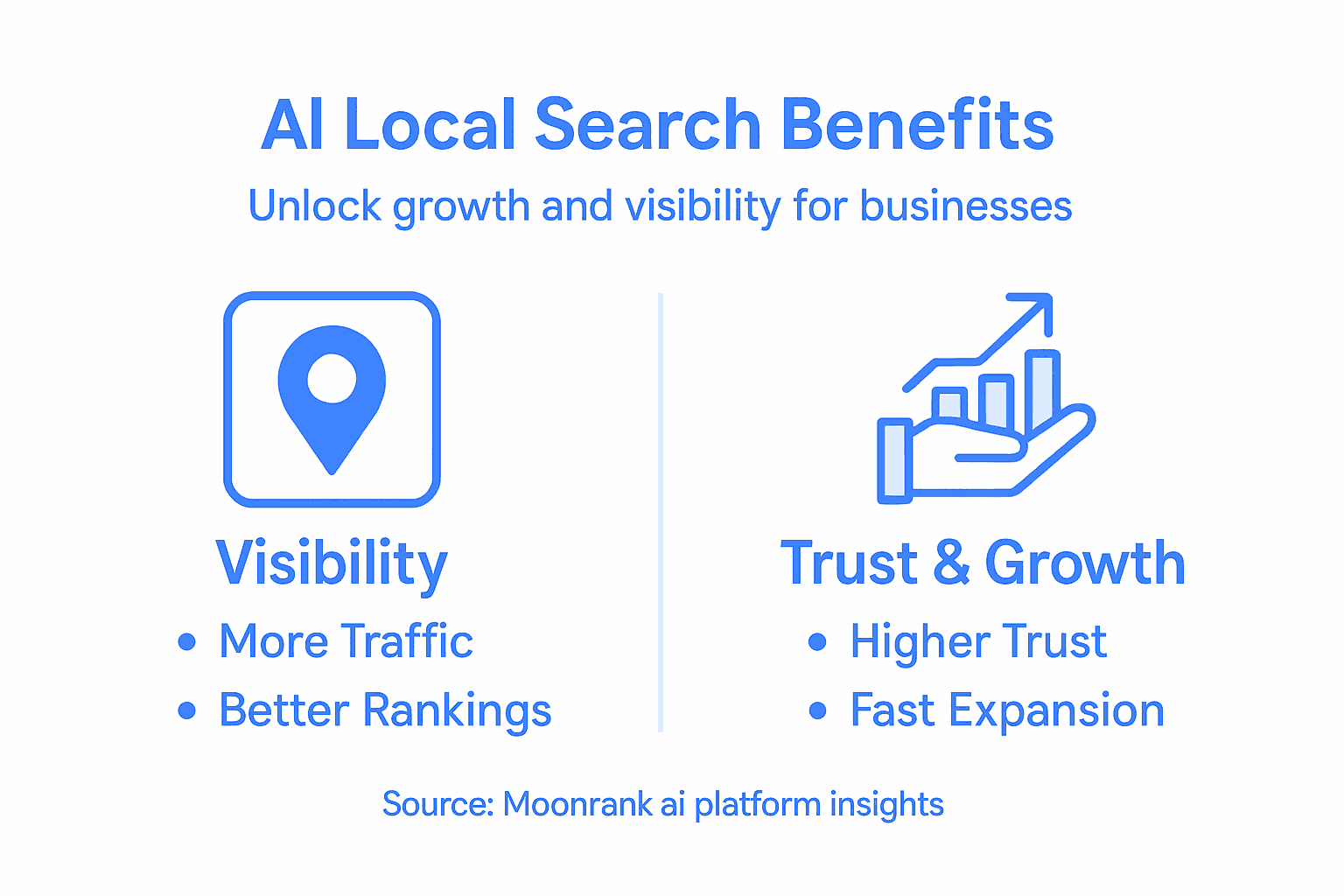
Pro Tip: Regularly update your business profiles with rich, accurate information and encourage authentic customer reviews to improve your AI search discoverability.
Key Tactics for AI Search Success
Crafting precise search strategies has become critical for businesses seeking visibility in the evolving AI-powered digital landscape. Unlike traditional search optimization, AI search success requires a nuanced approach that goes beyond keyword stuffing and focuses on creating contextually rich, authoritative content that AI systems can comprehend and trust.
Businesses must develop a comprehensive content strategy that addresses multiple dimensions of AI search optimization. This involves creating detailed, structured information that provides clear context, demonstrates expertise, and answers potential user queries comprehensively. The goal is to become a reliable source that AI engines recognize as credible and worth recommending, which requires a strategic approach to content creation and digital presence.
Key tactics for AI search success include:
Developing in-depth, context-rich content
Maintaining consistent business information across platforms
Using clear, precise language
Incorporating structured data and metadata
Building authoritative third-party references
Regularly updating and refreshing digital content
Optimizing for semantic search understanding
Successful AI search optimization demands a proactive and dynamic approach. Businesses must continuously monitor and adapt their digital strategies, understanding that AI search engines prioritize content that demonstrates expertise, relevance, and trustworthiness. This means going beyond traditional marketing tactics and focusing on creating genuine value for potential customers through comprehensive, well-researched information.
Pro Tip: Create a systematic content review process that updates your digital profiles and website content quarterly, ensuring maximum AI search engine discoverability and relevance.
Risks of Ignoring AI-Driven Search Trends
Competitive visibility risks have dramatically transformed how businesses must approach their digital strategy. Ignoring AI-driven search trends isn’t just about missing opportunities - it’s about potentially becoming invisible in an increasingly algorithmic digital ecosystem. Local businesses that fail to adapt risk being pushed to the margins of digital discovery, where potential customers simply cannot find them.
The consequences of neglecting AI search optimization extend far beyond simple ranking challenges. Digital relevance now depends on how effectively businesses can structure their online presence to be interpreted and recommended by AI systems. This means that traditional marketing approaches are quickly becoming obsolete, with businesses that resist technological adaptation facing potentially existential challenges in customer acquisition and brand visibility.
Key risks of ignoring AI search trends include:
Dramatic reduction in online discoverability
Loss of competitive market positioning
Decreased customer trust and engagement
Diminished authority in digital platforms
Potential revenue loss from reduced visibility
Falling behind more technologically adaptive competitors
Research indicates that businesses who do not proactively engage with AI search technologies risk more than just marketing inefficiency. They face a fundamental challenge of remaining relevant in a rapidly evolving digital landscape where artificial intelligence increasingly mediates consumer interactions and decision-making processes. The stakes are high, with potential long-term consequences for brand perception and market positioning.
Below is a summary of key risks faced by businesses ignoring AI-driven search:
Risk Type | Potential Outcome | Long-Term Impact |
|---|---|---|
Visibility Loss | Fewer customers find your brand | Market share erosion |
Trust Deficit | Decreased customer confidence | Brand loyalty decline |
Market Position Drop | Competitors gain digital advantage | Reduced competitive strength |
Revenue Decline | Lower online conversions | Unsustainable business growth |
Pro Tip: Conduct a quarterly audit of your digital presence, ensuring your online profiles are optimized for AI comprehension and structured to maximize discoverability.
Elevate Your Local Visibility with AI Search Optimization
The article highlights the urgent challenge local businesses face in adapting to AI-driven search trends that demand authoritative, structured, and consistent online information. If you are concerned about losing discoverability or falling behind competitors in AI search platforms like ChatGPT or Gemini you need solutions that focus on building an authoritative and trusted digital presence. Key pain points revolve around maintaining consistent business information, creating AI-friendly content, and ensuring your online data is verifiable by complex AI algorithms.
Moonrank.ai is designed precisely for these unique challenges. Our platform automates the auditing of your current online mentions and citations, aligning your digital footprint to meet the rigorous standards of AI search. With tools to manage Google Business Profiles, directory listings, and AI-optimized content creation, you can build the comprehensive, credible presence AI engines seek. Don’t let inconsistent or unstructured online data hold you back from becoming the trusted source AI recommendations prioritize.
Ready to future-proof your business’s local visibility and increase organic traffic from AI-powered search? Discover how Moonrank.ai helps you create a scalable, consistent, and authoritative online identity that AI systems recognize and recommend. Take control now by visiting Moonrank.ai and start optimizing your local presence today. Learn more about AI Search Optimization and how our tools support your growth in this evolving digital landscape.
Frequently Asked Questions
What is AI search optimization?
AI search optimization focuses on becoming an authoritative source recognized by AI systems, rather than just achieving high rankings in traditional search engines. It involves creating machine-readable, credible, and well-structured content.
How does AI search differ from traditional SEO?
AI search emphasizes authority and expertise, focusing on structured, credible content, whereas traditional SEO primarily targets keyword rankings and backlinks.
What are the key benefits of optimizing for AI search?
Optimizing for AI search increases local visibility, enhances customer trust, improves targeting accuracy, and allows businesses to effectively compete against larger players in their market.
What strategies can businesses use to improve their AI search optimization?
Businesses should develop detailed, context-rich content, maintain consistent information across platforms, use organized data, and regularly update their digital content to enhance their AI search discoverability.