
Why Position for AI Search: Essential Impact on Local Business
Position for AI search to boost local business visibility—learn how AI-driven search engines, citability, and consistency affect organic growth and reputation.
23 janv. 2026

Why Position for AI Search: Essential Impact on Local Business
Struggling to get your business noticed online while everything seems to be changing overnight? As generative AI platforms like ChatGPT, Gemini, and Perplexity reshape how customers discover brands, traditional search tactics alone are no longer enough. Local businesses that want to stand out must now focus on AI Search Positioning, ensuring their information is clear, authoritative, and trusted by these intelligent systems. This guide reveals how adapting your approach for AI-driven search puts your business in front of more customers, building credibility that drives real growth.
Table of Contents
AI Search Positioning Defined for Businesses
How AI-Driven Search Engines Evaluate Content
Types of AI Citations and Their Value
Building Trust and Authority Across Platforms
Common Mistakes Affecting AI Visibility
Maximizing Organic Growth Through AI Search
Key Takeaways
Point | Details |
|---|---|
AI Search Positioning Redefines Visibility | Businesses must adapt from traditional SEO to AI Search Positioning by ensuring clarity, authority, and consistency across platforms to enhance trustworthiness in AI responses. |
Content Should Directly Answer Questions | High-quality, well-structured content must directly respond to customer queries to improve chances of being recognized by AI systems as authoritative. |
Earned Media is Crucial | Gaining mentions in reputable third-party publications significantly boosts credibility and visibility compared to solely relying on brand-owned content. |
Maintain Consistency Across Platforms | Ensuring uniformity in business information across Google Business Profiles and directories creates trust, making AI more likely to recommend your services. |
AI Search Positioning Defined for Businesses
AI Search Positioning represents a fundamental shift in how businesses approach online visibility. Rather than optimizing solely for traditional search engine rankings, you now need to position your business to be recognized, trusted, and recommended by AI-powered platforms like ChatGPT, Gemini, and Perplexity. Strategic adaptation to AI-driven search means restructuring your online presence so that generative AI systems can easily identify your business as an authoritative answer to customer questions. This is not just a minor update to your current strategy. It’s a wholesale reimagining of visibility in a world where AI intermediaries now filter what customers see.
Traditional SEO focused on keyword density, backlink quantity, and technical ranking factors. AI Search Positioning flips this approach. AI systems prioritize clarity, context, and machine-readable authority. When someone asks an AI chatbot “Where can I get reliable plumbing services near me?” the AI doesn’t scroll through search results. It pulls from its training data and real-time information sources to generate a conversational response. For your business to appear in that response, three things must happen: your business information must be consistently represented across verified directories and platforms, your content must answer customer questions with precision and context, and your authority signals must be structured in ways that AI systems can parse and understand.
Market positioning through AI extends beyond just getting noticed. Leveraging AI capabilities enables precise customer segmentation and tailored messaging, which is especially critical for small and mid-sized businesses working with limited marketing budgets. Instead of casting a wide net, you can now use AI tools to understand which customer segments are searching for your specific services, what language they use, and what pain points matter most to them. This intelligence flows directly into how you structure your online presence. Your Google Business Profile, your directory listings, your website content, and your citations all work together as a unified system that communicates to AI systems exactly what your business does, who you serve, and why you matter.
The practical difference shows up in real results. A local retail store using AI Search Positioning principles typically sees increased recommendations in AI search responses, which translates to qualified traffic that translates differently than traditional SEO. These visitors already know what you offer because an AI recommended you. They’re further along in their decision-making process. They’re more likely to convert. The positioning itself becomes your competitive moat because it’s built on consistency, authority, and relevance across multiple systems rather than relying on a single ranking algorithm.
Here’s a side-by-side comparison of traditional SEO and AI Search Positioning to clarify their main differences:
Aspect | Traditional SEO | AI Search Positioning |
|---|---|---|
Optimization Focus | Keywords, backlinks, rankings | Clarity, authority, machine readability |
Target Algorithm | Google Search, classic engines | AI chatbots, generative systems |
Authority Signals | Link quantity, domain age | Verified citations, third-party mentions |
Content Structure | Keyword density, meta tags | Direct answers, semantic context |
Pro tip: Start by auditing how your business currently appears across AI search platforms by asking ChatGPT, Gemini, and Perplexity about your business directly. Note what information appears, what’s missing, and what’s inaccurate. This reveals your current positioning gaps and shows exactly where to focus your optimization efforts first.
How AI-Driven Search Engines Evaluate Content
AI-driven search engines operate on completely different criteria than the Google algorithm you’ve been optimizing for over the past decade. When an AI system evaluates your content, it’s not looking for keyword density or backlink authority in the traditional sense. Instead, AI platforms prioritize machine readability, relevance to user intent, and authority signals. This means your content needs to be structured in ways that AI systems can easily parse, understand, and extract information from. Think of it as writing for a highly intelligent robot rather than for a search algorithm trying to guess what humans want. The robot understands context, relationships between ideas, and the semantic meaning behind words. If your content is clear, well-organized, and directly answers specific questions, AI systems will recognize it as valuable.
One critical distinction separates AI evaluation from traditional SEO evaluation: trustworthiness matters more than self-promotion. Generative AI search engines favor earned media and authoritative third-party sources over brand-owned content, meaning an article about your business published in a respected trade journal carries far more weight than a blog post on your website. This creates a fundamental challenge for small business owners who don’t have massive PR budgets. But here’s what changes the game: when your business information is consistently verified across multiple authoritative directories, when citations about your business appear in reputable sources, and when your content demonstrates genuine expertise rather than sales language, AI systems begin to treat you as trustworthy. Your Google Business Profile becomes more valuable because it’s a verified source. Your local directory listings matter because they’re third-party validations. Your website content matters when it provides comprehensive answers rather than pitches.
The evaluation process also emphasizes specific technical and contextual factors that differ from traditional ranking signals. AI systems assess your content for freshness (is this information current?), semantic depth (does this answer cover the full complexity of the topic?), and citation-backed accuracy (can the claims be traced to reliable sources?). Your URL structure matters, but not for keyword optimization. Clean, logical URLs help AI systems understand your site’s organization. Content depth matters because surface-level answers get ignored when AI systems can find comprehensive resources. Semantic context matters because AI understands that “affordable legal services” and “budget-friendly attorney” mean the same thing, so keyword variation becomes less critical than topic comprehension.
For a local service business like a dental practice or home repair company, this translates into specific priorities. Your service descriptions need to address common patient or customer questions directly and completely. Your location pages need to establish clear connections between your business and your service area. Your testimonials and reviews need to demonstrate consistent positive outcomes. When a customer asks an AI system “Is Smith Dental trustworthy?” or “Who provides emergency plumbing in my area?” the AI pulls information from multiple sources to build a response. If your business appears consistently as a legitimate, capable provider across verified platforms, you’ll be recommended. If your information is scattered, incomplete, or contradictory, you’ll be ignored.

Pro tip: Audit your five most important service pages for clarity and completeness by reading them as if you’re an AI system. Can you extract a clear answer to a customer’s primary question within the first 100 words? Does the page explain what you do, who you serve, and why you’re qualified? If not, rewrite for directness before worrying about keyword optimization.
Types of AI Citations and Their Value
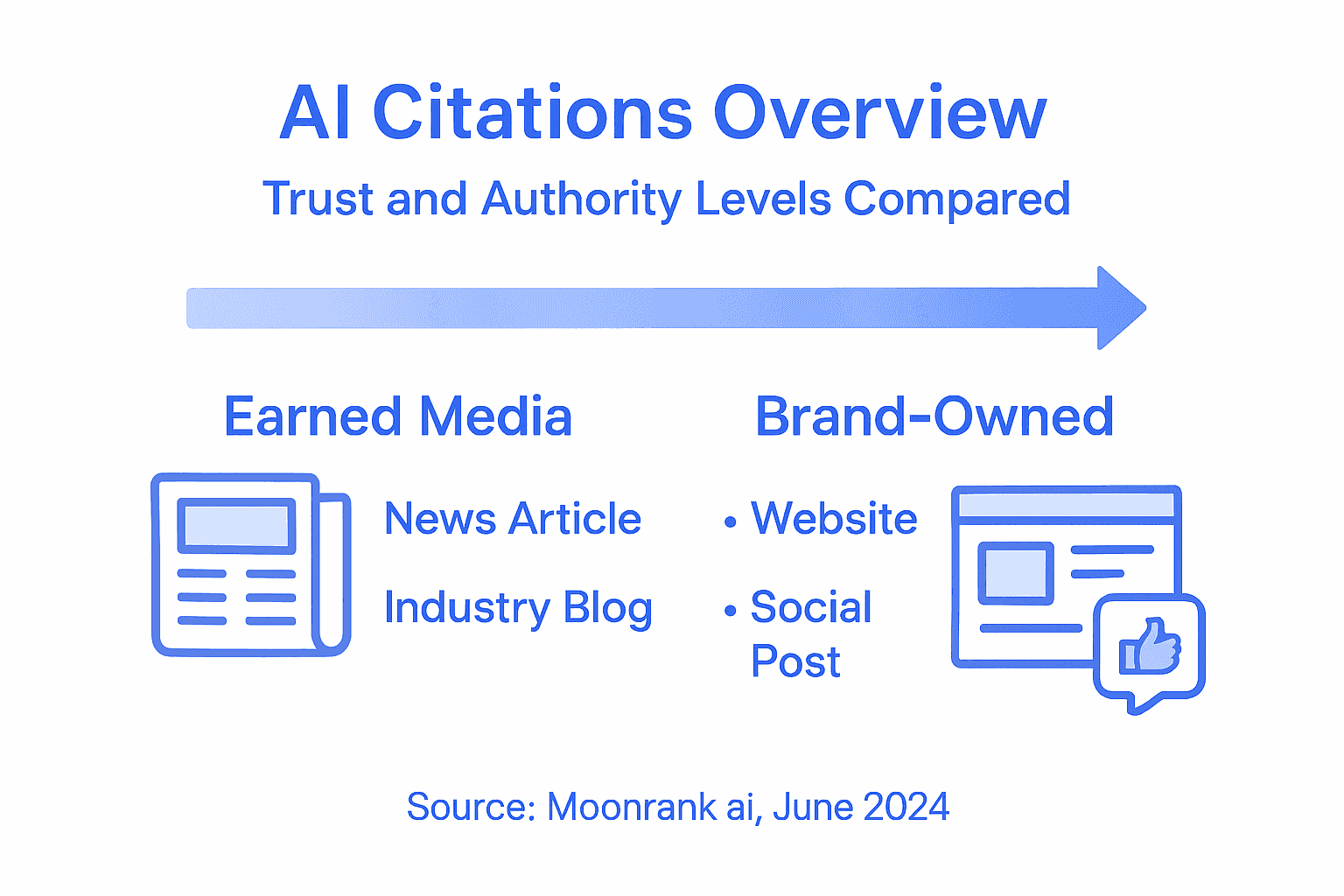
Not all citations carry equal weight in the AI search world. Understanding the three primary types of AI citations and how they influence your visibility is crucial to building a strategic presence that AI systems actually recommend. The hierarchy is clear: earned media sits at the top, followed by brand-owned content, with social content trailing behind. The difference in value comes down to trust. When an independent journalist writes about your business in a trade publication, an AI system recognizes that as genuine third-party validation. When you write about yourself on your own website, AI systems know you have motivation to exaggerate. This fundamental distinction reshapes how you should allocate your visibility efforts.
Earned media represents citations from authoritative third-party sources, and it holds the highest value for AI algorithms. AI citations from third-party authoritative sources demonstrate the highest trustworthiness because no financial incentive exists for someone else to promote your business. Think of a business magazine featuring your company in an article about local innovation, or an industry association recognizing you as a preferred vendor, or a customer review site highlighting your consistently high ratings. These earned citations signal to AI systems that your business has genuine merit. For a local retail business, this might mean getting mentioned in a local newspaper feature, being quoted in an industry blog, or having your business reviewed positively on trusted platforms. The more reputable the source, the greater the impact. A mention in a major industry publication carries exponentially more weight than a mention in a small local blog.
Brand-owned content includes everything you create and control on your own digital properties: your website, your blog, your company social media, your Google Business Profile. High-quality citations improve business credibility within AI-generated search results, but brand-owned sources require stronger authority signals to compete with earned media. The advantage of brand-owned content is control and directness. You can structure your information exactly as you need it, optimize your messaging, and ensure accuracy. Your Google Business Profile becomes a critical asset because it’s your direct channel to AI systems. Your website service pages matter because they answer specific customer questions comprehensively. Your blog posts add context and demonstrate expertise. However, these sources alone will never outrank earned media. AI systems treat them as important supporting evidence rather than proof of trustworthiness. Your strategy needs both types working together.
Social content occupies the lowest position in the AI citation hierarchy, though it still carries value when conditions are right. Posts on social media platforms like LinkedIn, Facebook, or industry-specific forums can influence AI search results, but only when the accounts posting have established credibility and the content receives meaningful engagement. A viral post about your business on a popular account with thousands of followers carries more weight than a post from your business account with minimal followers. User-generated content, like customers sharing their experiences on social platforms, adds credibility because it comes from independent voices. However, social content’s volatility and platform-dependency make it unreliable as your primary visibility strategy.
The table below summarizes the main types of AI citations and their impact on business visibility:
Citation Type | Source Example | Level of Trust | Primary Advantage |
|---|---|---|---|
Earned Media | Industry publications | Very high | Maximum credibility and influence |
Brand-Owned | Company website/blog | Moderate | Full control, supports authority |
Social Content | Social media posts | Variable | Amplifies reach, adds engagement |
The practical approach combines all three types strategically. Start by securing earned media through relationship building with journalists, industry publications, and review platforms in your sector. Simultaneously, strengthen your brand-owned content by ensuring your Google Business Profile is complete and authoritative, your website comprehensively addresses customer questions, and your citations are structured clearly. Use social content to amplify earned media mentions and encourage customer advocacy. When a journalist writes about your business, share that article across your social channels. When customers post positive reviews, engage with them professionally. The citations work together as a system, each type reinforcing the others.
Pro tip: Create a citation tracker listing the top 10 earned media sources where your target customers research solutions. Contact one source per month with a story pitch about your business. Even one quarterly mention in a respected publication dramatically increases your AI search visibility compared to businesses relying solely on brand-owned content.
Building Trust and Authority Across Platforms
Trust is the currency of AI search visibility. Unlike traditional search engines that rank based on links and keywords, AI systems evaluate whether to recommend your business by assessing your trustworthiness across multiple channels. This requires a coordinated strategy where your presence on different platforms reinforces a consistent message about who you are, what you do, and why customers should believe you. Building trust and authority across platforms involves active social media presence, mentions in trusted publications, and consistent brand reputation. When an AI system encounters your business, it doesn’t look at just one platform. It synthesizes information from your Google Business Profile, your website, industry directories, social media, customer reviews, and any mentions in publications. If all these sources tell the same story about your business with consistent details and positive sentiment, the AI concludes you’re trustworthy. If they contradict each other, the AI becomes suspicious.
Consistency across platforms creates the foundation for this trust. Start with your core business information: your name, address, phone number, hours of operation, and service areas must be identical everywhere they appear. This seems basic, but many businesses fail at this step. You list your hours one way on Google, another way on your website, and a third way on Facebook. AI systems see this inconsistency and flag your business as unreliable. Move beyond consistency into active authority building. This means regularly updating your Google Business Profile with fresh posts and offers, publishing content on your website that demonstrates expertise in your field, maintaining active social media accounts where you engage with customers, and actively seeking mentions in industry publications and local media. Each platform serves a specific purpose in the trust-building ecosystem. Your Google Business Profile is your official business card to AI systems. Your website is your expertise platform. Your social media is your engagement and community platform. Your citations in trusted publications are your credibility endorsements.
Establishing trust requires delivering expert, experience-based content and maintaining transparency and consistency across all channels. For a local service business, this translates into specific actions. Share case studies or before-and-after examples on your website. Post educational content on social media that helps customers understand your services. Ask satisfied customers to leave detailed reviews that explain why they chose you. Respond professionally to every review, positive or negative, showing that you care about customer experience. Create content that addresses common customer concerns and questions. When you publish an article on your blog about how to maintain your product or what to expect during your service, that becomes evidence of expertise that AI systems can recognize and trust.
The interconnection between platforms matters more than individual performance on any single platform. When a customer searches for your business on an AI system and the AI finds a recent article about your business in a respected industry publication, then cross-references your website and sees comprehensive service descriptions, then checks your Google Business Profile and sees dozens of positive reviews with recent engagement, then looks at your social media and sees regular activity and customer interaction, the cumulative effect convinces the AI that you’re genuinely authoritative. Each data point reinforces the others. Conversely, if the AI finds conflicting information, missing details, outdated content, or lack of engagement, it becomes hesitant to recommend you.
Building this interconnected trust system requires ongoing effort but rewards you with sustainable visibility. You’re not dependent on a single algorithm change or platform policy update. Your authority is distributed across multiple verified sources, making your visibility more resilient. When new customers interact with your business through AI search, they’re arriving with higher confidence because the AI has validated you across multiple channels. They’re more likely to become paying customers because they’ve already been convinced of your credibility before they contact you.
Pro tip: Create a quarterly “trust audit” where you manually search for your business on ChatGPT, Gemini, and Perplexity, then verify that the information matches across your website, Google Business Profile, and three major directories in your industry. Any inconsistencies you find are immediate priorities because they undermine your AI search credibility.
Common Mistakes Affecting AI Visibility
Most local business owners are still optimizing for the wrong search engine. They’ve spent years mastering traditional SEO tactics, and now they’re doubling down on those same strategies for AI search. This is a costly mistake. Common AI visibility mistakes include neglecting machine readability, over-optimizing for traditional SEO keywords, and providing vague content that AI cannot easily parse. The gap between what worked for Google and what works for ChatGPT is wider than most businesses realize. You can’t simply copy your traditional SEO approach into the AI era and expect the same results. The fundamental principles have shifted, and businesses that fail to adapt are watching their AI search visibility stagnate while competitors who understand these changes pull ahead.
One major pitfall is creating content that sounds good to humans but confuses AI systems. You’ve learned to write engaging marketing copy with varied sentence structure, subtle persuasion, and creative language. AI systems don’t care about any of that. They want clarity, precision, and directly answerable questions. If your service page opens with a five sentence marketing paragraph before actually explaining what you do, an AI system struggles to extract the core information. You need to lead with the answer. State clearly what your service is, who benefits from it, and why you’re qualified to provide it. Use structured formats like lists and tables when appropriate. Break complex information into digestible sections. Your content should be scannable and understandable not just by humans but by machines parsing for meaning.
Another critical error is ignoring the importance of external authority and citations. Businesses often rely solely on old SEO strategies and lack authoritative external references, severely limiting their AI search potential. You could have the best website in your industry, but if no trusted external sources mention your business, AI systems won’t prioritize you. This is a fundamental difference from traditional SEO where your own optimized content can rank highly. With AI, your brand-owned assets matter much less without external validation. Many businesses pour resources into their websites while neglecting to pursue mentions in industry publications, directory listings, or media coverage. This imbalance cripples your AI visibility. Your strategy must include active efforts to secure earned media and maintain consistent citations across authoritative directories.
Platform fragmentation is another mistake that undermines AI visibility. Many businesses maintain a presence on only one or two channels: maybe a website and a Google Business Profile, but nothing else. AI systems cross-reference information across multiple sources. When they find incomplete or inconsistent information, your credibility drops. You need active engagement across multiple platforms: your website with regularly updated content, your Google Business Profile with current posts and offers, social media accounts where you interact with customers, and consistent listings in the major directories serving your industry. Each platform contributes data points that collectively build your authority profile. Neglecting any major platform leaves gaps that AI systems notice.
A subtler but equally damaging mistake is poor technical structure. Confusing URL architectures, missing schema markup, and unstructured data make it harder for AI systems to understand your business. Your website might have all the right information, but if it’s structured in ways that AI systems can’t easily parse, that information stays invisible. Schema markup tells AI systems exactly what information appears on your page and what it means. Good URL structure tells AI systems how your content is organized. These technical elements seem less important than great writing or strategic positioning, but they directly impact whether AI systems can even access and understand your content.
Pro tip: Audit your three most important pages by copying sections and pasting them into ChatGPT with the question: “Based on this content, what does this business offer and who should use it?” If the AI’s answer is vague, unclear, or incomplete, your content needs restructuring for clarity regardless of how well it ranks on Google.
Maximizing Organic Growth Through AI Search
Organic growth through AI search follows a different playbook than traditional SEO growth. With Google, you could rank for a keyword and capture traffic from anyone searching that term. With AI search, you capture traffic from anyone asking a question where the AI decides your business is the best answer. This shift changes everything about how you approach visibility. Maximizing organic growth through AI search involves creating high-quality, authoritative content designed for machine readability and user intent. The traffic you get from AI recommendations carries different characteristics than traditional search traffic. People arriving through AI search have already been pre-qualified by the AI’s judgment that your business is trustworthy and relevant. They’re further along in their decision journey. They’re more likely to convert because they’ve been recommended by an intelligent system they trust.
The foundation of organic growth through AI is establishing yourself as the authoritative answer to specific customer questions in your industry. Start by identifying the ten to twenty questions your ideal customers ask most frequently. Then create comprehensive content that answers each question better than anything else available. These answers need to be detailed, well-structured, and directly responsive to the actual question. For a home renovation company, this might mean creating detailed guides on topics like “What should I expect during a kitchen remodel?” or “How do contractors determine renovation costs?” For a dental practice, it might be “What is the recovery time for dental implants?” or “How do I know if I need a root canal?” Each piece of content becomes a potential entry point for customers discovering your business through AI search. Producing conversational, authoritative content trusted by AI search models drives sustained visibility because AI systems recognize genuine expertise and recommend it consistently.
Simultaneously, you need to build external authority through earned media and strategic citations. This is the piece most businesses underinvest in, yet it multiplies the impact of everything else you do. When you secure a mention in an industry publication, that mention becomes a citation that AI systems recognize as third-party validation. When your business appears consistently across authoritative directories, AI systems note that consistency as a trust signal. When satisfied customers leave detailed reviews describing their positive experiences, AI systems interpret that as real-world evidence of your competence. These external signals amplify your organic reach because they expand where your business appears. Instead of being visible only through your owned channels, you’re visible wherever these citations exist. An AI system might find your business mentioned in three different industry directories, quoted in a relevant publication, and featured in customer reviews on a trusted platform. That multiplied visibility translates into more recommendations and more organic traffic.
The growth compounds when you integrate both strategies. Your owned content demonstrates expertise and answers customer questions comprehensively. Your external citations establish trustworthiness and authority. Together they create a system where AI increasingly recommends you. This recommendation effect differs fundamentally from traditional SEO ranking because recommendations are ongoing. An AI system that has recommended your business once will continue recommending you to similar queries as long as you maintain your authority signals. You’re not chasing algorithm updates or competing for limited ranking positions. You’re building structural credibility that generates recommendations continuously. For many local service businesses, this translates into a dramatic shift in traffic quality and quantity. Customers arriving through AI recommendations often convert at higher rates because they’ve already been vetted by an intelligent system.
Measuring your progress requires different metrics than traditional SEO. Stop focusing exclusively on keyword rankings and start tracking where your business appears in AI search responses. Set up regular audits where you ask ChatGPT, Gemini, and Perplexity questions relevant to your business and record whether and how you appear in the responses. Track your citation consistency across directories. Monitor your external mentions and earned media. Watch your review volume and sentiment. These metrics reflect your actual AI search visibility more accurately than traditional ranking data. Many businesses discover they’re appearing in AI responses for questions they never optimized for because their authority signals are strong enough that AI recommends them broadly within their category.
Pro tip: Pick your top five customer questions and create a content calendar to produce one comprehensive answer every two weeks over the next six months. Simultaneously, identify five industry publications or directories where your target customers research solutions and commit to pitching one mention per month. This dual approach of owned authority and external validation creates the foundation for sustained organic growth through AI search.
Position Your Local Business for Success in the AI Search Era
The shift to AI Search Positioning creates a critical challenge for local businesses seeking visibility. As the article explains, AI platforms like ChatGPT, Gemini, and Perplexity prioritize clarity, trustworthiness, and consistent authority signals across multiple platforms. Without actively managing your business’s AI search presence, you risk being invisible when customers ask intelligent systems for trusted local service recommendations. The pain points are clear. You need to audit your online citations, streamline your Google Business Profile, and create AI-friendly content that directly answers customer questions. This is no simple SEO tweak but a strategic overhaul demanding automation and precision.
Moonrank.ai is built to meet this exact need. By offering comprehensive tools for auditing your current AI search positioning, managing your directory listings, and optimizing your content for machine readability, we empower local businesses to build authoritative and consistent digital footprints. Our platform automates the entire process, increasing your chances of being recognized and recommended by AI search engines. If you want to stop guessing and start commanding visibility in AI-driven local search, discover the power of optimizing your Google Business Profile and ensuring your business is a trusted answer for AI queries.
Take control of your future now before competitors outpace you in this rapidly evolving landscape.
Ready to transform your local business visibility in the AI age Visit Moonrank.ai to start your free audit today and build an AI search presence that drives qualified traffic and meaningful growth.
Frequently Asked Questions
What is AI Search Positioning and why is it important for local businesses?
AI Search Positioning is the strategy of optimizing a business’s online presence to be recognized and trusted by AI-powered platforms. It’s important for local businesses as it enhances visibility in a world where AI influences customer decisions and recommendations.
How does AI Search Positioning differ from traditional SEO?
Unlike traditional SEO, which focuses on keywords and backlinks, AI Search Positioning emphasizes clarity, contextual relevance, and machine-readable authority, helping AI systems recognize a business as an authoritative source for customer inquiries.
What are the key elements required for effective AI Search Positioning?
Key elements include consistent business information across verified directories, content that directly answers customer questions with high precision, and structured authority signals that AI systems can easily understand and trust.
How can local businesses build trust and authority across multiple platforms?
Local businesses can build trust by ensuring consistent information on all platforms, actively engaging on social media, maintaining updated Google Business Profiles, and seeking mentions from reputable third-party sources to enhance their credibility.