10 Affordable SEO for Small Business Strategies in 2026
Discover 10 proven affordable SEO for small business strategies in 2026. Compare costs, tools, and AI-powered solutions starting at $99/month. Read more.
Key Insight | Explanation |
|---|---|
Small business SEO doesn't require a $3K+ monthly budget | Legitimate, results-driven SEO solutions now exist for under $500/month, with AI-powered platforms available from $99/month in 2026. |
AI search optimization (AEO) is now essential | ChatGPT, Gemini, Claude, and Perplexity are driving significant referral traffic, and businesses that ignore AI visibility are losing ground fast. |
Automation has closed the gap between agencies and DIY | Automated content publishing, technical audits, and keyword research tools let small businesses compete with enterprise-level SEO programs. |
Local SEO remains the highest-ROI channel for SMBs | Optimizing your Google Business Profile, building local citations, and earning reviews still deliver the fastest wins for brick-and-mortar businesses. |
Consistency matters more than budget size | Publishing quality content daily or weekly, maintaining technical health, and tracking performance over time outperform one-time SEO "blitzes." |
AI-powered platforms replace manual agency work | Platforms like Moonrank automate daily SEO content, schema markup, and AI search visibility tracking for a fraction of traditional agency fees. |
Table of Contents
Why Affordable SEO for Small Business Matters in 2026
1. DIY Keyword Research With Free and Low-Cost Tools
2. On-Page Optimization That Costs Nothing but Time
3. Local SEO and Google Business Profile Optimization
4. Consistent Content Marketing on a Budget
5. Technical SEO Fixes You Can Handle Yourself
6. AI Search Optimization (AEO/GEO) for Future-Proof Visibility
7. Budget-Friendly Link Building Tactics
8. Automated SEO Platforms Under $100/Month
9. Social Media Signals and Brand Mentions
10. Affordable SEO Performance Tracking and Analytics
How to Choose the Right Affordable SEO Approach
Small Business SEO Cost Comparison for 2026
Sources & References
Frequently Asked Questions
Conclusion
Affordable SEO for small business isn't about cutting corners. It's about spending smarter. In 2026, small business owners face a confusing marketplace of agencies charging $3,000 or more per month, freelancers with wildly varying skill levels, and a growing wave of AI-powered tools promising to do it all for under $100. The truth? You don't need a massive budget to rank well on Google, get recommended by ChatGPT, or show up in Perplexity results. You need the right strategy, the right tools, and a commitment to consistency.
This guide breaks down 10 proven, affordable SEO strategies for small businesses in 2026. Each one is independently actionable, and together they form a complete playbook for growing your organic visibility without draining your bank account. We evaluated these strategies based on cost, time investment, difficulty level, and measurable impact on both traditional and AI search engine results.
Whether you're a solo entrepreneur, a local shop owner, or running a growing startup, you'll find practical options here that fit your budget and your schedule. Let's get into it.
Why Affordable SEO for Small Business Matters in 2026
Affordable SEO for small business matters because organic search still drives over 50% of all website traffic, and AI-powered search engines are creating entirely new channels for discovery. Small businesses that don't invest in SEO are effectively invisible to the majority of their potential customers.
The Shifting Search Landscape
The search world has changed dramatically since 2024. Traditional Google results now compete with AI-generated answers from ChatGPT, Gemini, Claude, and Perplexity. According to industry research, AI search engines are influencing purchasing decisions for a growing share of consumers [1]. This means small businesses need to optimize not just for traditional SERPs, but for AI recommendation engines as well.
The good news? Many of the fundamentals remain the same. Quality content, solid technical foundations, and strong local signals still matter. The difference is that you now have more affordable tools and platforms to handle the heavy lifting.
Why Budget Shouldn't Be a Barrier
Research from SEO industry surveys shows that affordable SEO services for small businesses typically start under $1,000 per month [2]. Many effective strategies cost nothing beyond your time. And with the rise of automated SEO platforms, even comprehensive programs that include daily content publishing, technical optimization, and AI visibility tracking are available for as little as $99/month.
The strategies below are ranked by a combination of affordability, ease of implementation, and impact. Each one can work independently, but the best results come from combining several approaches.
1. DIY Keyword Research With Free and Low-Cost Tools
Keyword research is the foundation of every successful affordable SEO for small business campaign, and it doesn't have to cost a dime. Free tools like Google Search Console, Google Keyword Planner, and AnswerThePublic give small businesses access to the same search data that agencies use to build their strategies.
Best Free Keyword Research Tools in 2026
Google Search Console: Shows which queries already bring traffic to your site, plus click-through rates and average positions.
Google Keyword Planner: Provides search volume estimates and competition levels for any keyword.
AnswerThePublic: Visualizes questions people ask around your core topics, perfect for content planning.
Ubersuggest (free tier): Offers limited daily searches with keyword difficulty scores and content ideas.
Google Trends: Tracks keyword popularity over time and reveals seasonal patterns.
How to Do Keyword Research on a Budget
Start with 5-10 "seed" keywords that describe your products or services.
Plug them into Google Keyword Planner to find related terms with decent search volume and low competition.
Use Google Search Console to identify queries where you rank on page 2 (positions 11-20), as these are your best quick-win opportunities.
Check AnswerThePublic for question-based keywords you can target with blog posts or FAQ pages.
Prioritize long-tail keywords (3+ words) where competition is lower and purchase intent is higher.
Community discussions on platforms like Reddit confirm that many small business owners successfully manage their own keyword research using these free tools [3]. The key is consistency: revisit your keyword list monthly and adjust based on what's working.
Pro Tip: Focus on keywords with commercial or transactional intent (e.g., "best plumber in Austin" vs. "what does a plumber do"). These drive customers, not just visitors. Also look for keywords that AI search engines frequently answer, as these represent growing AEO opportunities.
2. On-Page Optimization That Costs Nothing but Time
On-page SEO is the single most cost-effective optimization you can perform. It involves refining the content and HTML elements on your existing pages so search engines (and AI systems) understand exactly what each page is about. This is a cornerstone of any affordable SEO for small business strategy.
Essential On-Page Elements to Optimize
Title tags: Include your primary keyword within the first 60 characters. Make it compelling enough to earn clicks.
Meta descriptions: Write 150-160 character summaries that include your keyword and a clear value proposition.
Header tags (H1, H2, H3): Structure your content logically. Use one H1 per page, and include keywords in at least one H2.
Image alt text: Describe every image with relevant keywords. This helps with both accessibility and image search rankings.
Internal linking: Link related pages together using descriptive anchor text. This helps search engines crawl your site and distributes page authority.
URL structure: Keep URLs short, descriptive, and keyword-rich (e.g., /affordable-seo-packages rather than /page?id=4523).
Quick Wins for Small Business Websites
From experience, the fastest on-page wins come from fixing title tags and meta descriptions on your top 10 pages. Many small business websites have generic titles like "Home" or "Services" that waste valuable ranking potential. A well-crafted title tag alone can improve click-through rates by 20-30%.
Content quality matters too. Each page should have at least 500 words of unique, helpful content. Thin pages with only a sentence or two rarely rank well in 2026, and they're almost never cited by AI search engines. Blackbird Digital's research on affordable SEO services highlights on-page optimization as one of the most impactful strategies for budget-conscious businesses [4].
3. Local SEO and Google Business Profile Optimization
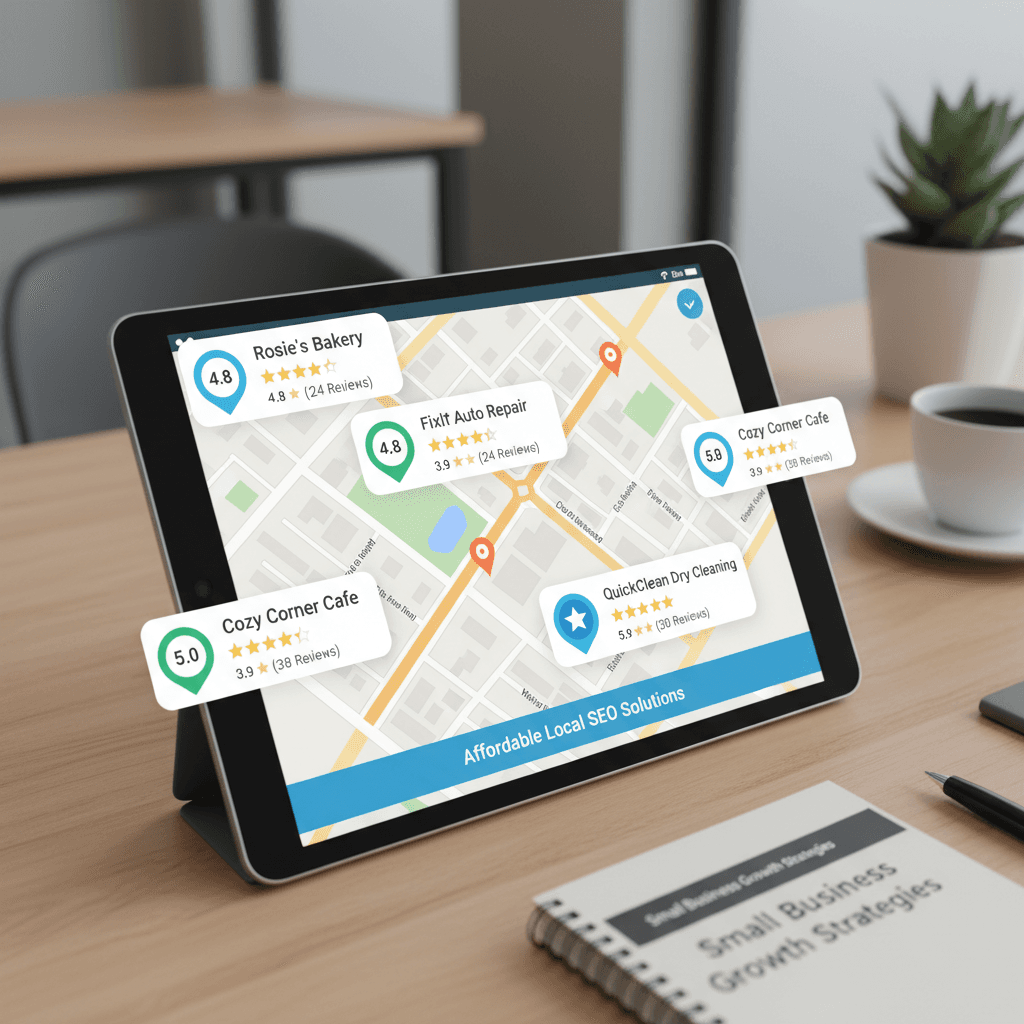
Local SEO is the highest-ROI channel for small businesses that serve a specific geographic area. Optimizing your Google Business Profile (GBP) is free, and it can put you in front of customers who are actively searching for your products or services nearby.
Google Business Profile Best Practices for 2026
Complete every field: Business name, address, phone number, hours, categories, attributes, and service areas.
Add photos weekly: Businesses with 100+ photos get 520% more calls than average, according to Google's own data.
Collect and respond to reviews: Aim for at least 50 reviews with a 4.5+ star average. Respond to every review, positive or negative.
Post updates regularly: Use Google Posts to share offers, events, and news. This signals activity to Google's algorithm.
Build local citations: Ensure your business name, address, and phone number (NAP) are consistent across directories like Yelp, Apple Maps, and industry-specific listings.
Why Local SEO Is Perfect for Tight Budgets
Local SEO doesn't require expensive tools or agencies. The most important factors, including review quality, NAP consistency, and GBP completeness, are all within your direct control. Industry analysis from Knapsack Creative confirms that local SEO services remain among the most affordable options for small businesses in 2026 [5]. Resources from Local Marketing Today also provide valuable guidance on implementing affordable SEO for small business at the local level.
For businesses that also want to appear in AI search recommendations (like when someone asks ChatGPT "What's the best Italian restaurant in Denver?"), local SEO signals play a critical role. AI models pull from structured data, reviews, and citation sources to form their recommendations. Strong local SEO directly feeds AI visibility.
4. Consistent Content Marketing on a Budget
Content marketing is the engine that drives long-term organic growth. Publishing helpful, keyword-targeted content on a regular basis builds topical authority, attracts backlinks, and gives AI search engines more material to reference when recommending your business.
Content Types That Work for Small Businesses
Blog posts: Answer common customer questions, share industry insights, and target long-tail keywords.
FAQ pages: Address the top 10-20 questions your customers ask. These are prime targets for AI search extraction.
How-to guides: Step-by-step tutorials related to your industry build trust and attract links.
Case studies: Showcase real results you've achieved for customers. These build credibility with both humans and AI systems.
Location pages: If you serve multiple areas, create unique pages for each location with locally relevant content.
How Often Should You Publish?
In practice, the businesses that see the fastest SEO growth publish new content daily or several times per week. But that's a tall order for a small business owner juggling a hundred other priorities. The minimum effective frequency is one quality post per week.
This is where automated content platforms shine. Rather than hiring a writer at $200-500 per article, AI-powered SEO platforms can generate and auto-publish optimized content every single day. Moonrank, for example, handles daily content creation, keyword targeting, and publishing without requiring any manual effort from the business owner. That kind of output would cost $6,000+ per month from a traditional agency.
Pro Tip: Don't just write for Google. Structure your content with clear question-and-answer formatting so AI search engines like ChatGPT and Perplexity can extract and cite your information. Use H2 headings phrased as questions, and provide direct answers in the first 1-2 sentences of each section.
5. Technical SEO Fixes You Can Handle Yourself
Technical SEO ensures search engines can crawl, index, and understand your website properly. Many critical technical fixes are straightforward and cost nothing beyond a few hours of your time.
Priority Technical Fixes for 2026
Page speed optimization: Compress images, enable browser caching, and minimize CSS/JavaScript. Use Google PageSpeed Insights (free) to identify issues.
Mobile responsiveness: Over 60% of searches happen on mobile devices. Test your site with Google's Mobile-Friendly Test tool.
SSL certificate: HTTPS is a ranking factor. Most hosting providers include free SSL certificates.
XML sitemap: Submit an updated sitemap to Google Search Console so all your pages get indexed.
Fix broken links: Use free tools like Screaming Frog (up to 500 URLs free) to find and fix 404 errors.
Schema markup: Add structured data (LocalBusiness, FAQ, Product schemas) to help search engines and AI systems understand your content.
The AI-Specific Technical Layer
As of 2026, there's an additional technical layer that most small businesses overlook: AI search optimization. This includes implementing llms.txt files (which tell AI crawlers how to interpret your site), adding comprehensive schema markup, and ensuring your content is structured for AI extraction.
These technical optimizations are increasingly important as AI search engines account for a larger share of referral traffic. Platforms like Moonrank include automated technical AI audits and optimization as part of their service, handling schema markup, structured data, and AI-specific configurations that most business owners wouldn't know how to implement manually [6]. For a deeper look at technical SEO packages, PG Insights offers a comprehensive breakdown of affordable SEO for small business services that include technical optimization.
6. AI Search Optimization (AEO/GEO) for Future-Proof Visibility
AI search optimization, also called Answer Engine Optimization (AEO) or Generative Engine Optimization (GEO), is the practice of making your business visible and recommendable by AI-powered search engines like ChatGPT, Gemini, Claude, and Perplexity. This is the most significant shift in search marketing since mobile optimization.
Why AEO Matters for Small Businesses
Traditional SEO focuses on ranking in Google's blue links. AEO focuses on getting your business mentioned, cited, or recommended in AI-generated answers. When a potential customer asks ChatGPT "What's the best affordable plumber in Chicago?", the answer isn't a list of 10 blue links. It's a direct recommendation, often with just 2-3 businesses named.
If your business isn't optimized for AI search, you're invisible in these conversations. And these conversations are happening millions of times per day in 2026.
How to Optimize for AI Search Engines
Build topical authority: Publish comprehensive content that covers your niche thoroughly. AI models favor sources that demonstrate deep expertise.
Earn citations and mentions: Get your business mentioned on authoritative websites, directories, and review platforms. AI models cross-reference multiple sources.
Use structured data: Schema markup helps AI systems understand your business type, location, services, and reviews.
Implement llms.txt: This emerging standard tells AI crawlers how to interpret and use your website content.
Track AI visibility: Monitor whether your business appears in AI search results for your target queries.
Moonrank was built specifically for this challenge. It tracks your visibility across ChatGPT, Claude, Perplexity, and Gemini, then automatically optimizes your content and technical setup to improve your AI search presence. For $99/month, it's the most affordable way to get ahead of this trend before your competitors do [7].
7. Budget-Friendly Link Building Tactics
Backlinks remain one of Google's top ranking factors in 2026, and they also influence how AI search engines evaluate your authority. The good news is that effective link building doesn't have to be expensive, making it a key component of affordable SEO for small business.
Free and Low-Cost Link Building Methods
Business directory listings: Submit to Yelp, BBB, industry-specific directories, and local chamber of commerce sites. Most are free.
Guest posting: Write articles for industry blogs and local news sites. You'll earn a backlink and build authority.
HARO and journalist queries: Respond to media requests from journalists. A single mention in a major publication can dramatically boost your domain authority.
Local partnerships: Partner with complementary businesses for cross-promotion and mutual linking.
Content that earns links naturally: Original research, infographics, and comprehensive guides attract links without outreach.
Broken link building: Find broken links on relevant websites, then offer your content as a replacement.
What to Avoid
Cheap link-building services that promise hundreds of backlinks for $50 are almost always harmful. These typically come from spammy, irrelevant websites and can trigger Google penalties. As Quora discussions on affordable SEO techniques emphasize, quality always beats quantity with backlinks [8]. One link from a respected industry publication is worth more than 1,000 links from low-quality directories.
8. Automated SEO Platforms Under $100/Month
Automated SEO platforms represent the biggest shift in affordable SEO for small business in 2026. These tools handle daily content creation, technical optimization, and performance tracking without requiring any manual work from the business owner.
What Automated Platforms Typically Include
Daily or weekly automated content generation and publishing
Keyword research tailored to your business niche
Technical SEO audits and fixes
Performance tracking and reporting
Competitive analysis
How Moonrank Stands Apart
Most automated SEO tools focus exclusively on traditional Google rankings. Moonrank takes a different approach by optimizing for both traditional search and AI search engines. Its platform includes AI search visibility tracking across ChatGPT, Claude, Perplexity, and Gemini, plus daily automated content publishing, technical AI audits (including schema markup and llms.txt implementation), personalized keyword research, and competitive landscape analysis across AI search engines.
At $99/month with a 3-day free trial, Moonrank costs a fraction of what traditional agencies charge ($3,000+/month) while delivering the kind of comprehensive, daily optimization that most agencies can't match. It's a fully hands-off solution: you sign up, and the platform handles everything on autopilot. As EZ Rankings notes in their analysis of small business SEO services, automation is rapidly becoming the most cost-effective path to sustainable search visibility.
Feature | Traditional Agency ($3K+/mo) | Generic SEO Tool ($100-300/mo) | Moonrank ($99/mo) |
|---|---|---|---|
Daily content publishing | Usually 4-8 posts/month | Varies; often manual | Automated daily |
AI search optimization | Rarely included | Not available | Core feature |
Technical SEO audits | Quarterly | Basic scans | Automated, ongoing |
AI visibility tracking | Not offered | Not offered | ChatGPT, Gemini, Claude, Perplexity |
Schema & structured data | Included | Recommendations only | Auto-implemented |
Manual effort required | Moderate (approvals, calls) | High (DIY) | Zero |
Industry analysts suggest that automated platforms will handle the majority of small business SEO by 2027, as the technology continues to improve and costs remain low [9]. For businesses exploring their options, eSEOspace provides a helpful guide on choosing affordable SEO packages without cutting corners.
9. Social Media Signals and Brand Mentions
Social media activity doesn't directly boost Google rankings, but it creates brand signals that influence both traditional and AI search visibility. Active social profiles generate brand mentions, drive traffic, and build the kind of online presence that AI models use to evaluate business credibility.
How Social Media Supports Affordable SEO
Brand searches: Active social media presence increases branded searches on Google, which is a positive ranking signal.
Content distribution: Sharing blog posts on social platforms drives initial traffic and can attract backlinks.
AI training data: AI models are trained on social media content. Consistent, positive brand mentions across platforms increase the likelihood of AI recommendations.
Local community engagement: Engaging with local Facebook groups, Nextdoor, and community forums builds local authority.
Minimum Viable Social Strategy
You don't need to be on every platform. Pick one or two where your customers spend time. For most local businesses, that's Facebook and Instagram. For B2B companies, LinkedIn is the priority. Post 3-5 times per week, engage with comments, and share your SEO content to amplify its reach.
The connection between social presence and AI search visibility is growing stronger. When AI systems evaluate whether to recommend a business, they look for consistent signals across multiple platforms. A business with an active website, strong reviews, and regular social activity is far more likely to be cited than one with a static website alone.
10. Affordable SEO Performance Tracking and Analytics
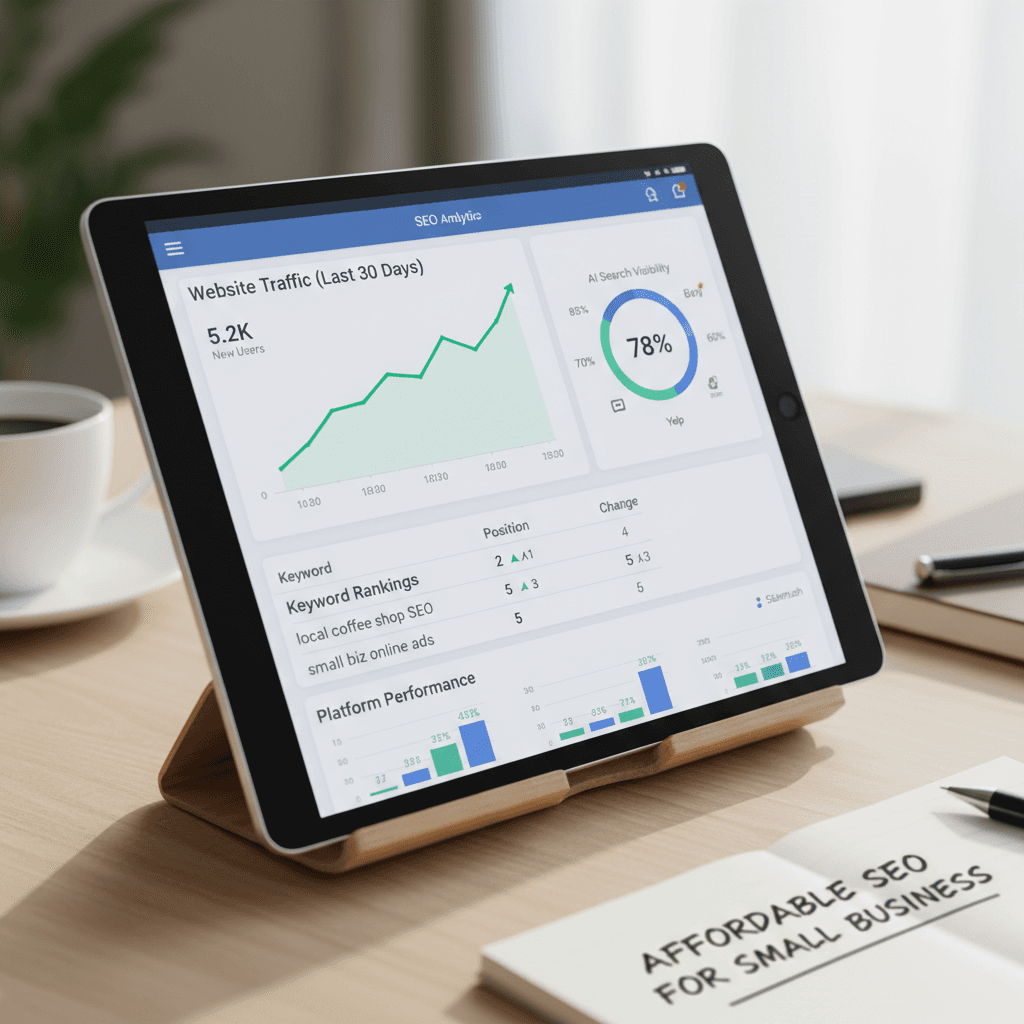
Tracking your SEO performance is essential for knowing what's working and where to invest your limited budget. Several powerful analytics tools are available for free or at very low cost, making performance tracking one of the most accessible aspects of affordable SEO for small business.
Free Tracking Tools Every Small Business Should Use
Google Search Console: Tracks keyword rankings, click-through rates, indexing status, and technical issues. Completely free.
Google Analytics 4: Monitors website traffic, user behavior, conversions, and traffic sources. Free.
Google Business Profile Insights: Shows how customers find your local listing, what actions they take, and how you compare to competitors. Free.
Bing Webmaster Tools: Similar to Search Console but for Bing. Also free and increasingly relevant as Bing powers some AI search features.
Tracking AI Search Visibility
Here's where most small businesses have a blind spot. Traditional analytics tools don't show you whether your business appears in AI search results. You might be completely invisible on ChatGPT or Perplexity and never know it.
Moonrank solves this by providing AI search visibility tracking across all major AI platforms. You can see exactly which queries trigger recommendations for your business (and your competitors) on ChatGPT, Gemini, Claude, and Perplexity. This data is invaluable for understanding where you stand and what to optimize next.
Research from EZ Rankings emphasizes that tracking performance across both traditional SERPs and AI platforms is becoming a baseline requirement for effective small business SEO in 2026 [1].
How to Choose the Right Affordable SEO Approach
The right affordable SEO for small business strategy depends on your budget, technical comfort level, and how much time you can dedicate to marketing. There's no one-size-fits-all answer, but this decision framework will help you find the best fit.
Decision Framework for Small Business SEO
Ask yourself these four questions:
What's my monthly budget? If it's under $100, focus on DIY strategies (keyword research, on-page optimization, local SEO, content marketing). If it's $100-500, consider an automated platform like Moonrank that handles the work for you.
How much time can I invest? DIY SEO requires 5-10 hours per week minimum. Automated platforms require near-zero time. Agencies fall somewhere in between.
Do I need local or national visibility? Local businesses should prioritize Google Business Profile, local citations, and location-specific content. National or online businesses need broader content marketing and link building.
Am I prepared for AI search? If you're not already optimizing for AI search engines, you're falling behind. Look for solutions that include AEO/GEO capabilities.
Red Flags to Watch For
Guaranteed rankings: No legitimate SEO provider can guarantee specific positions. Google's algorithm changes constantly.
Extremely cheap link packages: Bulk backlinks for $50-100 are almost always spammy and harmful.
Long-term contracts with no results clause: Reputable providers offer month-to-month billing or money-back guarantees [10].
No reporting or transparency: You should always be able to see what work is being done and what results it's producing.
Ignoring AI search entirely: Any SEO provider that focuses only on traditional Google rankings is already behind the curve in 2026.
Pro Tip: Start with a 3-month commitment to any SEO strategy before judging results. SEO is a compounding investment. The first month builds the foundation, the second month shows early signals, and the third month
Recommended Articles
Explore more from our content library:
