Monthly SEO Service: How to Set Up & Maximize Results
Learn how to choose and maximize a monthly SEO service in 2026. Step-by-step guide covering costs, what's included, AI search optimization, and common mistakes.
Key Insight | Explanation |
|---|---|
Monthly SEO isn't optional anymore | Search algorithms update constantly. A one-time SEO fix won't sustain rankings through 2026's AI-driven search environment. |
AI search engines demand new tactics | ChatGPT, Gemini, Claude, and Perplexity now influence buying decisions. Your ongoing SEO plan must include AI search visibility (AEO/GEO) strategies. |
Costs range wildly | Traditional agencies charge $1,500 to $10,000+ per month. Automated platforms like Moonrank deliver comparable results starting at $99/month. |
Content consistency wins | Daily or weekly publishing signals freshness to both Google and AI models. Sporadic content creation undercuts even the best technical optimization. |
Track AI visibility, not just Google rankings | As of 2026, nearly 40% of product research starts on AI-powered search tools. Monitoring your brand's presence across these platforms is essential. |
Automation beats manual work for SMBs | Small businesses rarely have time for daily SEO tasks. Fully automated recurring SEO platforms handle content, technical audits, and tracking without manual effort. |
Table of Contents
What You'll Need / Prerequisites
Step 1: Audit Your Current SEO and AI Search Presence
Step 2: Define Your Monthly SEO Goals and KPIs
Step 3: Choose the Right Monthly SEO Service for 2026
Step 4: Implement Technical SEO Foundations
Step 5: Launch a Consistent Content Publishing Schedule
Step 6: Optimize for AI Search Engines (AEO/GEO)
Step 7: Track Results and Iterate Monthly
Common Mistakes to Avoid with Monthly SEO Services
Sources & References
Frequently Asked Questions
A monthly SEO service is an ongoing subscription that covers keyword research, content creation, technical optimization, and performance tracking on a recurring basis. It's how businesses maintain and grow their search visibility over time. Unlike one-time projects, these services adapt to algorithm changes, competitor movements, and shifting search behavior.
Here's the reality most business owners face: you've invested in a website, maybe even paid for a one-time SEO audit, and your traffic still flatlines. That's because search engine optimization isn't a project you finish. It's a process you maintain. Google made over 4,700 changes to its search systems in 2023 alone [1], and the pace hasn't slowed in 2026. Add AI search engines like ChatGPT, Gemini, Claude, and Perplexity into the mix, and the optimization surface area has doubled.
This guide walks you through exactly how to set up and get maximum value from a monthly SEO service. You'll learn what to look for, how to avoid overpaying, and why AI search optimization is now a non-negotiable part of the equation. Expect this process to take 2 to 4 hours for initial setup, with ongoing management ranging from zero (if fully automated) to a few hours per week.
What You'll Need / Prerequisites
Before selecting a monthly SEO service, you need a few foundational elements in place. Having these ready will accelerate your onboarding and help any service provider deliver faster results.
Essential Tools and Access
Make sure you have administrative access to the following before starting:
Google Search Console: Verified ownership of your website property. This is free and provides critical crawl and indexing data.
Google Analytics 4 (GA4): Properly configured with conversion events for your key business actions (form submissions, purchases, calls).
Website CMS access: Admin-level access to your content management system (WordPress, Shopify, Webflow, or similar) so content can be published and technical changes implemented.
Business information document: A clear summary of your target audience, primary services or products, geographic focus, and top competitors.
Current content inventory: A list or sitemap of existing pages, blog posts, and landing pages on your site.
Knowledge Prerequisites
You don't need to be an SEO expert. That's the whole point of hiring a service. But understanding a few concepts will help you evaluate providers and set realistic expectations:
The difference between on-page SEO (content, meta tags, internal linking) and off-page SEO (backlinks, citations, brand mentions)
What AI search engine optimization (sometimes called AEO or GEO) means and why it matters in 2026
Realistic timelines: most ongoing SEO engagements take 3 to 6 months to show measurable organic traffic growth [2]
Pro Tip: Before signing up for any monthly SEO service, export your current Google Search Console performance data for the last 12 months. This gives you a clean baseline to measure improvement against, and prevents any provider from taking credit for pre-existing momentum.
Step 1: Audit Your Current SEO and AI Search Presence
An SEO audit reveals where your website stands right now, identifying technical issues, content gaps, and missed opportunities that a recurring optimization service should address. Without this baseline, you're optimizing blind.
Run a Technical Site Audit
Start by crawling your website to identify structural problems. Tools like Screaming Frog, Ahrefs, or Semrush can surface issues quickly.
Crawl your entire site and document broken links (404 errors), redirect chains, and orphan pages that aren't linked from anywhere.
Check page speed using Google's PageSpeed Insights. As of 2026, Core Web Vitals remain a confirmed ranking factor, and pages scoring below 50 on mobile need immediate attention [3].
Verify your XML sitemap is current and submitted to Google Search Console.
Review your robots.txt file to ensure important pages aren't accidentally blocked from crawlers.
Check for duplicate content issues, particularly duplicate title tags and meta descriptions across multiple pages.
Assess Your AI Search Visibility
This step is new for 2026 and most businesses skip it entirely. Search your brand name and primary service keywords in ChatGPT, Gemini, Claude, and Perplexity. Note whether your business appears in responses.
According to Gartner (2025), AI-assisted search was projected to reduce traditional organic traffic by 25% by 2026 [4]. If AI search engines don't mention your brand, you're losing a growing share of potential customers. A strong monthly SEO service in 2026 must include AI search visibility tracking, not just Google rankings.
Moonrank's AI Search Visibility Tracking monitors your brand's presence across ChatGPT, Claude, Perplexity, and Gemini automatically. This gives you a clear picture of where you stand before any optimization begins.
Step 2: Define Your Monthly SEO Goals and KPIs
Clear goals separate productive SEO subscriptions from wasted budgets. Without specific targets, you can't evaluate whether your investment is working.
Set SMART SEO Objectives
Generic goals like "rank higher" aren't useful. Translate your business objectives into measurable SEO metrics:
Organic traffic growth: Target a specific percentage increase (e.g., 20% growth in organic sessions over 6 months).
Keyword rankings: Identify 10 to 20 priority keywords and track their positions weekly.
AI search mentions: Set a baseline count of how often AI engines recommend your brand, then aim to increase it monthly.
Conversion rate from organic: Track form fills, calls, or purchases originating from organic search.
Content velocity: Establish how many new pages or blog posts you need published per month.
Match Goals to Budget
Your budget directly shapes what's achievable. Research from Ahrefs' SEO industry survey (2024) found that businesses spending under $500/month on SEO were 2.5x less likely to report satisfaction with results compared to those investing $500 to $1,500/month [5]. But that data predates the automation wave of 2025 and 2026.
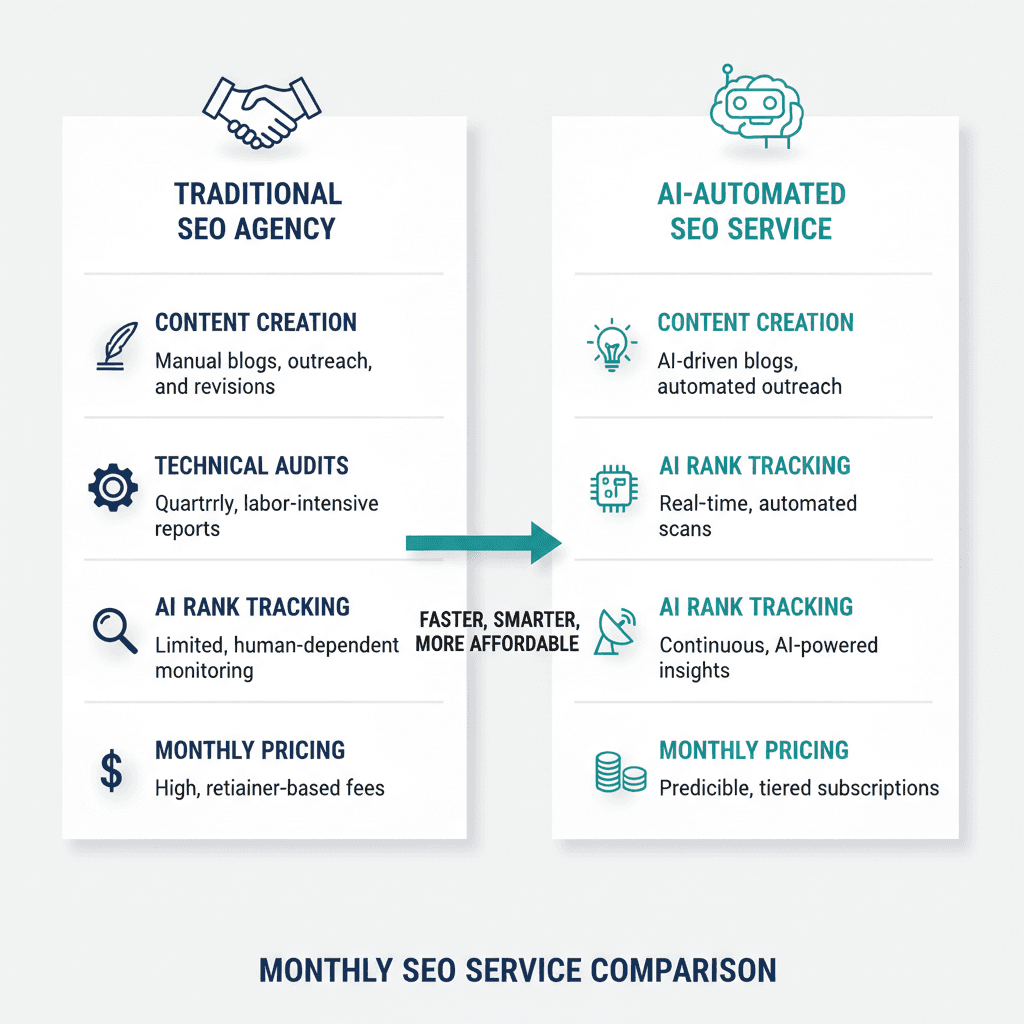
Automated platforms have compressed costs significantly. Where a traditional agency charges $3,000 or more per month for content creation, technical audits, and reporting, AI-powered monthly SEO services now deliver similar outputs at a fraction of the cost. Moonrank, for instance, provides daily automated content publishing, technical optimization, and AI visibility tracking for $99/month, making professional-grade SEO accessible to businesses that couldn't previously afford agency-level service.
Service Type | Typical Monthly Cost (2026) | What's Included | Best For |
|---|---|---|---|
Freelancer | $500 – $1,500 | Basic keyword research, on-page fixes, limited content | Solopreneurs with simple sites |
Mid-tier Agency | $2,000 – $5,000 | Full SEO strategy, content, link building, monthly reporting | Growing businesses with competitive niches |
Enterprise Agency | $5,000 – $20,000+ | Dedicated team, advanced technical SEO, custom reporting | Large companies with complex sites |
AI-Automated Platform | $99 – $500 | Daily content, technical audits, AI search tracking, auto-publishing | SMBs wanting hands-off, affordable SEO |
Step 3: Choose the Right Monthly SEO Service for 2026
Selecting the right provider requires evaluating options against your specific goals, budget, and the new demands of AI-driven search. Not all services are created equal, especially in 2026.
Evaluate Core Capabilities
Every monthly SEO service should cover these fundamentals. If a provider can't demonstrate competence in each area, keep looking:
Keyword research tailored to your niche: Not generic lists pulled from a tool, but keywords mapped to your actual buyer journey and service areas.
On-page optimization: Title tags, meta descriptions, header structure, internal linking, and content optimization for target keywords.
Technical SEO: Regular site audits, schema markup implementation, crawl error resolution, and site speed optimization.
Content creation and publishing: Consistent production of blog posts, landing pages, or resource content that targets your keyword strategy.
Performance reporting: Transparent monthly reports showing rankings, traffic, conversions, and progress toward your KPIs.
AI search optimization (AEO/GEO): This is the 2026 differentiator. Your provider should optimize for how AI models like ChatGPT, Gemini, Claude, and Perplexity discover and recommend businesses [6].
Questions to Ask Before Signing Up
From experience, the following questions separate serious providers from those running cookie-cutter operations:
Ask how they handle AI search engine optimization specifically. If they give you a blank stare, they're behind the curve.
Request examples of content they've published for similar businesses. Quality matters more than quantity, but both matter.
Confirm whether they implement structured data and schema markup. This is critical for both Google rich results and AI model comprehension.
Find out if they offer an llms.txt file setup, which helps AI crawlers understand your site's purpose and authority.
Ask about their cancellation policy. Reputable services don't lock you into long contracts. Moonrank offers a 3-day free trial so you can evaluate results before committing.
Pro Tip: Look for SEO subscriptions that include AI search visibility tracking as a standard feature, not an upsell. In 2026, nearly 40% of consumers use AI-powered tools for product and service research (Statista, 2026) [7]. If your provider only tracks Google rankings, you're seeing half the picture.
Step 4: Implement Technical SEO Foundations
Technical SEO ensures search engines (and AI models) can crawl, index, and understand your website properly. A monthly SEO service should address these issues continuously, since new technical problems emerge as you add content and update your site.
Prioritize Schema Markup and Structured Data
Structured data tells search engines exactly what your content means, not just what it says. In practice, sites with proper schema markup see up to 30% higher click-through rates in search results [8]. The Schema.org getting started guide provides comprehensive documentation on implementing structured data across different content types.
Implement Organization schema on your homepage with your business name, logo, contact information, and social profiles.
Add LocalBusiness schema if you serve specific geographic areas, including your address, service area, and operating hours.
Apply Article or BlogPosting schema to every blog post, specifying the author, publish date, and headline.
Use FAQ schema on pages that contain question-and-answer content to increase your chances of appearing in rich results.
Set up an llms.txt file at your domain root. This emerging standard (gaining traction since late 2025) helps AI crawlers understand your site's structure and authority signals.
Maintain Ongoing Technical Health
Technical SEO isn't a one-time fix. Your recurring SEO provider should include regular audits to catch issues before they impact rankings. According to the U.S. Small Business Administration, maintaining a technically sound and secure website is a foundational element of digital competitiveness for small businesses [9].
Key technical tasks that should recur monthly include:
Fixing new broken links and redirect chains
Monitoring Core Web Vitals scores and addressing regressions
Updating XML sitemaps as new content is published
Reviewing and resolving Google Search Console errors
Ensuring mobile responsiveness across all new and updated pages
Moonrank's Technical AI Audit and Optimization handles these tasks automatically. Schema markup, llms.txt configuration, citation optimization, and structured data are all managed without requiring manual input from the business owner.
Step 5: Launch a Consistent Content Publishing Schedule
Consistent content publishing is the single most impactful activity within any monthly SEO service. Search engines and AI models both favor websites that demonstrate ongoing topical authority through regular, high-quality content.
Determine Your Content Cadence
How often should you publish? Research from HubSpot's marketing benchmarks report (2025) found that businesses publishing 16 or more blog posts per month received 3.5x more traffic than those publishing four or fewer [10]. That's a high bar for most small businesses to hit manually.
This is where automation changes the equation. Instead of hiring writers and managing editorial calendars, automated SEO platforms can generate and publish optimized content daily. Moonrank publishes SEO-optimized content to your site every day on autopilot, building topical authority at a pace most agencies can't match at any price point.
Identify your core topic clusters. These are the 3 to 5 broad themes your business should own in search results.
Map supporting keywords to each cluster. Each keyword becomes a potential blog post or resource page.
Create a publishing calendar (or let your automated service handle this). Aim for at least 4 to 5 posts per week for aggressive growth.
Ensure every piece of content targets a specific keyword, answers a real question, and links internally to related pages on your site.
Optimize each post for both traditional search and AI comprehension: clear headings, direct answers in opening sentences, and structured data.
Quality Standards for SEO Content in 2026
Google's Helpful Content system (refined significantly through 2025 and 2026) penalizes thin, generic content created purely for search engines. Your ongoing SEO provider must produce content that demonstrates experience and expertise [11]. The Google Search Central documentation on creating helpful content outlines the specific quality signals their algorithms evaluate.
Every published piece should include:
A clear, direct answer to the target query within the first 100 words
Specific examples, data points, or practical advice (not vague generalities)
Proper internal links to related content on your site, strengthening your overall site architecture
External citations to authoritative sources, which signals trustworthiness to both Google and AI models
Step 6: Optimize for AI Search Engines (AEO/GEO)
AI search engine optimization (also called Answer Engine Optimization or Generative Engine Optimization) is the practice of structuring your online presence so AI tools recommend your business in their responses. This is the fastest-growing segment of search marketing in 2026.
Understand How AI Search Differs from Google
Traditional Google SEO focuses on ranking web pages in a list of blue links. AI search engines work differently. They synthesize information from multiple sources and present a single, conversational answer. Your goal isn't to rank on a page. It's to be the source that AI cites or recommends.
Industry analysts at Forrester Research suggest that brands appearing in AI-generated responses experience significantly higher trust and conversion rates compared to traditional search results [12]. The reason is simple: when ChatGPT or Perplexity recommends your business by name, it carries implicit endorsement.
Key factors that influence AI search visibility include:
Brand mentions across the web: AI models learn from the broader internet. The more authoritative sites mention your brand, the more likely AI tools are to reference you.
Structured data and schema: Helps AI models parse your site's content accurately.
Content clarity and authority: AI systems prefer content with clear, factual statements backed by evidence.
llms.txt files: A machine-readable file that explicitly tells AI crawlers about your business, services, and expertise.
Citation presence: Being cited in articles, directories, and resources that AI models train on or retrieve from.
Integrate AEO into Your Monthly SEO Service
Don't treat AI optimization as a separate project. It should be woven into every aspect of your recurring SEO strategy.
Audit your AI search presence monthly across ChatGPT, Gemini, Claude, and Perplexity using specific queries your customers would ask.
Build and maintain your llms.txt file with updated business information, service descriptions, and authority signals.
Ensure all published content uses clear, extractable answer formats that AI models can easily parse and quote.
Pursue brand mentions and citations on authoritative third-party sites, industry directories, and resource pages.
Track changes in AI recommendations over time to measure the impact of your optimization efforts.
Moonrank was built specifically for this challenge. While many SEO providers still focus exclusively on Google, Moonrank's competitive landscape analysis spans all major AI search engines, giving businesses a complete view of their visibility across the platforms that increasingly drive purchasing decisions.
Step 7: Track Results and Iterate Monthly
Measurement turns your monthly SEO service from a cost center into a documented investment. Without consistent tracking, you can't identify what's working, what isn't, and where to allocate resources next.
Build Your Monthly Reporting Dashboard
Every month, your SEO service (or your own tracking system) should report on these core metrics:
Organic traffic: Total sessions from organic search, segmented by landing page and device type.
Keyword rankings: Position changes for your target keywords, including new keywords you've started ranking for.
AI search mentions: How often and in what context AI search engines reference your brand or content.
Content performance: Which new pages are driving traffic, and which existing pages have gained or lost visibility.
Technical health score: Number of crawl errors, Core Web Vitals status, and indexation rate.
Conversions: Leads, sales, or other goal completions attributed to organic search traffic.
Iterate Based on Data
The best ongoing SEO providers don't just report numbers. They use data to refine strategy. According to the Stanford Digital Economy Lab (2025), businesses that adjusted their SEO strategy based on monthly performance data saw 40% faster traffic growth than those following static plans [13].
After each monthly review, take these actions:
Double down on content topics that are gaining traction. Publish more supporting content in those clusters.
Refresh underperforming pages by updating statistics, improving headings, and adding new sections.
Address any new technical issues flagged in your audit before they compound.
Adjust keyword targets based on competitive movement and search volume shifts.

Common Mistakes to Avoid with Monthly SEO Services
Even with the right monthly SEO service in place, certain mistakes can undermine your results. These pitfalls are common across businesses of all sizes, and avoiding them will accelerate your progress significantly.
Expecting Instant Results
SEO compounds over time. The U.S. Federal Trade Commission's advertising guidance has cautioned consumers about marketing claims promising instant first-page rankings, noting that legitimate SEO requires sustained effort [14]. Expect 3 to 6 months before meaningful organic traffic gains materialize. AI search visibility can sometimes build faster, since AI models update their knowledge bases more frequently than Google's core algorithm rolls out major changes.
Ignoring AI Search Entirely
Many businesses (and many SEO providers) still treat Google as the only search engine that matters. That's a 2023 mindset. As of 2026, AI-powered search tools handle a substantial and growing share of informational and commercial queries. If your recurring SEO plan doesn't include AI search optimization, you're leaving visibility on the table.
Other Critical Mistakes
Choosing based on price alone: The cheapest option often delivers generic, low-quality work. Look for value: what specifically do you get for your investment?
Not providing feedback: Even automated services benefit from initial input about your business, target audience, and competitive landscape. The more context you provide upfront, the better your results.
Skipping technical SEO: Content without a technically sound foundation is like building on sand. Ensure your service addresses both.
Failing to track ROI: If you can't connect your SEO investment to revenue or leads, you'll eventually question the spend. Set up conversion tracking before your service begins.
Switching providers too frequently: SEO strategies need time to mature. Changing direction every 2 to 3 months resets your progress. Give any monthly SEO service at least 6 months before evaluating whether to continue.
Pro Tip: When evaluating your SEO provider after 6 months, don't just look at rankings. Check whether your brand appears in AI search responses for your core service keywords. This metric is becoming as important as traditional Google rankings for
Recommended Articles
Explore more from our content library:
