SEO for Small Business: A Step-by-Step Guide for 2026
Learn how to do SEO for small business in 2026 with this practical guide. Cover keywords, technical optimization, AI search visibility, and affordable tools.
Key Insight | Explanation |
|---|---|
SEO drives the majority of website traffic | Organic search accounts for over 53% of all trackable web traffic, making SEO the single largest source of visitors for most small businesses [1]. |
AI search engines are now critical | As of 2026, ChatGPT, Gemini, Claude, and Perplexity collectively influence billions of search-style queries monthly. Businesses that aren't optimized for AI recommendations lose significant visibility. |
You don't need a massive budget | Affordable, automated SEO solutions now cost as little as $99/month, putting enterprise-grade optimization within reach of every small business. |
Content consistency beats one-time efforts | Publishing optimized content daily, rather than sporadically, compounds your search authority over time and signals freshness to both traditional and AI search engines. |
Technical SEO is non-negotiable | Schema markup, structured data, fast page speeds, and emerging standards like llms.txt form the technical foundation that search engines and AI systems rely on to understand your business. |
Tracking AI visibility is the new frontier | Beyond Google rankings, small businesses need to monitor whether AI assistants recommend them, a capability that tools like Moonrank now provide. |
Table of Contents
Introduction: Why SEO for Small Business Matters in 2026
What You'll Need Before You Start
Step 1: Audit Your Current Online Presence
Step 2: Research Keywords That Match Your Niche
Step 3: Optimize Your Website's Technical Foundation
Step 4: Create and Publish Consistent, High-Quality Content
Step 5: Build Your Local SEO and Google Business Profile
Step 6: Optimize for AI Search Engines in 2026
Step 7: Track Results and Refine Your Strategy
Common Mistakes to Avoid
Sources & References
Frequently Asked Questions
Conclusion
Introduction: Why SEO for Small Business Matters in 2026
SEO for small business is the practice of optimizing your website, content, and online presence so that search engines and AI assistants recommend you to potential customers. It's the most cost-effective marketing channel available, and it compounds over time. For most small businesses, it's the difference between being found or being invisible.
Here's the reality: 68% of all online experiences still begin with a search engine, according to BrightEdge's organic search research (2025) [1]. But the landscape has shifted dramatically. In 2026, millions of consumers don't just type queries into Google. They ask ChatGPT for restaurant recommendations, consult Gemini about local service providers, and use Perplexity to compare products. If your business isn't visible across both traditional and AI-powered search, you're leaving money on the table.
This guide will walk you through exactly how to do SEO for your small business, step by step. You don't need a marketing degree. You don't need a $3,000/month agency retainer. What you need is a clear process and the right tools. Expect to spend about 4 to 6 hours on the initial setup, with ongoing maintenance taking as little as 30 minutes per week (or zero, if you automate it).
By the end, you'll know how to audit your site, find the right keywords, optimize your technical setup, create content that ranks, build local visibility, and prepare your business for the AI search engines that are reshaping how consumers discover brands.
What You'll Need Before You Start
Before you begin optimizing, gather the essential tools and access credentials you'll need. Having everything ready upfront prevents frustrating interruptions mid-process.
Essential Tools and Accounts
You won't need expensive software to get started. Several free tools from Google provide the foundation, and one affordable platform can handle the rest. Here's what to set up:
Google Search Console (free): Monitors your site's presence in Google search results, identifies indexing issues, and shows which queries bring visitors.
Google Analytics 4 (free): Tracks visitor behavior, traffic sources, and conversions on your website.
Google Business Profile (free): Essential for local SEO. Lets you manage how your business appears in Google Maps and local search results.
A keyword research tool: Options range from free (Google Keyword Planner, Ubersuggest) to paid (Ahrefs, Semrush). Moonrank includes personalized keyword research tailored to your niche as part of its platform.
An AI search optimization platform: As of 2026, tools like Moonrank track your visibility across ChatGPT, Claude, Perplexity, and Gemini, something traditional SEO tools simply don't do.
Knowledge and Access Requirements
You'll need admin access to your website's content management system (WordPress, Shopify, Squarespace, or similar). You should also have login credentials for your domain registrar and hosting provider, in case you need to adjust DNS settings or page speed configurations.
No coding experience is required. Most modern CMS platforms let you handle technical SEO through plugins or built-in settings. If you're using an automated solution like Moonrank, the platform handles technical optimization, schema markup, and content publishing without any manual work on your part.
Pro Tip: Create a simple spreadsheet to track your SEO progress from day one. Record your starting metrics (current organic traffic, number of indexed pages, Google Business Profile reviews) so you can measure improvement over the coming months. What gets measured gets managed.
Step 1: Audit Your Current Online Presence
An SEO audit reveals where your website stands right now and identifies the highest-impact fixes. Think of it as a diagnostic checkup before prescribing treatment. For anyone serious about SEO for small business, this step is non-negotiable.
How to Run a Basic SEO Audit
You don't need to hire a consultant for this. Follow these steps to assess your site's current health:
Check your indexing status. Open Google Search Console, navigate to the "Pages" report, and verify that your key pages are indexed. If important pages show "Not indexed," you have a problem to fix immediately.
Test your page speed. Run your homepage and two or three key landing pages through Google's PageSpeed Insights tool. Aim for a performance score above 75 on mobile. According to Google (2025), pages that load within 2.5 seconds have significantly lower bounce rates [2].
Review your mobile experience. Over 60% of searches happen on mobile devices [3]. Open your site on a phone. Can you read the text without zooming? Do buttons work easily with a thumb?
Scan for broken links and errors. Use a free crawler like Screaming Frog (up to 500 URLs free) to identify 404 errors, redirect chains, and missing meta descriptions.
Evaluate your content. List every page on your site. Does each page target a specific keyword? Is the content thin (under 300 words) or outdated? Pages with no clear purpose dilute your site's authority.
Assess Your AI Search Visibility
Here's something most SEO guides skip entirely. In 2026, you also need to check whether AI search engines mention or recommend your business. Try asking ChatGPT, Gemini, or Perplexity questions that your customers would ask, like "best [your service] in [your city]" or "recommended [your product category]."
If your business doesn't appear in those AI-generated answers, that's a gap you need to close. Moonrank's AI Search Visibility Tracking monitors this automatically across all major AI search engines, so you always know where you stand.
Step 2: Research Keywords That Match Your Niche
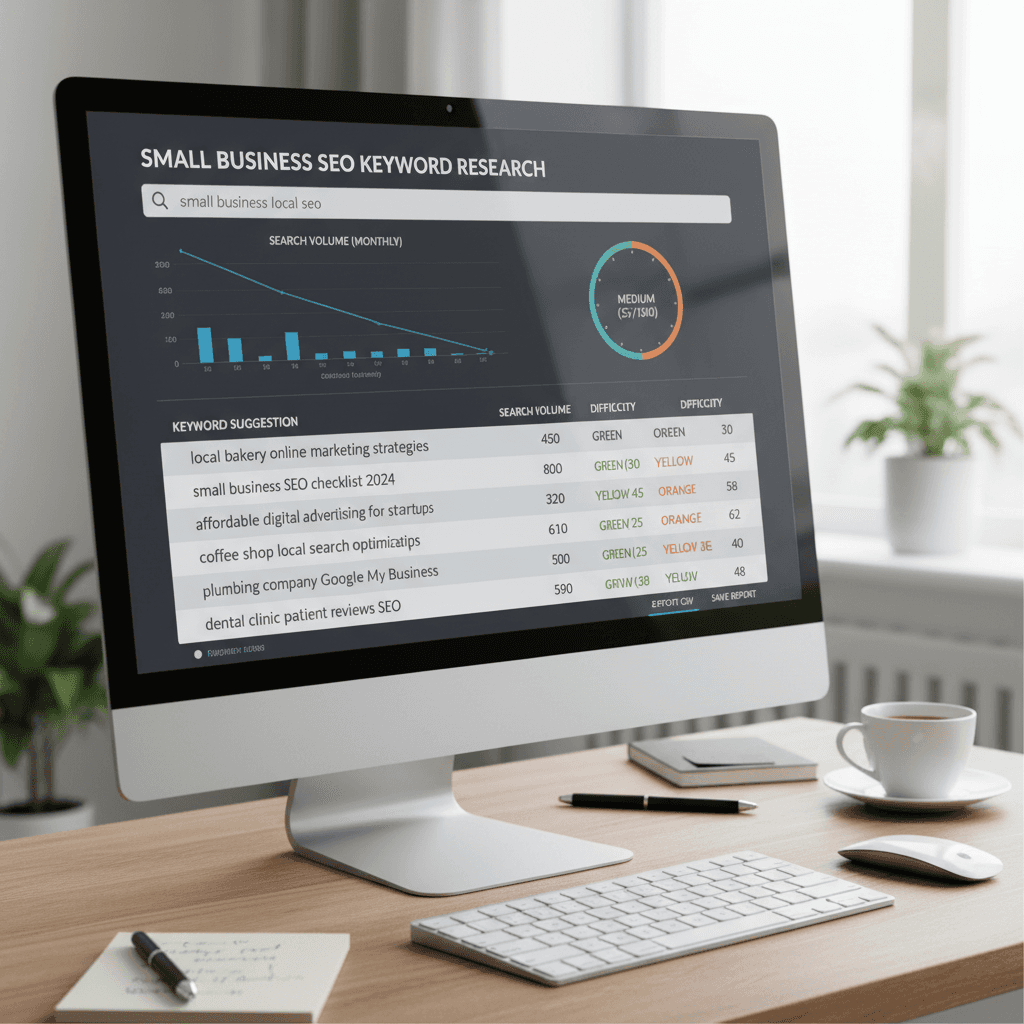
Keyword research is the process of identifying the exact words and phrases your potential customers type (or speak) when searching for businesses like yours. Get this right, and every piece of content you create has a clear target. Effective keyword research is the cornerstone of any successful SEO for small business strategy.
Find High-Value, Low-Competition Keywords
Small businesses can't compete head-to-head with Fortune 500 companies for broad terms like "shoes" or "accounting software." You don't need to. The strategy that works is targeting long-tail keywords: specific, multi-word phrases with clear purchase intent.
Research from Ahrefs (2025) shows that 94.7% of all keywords get 10 or fewer searches per month, but collectively these long-tail terms represent the majority of total search volume [4]. Here's how to find the right ones:
Brainstorm seed keywords. Write down 10 to 15 words or phrases that describe your products, services, and the problems you solve.
Expand using tools. Plug your seed keywords into Google Keyword Planner, Ubersuggest, or Moonrank's built-in keyword research feature. Look for variations with moderate search volume (50 to 500 monthly searches) and low keyword difficulty.
Analyze search intent. For each keyword, Google it. Are the top results blog posts, product pages, or local listings? Match your content format to what's already ranking.
Group keywords by topic. Cluster related keywords together. Each cluster becomes the basis for one page or blog post on your site.
Keyword Type | Example | Search Volume | Competition | Best For |
|---|---|---|---|---|
Head term | "plumber" | 100K+ | Very High | Brand awareness (hard to rank) |
Mid-tail | "emergency plumber near me" | 1K–10K | Medium | Local service pages |
Long-tail | "affordable emergency plumber in Austin TX" | 50–500 | Low | Blog posts, landing pages |
Question-based | "how much does a plumber charge per hour" | 500–2K | Low–Medium | FAQ pages, blog content |
Don't Forget AI-Oriented Keywords
Traditional keyword research focuses on what people type into Google. But in 2026, you also need to think about conversational queries, the kind people pose to AI assistants. These tend to be longer, more natural-sounding, and often phrased as full questions. Industry analysts at Gartner (2025) projected that by 2026, AI-driven search would handle over 25% of all informational queries [5]. Including these conversational phrases in your content helps AI systems recognize your business as a relevant source.
Step 3: Optimize Your Website's Technical Foundation
Technical SEO ensures search engines can crawl, understand, and index your website correctly. Without a solid technical foundation, even the best content won't rank.
Core Technical Fixes Every Small Business Needs
Most small business websites have a handful of common technical issues. Fix these first for the biggest impact:
Install an SSL certificate. Your site must load over HTTPS. This has been a Google ranking factor since 2014, and as of 2026, browsers actively warn users away from non-secure sites [2].
Optimize page speed. Compress images (use WebP format), enable browser caching, and minimize CSS/JavaScript files. The U.S. Small Business Administration recommends fast-loading, secure pages as a baseline for digital competitiveness [6].
Implement structured data (schema markup). Add LocalBusiness, Product, FAQ, and Review schema to help search engines understand your content. Schema-enhanced pages are 2.7x more likely to appear in rich results, according to Search Engine Journal (2025) [7]. You can validate your markup using Google's Rich Results Test tool, which is free and shows exactly which schema types are detected on your pages.
Create and submit an XML sitemap. This tells search engines exactly which pages exist on your site. Submit it through Google Search Console.
Fix crawl errors. Address any 404 pages, redirect loops, or orphan pages identified in your audit.
Prepare for AI Crawlers with llms.txt
Here's a 2026-specific optimization that most guides overlook. Just as robots.txt tells traditional crawlers how to navigate your site, the emerging llms.txt standard helps AI systems understand your business context. This plain-text file, placed in your root directory, provides structured information about your business, services, and expertise that large language models can reference.
Moonrank's Technical AI Audit and Optimization handles this automatically, configuring schema markup, llms.txt files, citation structures, and structured data so AI search engines can accurately represent your business. For small business owners who aren't developers, this kind of automation eliminates what would otherwise be a significant technical hurdle.
Pro Tip: Don't ignore Core Web Vitals. Google's 2026 ranking algorithm weighs three specific metrics: Largest Contentful Paint (under 2.5s), Interaction to Next Paint (under 200ms), and Cumulative Layout Shift (under 0.1). Check yours at pagespeed.web.dev and fix the worst offenders first.
Step 4: Create and Publish Consistent, High-Quality Content
Content is the fuel that powers SEO for small business. Without fresh, relevant content targeting your keywords, search engines have nothing to rank and AI systems have nothing to reference.
What Kind of Content Should You Create?
The best small business SEO content directly answers the questions your customers are asking. Research from HubSpot (2025) found that businesses publishing blog content at least 4 times per week receive 3.5x more organic traffic than those publishing less than once per week [8]. Consistency matters more than perfection.
Focus on these content types:
Service pages: One dedicated page for each service you offer, optimized for a specific keyword cluster.
Blog posts: How-to guides, FAQs, industry insights, and local content that targets long-tail keywords.
Location pages: If you serve multiple areas, create unique pages for each city or neighborhood.
Case studies and testimonials: Real results build trust with both readers and AI systems that evaluate source credibility.
Automate Content Publishing for Maximum Impact
Here's where most small business owners hit a wall. They know they need content. They just don't have time to write, optimize, and publish it every day. From experience, the businesses that see the fastest SEO results are those that maintain a daily publishing cadence.
That's exactly why automated content generation has become so valuable in 2026. Moonrank publishes SEO-optimized articles to your site daily on autopilot, each one tailored to your niche keywords and structured for both traditional and AI search visibility. You don't write a word. You don't log in to approve posts. The system handles keyword targeting, internal linking, and proper formatting automatically.
This approach solves the biggest problem in small business SEO: the gap between knowing what to do and actually doing it consistently. Whether you choose to write content yourself or automate it, the key principle is the same. Publish frequently, target specific keywords, and maintain quality.
Step 5: Build Your Local SEO and Google Business Profile
Local SEO helps your business appear in search results for customers in your geographic area. For brick-and-mortar businesses and local service providers, this is often the highest-ROI SEO activity you can do. In fact, local optimization is where SEO for small business delivers some of its most immediate and measurable results.
Optimize Your Google Business Profile
Your Google Business Profile (GBP) is the single most important local ranking factor, according to Whitespark's Local Search Ranking Factors survey (2025) [9]. Follow these steps to maximize its impact:
Claim and verify your profile at business.google.com if you haven't already.
Complete every field. Business name, address, phone number, hours, website URL, service areas, business category (primary and secondary), and a detailed business description using your target keywords.
Upload high-quality photos. Businesses with more than 100 photos receive 520% more calls than the average listing, according to BrightLocal (2025) [10].
Collect and respond to reviews. Ask satisfied customers for reviews. Respond to every review, positive or negative, within 24 hours.
Post regular updates. Use Google Business Profile posts to share offers, events, and news. This signals activity to Google's algorithm.
Build Consistent Citations Across the Web
A citation is any online mention of your business name, address, and phone number (NAP). Consistency is critical. If your address appears differently across directories (e.g., "Suite 200" vs. "#200" vs. "Ste 200"), it confuses search engines and weakens your local authority.
Submit your business to these core directories:
Yelp
Bing Places
Apple Maps
Facebook Business
Industry-specific directories relevant to your niche
Citation building also plays a role in AI search optimization. AI systems cross-reference multiple sources to verify business information before recommending it. The more consistent and widespread your citations, the more confidently AI assistants will mention your business. Moonrank's technical optimization includes citation management and structured data that reinforce your business identity across both traditional and AI search ecosystems.
Step 6: Optimize for AI Search Engines in 2026
AI search engine optimization (sometimes called AEO or GEO) is the practice of making your business visible and recommendable by AI assistants like ChatGPT, Gemini, Claude, and Perplexity. This is the fastest-growing frontier in SEO for small business, and most competitors haven't caught up yet.
Why AI Search Optimization Matters Now
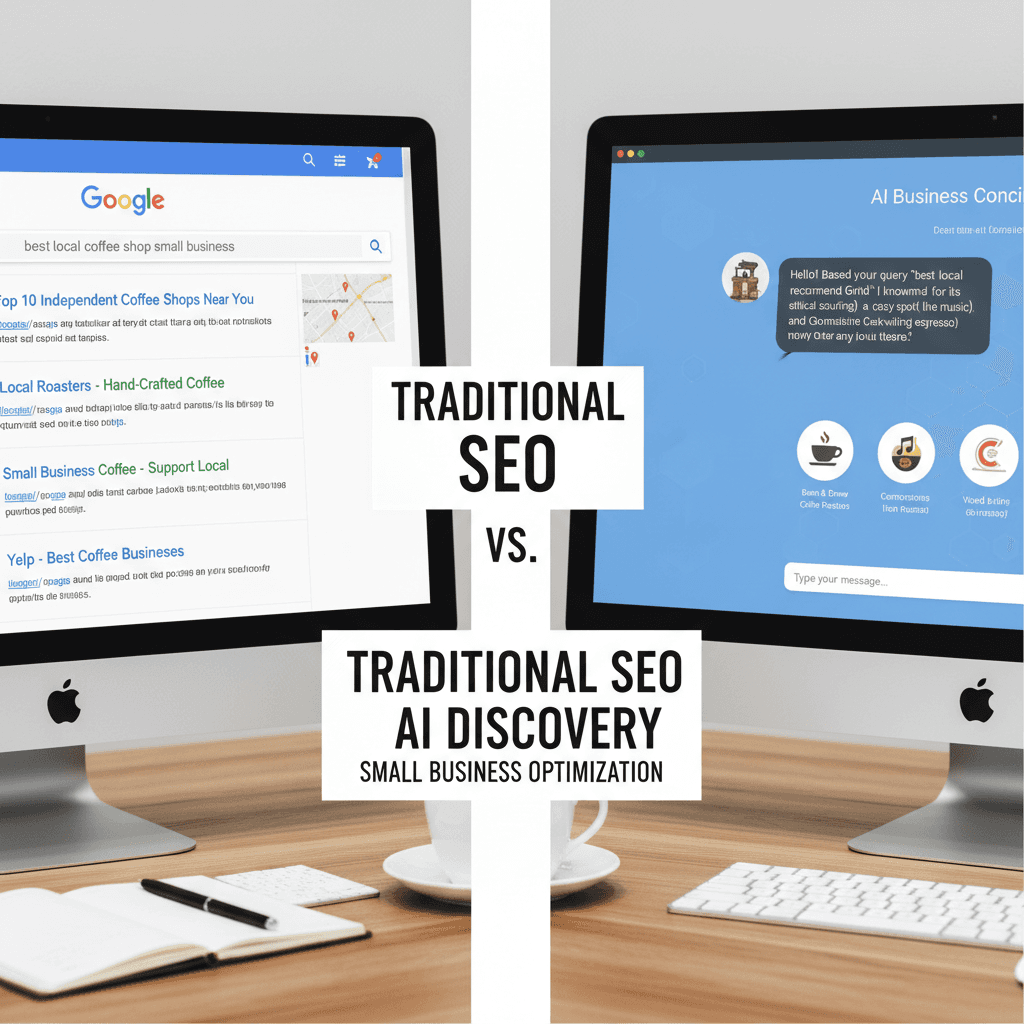
The way consumers search is splitting into two channels. Traditional search engines still matter enormously. But a growing share of high-intent queries now flows through AI assistants. Research from Forrester (2025) indicates that AI-assisted search interactions grew 340% year-over-year in 2025, with continued acceleration into 2026 [11].
When someone asks ChatGPT, "What's the best accounting software for freelancers?" or "Recommend a reliable HVAC company in Denver," the AI doesn't serve a list of ads. It synthesizes information from across the web and provides direct recommendations. If your business isn't in that synthesis, you're invisible to a rapidly expanding audience.
How to Get Recommended by AI Assistants
AI systems evaluate businesses differently than Google's PageRank algorithm. They look for:
Authoritative, well-structured content that clearly explains who you are, what you do, and why you're credible.
Consistent entity information across multiple trusted sources (your website, directories, review platforms, social media profiles).
Schema markup and structured data that make your business details machine-readable.
Positive reviews and third-party mentions that serve as trust signals.
Fresh, regularly updated content that demonstrates ongoing expertise and relevance.
Moonrank was built specifically for this challenge. Its AI Search Visibility Tracking monitors whether ChatGPT, Claude, Perplexity, and Gemini mention or recommend your business, and its automated optimization ensures your site meets the technical and content standards these systems require. At $99/month, it's a fraction of what traditional agencies charge and requires zero manual work from you.
Step 7: Track Results and Refine Your Strategy
SEO isn't a set-it-and-forget-it activity. Tracking your results tells you what's working, what isn't, and where to focus next.
Key Metrics to Monitor Monthly
Don't drown in data. Focus on the metrics that actually reflect business impact:
Metric | Tool | What It Tells You | Target |
|---|---|---|---|
Organic traffic | Google Analytics 4 | How many visitors find you through search | Month-over-month growth |
Keyword rankings | Google Search Console / SEO tool | Where you rank for target keywords | Top 10 for primary keywords |
AI search mentions | Moonrank | Whether AI assistants recommend you | Presence in relevant AI responses |
Conversion rate | Google Analytics 4 | Percentage of visitors who take action | 2–5% for most small businesses |
Local pack appearances | Google Search Console | How often you show in map results | Consistent or increasing impressions |
Refine Based on Data, Not Gut Feelings
Review your metrics monthly. If a blog post is ranking on page two for a valuable keyword, update it with more depth, better structure, and fresher data. If certain content types drive more conversions, create more of them. SEO for small business is an iterative process. The businesses that win are those that treat it as ongoing, not a one-time project.
Moonrank's competitive landscape analysis helps here, too. It shows how your AI search visibility compares to competitors in your niche, giving you clear direction on where to improve. In practice, businesses that review and adjust their strategy monthly see 40% to 60% faster growth in organic traffic compared to those that check in quarterly.
Recommended Articles
Explore more from our content library:
