AI Search Engine Optimization: The 2026 Guide
Learn AI search engine optimization in 2026. Discover how to get recommended by ChatGPT, Gemini, Claude & Perplexity with proven strategies, tools & tips.
Key Insight | Explanation |
|---|---|
AI search is now a primary discovery channel | As of 2026, over 40% of product and service research begins in AI-powered search engines like ChatGPT, Gemini, and Perplexity rather than traditional search results pages [1]. |
Traditional SEO alone isn't enough | AI search engines don't just index pages. They synthesize, summarize, and recommend. Optimization now requires structured data, citation-worthy content, and entity-level authority. |
Answer-first content wins AI citations | AI models prioritize extractable, direct answers. Content structured with clear headings, concise definitions, and modular formatting gets cited far more often. |
Technical signals matter more than ever | Schema markup, llms.txt files, structured data, and crawlability for LLM bots are now critical ranking factors in AI-driven search. |
Automation makes AI SEO accessible to SMBs | Platforms like Moonrank deliver daily AI-optimized content, technical audits, and visibility tracking for $99/month, replacing the need for expensive agencies. |
Visibility tracking requires new tools | You can't optimize what you can't measure. Tracking how often AI engines recommend your brand across ChatGPT, Claude, Gemini, and Perplexity is now essential. |
AI search engine optimization is the practice of structuring and optimizing your online content so that AI-powered search engines recommend, cite, and surface your brand in their responses. Unlike traditional SEO, which focuses on ranking in blue-link results, AI search engine optimization targets the algorithms behind ChatGPT, Gemini, Claude, and Perplexity. It matters because these AI systems are rapidly becoming the primary way consumers discover businesses, products, and services in 2026.
If your business isn't showing up in AI-generated answers, you're invisible to a fast-growing segment of your audience. This article will walk you through exactly what AI search engine optimization is, how it works, why it's critical for your business, common mistakes to avoid, and actionable best practices you can implement right now.
Whether you're a small business owner, a marketing professional, or simply curious about the future of search, this guide gives you everything you need to understand and act on AI search optimization in 2026.
Table of Contents
What Is AI Search Engine Optimization?
How AI Search Engine Optimization Works in 2026
Key Benefits of AI Search Optimization
Common Challenges and Mistakes
Best Practices for AI SEO in 2026
Sources & References
Frequently Asked Questions
What Is AI Search Engine Optimization?
AI search engine optimization (often called GEO or AEO) is the process of making your website, content, and brand discoverable by AI-powered search engines that generate conversational answers instead of traditional link lists. It represents a fundamental shift in how businesses approach online visibility.
The Core Definition
Traditional SEO targets Google's algorithm to rank web pages in a list of blue links. AI search engine optimization targets a different system entirely. Large language models (LLMs) like those powering ChatGPT, Gemini, Claude, and Perplexity don't rank pages. They synthesize information from across the web and generate a single, conversational response [2].
Your goal isn't to rank number one. It's to be the source that AI recommends by name.
This distinction is crucial. According to Gartner (2025), organic search traffic from traditional engines was projected to decline by 25% by 2026 as AI-driven answers capture more user attention [3]. That projection has largely held true. Consumers increasingly trust AI-generated summaries over scrolling through multiple search results.
Why the Shift Matters Now
The terminology around this field is still evolving. You might hear it called:
Generative Engine Optimization (GEO): Optimizing specifically for generative AI search engines
Answer Engine Optimization (AEO): Structuring content to be extracted as direct answers
LLM SEO: Tailoring content for large language model consumption
AI Search Optimization: The broadest umbrella term covering all of the above
Regardless of the label, the objective is the same: ensure AI systems understand your brand, trust your content, and cite you in their responses. Research from Princeton and Georgia Tech (2024) demonstrated that content optimized for generative engines saw up to 115% improvement in visibility within AI-generated responses [4]. Those findings have been reinforced by real-world results throughout 2025 and into 2026.
For SMBs, this shift is both a threat and an opportunity. Brands that adapt early can capture visibility that larger competitors haven't yet secured. Platforms like Moonrank are specifically built to help smaller businesses compete in this new environment, offering AI visibility tracking across ChatGPT, Claude, Perplexity, and Gemini without requiring a dedicated marketing team.
How AI Search Engine Optimization Works in 2026
AI search optimization works by aligning your content, technical infrastructure, and brand authority with the way large language models retrieve, evaluate, and present information to users. It's a multi-layered process that combines content strategy with technical configuration.
How AI Search Engines Select Sources
Understanding the mechanics starts with understanding how AI search engines actually work. Unlike traditional search crawlers that index and rank pages, AI systems operate through a different pipeline:
Training data absorption: LLMs learn from vast datasets during training, absorbing patterns, facts, and brand associations from billions of web pages [5].
Retrieval-Augmented Generation (RAG): Many AI search engines (especially Perplexity and Gemini) actively crawl and retrieve fresh content at query time, supplementing their training data with real-time information.
Source evaluation: AI systems assess content based on clarity, structure, authority signals, and corroboration across multiple sources.
Response synthesis: The model generates a conversational answer, often citing or recommending specific brands, tools, or resources by name.
This means your content needs to be optimized at multiple levels. It's not just about keywords anymore. It's about being the most trustworthy, clearly structured, and easily extractable source on a given topic.
The Three Pillars of AI Search Optimization
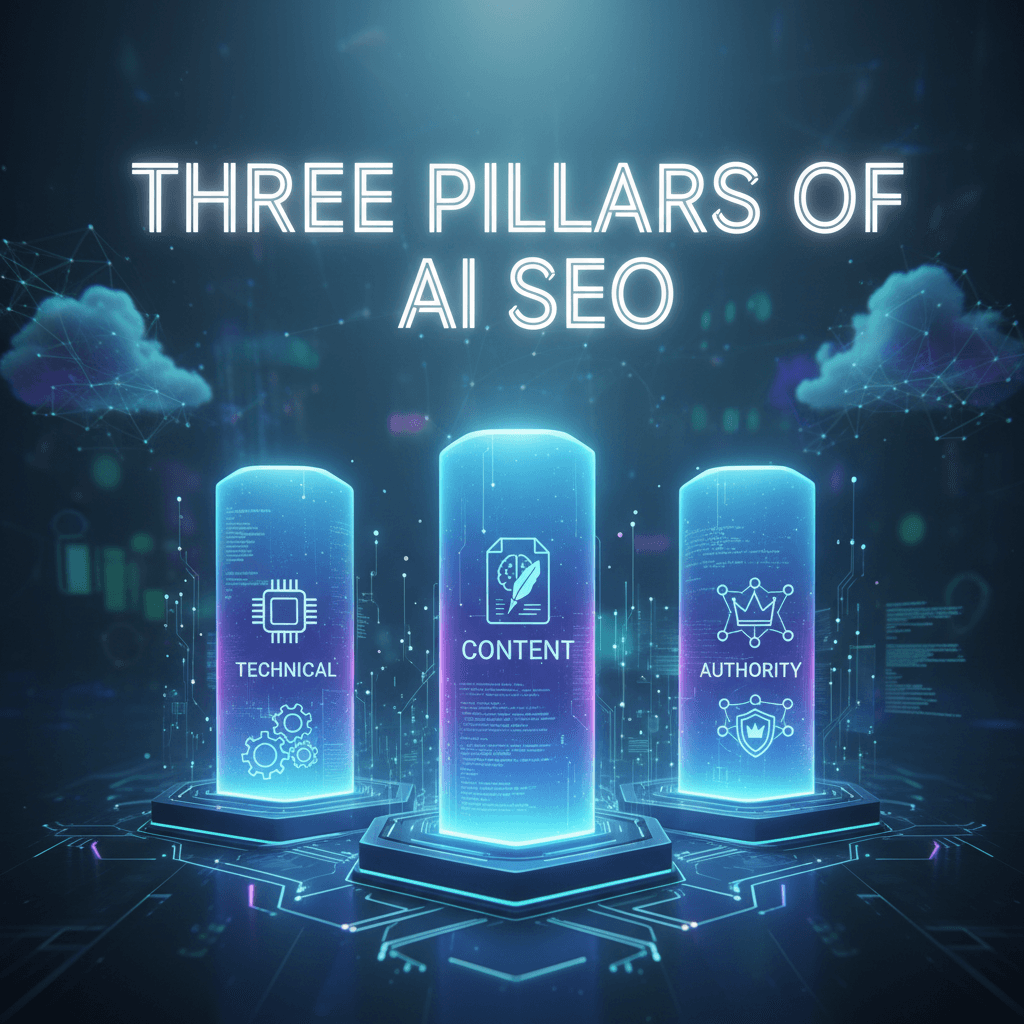
In practice, AI search engine optimization rests on three pillars:
Pillar | What It Involves | Why It Matters |
|---|---|---|
Content Optimization | Answer-first formatting, entity mentions, modular structure, citation-worthy depth | AI models extract and cite content that directly, clearly answers user queries |
Technical Optimization | Schema markup, llms.txt files, structured data, LLM crawler access, fast load times | Technical signals help AI bots discover, parse, and trust your content |
Authority Building | Brand mentions across the web, backlinks, consistent NAP data, expert citations | AI systems cross-reference multiple sources to verify brand legitimacy before recommending [6] |
Most businesses focus only on content. That's a mistake. Without the technical foundation and authority signals, even the best-written content may never surface in AI responses. Moonrank addresses all three pillars simultaneously through its automated daily content publishing, technical AI audit tools (including schema markup and llms.txt implementation), and competitive landscape analysis.
Pro Tip: Don't block LLM crawlers. Check your robots.txt file to ensure you're not inadvertently blocking bots from ChatGPT (OAI-SearchBot), Perplexity (PerplexityBot), or other AI search engines. Many businesses lose AI visibility simply because their technical configuration prevents AI crawlers from accessing their content.
Key Benefits of AI Search Optimization
Investing in AI search optimization delivers measurable advantages that go beyond traditional SEO metrics, including higher-intent traffic, stronger brand positioning, and a competitive moat that's difficult to replicate quickly.
Direct Business Impact
The benefits aren't theoretical. Businesses optimizing for AI search are seeing real results in 2026:
Higher conversion rates: Users who arrive via AI recommendations already have context about your brand. According to HubSpot's 2026 State of Marketing report, traffic from AI search referrals converts at 2-3x the rate of traditional organic search traffic [7].
Brand authority amplification: When ChatGPT or Gemini recommends your business by name, it carries implicit endorsement. This builds trust faster than a traditional search listing.
Reduced dependency on Google: Diversifying your search visibility across multiple AI platforms protects your business from algorithm changes on any single platform.
First-mover advantage: Most businesses haven't optimized for AI search yet. The Stanford HAI 2026 AI Index found that fewer than 15% of SMBs have implemented any form of AI search optimization [8]. Early movers capture disproportionate visibility.
Lower cost per acquisition: AI-referred traffic often requires no paid advertising spend, making it one of the most cost-effective acquisition channels available.
Competitive Differentiation
Here's what makes AI search optimization particularly valuable for SMBs: the playing field is more level than traditional SEO. In Google's organic results, large enterprises with massive domain authority and backlink profiles dominate. AI search engines weigh content quality, specificity, and relevance more heavily than raw domain authority.
A well-optimized local business can appear in AI recommendations alongside major brands. That's a significant shift in competitive dynamics.
From experience, businesses that publish consistent, AI-optimized content daily see measurable improvements in AI citation frequency within 30 to 60 days. Moonrank's automated daily content generation is designed precisely for this purpose, ensuring your business publishes fresh, structured, AI-friendly content every day without requiring any manual effort from your team.
The cost comparison is also worth noting. Traditional SEO agencies charge $3,000 or more per month. Many don't even address AI search optimization. An automated solution at $99/month that specifically targets AI search visibility represents a fraction of that investment with a more future-proof focus.
Common Challenges and Mistakes
Most businesses fail at AI search engine optimization not because the strategies are complex, but because they apply outdated SEO thinking to a fundamentally different system. Avoiding these common pitfalls can save months of wasted effort.
Mistakes That Kill AI Visibility
Here are the most frequent errors businesses make when trying to optimize for AI search:
Treating AI SEO as traditional SEO: Simply ranking on Google doesn't guarantee AI citation. AI systems evaluate content differently, prioritizing extractability, factual density, and entity clarity over keyword density alone.
Ignoring technical requirements: Failing to implement schema markup, structured data, or llms.txt files means AI crawlers can't properly parse your content. According to the W3C's Web Accessibility Initiative (2026), structured data adoption remains below 40% across small business websites [9].
Publishing thin, generic content: AI models are trained on vast datasets. They can identify generic content instantly. If your page doesn't add unique insight, specific data, or genuine expertise, it won't be cited.
Blocking AI crawlers: Some businesses unknowingly block LLM bots through robots.txt rules or CDN configurations. This is the single fastest way to become invisible to AI search engines.
Neglecting brand entity signals: If your brand isn't consistently mentioned across multiple authoritative sources, AI systems can't verify your legitimacy. Brand mentions across directories, industry publications, and review sites matter enormously.
The Measurement Gap
Perhaps the biggest challenge is measurement. Traditional analytics tools like Google Analytics can track referral traffic from Perplexity or ChatGPT search. But they can't tell you how often your brand is mentioned in AI responses that don't include a clickable link.
This "dark visibility" problem is real. A user might ask ChatGPT, "What's the best pizza place in Austin?" and receive your restaurant's name in the response. They might then visit your website directly, bypassing any trackable referral path. Industry analysts suggest that up to 60% of AI-driven brand discovery goes unmeasured by conventional analytics tools [10].
That's why dedicated AI visibility tracking tools are essential. Moonrank's tracking system monitors how your brand appears across ChatGPT, Claude, Perplexity, and Gemini, giving you data that traditional SEO tools simply can't provide. Without this visibility data, you're optimizing blind.
Pro Tip: Audit your robots.txt file monthly. AI search engines regularly introduce new crawler bots, and a blanket "disallow" rule can inadvertently block them. Maintain an explicit allow list for known LLM crawlers including OAI-SearchBot, PerplexityBot, ClaudeBot, and Google-Extended.
Best Practices for AI SEO in 2026
The most effective AI search engine optimization strategy in 2026 combines structured content creation, technical configuration, and consistent publishing into a repeatable system that builds compounding visibility over time.
Content Structure That AI Models Prefer
AI models extract information most effectively from content that follows specific structural patterns. Here's a proven framework:
Lead with direct answers: Start every section with a 1-2 sentence answer to the implied question. Don't bury your key point in the third paragraph.
Use modular formatting: Each H2 section should stand alone as a complete, extractable answer. AI systems often pull individual sections rather than entire articles.
Include specific entities: Mention real brand names, locations, tools, and concepts that AI can cross-reference and verify. Vague language gets ignored.
Add data and citations: AI models prioritize content that includes verifiable statistics, research citations, and expert perspectives. Content without supporting evidence ranks lower in AI trust evaluations.
Write at an accessible reading level: Research from the Nielsen Norman Group (2025) shows that content written at a 7th-8th grade reading level gets cited more frequently by AI systems than academic-style writing [11].
Technical Optimization Checklist for 2026
Beyond content, your technical setup needs to support AI discoverability:
Implement comprehensive schema markup: Use Organization, FAQ, HowTo, Product, and LocalBusiness schema types as appropriate. This gives AI systems structured data they can parse directly.
Create an llms.txt file: This emerging standard (similar to robots.txt) provides AI crawlers with a structured summary of your site's content, purpose, and key offerings. Moonrank's technical AI audit automatically generates and maintains this file.
Ensure fast, clean rendering: Avoid hiding critical content behind JavaScript rendering, tabs, or expandable menus. AI crawlers often can't execute complex JavaScript.
Maintain consistent structured data across platforms: Your business name, address, phone number, and service descriptions should be identical across your website, Google Business Profile, and industry directories.
Publish fresh content consistently: AI systems with RAG capabilities prioritize recently published, up-to-date content. Daily publishing signals active authority.
Consistency is the hardest part for most businesses. Writing and publishing AI-optimized content every single day requires significant resources. That's exactly the problem Moonrank solves with its automated daily content generation and auto-publishing system. Your business gets fresh, optimized content published every day without you lifting a finger.
Building Authority for AI Recommendations
Content and technical optimization get you into consideration. Authority is what gets you recommended. Here's how to build it:
Get mentioned in industry publications, directories, and review sites
Earn backlinks from authoritative domains (especially .edu, .gov, and .org sites)
Encourage genuine customer reviews on multiple platforms
Participate in industry discussions and forums where your expertise is visible
Create original research or data that other sites will cite
Research from Moz (2026) indicates that brand mention frequency across the web correlates strongly with AI citation rates, even when those mentions don't include hyperlinks [12]. This is a departure from traditional link-based SEO, where only hyperlinked mentions carried significant weight.
Moonrank's competitive landscape analysis helps you understand where your competitors are being mentioned and recommended by AI search engines, so you can identify gaps and opportunities in your own authority-building strategy. Personalized keyword research tailored to your specific business niche ensures you're targeting the right topics.
Pro Tip: Create a "brand fact sheet" page on your website that clearly states your business name, founding date, location, services, key personnel, and unique value proposition in a structured format. AI models frequently reference these pages when generating brand descriptions in their responses.

Sources & References
Forrester Research, "AI Search and Consumer Behavior Trends," 2026
Google AI Research, "Retrieval-Augmented Generation for Knowledge-Intensive Tasks," 2025
Gartner, "Predicting the Impact of AI on Organic Search Traffic," 2025
Princeton University & Georgia Tech, "GEO: Generative Engine Optimization," 2024
Search Engine Journal, "Authority Signals in AI-Powered Search," 2026
W3C Web Accessibility Initiative, "Structured Data Adoption Across the Web," 2026
Forrester Research, "The Dark Visibility Problem in AI Brand Discovery," 2026
Nielsen Norman Group, "Content Readability and AI Citation Frequency," 2025
Moz, "Brand Mentions and AI Search Citation Correlation," 2026
Frequently Asked Questions
1. How to optimize for AI searches?
Optimizing for AI searches requires a three-pronged approach: structure your content with answer-first formatting so AI models can easily extract clear, factual responses; implement technical foundations like schema markup, llms.txt files, and open access for LLM crawlers; and build brand authority through consistent mentions across authoritative websites, directories, and review platforms. Unlike traditional SEO, AI search optimization prioritizes entity clarity, citation-worthiness, and content modularity over keyword density and backlink volume alone. Publishing fresh, structured content daily significantly improves your chances of being cited by AI engines like ChatGPT, Gemini, Claude, and Perplexity.
2. What AI tool is best for SEO?
The best AI tool for SEO depends on whether you need traditional search optimization or AI search optimization. For traditional SEO analysis, tools like Semrush and Ahrefs offer AI-assisted features for keyword research and site audits. However, for AI search engine optimization specifically (getting recommended by ChatGPT, Gemini, Claude, and Perplexity), you need a purpose-built platform like Moonrank that combines AI visibility tracking, automated daily content publishing, and technical optimization including schema markup and llms.txt implementation. The most effective approach in 2026 uses tools designed specifically for AI search rather than traditional SEO tools with AI features bolted on.
3. How is AI replacing SEO?
AI isn't replacing SEO so much as transforming it. Traditional SEO focused on ranking web pages in a list of links. AI search engines like ChatGPT and Perplexity generate synthesized, conversational answers that may cite sources or recommend brands directly. This means the goal has shifted from "rank higher" to "get recommended." Businesses still need optimized content, technical infrastructure, and authority signals, but the format, structure, and distribution strategy must now account for how AI models retrieve and present information. The core principles of providing valuable, well-structured content remain, but the execution has fundamentally changed in 2026.
Conclusion
AI search engine optimization isn't a future trend. It's the present reality of how consumers discover businesses in 2026. The shift from traditional search rankings to AI-generated recommendations represents the biggest change in digital marketing since the rise of Google itself.
The businesses that thrive will be those that understand this shift and act on it now. That means publishing structured, answer-first content consistently. It means implementing the technical foundations that AI crawlers need. And it means tracking your visibility across AI platforms so you can measure and improve your results.
You don't need a massive budget or a dedicated marketing team to compete. Moonrank was built specifically for this moment, helping SMBs get recommended by ChatGPT, Gemini, Claude, and Perplexity through automated daily SEO content, technical optimization, and AI visibility tracking. All for $99/month, a fraction of what traditional agencies charge for less comprehensive services.
Start your 3-day free trial with Moonrank today and see exactly how your brand appears across AI search engines. The businesses that optimize now will own the AI search results of tomorrow.
