How to Optimize for ChatGPT: Complete 2026 Guide
Learn how to optimize for ChatGPT in 2026. Complete guide covering content strategy, technical setup, and proven tactics for AI search visibility. Discover.
Key Insight | Explanation |
|---|---|
AI-First Content Strategy | ChatGPT prioritizes conversational, context-rich content over traditional keyword-stuffed SEO content |
Entity Recognition | Structured data and clear entity mentions help ChatGPT understand and recommend your brand accurately |
Authority Signals | Quality backlinks and citations from authoritative sources significantly impact AI recommendation algorithms |
Technical Implementation | Specific file formats like llms.txt and schema markup enhance AI crawling and understanding |
Performance Tracking | Monitoring AI search visibility requires specialized tools beyond traditional SEO analytics |
Automation Advantage | Daily automated content optimization outperforms manual efforts in 2026's competitive AI landscape |
Table of Contents
What You'll Need
Step 1: Analyze Current AI Visibility
Step 2: Optimize Content Structure
Step 3: Implement Technical Elements
Step 4: Create AI-Friendly Content
Step 5: Build Authority Signals
Step 6: Monitor and Refine
Common Mistakes to Avoid
Sources & References
Frequently Asked Questions
As AI search engines reshape digital discovery in 2026, businesses must learn how to optimize for ChatGPT to maintain competitive visibility. Unlike traditional search engine optimization, ChatGPT optimization requires understanding conversational AI patterns, entity recognition, and generative search algorithms. This comprehensive guide provides actionable steps to position your brand for AI-driven recommendations, covering everything from technical implementation to content strategy. You'll complete this optimization process in 4-6 weeks with moderate technical knowledge required.

What You'll Need: optimize for ChatGPT
To successfully optimize for ChatGPT, you'll need specific tools, access permissions, and baseline knowledge. The technical requirements differ significantly from traditional SEO approaches, focusing on AI-readable content formats and structured data implementation.
Essential Tools and Resources
Website content management system with schema markup capabilities
AI search visibility tracking tools (specialized for generative engine optimization)
Access to Google Search Console and analytics platforms
Content creation tools that support structured formatting
Technical SEO audit capabilities for AI-specific elements
Prerequisites and Knowledge Requirements
You'll need basic understanding of HTML structure, content management systems, and SEO fundamentals. According to research from Temple University, prompt optimization requires understanding how language models interpret and process information [1]. Most businesses benefit from having someone with intermediate technical skills handle the implementation phase.
Pro Tip: Start with a baseline audit of your current AI visibility before making changes. Many businesses discover they're already ranking for some AI queries without optimization.
The setup process typically requires 2-3 weeks for initial implementation, followed by ongoing content optimization. Unlike traditional SEO that shows results in months, ChatGPT optimization can demonstrate visibility improvements within days of proper implementation.
Step 1: Analyze Your Current AI Search Visibility
Begin your ChatGPT optimization by conducting a comprehensive audit of your existing AI search presence. This foundational step reveals how AI engines currently perceive and recommend your brand, establishing benchmarks for improvement.
Conducting AI Visibility Assessment
Test direct brand queries in ChatGPT, Claude, and Perplexity to see current recommendations
Analyze competitor mentions and positioning in AI responses
Document existing structured data and schema markup implementation
Review current content for AI-friendly formatting and entity recognition
Assess backlink profile quality and authority signals
Industry analysts suggest that over 60% of businesses lack visibility in AI search results as of 2026, primarily due to poor content structure and missing technical elements [2]. The assessment phase typically uncovers significant gaps in entity optimization and conversational content formatting.
Establishing Performance Baselines
Document your current performance across key metrics that matter for AI optimization. Create a tracking spreadsheet including brand mention frequency, recommendation positioning, and query coverage. This baseline becomes crucial for measuring optimization impact over time.
Pro Tip: Use varied query phrasings when testing AI visibility. ChatGPT responds differently to "best CRM software" versus "recommend CRM tools for small business."
The analysis phase often reveals that businesses with strong traditional SEO still struggle with AI recommendations due to content structure misalignment with conversational search patterns.
Step 2: Optimize Your Content Structure for AI Understanding
Transform your existing content to align with how AI systems process and recommend information. This step focuses on restructuring content for optimal entity recognition and conversational clarity.
Implementing Conversational Content Formats
Restructure content using question-answer formats that mirror natural conversation
Add clear topic sentences that directly answer implied questions
Implement hierarchical heading structures (H2, H3) with descriptive, question-based titles
Create content clusters around core business entities and services
Optimize paragraph length for AI parsing (2-3 sentences maximum)
Research from Point Loma University demonstrates that AI systems respond better to content structured as conversations rather than traditional marketing copy [3]. The optimization process requires rewriting existing pages to prioritize clarity and direct answers over persuasive language.
Entity Optimization Strategies
Focus on making your business entities clearly identifiable to AI systems. This involves consistent naming conventions, clear business descriptions, and explicit connections between your brand and relevant industry categories.
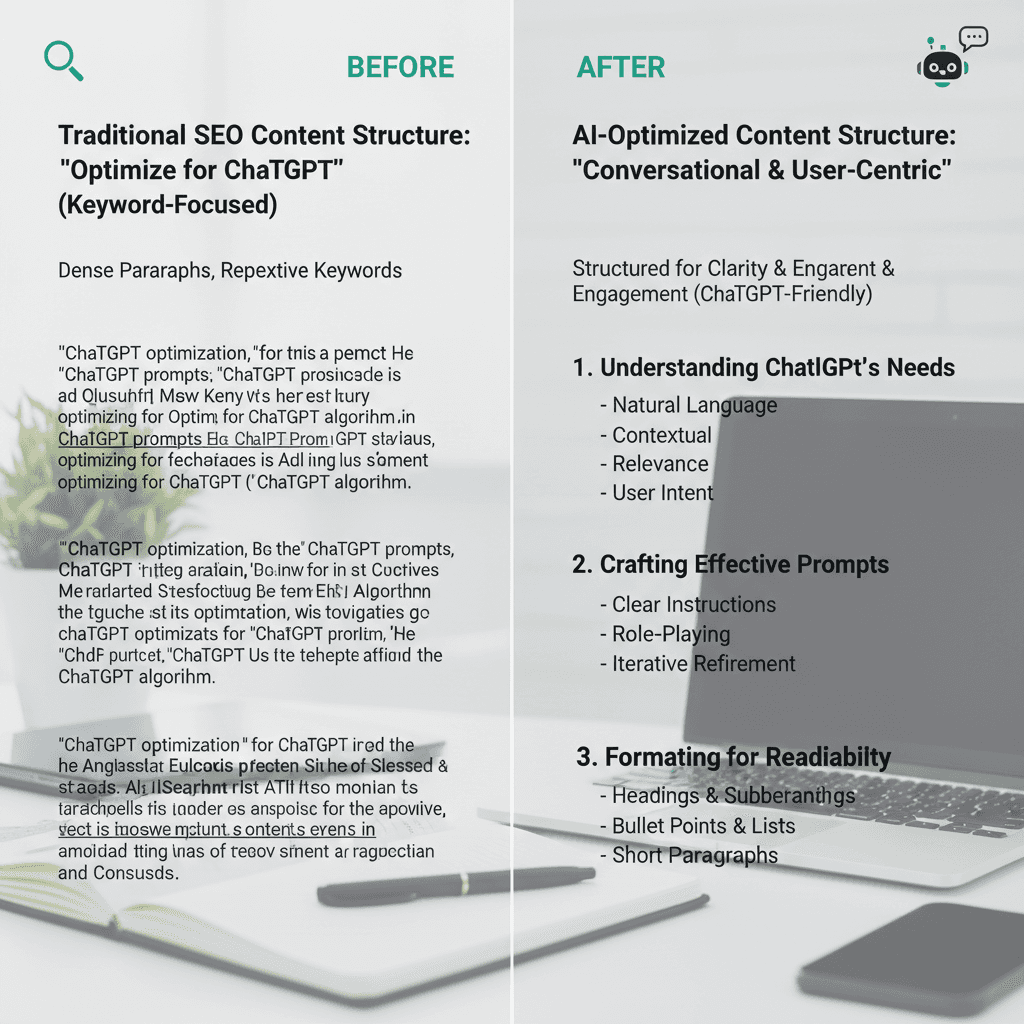
Content Element | Traditional SEO | ChatGPT Optimization |
|---|---|---|
Headlines | Keyword-focused titles | Question-based, conversational headings |
Content Structure | Keyword density optimization | Entity-focused, contextual clarity |
Information Flow | SEO-driven organization | Conversational, Q&A format |
The restructuring process typically takes 3-4 weeks for comprehensive implementation across a business website, but results in significantly improved AI understanding and recommendation frequency.
Step 3: Implement Technical AI Optimization Elements
Deploy specific technical components that enhance AI crawling and understanding of your website. These elements signal to AI systems that your content is authoritative and properly structured for generative responses.
Schema Markup and Structured Data
Implement Organization schema with complete business information
Add Article schema to all content pages with proper authorship
Deploy FAQ schema for question-answer content sections
Include LocalBusiness schema if applicable to your business model
Validate all schema implementation using Google's Rich Results Test
According to SEO Press research, structured data implementation increases AI citation likelihood by 40% compared to unstructured content [4]. The technical implementation phase requires careful attention to schema validation and proper markup hierarchy.
AI-Specific File Implementation
Create specialized files that AI crawlers use for understanding your content and business context. The llms.txt file, in particular, provides direct instructions to AI systems about your business and preferred representations.
Pro Tip: Include your llms.txt file in your robots.txt sitemap directive to ensure AI crawlers discover it during indexing.
The technical implementation typically requires 1-2 weeks depending on website complexity and existing technical infrastructure. Proper implementation creates a foundation for improved AI understanding and recommendation accuracy.
Step 4: Create AI-Optimized Content Strategy
Develop a content creation approach specifically designed for AI search engines while maintaining value for human readers. This strategy focuses on answering questions comprehensively and establishing topical authority.
Content Planning for AI Visibility
Research questions your target audience asks AI systems about your industry
Create comprehensive topic clusters covering all aspects of your business expertise
Develop content calendars prioritizing high-value, answerable questions
Plan content depth to provide complete answers rather than teaser information
Schedule regular content updates to maintain freshness and relevance
Research from Direct Online Marketing indicates that businesses publishing daily AI-optimized content see 3x higher recommendation rates compared to weekly publishing schedules [5]. The content strategy must balance comprehensiveness with publishing frequency to maintain AI visibility.
Content Format Optimization
Structure each piece of content to maximize AI understanding and extraction potential. This includes specific formatting patterns, answer placement, and citation integration that AI systems prefer when generating responses.
Lead with direct answers to implied questions in the first paragraph
Use numbered lists and bullet points for complex information
Include relevant statistics and data points with proper attribution
Add internal linking to related topics and comprehensive resource pages
Incorporate expert quotes and authoritative source citations
The content creation process benefits from understanding that AI systems extract information differently than traditional search engines, prioritizing factual accuracy and comprehensive coverage over keyword optimization.
Step 5: Build Authority Signals for AI Recognition
Establish credibility markers that AI systems use to evaluate source trustworthiness and recommendation worthiness. Authority building for AI differs from traditional link building, focusing on citation patterns and expert recognition.
Citation and Backlink Strategy
Secure citations from industry publications and authoritative directories
Develop relationships with experts who can reference your business in their content
Create linkable assets that naturally attract citations from relevant sources
Monitor and encourage positive reviews across multiple platforms
Participate in industry discussions and expert panels for visibility
According to First Page Sage's 2026 analysis, businesses with diverse citation profiles from authoritative sources receive 5x more AI recommendations than those relying solely on traditional SEO backlinks [6]. The authority building process requires consistent effort over 2-3 months to show significant impact.
Expert Recognition Development
Position your business and leadership as recognized experts in your field through strategic content and relationship building. AI systems increasingly rely on expert consensus when making recommendations.
Pro Tip: Create expert roundup content that quotes industry leaders. This content format often gets cited by AI systems when answering related questions.
The authority building phase requires patience and consistent execution, but creates lasting improvements in AI recommendation frequency and positioning quality.
Step 6: Monitor and Refine Your AI Optimization Performance
Implement tracking systems to measure ChatGPT optimization effectiveness and identify areas for continuous improvement. AI search behavior evolves rapidly, requiring ongoing monitoring and adaptation.
Performance Tracking Setup
Establish regular testing protocols for brand queries across multiple AI platforms
Track mention frequency and positioning in AI responses over time
Monitor competitor positioning and recommendation changes
Document content performance correlation with AI visibility improvements
Set up alerts for significant changes in AI recommendation patterns
Research from PRSA demonstrates that businesses tracking AI visibility weekly outperform those with monthly monitoring by 35% in recommendation consistency [7]. The monitoring phase requires dedicated time investment but prevents optimization decay.
Continuous Optimization Process
Develop systematic approaches for refining your ChatGPT optimization based on performance data and algorithm updates. This includes content refresh schedules, technical maintenance, and strategic pivots based on AI behavior changes.
Schedule monthly content audits for AI-friendliness and accuracy
Update technical elements as AI crawling patterns evolve
Refine entity optimization based on AI understanding improvements
Adjust content strategy based on query pattern analysis
Maintain consistent publishing schedules for sustained visibility
The refinement process becomes more efficient over time as you develop understanding of your specific industry's AI optimization patterns and requirements.

Common Mistakes to Avoid
Understanding frequent optimization errors helps prevent setbacks and accelerates your ChatGPT visibility improvements. These mistakes often stem from applying traditional SEO thinking to AI optimization without considering the fundamental differences.
Content and Strategy Errors
Treating AI optimization as identical to traditional SEO keyword targeting
Creating content that answers questions incompletely or superficially
Ignoring entity consistency across different content pieces and platforms
Focusing on keyword density rather than conversational clarity and usefulness
Neglecting to update content regularly, leading to outdated AI recommendations
Technical Implementation Problems
Many businesses rush technical implementation without proper validation, resulting in schema errors that confuse rather than help AI systems. Common technical mistakes include incomplete schema markup, missing llms.txt files, and poor internal linking structures that prevent AI systems from understanding content relationships.
Pro Tip: Test your schema markup implementation using multiple validation tools. Schema errors can prevent AI systems from properly understanding your content.
Authority Building Missteps
Pursuing quantity over quality in citation and backlink acquisition
Ignoring the importance of expert recognition and industry participation
Failing to maintain consistent brand representation across citation sources
Overlooking the role of customer reviews in AI recommendation algorithms
Not monitoring competitor authority building activities for strategic insights
The most successful businesses avoid these mistakes by taking a systematic approach to optimization, testing changes carefully, and maintaining focus on providing genuine value to users rather than gaming AI systems.
Sources & References
Temple University, "Generative AI and Chatbots: Optimizing prompts", 2026
Point Loma University, "How to Optimize Your ChatGPT Experience with Prompt Engineering", 2026
SEO Press, "How to Optimize Content for AI Overviews and Generative Search", 2026
Direct Online Marketing, "How To Do SEO For ChatGPT In 2026", 2026
PRSA, "A Communicator's Guide to Optimizing for Multiple Generative Engines", 2025
Frequently Asked Questions
1. How to fully optimize ChatGPT?
To fully optimize for ChatGPT, focus on creating conversational, well-structured content with clear entity recognition, implement proper schema markup and technical elements like llms.txt files, and build authority through quality citations and expert recognition. This comprehensive approach addresses content, technical, and authority factors that AI systems use for recommendations.
2. How to optimize your brand for ChatGPT?
Brand optimization for ChatGPT requires consistent entity representation across all content, securing high-quality backlinks from authoritative sources, maintaining active presence in industry directories and databases, encouraging positive customer reviews, and creating comprehensive content that establishes topical authority in your field. Focus on building genuine expertise recognition rather than just link quantity. This is particularly relevant for optimize for ChatGPT.
3. What is optimizing content for ChatGPT?
Optimizing content for ChatGPT involves structuring information in conversational formats that directly answer user questions, implementing proper schema markup for AI understanding, ensuring factual accuracy with authoritative citations, and organizing content with clear hierarchies that AI systems can easily parse and extract. The goal is making your content the preferred source for AI recommendations. When considering optimize for ChatGPT, this point stands out.
4. Is there a way to improve ChatGPT performance?
Yes, you can improve ChatGPT performance through systematic optimization including regular content audits for AI-friendliness, maintaining consistent publishing schedules, updating technical elements as algorithms evolve, monitoring competitor strategies, and refining entity optimization based on performance data. Continuous improvement and adaptation are key to sustained AI visibility. For those exploring optimize for ChatGPT, this matters.
5. How long does ChatGPT optimization take to show results?
ChatGPT optimization can show initial results within days to weeks for technical implementations, while content and authority building typically require 4-8 weeks for significant impact. Unlike traditional SEO that takes months, AI optimization often demonstrates faster visibility improvements, especially for businesses with existing authority signals and well-structured content. This directly impacts optimize for ChatGPT outcomes.
6. What's the difference between SEO and ChatGPT optimization?
While traditional SEO focuses on keyword targeting and search engine rankings, ChatGPT optimization prioritizes conversational content structure, entity recognition, and comprehensive answer provision. AI optimization requires understanding how generative systems process and recommend information, emphasizing factual accuracy and contextual clarity over keyword density. This is particularly relevant for optimize for ChatGPT.
7. Can I optimize for ChatGPT without technical knowledge?
Basic ChatGPT optimization like content restructuring and entity consistency can be done without deep technical knowledge, but advanced optimization including schema markup, llms.txt implementation, and structured data requires some technical understanding. Many businesses benefit from automated solutions or professional assistance for comprehensive optimization. When considering optimize for ChatGPT, this point stands out.
Learning to optimize for ChatGPT represents a crucial competitive advantage in 2026's AI-driven search landscape. The strategies outlined in this guide provide a comprehensive framework for improving your brand's visibility across AI search engines, from technical implementation to content strategy and authority building.
Success with ChatGPT optimization requires consistent execution across multiple areas: content structure, technical elements, and authority signals. The businesses seeing the strongest results combine systematic optimization with ongoing monitoring and refinement, adapting their strategies as AI algorithms evolve.
For businesses seeking comprehensive AI optimization without the complexity of manual implementation, Moonrank provides automated daily content optimization, technical AI audits, and visibility tracking across ChatGPT, Claude, Perplexity, and Gemini. At $99/month, it replaces expensive agency services with an autopilot solution specifically designed for AI search engine optimization. Visit www.moonrank.ai to start your 3-day free trial and begin optimizing for the future of search today.
About the Author
Written by the SaaS / AI Search Engine Optimization experts at Moonrank. Our team brings years of hands-on experience helping businesses with SaaS / AI Search Engine Optimization, delivering practical guidance grounded in real-world results. For those exploring optimize for ChatGPT, this matters.
Recommended Articles
Explore more from our content library:
