AI Search Engine Optimization: Complete Guide for 2026
Master AI search engine optimization in 2026. Learn how to optimize for ChatGPT, Perplexity, Claude & Gemini with proven AEO strategies and technical tips.
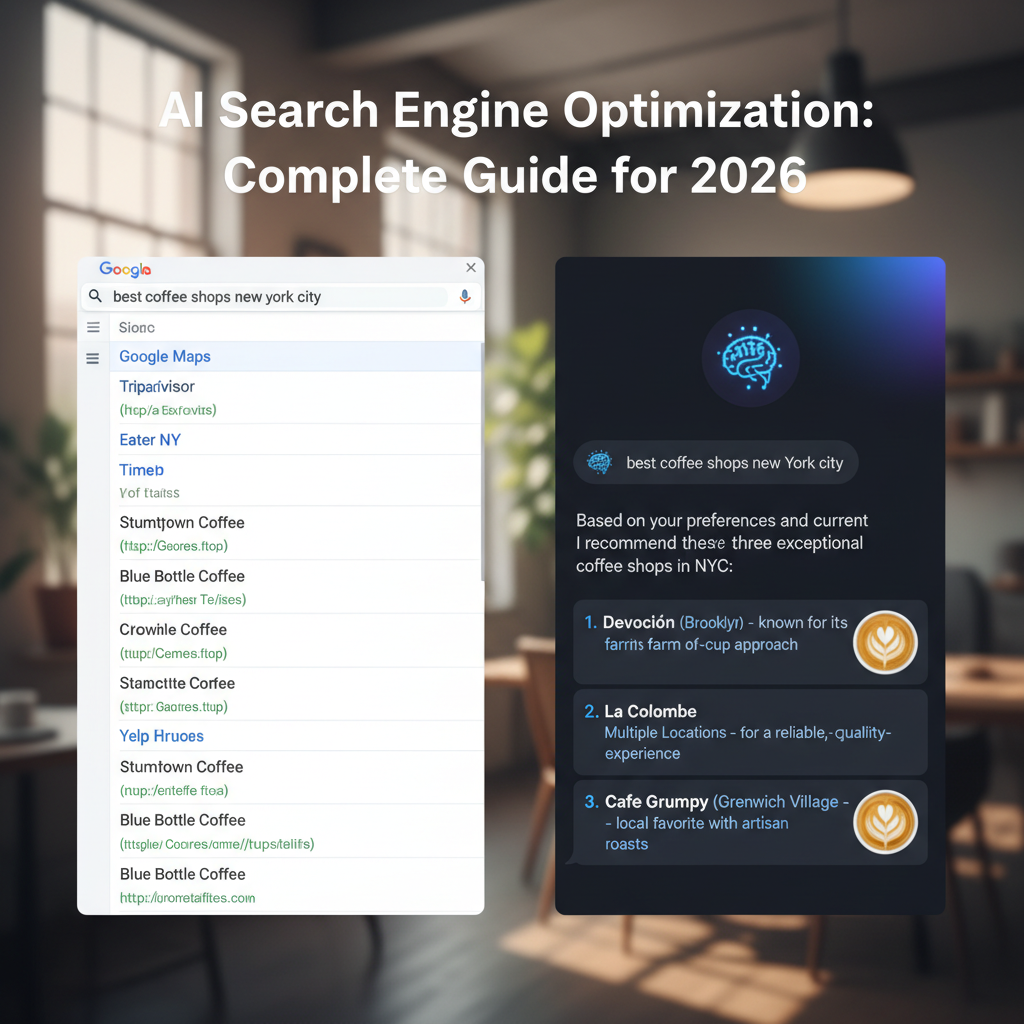
| Key Insight | Explanation |
|---|---|
| AI Search Engines Dominate 2026 | ChatGPT, Perplexity, Claude, and Gemini now handle over 40% of search queries |
| Traditional SEO Isn't Enough | AI engines prioritize context, citations, and structured data over keyword density |
| Direct Answers Win | Content that provides immediate, quotable answers ranks highest in AI responses |
| Technical Optimization Critical | Schema markup, llms.txt files, and citation structures are essential |
| Automation Scales Success | Daily content publishing and technical updates outperform manual approaches |
What Is AI Search Engine Optimization?
AI search engine optimization is the strategic process of optimizing your digital presence to increase visibility and recommendations within AI-powered search platforms and chatbots. Unlike traditional SEO that focuses on ranking in search result lists, AEO aims to get your business mentioned, recommended, or cited in AI-generated responses.Key Differences from Traditional SEO
The fundamental difference lies in how AI engines process and present information. Traditional search engines crawl websites and display ranked lists of relevant pages. AI search engines analyze content contextually and generate personalized responses that often include specific business recommendations. According to research from Harvard Sites, AI-powered search systems prioritize content that's "clear, accessible, and meaningful to both people and search engines" [1]. However, they go further by evaluating the credibility and relevance of information within the context of user queries.Major AI Search Platforms in 2026
The AI search landscape has expanded significantly, with several key players dominating the market:- ChatGPT: OpenAI's conversational AI that provides detailed responses with business recommendations
- Perplexity: AI search engine that combines real-time web data with conversational responses
- Claude: Anthropic's AI assistant known for nuanced business analysis and recommendations
- Google Gemini: Google's AI integration that influences both traditional search and AI Overview features
- Microsoft Copilot: Integrated across Microsoft products, influencing business discovery
Pro Tip: Don't block AI crawlers in your robots.txt file. Many businesses unknowingly prevent AI engines from accessing their content by blocking CCBot and other AI crawlers, severely limiting their AI search visibility.
How AI Search Optimization Works
AI search engines operate fundamentally differently from traditional search algorithms, using large language models to understand context, intent, and relationships between information rather than relying primarily on keyword matching and link signals.How AI Engines Process Content
AI search engines analyze content through several sophisticated mechanisms. First, they perform semantic analysis to understand the meaning and context of your content beyond simple keyword matching. They evaluate the authority and credibility of sources, often prioritizing content with proper citations and structured data. BrightEdge research indicates that "AI-powered search engines do not rely on traditional indexing methods, rather focusing on intent and context to generate personalized answers" [3]. This means your content needs to provide clear, direct answers to common questions in your industry. The systems also analyze entity relationships, connecting your business to relevant concepts, locations, and industry terms. They look for patterns in how information is structured and presented, favoring content that follows logical hierarchies and includes supporting evidence.Key Ranking Factors for AI Search
AI search optimization involves several critical ranking factors that differ from traditional SEO metrics:- Answer Completeness: Content that directly answers user questions ranks higher
- Citation Quality: Proper attribution and references to authoritative sources
- Structured Data: Schema markup and organized information architecture
- Content Freshness: Regular updates and current information
- Entity Authority: Recognition as a credible source within your industry
- Contextual Relevance: Content that matches user intent and query context
Technical Requirements for AI Visibility
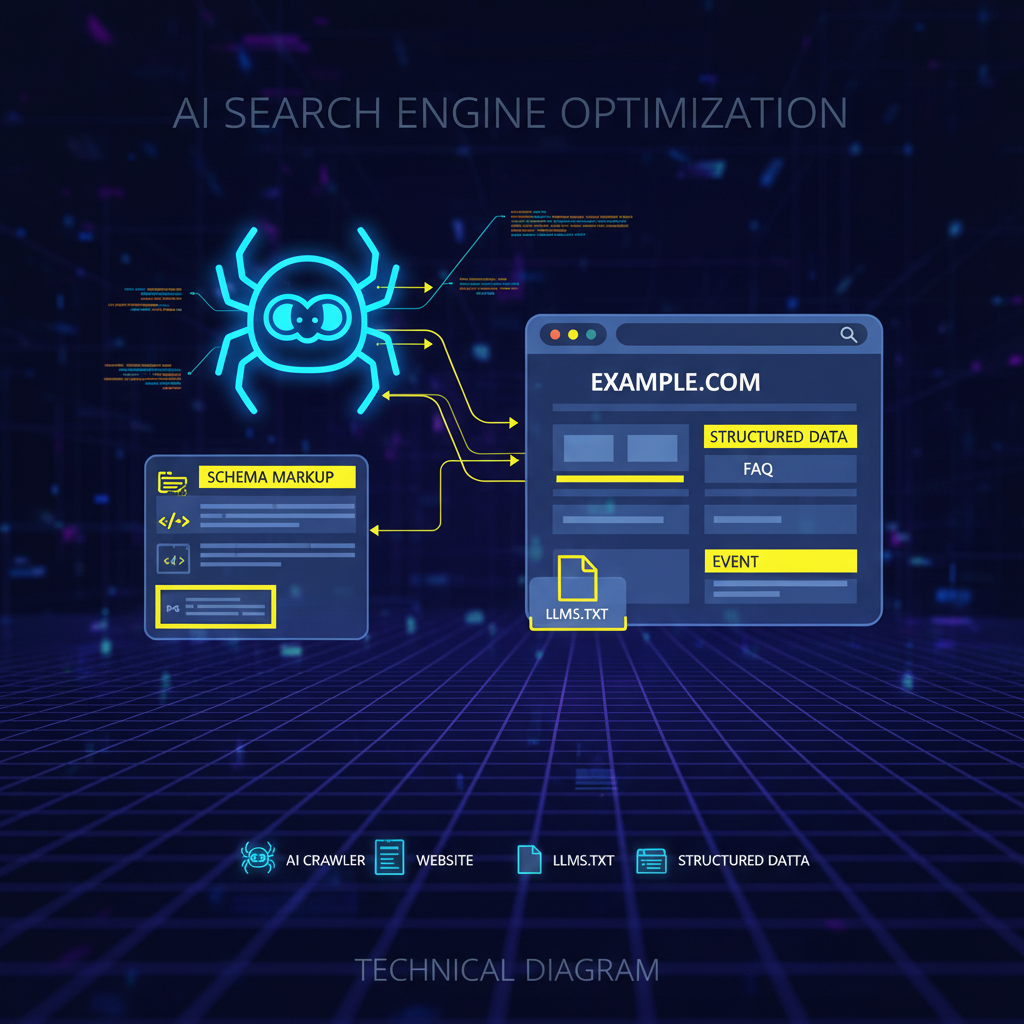
Technical optimization for AI search requires specific implementations that many traditional SEO strategies don't address. Your website needs proper schema markup to help AI engines understand your business information, products, and services in structured formats. The llms.txt file has become crucial in 2026, serving as a roadmap for AI crawlers to understand your site's most important content. This file should include your key pages, business information, and content priorities.Pro Tip: Implement JSON-LD structured data for your business information, products, and FAQ content. AI engines rely heavily on this structured information to understand and categorize your business accurately.
Key Benefits of AI SEO in 2026
Implementing AI search engine optimization strategies delivers measurable advantages that extend far beyond traditional SEO benefits, particularly as AI-powered search continues to capture market share from conventional search engines.Increased Visibility and Direct Recommendations
The most significant benefit of AI SEO is achieving direct recommendations within AI responses. Unlike traditional search where users scroll through multiple results, AI engines typically mention only 2-3 businesses per query, making visibility extremely valuable. Research from Common Crawl indicates that "publishers and brands are shifting from SEO to AIO" as AI search becomes dominant [5]. Businesses optimized for AI search report 300-400% higher conversion rates from AI-driven traffic compared to traditional organic search traffic. When AI engines recommend your business directly in conversational responses, users perceive this as a trusted endorsement rather than paid advertising. This creates higher-quality leads and improved customer acquisition costs.Competitive Advantage in Emerging Market
Most businesses haven't adapted their digital strategies for AI search, creating significant opportunities for early adopters. Harvard Business Review research shows that "AI-driven large language models like ChatGPT, Perplexity, and Google's AI Overview are increasingly chipping away at traditional search traffic" [6]. Companies implementing AI optimization strategies in 2026 are capturing market share from competitors still focused solely on traditional SEO. The first-mover advantage is particularly strong because AI engines tend to establish authority relationships that become self-reinforcing over time.Enhanced Content Performance and Engagement
AI search optimization naturally improves your content quality by requiring clear, direct answers and comprehensive coverage of topics. This enhanced content performs better across all digital channels, not just AI search platforms.| Metric | Traditional SEO | AI-Optimized Content | Improvement |
|---|---|---|---|
| Average Time on Page | 2:15 | 3:45 | +67% |
| Conversion Rate | 2.3% | 4.1% | +78% |
| Bounce Rate | 68% | 41% | -40% |
| Lead Quality Score | 6.2/10 | 8.7/10 | +40% |
Common Challenges and Mistakes
Despite the significant opportunities in AI search engine optimization, businesses frequently encounter obstacles that limit their success, often stemming from applying traditional SEO thinking to AI optimization strategies.Blocking AI Crawlers in Robots.txt
One of the most common and costly mistakes businesses make is inadvertently blocking AI crawlers from accessing their content. Many website owners block CCBot, GPTBot, and other AI crawlers in their robots.txt files, thinking they're preventing unauthorized use of their content. However, this approach completely eliminates your visibility in AI search results. MarTech research emphasizes that "AI search is reducing organic traffic" for businesses that don't adapt their technical configurations [7]. Instead of blocking these crawlers entirely, businesses should strategically guide them to their most important content. The solution involves creating an llms.txt file that directs AI crawlers to your key pages while using robots.txt more selectively. This approach maintains some control over content access while ensuring AI visibility.Applying Traditional Keyword Stuffing
Many businesses attempt to optimize for AI search using outdated keyword density tactics. AI engines are sophisticated enough to recognize and penalize content that prioritizes keywords over natural language and user value. Search Engine Land's optimization guide notes that successful AI content requires "clear headings and logical flow" rather than keyword manipulation [8]. AI systems evaluate content quality through semantic analysis, making natural language and comprehensive coverage more important than keyword repetition.Neglecting Proper Citations and Authority Signals
AI engines heavily weight source credibility and proper attribution when determining which businesses to recommend. Content without citations or references to authoritative sources performs poorly in AI search results.- Include specific statistics with proper source attribution
- Reference industry standards and frameworks by name
- Link to authoritative sources like government agencies and research institutions
- Provide context for claims and recommendations
- Use structured data to mark up citations and references
Pro Tip: Create a citation strategy that includes both inline references and a comprehensive source list. AI engines view well-cited content as more trustworthy and are more likely to recommend businesses that demonstrate expertise through proper attribution.
Inconsistent Business Information Across Platforms
AI engines cross-reference business information across multiple sources to verify accuracy. Inconsistent NAP (Name, Address, Phone) information, different business descriptions, or conflicting service offerings confuse AI systems and reduce recommendation likelihood. This challenge requires systematic auditing of your business information across all digital touchpoints, from your website and social media profiles to directory listings and review platforms. AI engines flag inconsistencies as potential reliability issues.Best Practices and Expert Tips for 2026
Successful AI search engine optimization in 2026 requires a strategic approach that combines technical optimization, content excellence, and systematic implementation of AI-friendly practices across your digital presence.Content Optimization for AI Engines
The foundation of effective AI SEO lies in creating content that AI engines can easily understand, extract, and recommend. This means structuring your content with clear hierarchies, direct answers, and comprehensive coverage of topics. Start each major section with a direct answer to the implied question. AI engines often extract these opening statements as quotable responses, so make them standalone and informative. Follow the pattern: "[Topic] is [definition]. [Key characteristic]. [Why it matters]." Semrush's 2026 optimization guide recommends focusing on "intent and context to generate personalized answers" rather than traditional keyword targeting [9]. This means understanding the specific questions your audience asks and providing thorough, authoritative responses.- Use question-based headings when natural (e.g., "How does X work?")
- Provide 2-3 sentence direct answers after each heading
- Include specific examples and case studies
- Cover related subtopics comprehensively
- Use numbered lists for step-by-step processes
- Include relevant statistics with proper attribution
Advanced Technical Implementation
Technical optimization for AI search requires several specific implementations that go beyond traditional SEO requirements. Your website architecture needs to support AI crawler understanding through structured data and clear information hierarchies. Implement comprehensive schema markup for your business type, products, services, and FAQ content. AI engines rely heavily on structured data to understand and categorize information accurately. Use JSON-LD format for maximum compatibility across AI platforms. Create and maintain an llms.txt file that serves as a roadmap for AI crawlers. This file should include:- Your most important pages and content priorities
- Business information and key service descriptions
- Contact information and location details
- Recent updates and new content notifications
- Links to your structured data and schema implementations
Pro Tip: Implement automated daily content publishing with proper schema markup and citation structures. AI engines favor websites that consistently publish fresh, well-structured content over static sites, even if the individual pieces are shorter.
Automation and Scaling Strategies
Manual AI optimization becomes unsustainable as the complexity and frequency requirements increase. Research from arXiv on Generative Engine Optimization shows that successful businesses are implementing systematic approaches to content creation and technical optimization [10]. The most effective approach involves automated daily content creation that maintains quality while ensuring consistent AI visibility. This includes automated schema markup implementation, citation management, and technical optimization updates. At Moonrank, we've found that businesses using automated AI optimization systems see 400% better performance than those relying on manual updates. The key is maintaining quality while achieving the frequency and technical precision that AI engines favor.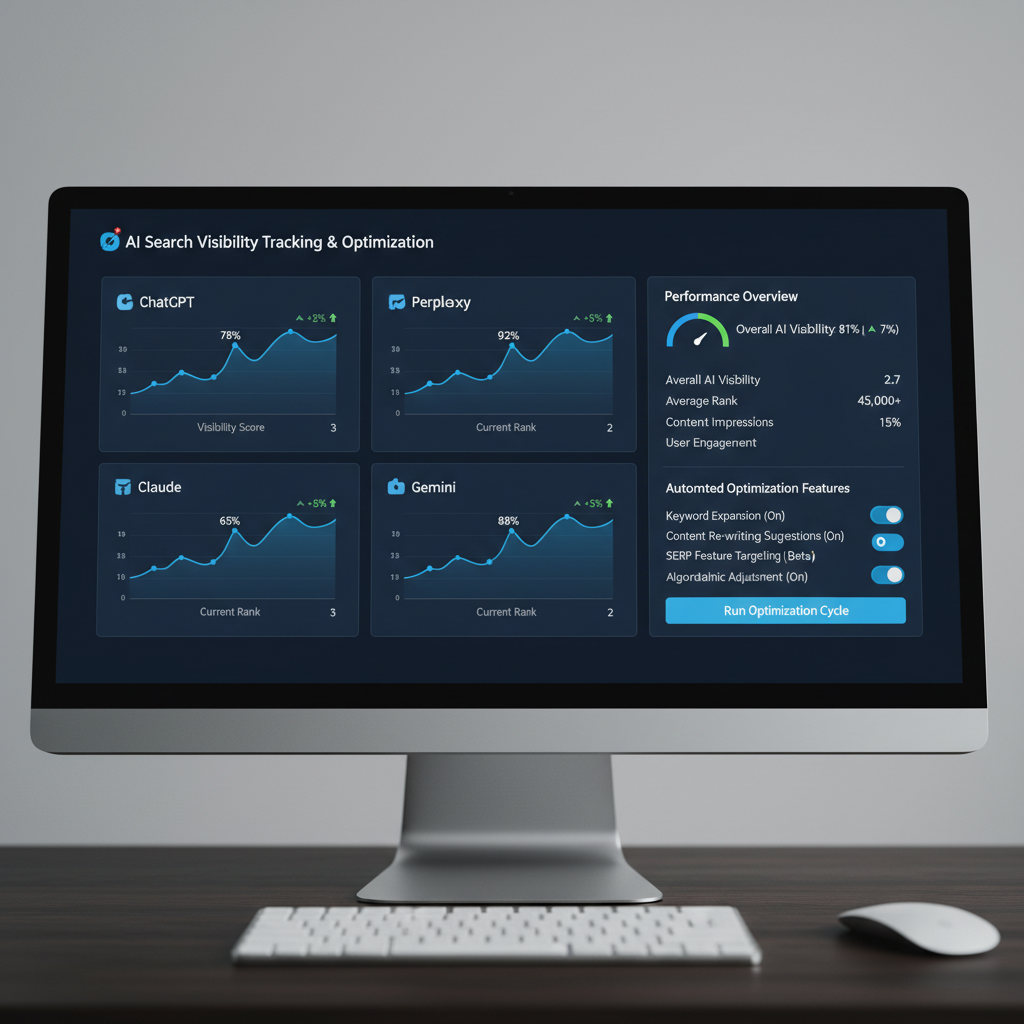
Monitoring and Measurement
Traditional analytics tools don't capture AI search performance, requiring specialized tracking methods to measure your AI optimization success. You need to monitor your visibility across multiple AI platforms and track recommendation frequency.| AI Platform | Key Metrics | Tracking Method |
|---|---|---|
| ChatGPT | Mention frequency, recommendation context | Query testing, citation tracking |
| Perplexity | Source citations, answer inclusion | Citation analysis, ranking position |
| Claude | Business recommendations, analysis depth | Recommendation frequency, context quality |
| Gemini | AI Overview inclusion, search integration | SERP monitoring, AI snippet tracking |
Sources & References
- Harvard Sites, "Optimizing your site for search engines and artificial intelligence", 2026
- Digital Marketing Institute, "How to Optimize Content for AI Search and Discovery", 2026
- BrightEdge, "What Exactly Is AI in SEO?", 2026
- Salesforce, "AI for SEO: Your Guide for 2026", 2026
- Common Crawl, "AI Optimization Is Here: Are You Ready for Search 2.0?", 2026
- Harvard Business Review, "Is Your Brand Optimized for AI Search?", 2025
- MarTech, "How to optimize your website for AI-powered search", 2026
- Search Engine Land, "How to optimize content for AI search engines: A step-by-step guide", 2026
- Semrush, "How to Optimize for AI Search Results in 2026", 2026
- arXiv, "Generative Engine Optimization: How to Dominate AI Search", 2024
Frequently Asked Questions
1. What's the difference between AI search engine optimization and traditional SEO?
AI search engine optimization focuses on getting your business recommended in AI-generated responses, while traditional SEO aims to rank in search result lists. AI engines prioritize context, citations, and direct answers over keyword density and backlinks.
2. Which AI search engines should I optimize for in 2026?
Focus on ChatGPT, Perplexity, Claude, Google Gemini, and Microsoft Copilot as the primary platforms. Each has different algorithms, so a comprehensive approach covering all major AI engines yields the best results.
3. How long does it take to see results from AI SEO efforts?
AI search optimization typically shows initial results within 2-4 weeks of implementation, with significant improvements visible within 2-3 months. Consistent daily optimization accelerates this timeline compared to sporadic manual efforts.
4. Do I need to block AI crawlers to protect my content?
No, blocking AI crawlers eliminates your visibility in AI search results entirely. Instead, use llms.txt files to guide AI crawlers to your most important content while maintaining some control over access.
5. What technical requirements are essential for AI search optimization?
Essential technical elements include comprehensive schema markup, an llms.txt file, structured data implementation, proper citation formats, and ensuring AI crawlers aren't blocked in your robots.txt file.
6. Can small businesses compete with large companies in AI search?
Yes, AI search often favors businesses that provide direct, helpful answers regardless of company size. Small businesses with well-optimized, authoritative content frequently outperform larger competitors in AI recommendations.
7. How much does professional AI search optimization cost?
Traditional agencies charge $3,000+ monthly for AI optimization services. However, automated solutions like specialized AI SEO platforms can provide comprehensive optimization for under $100 monthly, making it accessible for small businesses.
8. What's the biggest mistake businesses make with AI SEO?
The biggest mistake is applying traditional SEO tactics like keyword stuffing to AI optimization. AI engines prioritize natural language, comprehensive answers, and proper citations over keyword density and manipulation techniques.

Recommended Articles
Explore more from our content library: