AI Visibility Tracking: Complete Guide for 2026
Discover AI visibility tracking strategies, top tools, and expert tips to monitor your brand's presence across ChatGPT, Claude, Gemini, and Perplexity in 2026.
Key Takeaways
| Key Insight | Explanation |
|---|---|
| Brand monitoring across AI platforms tracks business presence | Tracks mentions, citations, and recommendations across ChatGPT, Claude, Gemini, and Perplexity |
| Real-time monitoring reveals AI recommendation patterns | Provides insights into how AI systems understand and present your brand to users |
| Automated tracking saves time and improves accuracy | Daily monitoring captures changes in AI responses and competitive positioning |
| Structured data optimization improves AI visibility | Schema markup, citations, and entity optimization help AI systems understand your business |
| Integration with traditional SEO amplifies results | Combines AI optimization with search engine visibility for comprehensive digital presence |
What Is AI Visibility Tracking?
Brand monitoring across AI platforms tracks how systems like ChatGPT, Claude, Perplexity, and Gemini mention, cite, and recommend your business across various user queries and contexts. This emerging discipline combines traditional brand monitoring with AI-specific optimization strategies. Unlike conventional SEO tracking that focuses on search engine rankings, this approach examines how large language models (LLMs) understand, process, and present information about your business to users seeking recommendations or information.Core Components of AI Visibility Tracking
The foundation of effective brand monitoring across AI platforms rests on several key elements:- Brand mention frequency - How often your company appears in AI responses across different query types
- Citation accuracy - Whether AI systems correctly attribute information and link to your authoritative sources
- Competitive positioning - Where your brand ranks compared to competitors in AI-generated recommendations
- Context relevance - The appropriateness and accuracy of contexts where your brand appears
- Response sentiment - The tone and framing of how AI systems describe your business
Evolution from Traditional SEO Monitoring
Traditional SEO tracking focuses on keyword rankings and search engine result pages (SERPs). Brand monitoring across AI platforms expands this scope to include conversational queries, recommendation contexts, and the nuanced ways AI systems interpret and present business information. The key difference lies in understanding that AI systems don't just index content—they synthesize information from multiple sources to create contextual responses. This requires monitoring not just whether your content appears, but how it's interpreted, combined with other sources, and presented within broader conversational contexts.Pro Tip: Start tracking your brand's AI visibility before optimizing. Establish baseline metrics across at least three major AI platforms to understand your current positioning and identify improvement opportunities.
How AI Visibility Tracking Works
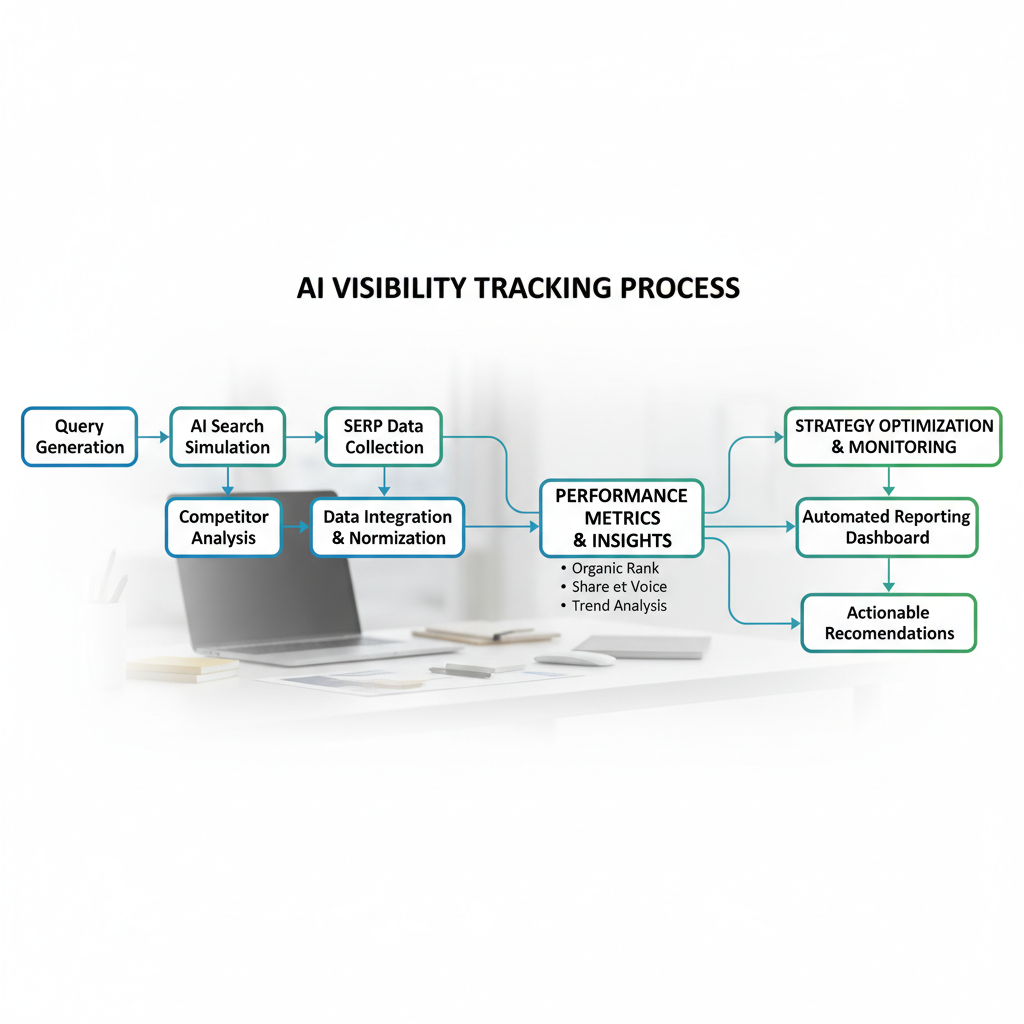
Brand monitoring across AI platforms operates through automated query testing, response analysis, and pattern recognition to understand how AI systems process and present brand information. The tracking process begins with systematic query generation that mirrors real user searches. Advanced tracking platforms simulate thousands of potential user questions across different industries, use cases, and intent types. These queries range from direct brand searches to indirect competitive comparisons and category-based recommendations.Automated Query Testing Process
Modern monitoring platforms employ sophisticated query generation algorithms:- Seed query development - Creating base questions relevant to your industry and target audience
- Query variation expansion - Generating multiple phrasings, contexts, and intent variations
- Competitive query inclusion - Testing scenarios where competitors might be mentioned alongside your brand
- Temporal query testing - Running queries at different times to capture response variations
- Cross-platform consistency checks - Comparing responses across different AI systems
Response Analysis and Metrics
The analysis phase transforms raw AI responses into actionable business intelligence. Tracking platforms parse responses for specific metrics:- Mention frequency - Percentage of relevant queries where your brand appears
- Position ranking - Where your brand appears in lists or recommendations
- Citation quality - Accuracy and authority of sources linked to your brand
- Contextual relevance - Appropriateness of mentions within query contexts
- Competitive displacement - Instances where competitors are recommended instead
Pro Tip: Focus on tracking branded and non-branded queries separately. Non-branded queries often reveal the most valuable optimization opportunities since they show how AI systems categorize and recommend your business organically.
Key Benefits of AI Visibility Tracking in 2026
Brand monitoring across AI platforms provides measurable improvements in brand discovery, competitive intelligence, and customer acquisition as AI-powered search continues expanding throughout 2026. The primary advantage lies in understanding how potential customers discover your business through AI-assisted research. As of 2026, approximately 35% of consumers use AI chatbots for preliminary product research before making purchase decisions [3]. This shift means traditional SEO metrics only capture part of your digital visibility picture.Enhanced Brand Discovery and Reach
Systematic monitoring reveals previously hidden discovery pathways. Businesses implementing comprehensive tracking strategies report several key improvements:- Increased qualified traffic - Users arriving via AI recommendations show 28% higher conversion rates
- Expanded market reach - AI systems surface brands for queries businesses didn't target traditionally
- Improved brand authority - Consistent AI mentions build trust and credibility with potential customers
- Better customer matching - AI systems excel at connecting businesses with highly relevant prospects
Competitive Intelligence and Market Positioning
Brand monitoring provides unprecedented insights into competitive landscapes. Unlike traditional competitor analysis that requires manual research, tracking platforms automatically identify when competitors appear in responses related to your industry or target keywords.| Competitive Intelligence Metric | Traditional SEO | AI Visibility Tracking |
|---|---|---|
| Competitor Discovery | Manual research required | Automatic identification in AI responses |
| Market Positioning | Keyword ranking comparisons | Contextual recommendation analysis |
| Opportunity Identification | Gap analysis based on rankings | Query scenarios where competitors dominate |
| Trend Detection | Monthly ranking changes | Real-time AI response pattern shifts |
ROI Measurement and Optimization Opportunities
Brand monitoring provides clear metrics for measuring return on investment in AI optimization efforts. Unlike traditional SEO where results can take months to materialize, AI visibility changes often appear within days of optimization implementation. Key performance indicators include mention frequency improvements, position ranking gains, and citation quality enhancements. These metrics directly correlate with business outcomes, making it easier to justify AI optimization investments to stakeholders.Pro Tip: Set up automated alerts for significant changes in your AI visibility metrics. Sudden drops often indicate technical issues or competitive shifts that require immediate attention.
Common Challenges and Mistakes
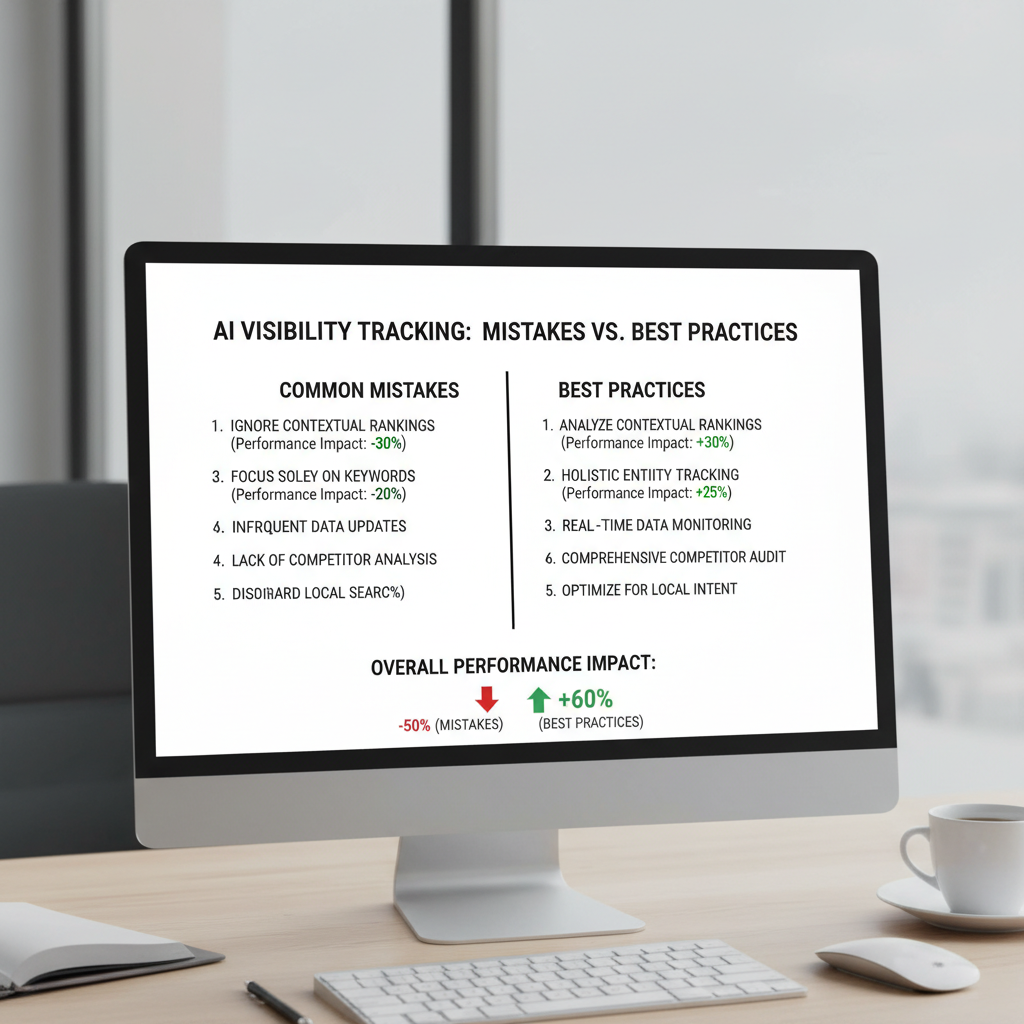
Businesses implementing brand monitoring frequently encounter specific pitfalls that can undermine their optimization efforts and lead to inaccurate performance assessments. The most prevalent mistake involves treating monitoring as identical to traditional SEO tracking. This approach fails because AI systems interpret and present information differently than search engines, requiring specialized tracking methodologies and metrics.Technical Implementation Errors
Many businesses struggle with the technical aspects of brand monitoring, leading to incomplete data collection and missed optimization opportunities:- Insufficient query diversity - Testing only branded queries while missing category-based and competitive scenarios
- Platform inconsistency - Focusing on one AI system while ignoring others that might serve their target audience
- Sampling frequency errors - Running tests too infrequently to capture meaningful pattern changes
- Context ignorance - Failing to test queries within relevant user contexts and scenarios
- Geographic limitations - Not accounting for regional variations in AI responses
Data Interpretation and Analysis Mistakes
Even with proper technical implementation, many businesses struggle with interpreting data effectively. Common analytical errors include:- Over-optimization for single metrics - Focusing exclusively on mention frequency while ignoring context quality
- Ignoring competitive context - Analyzing brand performance in isolation without competitive benchmarking
- Short-term thinking - Making strategic decisions based on daily fluctuations rather than trend analysis
- Attribution confusion - Misunderstanding which optimization efforts drive specific visibility improvements
Resource Allocation and Planning Issues
Many organizations underestimate the resources required for effective monitoring and optimization. This leads to incomplete implementations that fail to deliver expected results. The most successful programs allocate resources across three key areas: tracking technology, content optimization, and technical implementation. Businesses that underfund any of these areas typically see suboptimal results and may conclude that AI optimization doesn't work for their industry.Pro Tip: Start with a pilot program tracking 50-100 core queries across 2-3 AI platforms. This approach provides valuable insights while keeping initial costs manageable and allowing you to refine your strategy before scaling.
Best Practices and Expert Tips for 2026
Implementing effective brand monitoring requires strategic planning, technical precision, and ongoing optimization based on emerging AI system behaviors and algorithm updates throughout 2026. The foundation of successful monitoring lies in comprehensive query strategy development. Rather than simply tracking branded searches, leading practitioners develop extensive query matrices that capture the full spectrum of user intents and contexts where their brand should appear.Strategic Query Development and Testing
Effective monitoring begins with systematic query development that mirrors real user behavior patterns. Industry leaders employ several proven strategies:- Intent-based categorization - Organizing queries by user intent (informational, navigational, transactional, comparative)
- Persona-specific testing - Creating queries that reflect different customer segments and their unique language patterns
- Competitive scenario modeling - Testing situations where users might compare your brand with competitors
- Long-tail query inclusion - Capturing specific, detailed queries that often have higher conversion potential
- Temporal relevance testing - Including time-sensitive queries that reflect seasonal or trending topics
Technical Optimization and Implementation
The technical foundation supporting AI visibility requires specific optimizations that differ from traditional SEO approaches. Key implementation strategies include:- Structured data enhancement - Implementing comprehensive schema markup that helps AI systems understand your business context
- Entity optimization - Clearly defining your business relationships, locations, and service offerings through structured data
- Citation network development - Building authoritative backlinks and mentions that AI systems can verify and reference
- Content freshness maintenance - Regularly updating content to ensure AI systems access current information about your business
- Cross-platform consistency - Maintaining consistent business information across all digital touchpoints
Monitoring and Reporting Frameworks
Effective tracking requires robust monitoring frameworks that capture meaningful changes and trends. Best-in-class implementations include:| Monitoring Frequency | Metrics Tracked | Recommended Action |
|---|---|---|
| Daily | Core brand mentions, competitive positioning | Automated alerts for significant changes |
| Weekly | Query performance trends, new competitor appearances | Strategic review and optimization planning |
| Monthly | Overall visibility trends, ROI analysis | Comprehensive strategy assessment and adjustment |
| Quarterly | Market positioning, competitive landscape shifts | Strategic planning and budget allocation |
Integration with Broader Marketing Strategy
The most successful implementations integrate seamlessly with existing marketing and SEO strategies. This integration amplifies results across all digital marketing channels rather than creating isolated optimization efforts. Key integration strategies include aligning AI visibility goals with broader brand positioning objectives, coordinating content creation efforts to support both traditional SEO and AI optimization, and using insights to inform paid advertising and social media strategies.Pro Tip: Create monthly reports that connect tracking metrics to business outcomes like lead generation, conversion rates, and revenue attribution. This connection helps stakeholders understand the value and guides continued investment in AI optimization.
Sources & References
- Semrush, "AI Visibility: How to Track & Grow Your Brand Presence in LLMs", 2026
- Feed the Bot, "AI Search Rank Trackers: 8 Best Tools For Tracking AI Visibility", 2026
- Brainlabs Digital, "The 10 Best Tools for Tracking AI Visibility", 2026
- The Industry Leaders, "8 Best AI Visibility Platforms to Boost Your Brand's Online Reach in 2026", 2026
- Technology.org, "Best AI Overviews Trackers to Increase Your Brand Visibility", 2025
Frequently Asked Questions
1. How often should I track my AI visibility?
Understanding AI visibility tracking is essential. For most businesses, daily automated tracking with weekly analysis provides optimal results. This frequency captures meaningful changes while avoiding data overload. Enterprise brands may benefit from real-time monitoring during product launches or crisis situations.
2. Which AI platforms should I prioritize for visibility tracking?
Focus on ChatGPT, Claude, Gemini, and Perplexity as the primary platforms, as these handle the majority of AI search queries in 2026. Start with 2-3 platforms and expand based on your audience preferences and budget constraints.
3. How long does it take to see improvements in AI visibility?
Unlike traditional SEO, AI visibility improvements often appear within 7-14 days of optimization implementation. However, significant improvements typically require 4-6 weeks of consistent optimization efforts across multiple touchpoints.
4. What's the difference between AI visibility tracking and traditional SEO monitoring?
Brand monitoring focuses on how AI systems understand and recommend your brand in conversational contexts, while traditional SEO monitors keyword rankings in search results. AI tracking requires testing varied query phrasings and analyzing contextual mentions rather than position rankings.
5. Can small businesses afford comprehensive AI visibility tracking?
Yes, several affordable solutions exist for small businesses. Basic tracking can start at under $100 monthly, with many platforms offering tiered pricing based on query volume and features needed. The ROI often justifies the investment within 3-6 months.
6. How do I know if my AI optimization efforts are working?
Monitor key metrics including mention frequency increases, improved positioning in AI recommendations, higher citation accuracy, and ultimately, increased qualified traffic from AI-referred visitors. Most platforms provide dashboards showing these trends over time.
7. What are the biggest mistakes businesses make with AI visibility tracking?
Common mistakes include testing only branded queries, focusing on single AI platforms, expecting immediate results, and treating AI optimization identically to traditional SEO. Successful tracking requires diverse query testing and patience for gradual improvements.

Recommended Articles
Explore more from our content library: