SEO Automation Platforms for Solo Founders Under $150/Month
A solo founder can run a full SEO automation stack under $150/month by combining one core automation platform with free tools like Google Search Console.....

Understanding best seo automation platforms for solo founders under 150 dollars per month is essential. A solo founder can run a full SEO automation stack under $150/month by combining one core automation platform with free tools like Google Search Console rather than paying for a single expensive enterprise suite. The right setup handles daily content publishing, technical audits, and rank tracking without manual work, replacing tasks that would otherwise require hiring an agency or freelancer. The key is matching tool scope to your actual workload, ecommerce, SaaS, security, or hospitality sites each lean on automation differently, instead of paying for features you won't use.
Which SEO Automation Platforms Actually Fit a Solo Founder's Budget Under $150 a Month?
The test is simple: a platform fits if it automates your actual daily workload for one person, not if it merely has a cheap-looking entry plan with seats and usage caps bolted on. Many tools marketed to small teams are enterprise products with a trimmed-down tier, the moment you add a second website, more tracked keywords, or daily publishing, the bill jumps well past the budget range.
What Separates Budget-Friendly Tools From Scaled-Down Enterprise Plans?
Enterprise SEO suites are built around team seats, multi-client workspaces, and usage billed by keyword or crawl volume, costs that climb fast even when you're the only person using the account. Semrush's own pricing page, for example, lists a starter SEO plan around $117 to $139 monthly for just five sites and 500 tracked keywords, with AI visibility features reserved for a second, separate tier near $165 to $199 monthly [1]. That structure makes sense for an agency billing multiple clients. For a solo founder, it means paying for seat-based infrastructure you'll never fill.
When you're comparing the best seo automation platforms for solo founders under 150 dollars per month, look for flat, single-workspace pricing rather than per-seat or per-client tiers.
What Are the Hidden Costs and Free Tier Limits to Watch For?
Word limits, content credits, and crawl-frequency caps are where a "budget" plan quietly turns into a mid-range bill. Some tools charge per generated article or per crawl, which looks affordable until daily publishing pushes you into overage fees [3]. Others cap keyword tracking or domain monitoring low enough that a growing product catalog or blog forces an upgrade within months. Free tiers, Google Search Console included, are genuinely useful for monitoring rankings and catching crawl errors, but they don't publish content, run technical audits, or track how your brand shows up in AI-generated answers. Treat free tools as a complement, not a replacement, for an automation platform.
How Do Affordable Platforms Compare Feature-for-Feature at This Price Point?
What you need depends heavily on business type. An ecommerce store needs automated product-page optimization and schema for every SKU, not just blog content. A B2B SaaS site leans on technical crawling and structured data that help AI engines parse feature pages correctly. Cybersecurity and hotel sites depend on trust signals and local or schema markup, reviews, certifications, location data, that AI search engines weigh heavily when recommending a provider.
Tools priced per feature, content scoring here, technical audit there, rank tracking elsewhere, add up fast once you stack three subscriptions to cover what one founder needs. An all-in-one approach that bundles daily content generation, technical optimization, and AI visibility tracking tends to fit a single-founder budget better, since you're paying once for the full workflow instead of assembling it piece by piece. Moonrank, for instance, runs daily automated publishing, schema and llms.txt optimization, and AI search visibility tracking across ChatGPT, Gemini, Claude, and Perplexity in one subscription at $99/month, built specifically for owners who can't justify agency fees that start at $3,000/month.
What Makes SEO Automation Worth It for Solo Founders in 2026?
Automation earns its cost for a solo founder when it replaces hours of manual publishing and technical fixes that no longer scale to how people actually search in 2026.
Is SEO Still Worth It as AI Search Engines Change How People Find Content?
Yes, but the job has quietly doubled. A decade ago, visibility meant ranking in Google's blue links. Now a customer researching a Shopify store's return policy or a B2B SaaS tool's integrations might just as easily ask ChatGPT, Perplexity, or Gemini for a recommendation instead of running a traditional search. Semrush's own pricing structure reflects this shift directly, bundling keyword tracking with AI visibility reports and prompt monitoring as a separate add-on tier rather than an afterthought [1].
That's two discovery channels to maintain with the same founder hours available as before. Nobody handed solo founders an extra ten hours a week to cover AI search monitoring on top of classic SEO. This is exactly why the search for the best seo automation platforms for solo founders under 150 dollars per month has become a real budgeting question rather than a nice-to-have.
What Specific Tasks Can Automation Handle That Actually Move the Needle?
Four tasks are genuinely automatable without sacrificing quality: daily content drafting and publishing, technical audits that catch crawl errors or missing schema, structured data and markup updates that help AI engines parse what a business actually sells, and ongoing rank or visibility tracking across both Google and AI answer engines. These are repetitive, rules-based processes, the kind of work automation tools consistently compress from hours to minutes [5].
What automation can't do is decide brand voice, prioritize which keywords actually matter for a specific niche, or make judgment calls about messaging during a product launch. Those decisions still need a human who understands the business. A hotel owner knows which guest complaints to address in content; software doesn't.
The math is simple for a one-person operation: every hour spent manually auditing a site or formatting a blog post is an hour not spent closing sales or shipping product. For B2B SaaS founders and e-commerce operators running lean, that tradeoff is the entire argument for automation.

Should You Stack Affordable Tools or Pay for One All-in-One Platform?
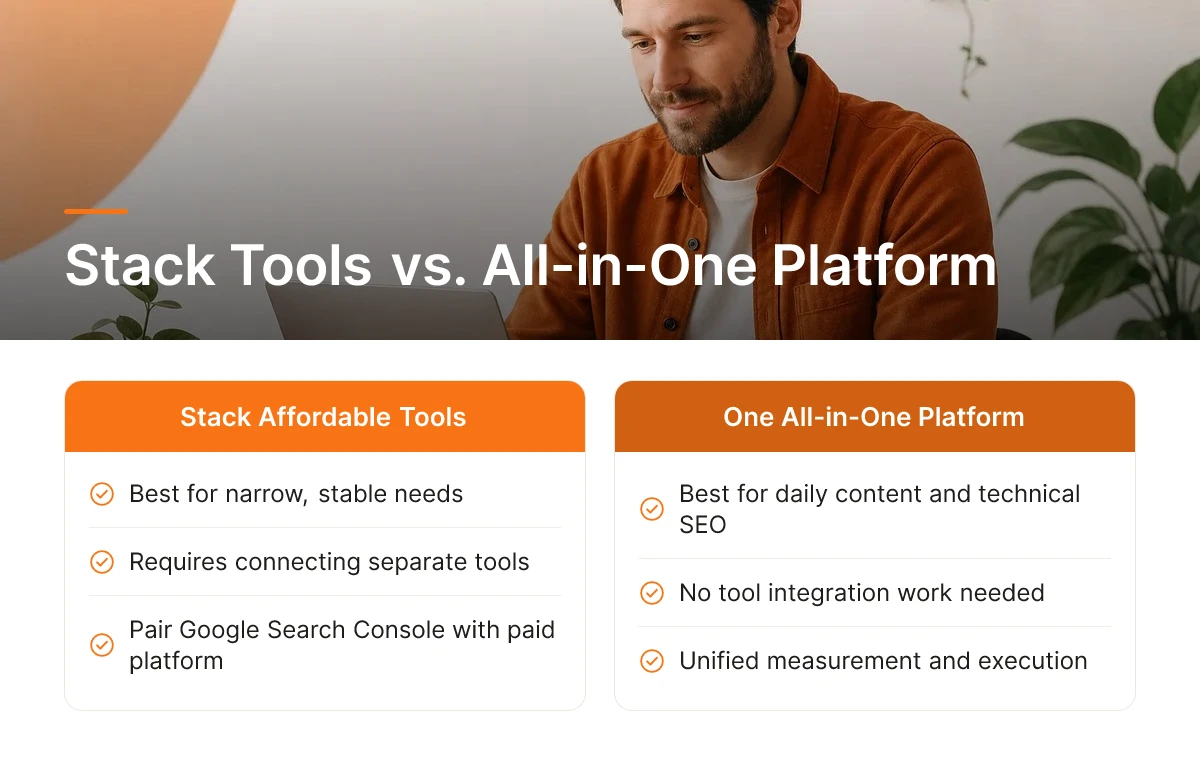
Stack tools when your needs are narrow and stable; consolidate into one platform when you need daily output across both content and technical SEO. The right answer depends on how much of your week you're willing to spend connecting tools that were never built to talk to each other.
Can You Combine Free Tools With Cheap Paid Tools Instead of an Expensive Platform?
Yes, pairing Google Search Console with a single paid automation platform covers both measurement and execution without paying twice for the same function. Search Console is free and already shows you which queries bring impressions and clicks, so there's no reason to pay a separate tool for that layer. The gap most solo founders actually have isn't data, it's publishing. They can see which keywords they're missing but have no system producing content or fixing technical issues against those keywords every day. That's the half of the equation worth paying for, and it's the half that determines whether you ever close the gap Search Console shows you.
What's the Integration Overhead of Stitching Together Multiple Budget Tools?
Every additional tool in your stack adds a login, an export, an import, and a reconciliation step, and those minutes compound into the hours automation was supposed to give back. A rank tracker that doesn't talk to your content tool means manually copying keyword targets. A content generator that doesn't publish means manually formatting and uploading drafts. A schema plugin that doesn't sync with either means manually auditing pages to see what's still broken. None of this shows up on a pricing page, but it shows up on your calendar [3].
This is also where stacking quietly stops being cheap. Add a content tool at one tier, a rank tracker at another, a technical audit tool for overage credits, and the combined bill often lands close to, or above, a single consolidated platform, especially once usage-based add-ons kick in [3]. Among the best seo automation platforms for solo founders under 150 dollars per month, the ones that win on total cost are usually the ones that replace three subscriptions rather than add a fourth.
Moonrank is built around this exact tradeoff: one $99/month subscription that handles daily content publishing, technical fixes like schema markup and llms.txt, and AI search visibility tracking across ChatGPT, Gemini, Claude, and Perplexity, so there's nothing left to stitch together.
What's the Real ROI When You Automate SEO Instead of Hiring an Agency?
Automation pays back the moment it replaces work you'd otherwise pay an agency a flat monthly fee to do slower, because the cost stays fixed while the output doesn't stop.
An agency retainer is a time-based commitment, not an output-based one. You pay the same fee whether they publish four posts or zero that month, and client communication, revision cycles, and strategy calls eat into delivery time. An automation platform flips that structure: the fee is fixed, but the system keeps generating and publishing content every day regardless of how busy your account manager is. For a solo founder comparing the this strategy against a retainer, that distinction matters more than any feature checklist.
What Do Solo Founders Actually Get Back From SEO Automation Tools?
You get back the hours you'd spend writing, auditing, and reporting, plus consistency an agency struggles to match at a comparable price. Manual SEO work for a solo operator usually breaks into three buckets: writing content, fixing technical issues like schema markup or structured data, and tracking whether any of it worked. A platform like Moonrank automates all three, publishing daily content, handling technical AI-readability fixes, and tracking visibility across ChatGPT, Gemini, Claude, and Perplexity, which means the "output" isn't a report you have to interpret, it's pages already live and signals already corrected [4].
How Much Time Do These Tools Save Per Week Compared to the Cost?
The payback threshold is low: automation earns its cost back once it replaces just a few hours a week of manual writing, auditing, or reporting work. If drafting and publishing even one SEO article per week takes a founder two to three hours, and technical audits add another hour, a tool charging under $150 a month breaks even quickly against the hourly value of founder time spent elsewhere [5]. Rather than estimating a dollar ROI figure, track three things instead: your organic traffic trend over 60 to 90 days, how many pages are getting indexed, and how many hours per week you've reclaimed from content and reporting tasks. Those three signals tell you more than a projected return ever will.
Agencies still earn their fee where judgment matters most, shaping strategy, interpreting nuance, and managing stakeholder conversations. Automation wins on the dimensions a solo founder actually lacks time for: showing up every day, fixing technical gaps immediately, and never missing a publishing cycle because of a busy week.
How Do You Set Up and Run SEO Automation With No Technical Background?
Setup takes four steps, connect your site, set your target topics, review the first content batch, then let the platform run on its own schedule.
That sequence is roughly identical across the this approach, which is one reason this category appeals to people without an SEO background. The work is front-loaded into onboarding, not spread across a weekly task list.
What's the Step-by-Step Workflow for Running a Platform on Autopilot?
Start by connecting your website, usually through a CMS login, an API key, or a short embed snippet, depending on the platform. Moonrank, for example, asks for your site and niche during onboarding, then builds a keyword list specific to your business rather than applying a generic template [2].
Next, you confirm the topics and keywords the platform wants to target. This is the one place founder judgment matters: you're telling the system which product lines, features, or locations deserve priority.
After that, the platform generates a first batch of content. Review it once, check tone, accuracy, and whether it sounds like your business, then approve the publishing schedule. From there, daily content generation, auto-publishing, and technical fixes like schema markup and llms.txt configuration run without further input [4].
Do You Need to Know Code or Technical SEO to Make These Platforms Work?
No. "No-code" here means you never touch schema markup directly, never SSH into a server, and never wrestle with a stack of CMS plugins beyond the initial connection step.
The platform handles structured data, citation building, and technical audits in the background [4]. Your job shifts from doing the work to periodically checking it: a monthly look at published posts, a glance at an AI visibility report, a quick scan of which pages are getting cited by ChatGPT or Perplexity. That's a materially lighter load than the daily keyword research and manual publishing some guides describe as the solo founder's baseline task list [5].
The application layer looks different depending on what you run. An ecommerce founder typically automates product and category page optimization, since those pages compound traffic over time. A B2B SaaS founder leans toward feature pages and comparison content, the pages prospects actually search for when evaluating options. A boutique hotel owner automates location and neighborhood pages, since "best hotel near [landmark]" is exactly the kind of query AI engines now answer directly. Moonrank's competitive landscape analysis adapts to whichever of these applies, flagging where competitors already outrank you in AI recommendations so the content calendar targets those gaps first [4].

Frequently Asked Questions
Can a solo founder replace an SEO agency with automation alone?
Yes, for most of the recurring work an agency bills for, content production, technical fixes, and visibility tracking, automation now handles it at a fraction of the cost. Agencies still add value for custom strategy calls and brand positioning work, but daily publishing, schema markup, and AI search monitoring no longer require a human retainer. Moonrank, for example, runs that entire workflow automatically for $99/month instead of a $3,000+/month agency fee.
How long does it take to see results from SEO automation as a new site?
Most solo founders start seeing measurable movement in AI search visibility and organic traffic within 60 to 90 days of consistent automated publishing. Technical fixes like structured data and llms.txt configuration can show up in crawl behavior sooner, but content-driven rankings and AI citations take longer to compound.
What's the biggest mistake solo founders make when choosing an affordable SEO tool?
They pick a content-only tool and assume publishing alone will fix visibility, ignoring technical optimization entirely. A tool that scores your writing but skips schema markup, llms.txt setup, or AI search tracking leaves half the job undone, so founders end up paying for a second or third tool to cover the gap.
Do cyber security and B2B SaaS companies need different SEO automation than ecommerce stores?
The core automation stays the same, but the content focus and keyword targeting differ significantly between the two. B2B SaaS and cyber security buyers research longer before converting, so they need content built around technical credibility and trust signals, while ecommerce stores benefit more from product-led, comparison, and local-intent content. A platform that personalizes keyword research to your niche handles both without manual reconfiguration.
Conclusion
Choosing an SEO automation platform under $150/month comes down to three things: does it handle technical optimization and not just content, does it track visibility in the places customers actually search now, including ChatGPT, Gemini, Claude, and Perplexity, and does it run without eating your week. Tools that only score content leave founders stitching together two or three subscriptions to cover the rest.
If you're ready to stop guessing whether AI search engines even know your business exists, start a free trial at moonrank.ai and see your current AI visibility report in minutes.
Sources & References
- SEO & AI Search Plans and Pricing | Semrush
- AI SEO Tools for Solo Founders: Cheap and Free Picks 2026
- Seo automation pricing: top tools cost & plans compared
- 9 Best SEO Automation Software For Founders in 2026
- AI SEO Tools for Solo Founders: Automate Rankings | Aug 23, 2026
Recommended Articles
Explore more from our content library: