Entity Based SEO: The Complete 2026 Guide
Learn what entity based SEO is, how it works, and why it matters for AI search visibility in 2026. Practical tips for SMBs included. Discover essential entity.
| Key Insight | Explanation |
|---|---|
| Entity based SEO centers on concepts, not keywords | Search engines and AI tools now recognize entities (people, places, brands, ideas) rather than matching raw keyword strings. |
| Google's Knowledge Graph powers entity understanding | Google uses a vast entity database to connect concepts, enabling more accurate, context-aware search results. |
| Structured data is the implementation backbone | Schema markup and structured data help AI engines parse exactly what your business, products, and content represent. |
| AI search engines rely heavily on entity signals | ChatGPT, Gemini, Claude, and Perplexity use entity relationships to decide which brands to surface in recommendations. |
| Topical authority builds entity trust | Publishing consistent, in-depth content on related subtopics signals to search engines that your brand is a credible entity in its niche. |
| SMBs can compete through entity optimization | Small businesses that clearly define their entity attributes can outperform larger competitors in AI-driven search recommendations. |
Most business owners still think SEO is about stuffing the right keywords onto a page. That mindset is costing them visibility. Entity based SEO is the practice of optimizing your content around recognizable concepts, relationships, and context so that search engines and AI tools understand what your business actually is, not just what words appear on your site. It's the difference between Google reading your page and Google knowing your brand. This guide covers exactly what entity based SEO means, how it works under the hood, why it matters more than ever in 2026, and what practical steps you can take today to make AI search engines like ChatGPT, Gemini, Claude, and Perplexity recommend your business with confidence.
What Is Entity Based SEO?
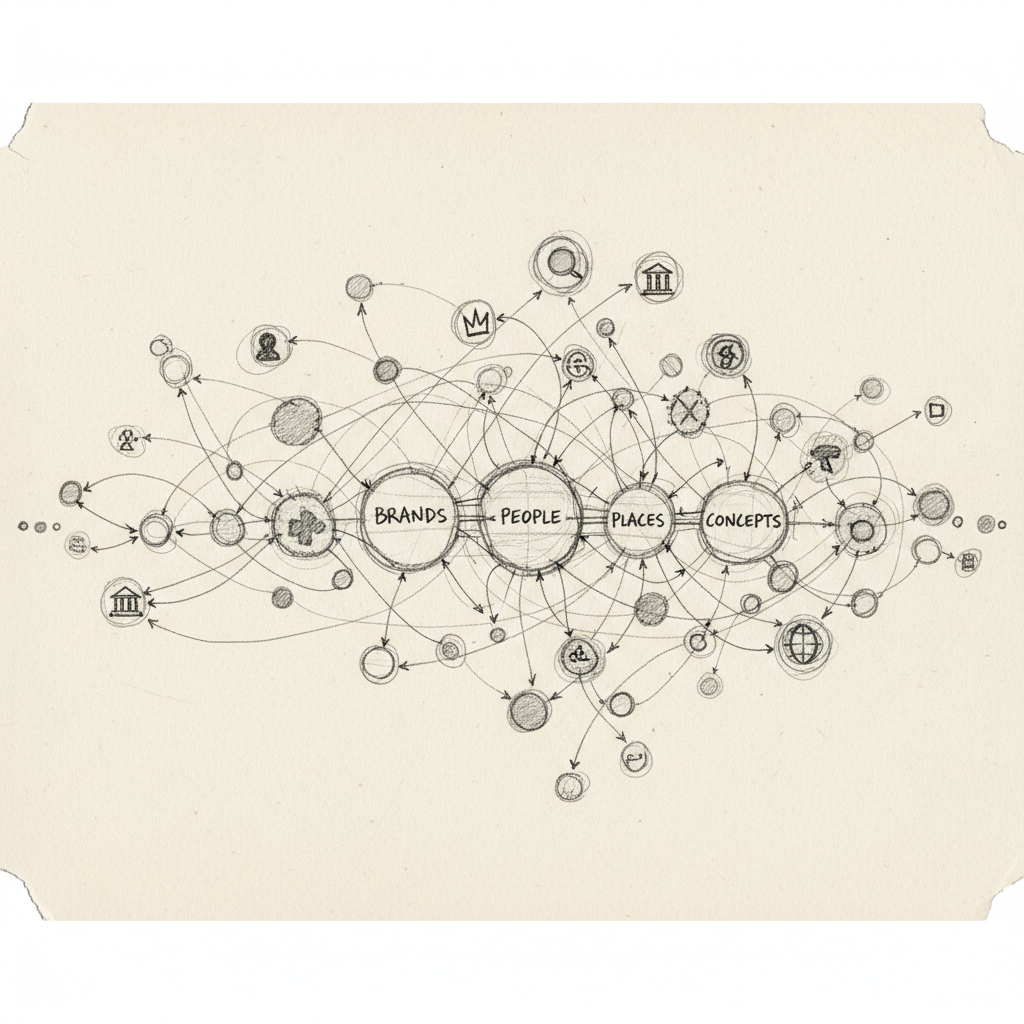
Entity based SEO is an optimization approach that focuses on entities (distinct, uniquely identifiable concepts such as brands, people, places, products, and ideas) rather than isolated keyword strings, helping search engines understand the meaning and relationships behind your content. [1]
From Strings to Things
Google's shift from "strings to things" started with the 2012 Knowledge Graph update and has accelerated sharply since. Before that shift, search engines matched literal text. Type "apple," and the engine looked for pages with the word "apple." The problem? Context was invisible. Was the searcher asking about the fruit, the tech company, or the record label?
Entities solve that problem. An entity is any well-defined, unique concept that can be disambiguated from other concepts. According to Ahrefs, entity based SEO centers on making those concepts the primary unit of optimization rather than individual keyword phrases. [1]
Think of it this way: a keyword is a string of characters. An entity is a thing that exists in the real world (or conceptually) and has attributes, relationships, and a unique identity. Your business is an entity. Your product category is an entity. The problem you solve is an entity.
Why This Matters More in 2026
As of 2026, AI search engines have become a primary discovery channel for consumers. Perplexity reported over 100 million weekly queries by late 2024, and that figure has grown substantially since. ChatGPT, Gemini, and Claude now answer millions of product and service recommendation queries daily.
These AI systems don't crawl and rank like traditional search engines. They retrieve information based on what they understand about entities and their relationships. If AI engines don't have a clear, structured understanding of your brand as an entity, they simply won't recommend you, regardless of how many keywords you've optimized. [2]
According to Insightland, entity based SEO ensures search engines understand the meaning and relationships of topics in your content, not just the presence of specific words. [2] That distinction is everything in the AI search era.
Pro Tip: Before doing any keyword research, write a one-paragraph "entity definition" for your business: what it is, who it serves, what category it belongs to, and what makes it distinct. This becomes the foundation for every entity-based optimization decision you make.
How Entity Based SEO Works
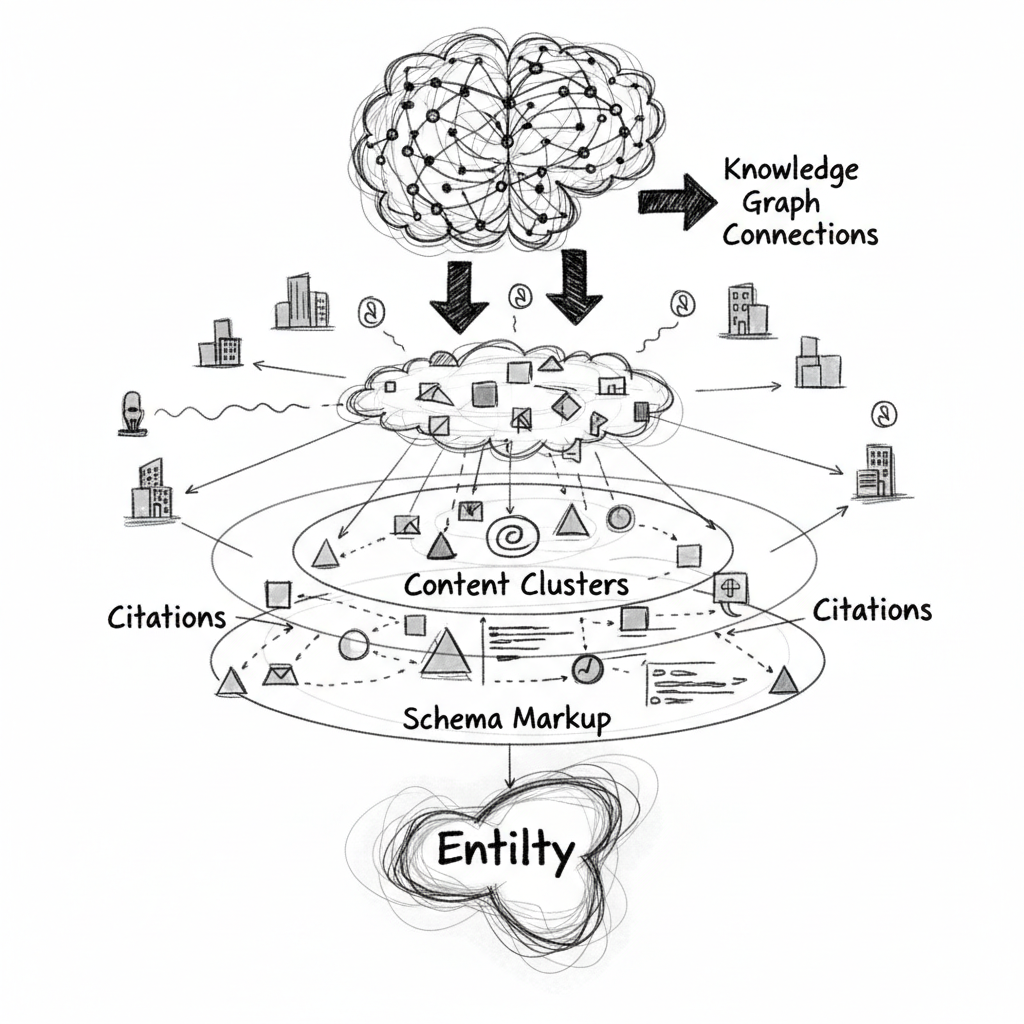
Entity based SEO works by helping search engines and AI models build an accurate, structured understanding of your brand through schema markup, semantic content, and consistent entity signals across authoritative sources. [3]
The Knowledge Graph and Entity Relationships
Google's Knowledge Graph is the backbone of entity-based search. It's a massive database of entities and their relationships. When Google crawls your site, it's not just indexing words. It's asking: "What entity does this content describe? What other entities is it related to? How authoritative is this source on this entity?"
The same logic applies to AI language models. ChatGPT, Gemini, Claude, and Perplexity are trained on vast datasets that encode entity relationships. When a user asks "What's the best project management tool for small teams?", the AI retrieves entities that match the attributes of that query, tools, small business context, and relevant features, and surfaces the ones with the strongest entity signals. [3]
According to Search Engine Land, entity SEO is where search engines are headed with regard to choosing what content to rank and determining its meaning. [4]
The Mechanics: How Entity Signals Are Built
Building strong entity signals involves several interconnected layers:
- Schema markup: Structured data (the code-level signals that tell AI engines exactly what your business, products, and content represent) applied using vocabulary from Schema.org. This is the most direct way to declare your entity attributes to machines. [5]
- Consistent NAP data: Name, Address, and Phone number consistency across your website, Google Business Profile, and third-party directories reinforces your entity's identity.
- Topical content clusters: Publishing interconnected content that covers a topic from multiple angles tells search engines your entity has genuine depth and authority in a subject area.
- Entity mentions and co-citations: Being mentioned alongside other recognized entities in authoritative sources strengthens your own entity status. If trusted publications mention your brand in the same context as established industry players, that's a powerful signal.
- Internal linking with semantic context: Links between your pages, when anchored with descriptive, contextual text, help search engines map the relationships between entities on your site.
- llms.txt configuration: A newer technical signal, llms.txt is a file that helps large language models understand what your site contains and how to interpret it, directly targeting AI search engine comprehension.
As Schema App explains, entity SEO focuses on unique, well-defined concepts and uses structured data to make those concepts machine-readable. [5]
| Entity Signal Type | What It Does | Impact Level |
|---|---|---|
| Schema Markup | Declares entity type, attributes, and relationships in machine-readable code | Very High |
| Topical Content Clusters | Builds topical authority by covering related subtopics comprehensively | High |
| Entity Co-Citations | Third-party mentions alongside trusted entities boost authority | High |
| NAP Consistency | Confirms entity identity across directories and platforms | Medium-High |
| llms.txt Configuration | Directly signals content structure to LLM-based AI search engines | Medium-High (growing) |
| Internal Semantic Linking | Maps entity relationships within your own content ecosystem | Medium |
Key Benefits of Entity Based SEO for 2026
Entity based SEO delivers stronger, more durable visibility across both traditional search and AI-powered platforms by building a machine-readable identity for your brand that algorithms can trust and recommend. [6]
Better AI Search Visibility
This is the most critical benefit in 2026. When ChatGPT, Gemini, Claude, or Perplexity receives a query about your product category, they surface entities they understand well. A business with strong entity signals, clear schema markup, consistent citations, and topical authority, is far more likely to appear in those AI-generated recommendations than one optimized purely for keyword density.
Research from Stanford University's SHIFT program highlights that AI search systems rely on entity relationships to determine relevance and authority, making entity optimization a prerequisite for AI visibility. [6]
At Moonrank, we've found that SMBs who implement proper entity signals, particularly schema markup and topical content clusters, see measurable improvements in AI search recommendations within the first 30 days of optimization.
Durability Against Algorithm Updates
Keyword-stuffing strategies get punished by algorithm updates. Entity-based strategies don't, because they align with how search engines are fundamentally designed to work. When you build genuine entity authority, you're not gaming an algorithm. You're giving it exactly what it's looking for.
According to Neil Patel, entity SEO is the practice of optimizing content around recognizable concepts so search engines better understand and rank your content, and this approach remains stable across updates precisely because it mirrors search engine intent. [7]
Additional benefits of entity based SEO include:
- Rich result eligibility: Proper schema markup unlocks rich snippets, knowledge panels, and featured placements that significantly increase click-through rates.
- Cross-platform consistency: Entity signals work across Google, Bing, ChatGPT, Gemini, Claude, and Perplexity simultaneously, so one investment pays dividends everywhere.
- Competitive differentiation: Most SMBs haven't implemented entity optimization yet. Getting there first creates a moat that's hard for competitors to close quickly.
- Semantic search alignment: Semantic SEO (optimizing for meaning and context rather than exact match keywords) is the natural companion to entity optimization, and both reinforce each other.
- Long-tail query coverage: Strong entity authority means search engines surface your content for related queries you never explicitly targeted, expanding organic reach without additional effort.
The Hospitality Net notes that entity based SEO helps return rich results and connect content to the appropriate topics, directly improving visibility for businesses in competitive local markets. [8]
Common Challenges and Mistakes in Entity Based SEO
The most common mistake in this approach is treating it as a one-time technical fix rather than an ongoing strategy that requires consistent content, citation building, and structured data maintenance. [9]
Inconsistent Entity Signals
A common mistake is having conflicting information about your business across different platforms. Your business name appears one way on your website, slightly differently on Google Business Profile, and another way on industry directories. To a search engine trying to resolve your entity, that inconsistency creates doubt.
In practice, we see this constantly when working with new clients. A restaurant lists itself as "The Blue Door Café" on its website, "Blue Door Cafe" on Yelp, and "Blue Door Restaurant" on TripAdvisor. Each variation weakens the entity signal. Consistency isn't just good housekeeping. It's a direct ranking factor for entity-based systems.
Neglecting Topical Depth
Another frequent error is publishing broad, shallow content rather than building genuine topical authority. Search engines and AI models assess entity credibility partly by how comprehensively a source covers its subject area.
One pitfall to watch for: publishing a single "ultimate guide" and then stopping. Entity authority is built through consistent, interconnected content over time. A single piece, however well-written, doesn't establish your brand as a recognized entity in a topic cluster.
Other challenges include:
- Missing or incomplete schema markup: Many businesses have no structured data at all, or implement it incorrectly. Errors in schema can actively confuse search engines about your entity attributes.
- Ignoring AI-specific technical signals: Traditional SEO audits don't check for llms.txt configuration or AI crawler accessibility. These gaps directly hurt visibility on ChatGPT, Gemini, and Perplexity.
- Over-relying on keywords alone: As IFACTORY notes, entity based SEO isn't a replacement for keywords entirely, but treating keywords as the only signal misses the broader semantic context that modern search engines require. [9]
- No citation strategy: Being mentioned by authoritative third-party sources is a core entity signal. Businesses that never pursue press mentions, directory listings, or industry citations build weak entity profiles.
- Treating entity SEO as a one-person job: Effective entity optimization touches content, technical SEO, and off-page authority simultaneously. Without automation or a dedicated system, most SMBs simply don't maintain it consistently.
Pro Tip: Run a quick entity audit by searching your business name in Google and checking whether a Knowledge Panel appears. If it doesn't, your entity signals are too weak. Start by claiming your Google Business Profile, adding Organization schema to your homepage, and ensuring your business name, address, and phone number match exactly across your top 10 directory listings.
Best Practices for Entity Based SEO in 2026
The most effective this strategy in 2026 combines technical structured data implementation, consistent topical content publishing, and proactive citation building across authoritative platforms. [10]
Build Your Entity Foundation
Start with the technical layer. Every business website should have, at minimum:
- Organization or LocalBusiness schema: Declare your entity type, name, description, logo, founding date, service area, and contact information in structured data on your homepage.
- Product or Service schema: For each core offering, implement schema that describes what it is, who it's for, and how it's priced.
- FAQ schema: Mark up your frequently asked questions so AI engines can extract direct answers and attribute them to your entity.
- Author and Person schema: For content-heavy sites, marking up authors as entities builds E-E-A-T (Experience, Expertise, Authoritativeness, and Trustworthiness) signals that AI systems weight heavily.
- llms.txt configuration: Add this file to your site root to directly communicate your content structure and entity attributes to large language model crawlers.
According to InLinks, it provides a practical path to increasing web traffic precisely because it aligns your content with how modern search systems process meaning. [10]
Build Topical Authority Through Consistent Content
Content strategy for this method follows the "hub and spoke" model, sometimes called a semantic hub. Create a central pillar page for your core entity (your main product, service, or expertise area), then publish supporting content that covers related subtopics, use cases, questions, and comparisons.
The key is consistency. Publishing one article a month won't build entity authority fast enough to compete in AI search. Publishing daily content on relevant topics, each piece internally linked and semantically connected, signals to search engines that your entity is active, authoritative, and trustworthy.
As HubSpot explains, this strategy is built around concepts, relationships, and context rather than isolated keyword phrases, and content strategy must reflect that relational structure. [11]
Additional best practices include:
- Pursue authoritative citations: Get your business mentioned in industry publications, local news, and niche directories. Each mention strengthens your entity's credibility profile.
- Use entity-first keyword research: Instead of starting with search volume, start by mapping the entities in your niche and then finding the queries people use to find them.
- Monitor AI search visibility: Track how and when ChatGPT, Gemini, Claude, and Perplexity mention your brand. This tells you whether your entity signals are working and where gaps remain.
- Update structured data regularly: Entity attributes change. New products, new locations, new team members. Keep your schema current so AI engines have accurate information.
Pro Tip: Our team at Moonrank recommends auditing your structured data every quarter using Google's Rich Results Test. Broken or outdated schema is worse than no schema in some cases, because it sends conflicting entity signals to both traditional and AI search engines.
According to Clearscope, focusing on entities rather than just keywords helps businesses rank for a broader range of related queries because search engines understand the conceptual territory your content covers. [12]
The Paid Search.org guide to entity-based competitor analysis also notes that entity analysis helps businesses expand their reach and uncover hidden opportunities that purely keyword-focused strategies miss. [13] In practice, this means mapping your competitors' entity profiles and identifying gaps where your brand can establish authority they haven't claimed.

Sources & References
- Ahrefs, "What is Entity-Based SEO?", 2026
- Insightland, "Entity-Based SEO", 2026
- InLinks, "Entity SEO: the Guide to Understanding", 2026
- Search Engine Land, "Entity SEO: The definitive guide", 2026
- Schema App, "What is Entity SEO and How Do I Implement It?", 2026
- Stanford SHIFT, "AI and Entity-Based SEO: Understanding and Leveraging Search Entities", 2026
- Neil Patel, "Why Entity-Based SEO is a New Way of Thinking About Optimization", 2026
- Hospitality Net, "Why Entity-Based SEO is the One Strategy You Need to Implement", 2026
- IFACTORY, "What Marketers Need to Know About Entity-Based SEO", 2026
- InLinks, "Entity SEO: the Guide to Understanding", 2026
- HubSpot, "Entity-based SEO: An explainer for SEOs and content marketers", 2026
- Clearscope, "What Is an Entity and Why Does It Matter for SEO", 2026
- Paid Search.org, "Entity-based competitor analysis: An SEO's guide", 2026
Frequently Asked Questions
1. Is SEO dead or evolving in 2026?
SEO is very much alive in 2026, but it has fundamentally shifted in what it requires. Traditional keyword-ranking tactics alone are no longer sufficient because a growing share of search activity now happens inside AI engines like ChatGPT, Gemini, Claude, and Perplexity, which use entity signals and semantic context rather than keyword matching to surface recommendations. Businesses that adapt by implementing this approach, structured data, and topical authority strategies are seeing stronger visibility across both traditional and AI-powered search, while those clinging to keyword-only approaches are losing ground.
2. What are the 4 types of SEO?
The four traditional types of SEO are On-Page SEO (optimizing content, headings, and metadata on individual pages), Off-Page SEO (building backlinks and external authority signals), Technical SEO (improving site speed, crawlability, and structured data), and Local SEO (optimizing for geographically relevant searches). As of 2026, a fifth category has become essential for many businesses: AI Search Optimization, or Generative Engine Optimization (GEO), which focuses on entity signals, schema markup, and content structures that help AI engines like ChatGPT and Gemini understand and recommend your brand. this cuts across all five, providing the semantic foundation that makes every other type of optimization more effective.
3. Is SEO being phased out?
SEO isn't being phased out. It's being expanded and redefined. The core goal, making your business visible and credible to the systems people use to find information, hasn't changed. What has changed is that those systems now include AI engines alongside traditional search, and those AI engines respond to entity signals, semantic context, and structured data rather than raw keyword density. Businesses that embrace it and AI search optimization are actually gaining more visibility channels, not fewer. The risk isn't that SEO disappears. It's that businesses optimizing only for yesterday's search signals get left behind by competitors who've adapted.
4. What is an example of entity based SEO in practice?
Consider a local accounting firm. A keyword-focused approach targets phrases like "tax accountant near me." An this method approach goes further: the firm implements LocalBusiness and ProfessionalService schema on its homepage, publishes a content cluster covering topics like "small business tax deductions," "quarterly estimated taxes," and "LLC vs. S-Corp tax implications," ensures its name and contact details match exactly across Google Business Profile, Yelp, and industry directories, and pursues mentions in local business publications. The result is that Google and AI engines like Perplexity recognize the firm as a credible, well-defined entity in the accounting space and surface it for a much broader range of relevant queries, including conversational AI recommendations.
5. How does entity based SEO differ from semantic SEO?
this strategy and semantic SEO are closely related but not identical. Semantic SEO is the broader practice of optimizing for meaning, intent, and context rather than exact keyword matches. this approach is a specific application of that principle, focusing on making distinct, identifiable concepts (your brand, products, people, and topics) machine-readable and authoritative. Think of semantic SEO as the philosophy and this as the implementation. In practice, the two strategies reinforce each other: building entity authority naturally improves semantic relevance, and creating semantically rich content naturally strengthens entity signals.
6. Do small businesses need entity based SEO?
Small businesses arguably need it more than large enterprises do. Big brands already have strong entity recognition built through years of press coverage, backlinks, and brand searches. SMBs have to actively build that recognition through deliberate optimization. The good news is that this method is highly actionable even with a small budget. Adding schema markup, publishing consistent topical content, and ensuring citation consistency are all achievable without an agency. Tools that automate these processes, like Moonrank, make it practical for a solo business owner to implement and maintain a full entity optimization strategy at a fraction of traditional agency costs.
Conclusion
this strategy isn't a trend. It's the fundamental way that both traditional search engines and AI platforms now understand the web. If your business isn't clearly defined as a recognizable entity, with consistent structured data, topical authority, and citation signals, you're invisible to the systems your customers are increasingly using to find recommendations.
The practical steps are clear: implement schema markup, build topical content clusters, maintain citation consistency, and track your visibility across ChatGPT, Gemini, Claude, and Perplexity. The challenge for most SMBs is doing all of that consistently, day after day, without a dedicated marketing team.
That's exactly the problem Moonrank solves. Moonrank handles daily automated content publishing, technical AI optimization (including schema markup, llms.txt, and structured data), and AI search visibility tracking across all four major AI engines, all for $99/month. You get the full this approach infrastructure running on autopilot, without hiring an agency or writing a single word yourself. Visit www.moonrank.ai to start your free 3-day trial and see how quickly your entity signals can improve.