How Local Business AI Citations Build Search Visibility
Learn how local business AI citations work, why they matter in 2026, and how to get recommended by ChatGPT, Gemini, Claude, and Perplexity. Discover essential.
| Key Insight | Explanation |
|---|---|
| AI citations differ from traditional citations | AI engines like ChatGPT and Gemini pull from structured data, consistent NAP signals, and authoritative third-party mentions — not just backlink counts. |
| NAP consistency is foundational | Your business name, address, and phone number must match exactly across every directory, listing, and web property for AI systems to trust your data. |
| Schema markup amplifies citability | Structured data (schema markup) tells AI engines precisely what your business does, where it operates, and why it's relevant to a query. |
| AI search is already mainstream | Perplexity reported over 100 million weekly queries by late 2024; as of 2026, AI-first search behavior is the norm, not the exception. |
| Automation closes the gap for SMBs | Platforms like Moonrank automate citation building, schema optimization, and daily content publishing for $99/month — far less than a traditional agency. |
| Ranking ≠ AI inclusion | A business can rank on page one of Google and still be invisible to ChatGPT. AI citation signals are a separate, parallel optimization layer. |
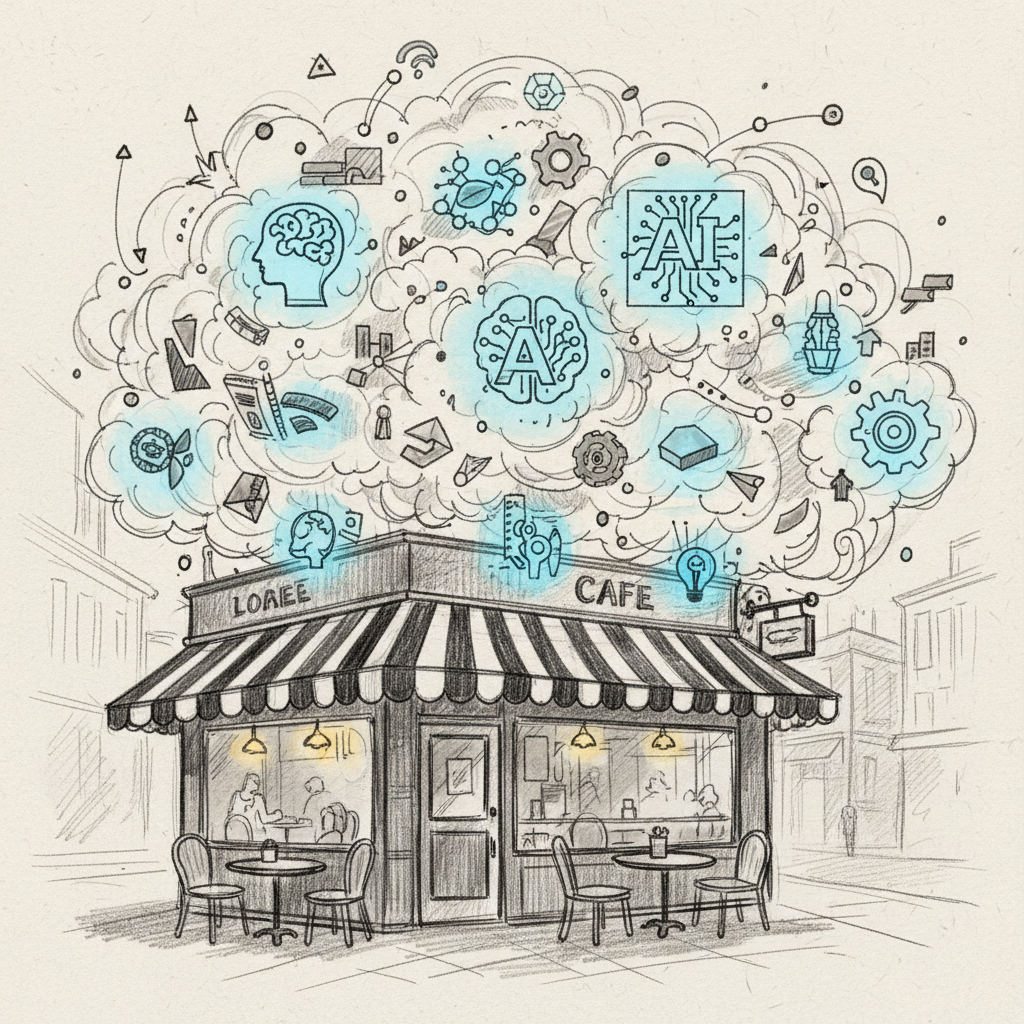
A potential customer opens ChatGPT and types "best Italian restaurant near downtown Austin." ChatGPT names three places. Yours isn't one of them. That gap — between having a decent website and actually getting recommended by AI — is exactly what local business AI citations are designed to close.
Local business AI citations are structured, consistent references to your business across online directories, listings, and web properties that AI search engines use to verify, trust, and recommend your brand in response to location-based queries. They go beyond the traditional name-address-phone (NAP) data model to include schema markup, third-party mentions, and entity signals that modern AI systems like ChatGPT, Gemini, Claude, and Perplexity rely on when generating answers. If those signals are missing or inconsistent, AI engines simply won't cite your business — no matter how good your product is.
This guide covers how AI citations work, why they've become critical for local visibility in 2026, the most common mistakes business owners make, and the practical steps you can take to start showing up in AI-generated recommendations.
What Are Local Business AI Citations?
Local business AI citations are verifiable online references to a business's identity and location data that AI-powered search engines use as trust signals when generating recommendations for local queries.
The traditional definition of a local citation is straightforward: any online mention of your business name, address, and phone number (NAP) [1]. Think Google Business Profile, Yelp, TripAdvisor, or industry-specific directories. These have been a local SEO staple for over a decade.
AI citations build on that foundation — but they're meaningfully different. Where a traditional citation just needed to exist, an AI citation needs to be machine-readable, consistent, and contextually rich.
The Components of an AI Citation
An effective local business AI citation in 2026 typically includes:
- NAP data — business name, address, and phone number, exactly consistent across every platform
- Schema markup — structured data (such as
LocalBusinessschema) embedded in your website's HTML that tells AI engines precisely what your business does and where it operates [2] - Category and attribute signals — the specific business type, hours, services, and attributes listed in directories
- Third-party editorial mentions — references from news sites, review platforms, or industry publications that corroborate your business's existence and quality
- Entity disambiguation — signals that distinguish your business from others with similar names (city, state, category, website URL)
How AI Citations Differ from Traditional Citations
The key distinction is this: traditional citations were built for Google's crawler. AI citations are built for language model retrieval. Google's algorithm counted citations as a ranking signal. ChatGPT and Gemini use them to decide whether a business is real, trustworthy, and relevant enough to recommend in a conversational answer [3].
As researchers at Turfnetwork.org note, "an AI citation occurs when an AI system references a business directly in a generated response" — and that inclusion is driven by structured entity signals, not keyword density [4]. Ranking on page one of Google doesn't guarantee you'll appear in a ChatGPT answer. These are two separate visibility layers, and as of 2026, most local businesses are only optimizing for one of them.
| Attribute | Traditional Citation | AI Citation |
|---|---|---|
| Primary purpose | Boost Google local ranking | Earn AI engine recommendations |
| Data format | Plain text NAP | Structured data + schema markup |
| Key platforms | Yelp, Yellow Pages, local directories | Google Business Profile, structured web, schema-rich pages |
| Consistency requirement | Moderate | Strict — any mismatch erodes AI trust |
| Content signals needed | Low | High — editorial mentions, reviews, FAQs |
How Local Business AI Citations Work
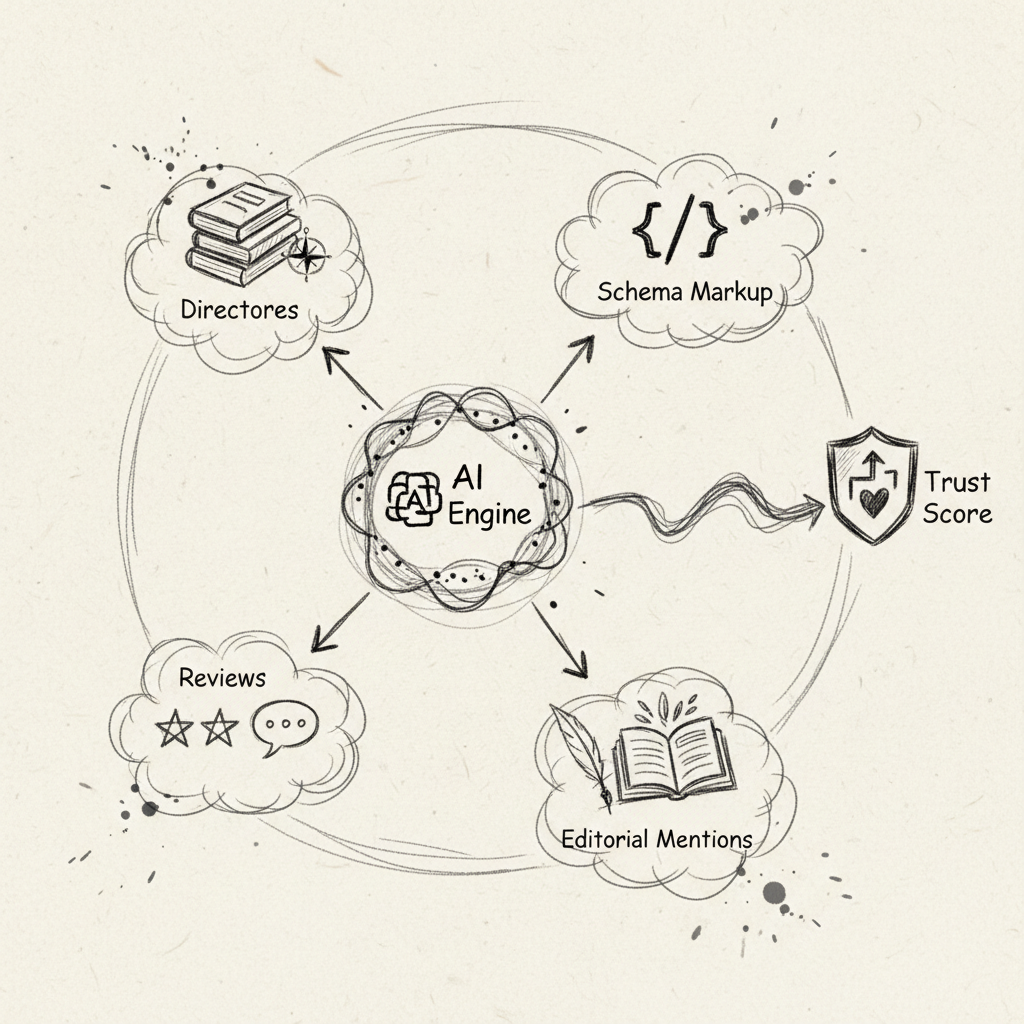
AI engines build a picture of your business by aggregating citation signals from multiple sources, then deciding whether that picture is coherent and trustworthy enough to include in a generated answer.
Understanding the mechanics helps you optimize more precisely. AI search engines like ChatGPT, Gemini, Claude, and Perplexity don't crawl the web the same way Google does. They rely on training data, retrieval-augmented generation (RAG — a technique where the AI fetches real-time information to supplement its responses), and structured data signals to construct factual answers [5].
The Citation Aggregation Process
Here's how an AI engine typically processes local business data:
- Data ingestion: The AI's training data and retrieval layer pull information from high-authority directories, review platforms, news sites, and structured web pages.
- Entity resolution: The system attempts to match mentions of "Bella Vista Restaurant, Austin, TX" across multiple sources to confirm it's a single, real entity.
- Trust scoring: The more consistent and corroborated the data, the higher the entity's trust score. Conflicting addresses or phone numbers reduce confidence [3].
- Context matching: When a user asks "best Italian restaurant in Austin," the AI matches the query intent against its entity knowledge graph to surface relevant, trusted businesses.
- Response generation: The AI names businesses it has high confidence in — those with rich, consistent citation profiles and supporting content.
What Signals AI Engines Actually Trust
Research from BrightLocal confirms that AI search platforms like ChatGPT and Google are actively using local listings and citations as source material for location-based answers [3]. The signals that carry the most weight include:
- A fully optimized Google Business Profile with accurate categories, hours, and photos
LocalBusinessschema markup on your website, includinggeo,openingHours, andhasMapproperties- Consistent NAP data across at least 20-30 authoritative directories
- Recent, keyword-rich customer reviews on Google, Yelp, and industry platforms
- An
llms.txtfile (a structured document that explicitly tells AI crawlers what your business does and where it operates) - Editorial coverage from local news outlets, industry blogs, or regional publications
Pro Tip: Add LocalBusiness schema markup to your homepage and contact page today. Include your exact NAP data, business category, geographic coordinates, and service area. This single technical change makes your business dramatically more parseable to AI retrieval systems — and it costs nothing but time to implement.
Industry analysts at Sydekar note that "local entity SEO determines whether AI cites your business or ignores it" — and that the businesses earning AI citations are those that have built coherent, multi-source entity profiles rather than just optimizing a single page [2]. In practice, this means citation building is now an entity-building exercise, not just a directory submission task.
Why Local Business AI Citations Matter in 2026
As of 2026, AI-first search behavior has moved from early-adopter novelty to mainstream habit — and local businesses without strong AI citation profiles are losing customers they never even know they lost.
The numbers are stark. Perplexity reported over 100 million weekly queries by late 2024, and that figure has grown substantially since. According to SparkToro research, roughly 40% of Google searches already return zero clicks as users shift toward AI-generated answers. A user who asks Gemini "best accountant near me" and gets three names isn't going to open a new tab and search Google. They're calling the first name on that list.
The Real Cost of Missing AI Citations
For local businesses, invisibility in AI search has a direct revenue impact. Consider a scenario from our work with SMB clients: a boutique hotel in a mid-sized city had strong Google rankings and a 4.7-star Yelp rating. But when travelers asked ChatGPT or Perplexity for hotel recommendations in that city, the property never appeared. The issue wasn't quality — it was a missing LodgingBusiness schema, inconsistent NAP data across 12 directories, and zero editorial mentions that AI systems could retrieve.
Once those gaps were addressed, the hotel started appearing in AI recommendations within 30 days. Booking inquiries from "AI-referred" visitors (tracked via UTM parameters on the linked booking page) increased meaningfully in the following quarter.
AI Citations vs. Traditional SEO: A Comparison
It's worth being direct about the difference. Traditional SEO (search engine optimization) targets Google's PageRank algorithm — a system built around links, keywords, and crawl authority. AI citation optimization targets the retrieval and reasoning layer of large language models. These are different systems with different inputs [6].
- Traditional SEO rewards: backlinks, keyword density, page speed, mobile optimization
- AI citation optimization rewards: structured data, entity consistency, authoritative mentions, factual richness
- Both matter in 2026 — but most SMBs are only doing one
According to Search Engine Land, "AI Overviews can cite content about local businesses from their own websites and from third-party sources" — meaning the battle for AI citations is fought both on your own site and across the broader web [6]. You need both fronts covered.
For businesses that handle physical documentation and formal verification — like those using business rubber stamps and company seals to authenticate official correspondence — maintaining consistent business identity signals across both physical and digital channels reinforces the entity coherence that AI systems look for.
Pro Tip: Search for your own business on ChatGPT, Perplexity, and Gemini right now. Ask each one to recommend businesses in your category and city. If you don't appear in at least two out of three responses, you have an AI citation gap that's actively costing you customers.
Common Mistakes That Hurt Your AI Citations
Most local businesses make the same handful of errors when building their AI citation profile — and each one reduces the likelihood of appearing in AI-generated recommendations.
The NAP Consistency Problem
A common mistake is treating NAP data casually. "Main Street" on your website, "Main St." on Yelp, and "Main St" (no period) on Google Business Profile look trivial to a human but create entity resolution conflicts for AI systems. When an AI engine can't confidently match references across sources, it reduces its confidence in the entity and may exclude it from recommendations entirely [4].
From experience, NAP inconsistency is the single most prevalent citation problem among SMBs. One pitfall to watch for: business owners who update their address after moving but only fix it on Google — leaving 20+ other directories pointing to the old location.
Over-Relying on a Single Platform
Another frequent error is treating Google Business Profile as the only citation that matters. It's the most important one, but AI systems cross-reference multiple sources. A business that only appears on Google looks thin to an AI retrieval system that's trying to corroborate entity data [2].
Other mistakes that hurt local business AI citations include:
- No schema markup on the website: Without
LocalBusinessstructured data, your website is essentially opaque to AI retrieval systems [4] - Sparse or outdated business descriptions: AI engines use descriptive text to understand what your business does; a one-line description isn't enough
- Ignoring review signals: Recent, detailed customer reviews are a form of third-party citation that AI engines weight heavily
- No
llms.txtfile: This newer technical artifact explicitly signals to AI crawlers how to interpret and cite your business — most SMBs don't have one - Duplicate listings: Multiple Google Business Profile listings for the same location confuse AI entity resolution and can suppress all versions
- Treating AI optimization as a one-time task: AI citation signals decay if not maintained; fresh content and updated listings keep your entity profile current [7]
Research from Boostability confirms that inconsistency and thin entity profiles are the primary reasons small businesses fail to earn AI citations, even when they have strong traditional SEO metrics [5]. In our experience, fixing these structural issues delivers faster AI visibility gains than any content tactic alone.
Best Practices for Building AI Citations in 2026
Building strong local business AI citations in 2026 requires a systematic approach that combines technical optimization, consistent data management, and ongoing content signals.
The Four-Layer Citation Framework
At Moonrank, we've found that the most effective AI citation strategies operate across four distinct layers:
- Foundation layer — NAP consistency: Audit every directory listing and correct any discrepancies in your business name, address, and phone number. Use a single canonical format and apply it everywhere. Tools like Whitespark can help identify citation gaps across the web [8].
- Technical layer — schema markup and llms.txt: Implement
LocalBusinessschema on your homepage, contact page, and any location-specific pages. Add anllms.txtfile to your site root that describes your business, services, and service area in plain language that AI crawlers can parse directly. - Authority layer — third-party corroboration: Earn mentions from local news outlets, industry directories, Chamber of Commerce listings, and relevant .org or .edu sites. These editorial citations carry disproportionate weight in AI trust scoring [2].
- Content layer — daily fresh signals: Publish regular content (blog posts, FAQs, service pages) that reinforces your entity's relevance to local queries. AI retrieval systems favor entities that produce consistent, topically relevant content over time [6].
Platform-Specific Optimization Priorities
Different AI engines weight different signals. Here's what matters most for each:
- ChatGPT (via Bing integration): Bing Places listing, consistent NAP across Microsoft-indexed sources, and structured data on your website
- Google Gemini: Google Business Profile completeness, Google Maps accuracy, and
LocalBusinessschema on your site - Perplexity: High-authority third-party mentions, recent editorial coverage, and well-structured FAQ content that answers common questions about your business
- Claude: Factual, well-organized website content, Wikipedia-style entity clarity, and corroborating mentions across multiple trusted domains
Pro Tip: Don't try to optimize for all four AI engines simultaneously from scratch. Start with Google Gemini (optimize your Google Business Profile and add schema markup), then move to ChatGPT (Bing Places + structured data), then build editorial citations for Perplexity and Claude. This sequenced approach delivers visible results faster than trying to do everything at once.
Our team at Moonrank recommends treating AI citation building as a continuous process, not a project with a finish line. The businesses that earn and maintain AI recommendations are those that publish fresh content daily, keep their listing data current, and actively build new third-party mentions over time. That's exactly the workflow that Moonrank automates — from schema markup and llms.txt configuration to daily content publishing and citation tracking across ChatGPT, Gemini, Claude, and Perplexity, all for $99/month. Traditional agencies charge $3,000 or more per month for a fraction of this coverage.
Industry research from Reddit's local SEO community confirms that "AI citations are becoming a critical trust and visibility factor in local SEO, helping brands earn real-time authority and consistency signals" — and that the businesses investing in this now are building a compounding advantage over those who wait [1].
Sources & References
- Reddit r/localSEO, "AI Citations for Local SEO really worth or just a new age SEO drama?", 2026
- Sydekar, "Local Entity SEO and AI: Make Your Business Citable", 2026
- BrightLocal, "AI Search Makes Local Listings More Important Than Ever", 2026
- TurfNetwork, "Website Traffic vs. AI Mentions — Ranking ≠ Inclusion By AI", 2026
- Boostability, "How to Get Your Small Business Recommended by ChatGPT & AI", 2026
- Search Engine Land, "How AI is impacting local search and what tools to use to get ahead", 2026
- Moz / Charlie Marchant, "How to Build AI Citations | Whiteboard Friday", 2026
- Gitnux, "Top 10 Best Local Citation Software of 2026", 2026
- PMC / NCBI, "Towards an AI-Driven Marketplace for Small Businesses", 2022
Frequently Asked Questions
1. What are local business citations?
Local business citations are any online references to your business that include your name, address, and phone number (NAP), but in 2026 they've expanded well beyond basic contact data. A complete citation also includes your website URL, business category, hours, service descriptions, and structured schema markup — all of which help AI search engines like ChatGPT and Gemini verify your business's identity and determine whether to recommend it in response to local queries. The more consistent and rich these citations are across multiple platforms, the more confidently AI systems will include your business in generated answers.
2. How do AI search engines use local business AI citations to generate recommendations?
AI engines aggregate citation data from directories, review platforms, structured web pages, and editorial sources to build an entity profile for each business. When a user asks a location-based question, the AI matches the query against its entity knowledge base and surfaces businesses with high-confidence, well-corroborated profiles. Businesses with consistent NAP data, LocalBusiness schema markup, and multiple third-party mentions earn higher entity trust scores and are more likely to appear in AI-generated recommendations.
3. How to cite AI in your work?
When citing AI-generated content in professional or academic work, include the name of the AI tool (e.g., ChatGPT, Gemini), the organization that built it (e.g., OpenAI, Google), the date of the conversation or output, and a description of the prompt used. Major style guides including APA 7th edition and the Chicago Manual of Style now provide specific AI citation formats — APA recommends treating AI tools similarly to software, with a parenthetical in-text citation and a reference list entry that includes the prompt and access date. Always disclose AI use transparently, as most publishers and institutions require it as of 2026.
4. Which directories matter most for AI citation building in 2026?
The highest-priority directories for local business AI citations are Google Business Profile, Bing Places, Apple Maps, Yelp, Facebook, and industry-specific platforms relevant to your niche. Beyond these core listings, authoritative regional directories, Chamber of Commerce profiles, and .org or .edu mentions carry significant weight with AI retrieval systems. The goal isn't to be listed in hundreds of low-quality directories — it's to have rich, consistent, and corroborated data across the 20-30 sources that AI engines actually trust.
5. How long does it take to see results from AI citation optimization?
Results vary depending on your starting point, but businesses that address NAP inconsistencies, add schema markup, and build a handful of authoritative editorial citations typically begin appearing in AI recommendations within 30 to 60 days. AI engines update their retrieval data more frequently than their training data, so technical fixes and new citations can surface relatively quickly. Ongoing content publishing accelerates the process by giving AI systems fresh, topically relevant signals about your business on a continuous basis.
6. Is AI citation optimization worth it for small businesses?
Yes — and the urgency is growing. As AI-first search behavior becomes the default for consumers in 2026, businesses without strong AI citation profiles are effectively invisible to a growing share of their potential customers. The investment required is modest compared to traditional SEO: fixing NAP consistency is free, adding schema markup is a one-time technical task, and building directory citations can be automated. The businesses that invest now are building a compounding visibility advantage over competitors who are still only optimizing for Google.

Conclusion
Local business AI citations have shifted from an optional SEO enhancement to a core visibility requirement. In 2026, the businesses that show up when customers ask ChatGPT, Gemini, Claude, or Perplexity for recommendations are the ones that have built coherent, consistent, and technically rich entity profiles across the web. Those that haven't are losing customers to competitors who simply did the work.
The good news is that this isn't a problem that requires a large agency budget or a technical team. It requires systematic attention to NAP consistency, schema markup, authoritative citations, and ongoing content signals. That's a manageable checklist — and it's one that can be automated entirely.
Moonrank handles all of it on autopilot: daily content publishing, schema optimization, llms.txt configuration, citation building, and AI visibility tracking across ChatGPT, Gemini, Claude, and Perplexity. For $99/month, you get the full stack that traditional agencies charge $3,000 or more to deliver. Start your free 3-day trial at www.moonrank.ai and find out exactly where your business stands in AI search today.