What Is Semantic Search Optimization and How It Boosts AI
Semantic search optimization is the practice of structuring your content so search engines and AI tools like ChatGPT, Gemini, and Perplexity understand the meaning and...

Semantic search optimization is the practice of structuring your content so search engines and AI tools like ChatGPT, Gemini, and Perplexity understand the meaning and context behind queries, not just the exact words used. Instead of matching keywords, semantic search matches intent, entities, and relationships. Optimizing for it means writing topically authoritative content, using structured data, and answering questions in natural language so your brand gets found and cited across both traditional and AI-powered search.
What Is Semantic Search Optimization and How Does It Differ from Traditional SEO?
Semantic search optimization aligns content with user intent, entities, and contextual meaning, not keyword frequency or exact-match strings.
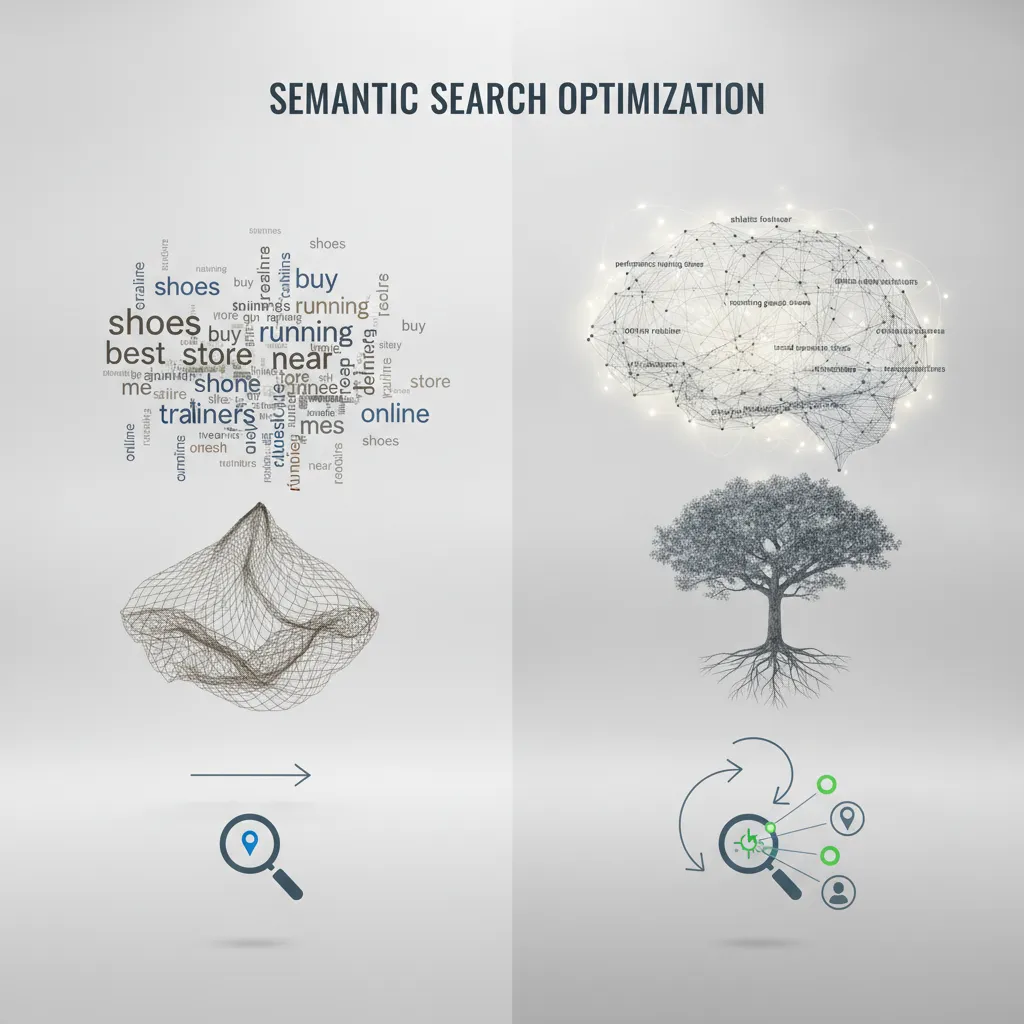
Traditional SEO rewarded pages that repeated a target phrase at the right density and accumulated backlinks pointing to that page. Semantic SEO rewards something different: topical depth, entity coverage, and natural language relevance that signals genuine expertise on a subject.
Why Semantic Search Matters for Modern SEO
Google's shift toward semantic understanding didn't happen overnight. The Hummingbird update in 2013 [1] introduced query interpretation based on meaning rather than individual words. RankBrain in 2015 [1] added machine learning to handle ambiguous queries. BERT in October 2019 [1] gave Google the ability to parse the relationship between words in a sentence, the same way a human reader would.
Each update moved ranking signals further away from exact-match text and toward contextual relevance. By the time AI engines like ChatGPT, Gemini, and Claude arrived, semantic understanding was already the standard, not an experiment.
AI search engines compound this further. ChatGPT, Gemini, and Claude cite semantically rich, topically authoritative content when generating answers [2]. Keyword-stuffed pages rarely appear in those citations because the models can't extract coherent, trustworthy information from them.
How Semantic Search Optimization Compares to Traditional SEO in Ranking Improvements
The practical difference shows up in query coverage. A page built around exact-match keyword targeting typically ranks for that phrase, and little else. A page optimized for semantic search tends to rank for dozens of related queries simultaneously [2], because search engines recognize it as authoritative across an entire topic cluster.
For an e-commerce store or B2B SaaS company, that difference is the gap between capturing one search intent and capturing an entire category of buyer questions, across Google, Perplexity, and every AI engine that pulls from the web.
How Semantic Search Actually Works Behind the Scenes
Semantic search uses vector embeddings, knowledge graphs, and transformer models to match queries by meaning, not by matching character strings.
What Technology and AI Powers Semantic Search Engines
Search engines convert every word and document into a numerical vector, a list of hundreds or thousands of numbers that positions content in high-dimensional space. Content that shares meaning clusters near each other in that space, so a query about "car insurance quotes" retrieves pages about "auto coverage costs" even when none of those exact words overlap.
Google's Knowledge Graph extends this by linking entities, people, places, brands, and concepts, and mapping the relationships between them. That's how the engine knows "Apple" in an article about quarterly earnings refers to the company, not the fruit. The graph gives the engine structured world knowledge to draw on when interpreting ambiguous terms.
Transformer models like BERT (launched October 2019) [1] and MUM read full sentences bidirectionally, weighing every word against its neighbors. In a query about "opening a bank account after bankruptcy," the model reads the entire phrase before deciding that "bank" means a financial institution, not a riverbank. Semantic search optimization depends on producing content that satisfies this full-sentence understanding, not just inserting isolated keywords.
How Semantic Search Handles Voice Search and Conversational Queries
Voice queries arrive as complete natural-language questions, "What's the best way to fix a leaky faucet?", not keyword fragments. Semantic search maps the full question to an intent cluster, then retrieves content that answers that intent [3]. Pages written in Q&A or conversational formats match those intent clusters more precisely than keyword-dense paragraphs.
ChatGPT and Perplexity use the same embedding-based retrieval logic to decide which sources to cite in their answers [3]. Content structured around clear entities, explicit answers, and natural question-and-answer formatting is more likely to be pulled into an AI-generated response, which is exactly the visibility gap that tools like Moonrank are built to close through daily content publishing and technical optimization.
How to Optimize Your Content for Semantic Search
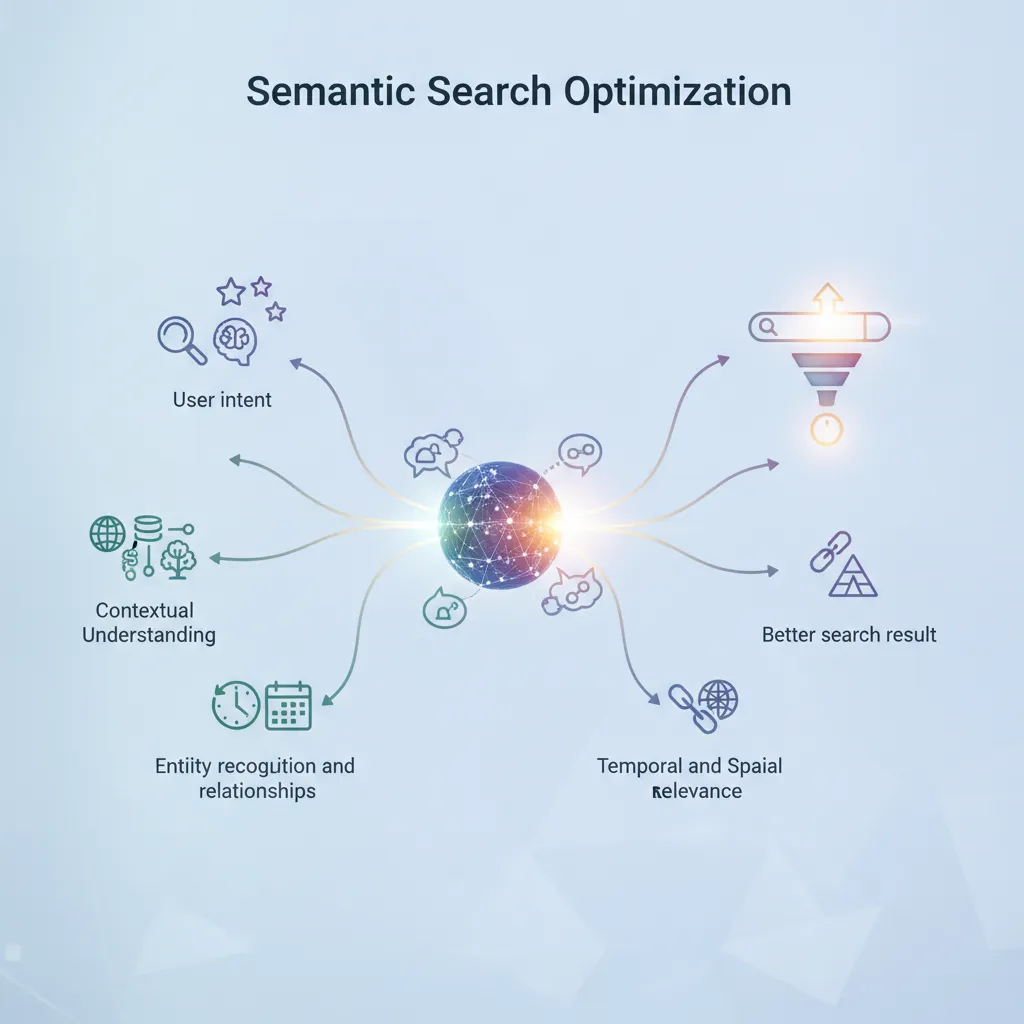
Semantic search optimization works through four concrete levers: topical authority, entity tagging, structured data, and question-driven content structure. For more information, see Senejac.
Best Practices and Technical Setup for Semantic SEO Implementation
Build topical authority through content clusters. Rather than publishing isolated pages targeting individual keywords, create a hub-and-spoke structure, one pillar page covering a broad topic, supported by multiple interlinked pages that go deep on each sub-topic. Google's systems reward sites that demonstrate depth on a subject [2], not sites that scatter thin content across unrelated areas.
Name and define your entities explicitly. Entities are the specific people, brands, products, and locations your content references. When you name them clearly, rather than relying on pronouns or vague descriptions, search engines can map your page into their knowledge graph [3] and associate your site with a topic, not just a keyword string. A restaurant page that names its head chef, neighborhood, and cuisine type gives AI engines far more to work with than one that says "our talented team serves great food locally."
Use descriptive internal anchor text. Linking related pages with anchor text like "AI SEO tools for small businesses" signals topical relationships to crawlers. This reinforces your site's authority cluster around a subject and helps AI engines understand how your pages connect.
A Practical Implementation Guide: Schema, Entities, and Content Structure
Add schema markup in JSON-LD format. FAQ schema and Article schema are the highest-impact starting points for most business pages [1], they tell Google and AI engines like ChatGPT and Perplexity exactly what your content covers, who wrote it, and which questions it answers. Tools like Moonrank handle this automatically, implementing structured data without requiring you to edit code manually.
Write in question-and-answer structure. Use H2s that mirror real user questions, then answer them directly in the first sentence below the heading [2]. This format feeds featured snippets and gives AI citation engines a clean passage to pull from when generating answers.
The Real Impact of Semantic Search on Rankings and Featured Snippets
Semantic search optimization directly increases featured snippet eligibility, expands query coverage, and creates a citation channel inside AI engines like ChatGPT and Gemini.
How Semantic Search Optimization Affects Position Zero and Featured Snippet Rankings
Google pulls featured snippet content from pages that answer a question directly, in a concise and structured format [1]. Domain authority alone does not determine snippet eligibility, a mid-authority page with clear Q&A structure, entity context, and schema markup can outrank a high-authority competitor that buries its answer in dense prose.
The same content qualities that earn position zero, direct answers, clear structure, authoritative topical context, are the exact signals that ChatGPT, Gemini, and Perplexity use when selecting sources to cite in AI-generated answer panels [3]. A page optimized for featured snippets is simultaneously optimized for AI citation, making semantic search optimization a dual-channel win rather than a trade-off between old and new search behavior.
Pages with strong semantic signals, entity clarity, structured data, and deep topical coverage, are disproportionately cited by AI engines, opening a traffic channel that exists entirely outside traditional blue-link rankings.
Measurable Traffic and Ranking Improvements: What Real Semantic SEO Strategies Show
Semantically optimized pages routinely appear for 5–20x more queries than their keyword-targeted equivalents [2]. The engine recognizes topical relevance across related searches and surfaces the page for terms the author never explicitly targeted, multiplying organic traffic without requiring additional content production.
Sites that shifted from keyword-stuffed thin pages to entity-optimized, semantically rich content consistently report measurable improvements in impressions and click-through rates within 60–90 days [2]. The mechanism is straightforward: the algorithm identifies broader topical relevance and expands the page's query footprint accordingly.
This "rank for many" effect compounds over time. Each semantically related query the page captures reinforces its topical authority signal, which in turn increases its eligibility for featured snippets and AI citations, creating a self-reinforcing cycle that keyword targeting alone cannot replicate.
Tools and Strategies to Put Semantic SEO Into Practice
Semantic search optimization requires four distinct tool categories, a structured workflow, and a shift away from rank tracking as your primary success metric.
Top SEO Tools for Semantic Search Optimization
Traditional SEO platforms built around keyword rank tracking can't measure what semantic search actually rewards. They don't surface entity coverage gaps, topical authority deficits, or how often an AI engine cites your brand, so a new category of AI-native tools is required alongside the old stack.
The four categories you need:
- Semantic keyword and entity research tools, surface related concepts, co-occurring entities, and questions your audience asks, not just monthly search volume. Tools like Google's "People Also Ask" data, AlsoAsked, and NLP-based research platforms fit here.
- Schema markup generators, implement structured data (FAQ, HowTo, Product, LocalBusiness) so search engines and AI models can parse your content precisely without guessing.
- AI content optimization platforms, score your pages for topical coverage and entity density, flagging gaps that prevent you from ranking for the full semantic cluster around a topic.
- AI search visibility trackers, monitor how your brand appears inside ChatGPT, Gemini, Claude, and Perplexity, not just Google's ten blue links. This is the metric that traditional SEO dashboards don't track at all.
The strategic workflow ties these together: audit existing content for entity gaps → build or update schema markup → restructure key pages into Q&A format → publish supporting cluster content → monitor AI search visibility alongside Google rankings.
Moonrank handles this entire workflow on autopilot for SMBs. It tracks brand visibility across ChatGPT, Gemini, Claude, and Perplexity; publishes semantically optimized content daily without requiring manual input; and implements schema markup and structured data automatically, the technical signals that determine whether AI engines cite your business or a competitor's.
Is Traditional SEO Still Relevant Now That AI and Semantic Search Are Dominant?
Yes, but as a foundation, not a differentiator. Backlinks, page speed, mobile usability, and crawlability still matter; without them, no amount of semantic optimization will compensate. But they're table stakes now.
The sites that actually rank and get cited by AI engines are the ones that go further: they build topical authority through entity-rich content, implement structured data that AI models can read directly, and maintain consistent visibility signals across both Google and AI search platforms. Technical health gets you into the game. Semantic depth is what wins it.
Frequently Asked Questions
How long does it take to see results from semantic search optimization?
Most sites see measurable improvements in organic visibility within 3 to 6 months of consistent semantic SEO work. Early gains, such as appearing in featured snippets or AI-generated answers, can surface in 6 to 8 weeks if your technical foundation is solid. Results depend on your site's existing authority, how frequently you publish topically relevant content, and whether your structured data is correctly implemented. Automated daily publishing, as Moonrank delivers, compresses this timeline by building topical depth faster than manual content schedules allow.
Does semantic SEO work for small business websites with low domain authority?
Yes, low domain authority does not block semantic search gains, because AI engines and Google's semantic layer reward topical relevance and content clarity, not just backlink counts [2]. A local restaurant or Shopify store that thoroughly covers a narrow topic, say, "gluten-free catering in Austin", can outrank higher-authority generalist sites for that specific query. Structured data and schema markup give smaller sites a technical signal boost that partially offsets authority gaps.
What is the difference between semantic SEO and topic clusters?
Semantic SEO is the broader discipline of aligning content with meaning and intent; topic clusters are one structural tactic within it [1]. A topic cluster organizes pages around a central pillar and supporting subtopics to signal subject authority to search engines. Semantic SEO also covers entity optimization, structured data, natural language signals, and how AI systems interpret your content, well beyond site architecture alone.
How does semantic search optimization affect how AI tools like ChatGPT cite your content?
AI engines like ChatGPT, Gemini, and Perplexity pull citations from content they can parse, trust, and match to a user's intent, exactly what semantic optimization prepares your site for [3]. When your pages clearly define entities, use structured data, and answer specific questions directly, AI retrieval systems are more likely to surface and attribute your content. Technical signals such as schema markup and llms.txt configuration, both implemented automatically by Moonrank, make your site's content machine-readable at the level these AI systems require.
Conclusion
Semantic search optimization is no longer a refinement on top of traditional SEO, it is the foundation that determines whether your content gets found by both Google and the AI engines your customers are already using. Three actions move the needle most: build content around entities and intent rather than isolated keywords, implement structured data so AI systems can parse what your business does, and publish consistently enough to establish topical authority in your niche.
If you want to see where your business currently stands in AI search results across ChatGPT, Gemini, Claude, and Perplexity, start a free 3-day trial at moonrank.ai, Moonrank runs the technical audit and begins publishing optimized content automatically, so you have real visibility data within days, not months.
Sources & References
- Semantic Search: What It Is and Why It Matters for SEO
- Semantic SEO Strategy for AI and Classic Search Engines
- What is semantic search, and how does it work? | Google Cloud
Recommended Articles
Explore more from our content library: