How SEO Writer AI Tools Help SMBs Get Cited by ChatGPT
Learn how SMBs use an seo writer ai tool to create content that ChatGPT and Perplexity actually cite, not just content that ranks on Google.

Understanding seo writer ai is essential. SMBs can use AI writing tools to produce SEO content that AI search engines like ChatGPT and Perplexity actually recommend, but only if the content is optimized for a different goal than ranking on Google: clear, well-structured, factually specific answers rather than keyword-dense pages built for click-through. AI engines pull from content that directly answers a question, cites concrete details, and is structured so a language model can extract and quote it. That means a seo writer ai workflow needs a review layer for accuracy and structure, not just fast drafting, and it must serve both goals at once rather than favoring one over the other.
How Does SEO Writer AI Help SMBs Get Recommended by AI Search Engines?
A seo writer ai tool helps SMBs get recommended by ChatGPT and Perplexity by producing content structured as direct answers, not pages built to win a click.
Google's ranking system rewards pages that earn a click and hold attention once someone lands on them. ChatGPT and Perplexity work differently: they scan for a passage that answers a question cleanly enough to quote or paraphrase without the user ever visiting the source. That means a paragraph naming a specific product spec, a clear price range, or a direct comparison between two options gets pulled into an AI answer far more often than a page padded with keyword repetition. Content written for extraction needs short, self-contained answers near the top of the page, plain factual claims, and structure, headers, lists, tables, that a language model can parse without guessing at intent.
Why Are SMBs Moving Away From Traditional SEO Agencies?
Retainer-based agencies charge a fixed monthly fee regardless of output, and SMB owners increasingly find that unpredictable and slow compared to automated content tools. A typical agency contract runs a multi-month commitment with deliverables that arrive weekly or biweekly, which leaves gaps in coverage while AI search visibility changes daily. Automated publishing tools compress that cycle: content goes live the same day it's generated, and the cost stays fixed and low regardless of volume. For an owner-operator running a Shopify store or a boutique hotel, that predictability matters more than an agency's strategy deck, they need pages published now, not a quarterly report explaining why rankings haven't moved.
What Content Gaps Do AI Writing Tools Fill for SMBs Daily?
Most SMB sites carry gaps that never get closed because nobody has time to write for them: niche customer questions, thin product and service pages, and comparison content against competitors. Common examples include:
- Niche customer questions, like "does this fabric shrink in the dryer," that come up constantly in support tickets but never make it onto the site.
- Thin product or service pages that describe a category in generic terms instead of the specific details a buyer needs to decide.
- Comparison pages against named competitors, which founders often skip because they assume the content will read as combative.
- Location- or use-case-specific pages that a single business could realistically dominate but has never had time to write.
Daily AI-assisted publishing closes these gaps at a pace no owner can match manually, filling out the long tail of specific questions that AI engines are more likely to cite. A seo writer ai tool that's built around a business's own niche, rather than generic templates, tends to surface these gaps faster than manual keyword research alone.
None of this replaces judgment. Content still needs a human check for factual accuracy, correct prices, correct specs, correct claims about a business, and for brand voice before it goes live. Moonrank builds that review logic into its daily automated publishing, pairing keyword research specific to a business's niche with technical optimization like schema markup and structured data, so content serves AI extractability and accuracy at once rather than trading one for the other.
Writing for Google Rankings vs Writing for AI Search Recommendations
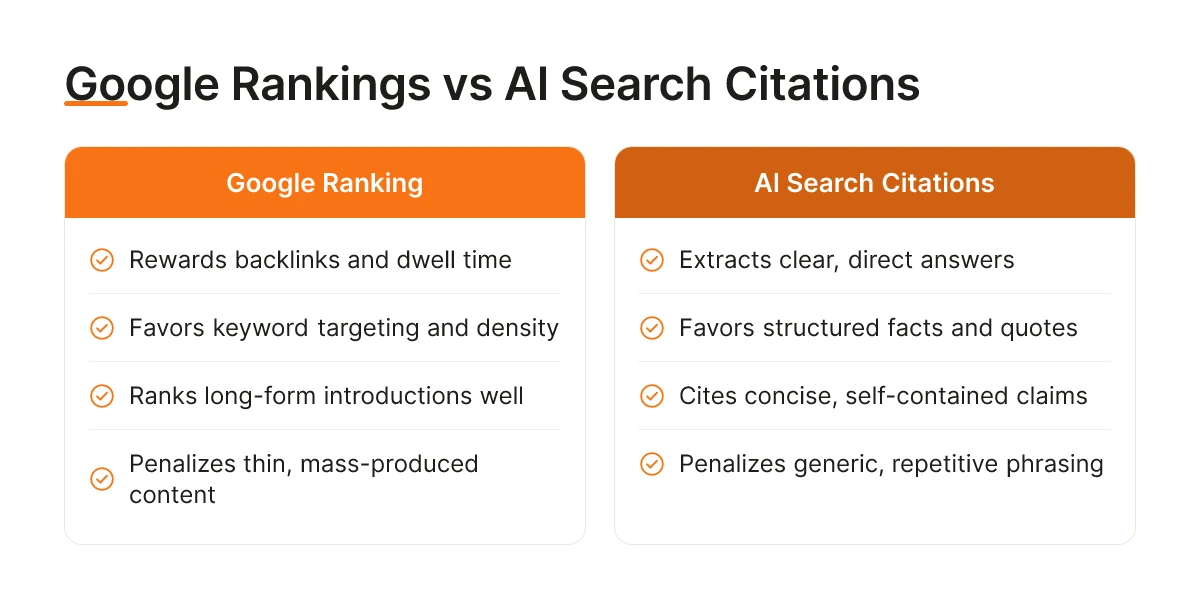
Google ranks pages by weighing backlinks, dwell time, and keyword density; AI engines extract passages by weighing clarity, directness, and how easily a claim can be lifted out and quoted. That difference explains why a page sitting at position one on Google can be invisible when someone asks ChatGPT the same question.
Traditional SEO still rewards a slow build: get links from other sites, keep visitors on the page, work a keyword into the title, headers, and body a set number of times. AI answer engines don't care how long someone stays on your page, they care whether a sentence in your third paragraph answers the question cleanly enough to quote without editing. A business owner running a seo writer ai workflow for the first time usually discovers this gap the hard way: the content ranks, but nobody's chatbot mentions the brand.
How Does Optimization Differ Between ChatGPT, Perplexity, Claude, and Google?
Each engine weighs different signals, so content built for one doesn't automatically work for the others. Perplexity leans heavily on fresh, recently published content and visible citations, which is why stale evergreen posts tend to underperform there even when they still rank on Google. ChatGPT favors clear structure and recognizable authority signals, consistent headings, direct definitions, and content that reads as organized rather than exploratory. Claude tends to reward self-contained, factually precise statements it can extract without needing surrounding context to make sense of them.
None of this replaces Google SEO. It sits alongside it as a separate set of mechanics a business now has to satisfy at the same time.
Why Do Some High-Ranking Google Articles Never Get Recommended by AI Engines?
Most miss the moment because they bury the answer. A common Google SEO pattern, a 300-word introduction building context before the actual answer shows up in paragraph six, works fine for dwell time but gives an AI engine nothing quotable near the top. If the direct fact or recommendation isn't stated plainly and early, the extraction step often skips the page entirely, even if it outranks competitors on Google.
The fix is structural, not stylistic. Lead each section with the direct answer, use subheadings that describe exactly what follows, and write factual claims as complete, self-contained sentences that make sense pulled out of the page entirely, no pronouns pointing back three sentences, no "as mentioned above." Moonrank builds this structure into every article it auto-publishes, pairing it with schema markup and structured data so AI engines can parse the page's facts as cleanly as a reader would.
Can You Use AI to Write SEO Content Without Detection or Penalties?
Yes, the risk isn't AI authorship, it's thin, unedited, mass-produced content, and any seo writer ai tool can produce either good or bad output depending on how you use it.
What Is the Real Risk of AI Detection Penalties for SMBs?
Google's own guidance says it rewards helpful, reliable content "regardless of how it is produced," and targets low-quality content at scale, not AI writing as a category. That distinction matters for a shop owner worried that publishing daily means risking a penalty.
AI detection tools don't actually detect "AI" in any technical sense. They flag statistical patterns, repetitive sentence structures, predictable word choices, generic phrasing that reads the same as ten thousand other pages on the same topic. A blog post about "the best running shoes for flat feet" that reads like every other AI-generated roundup will get flagged, and so will a human-written version with the same generic filler. The pattern is what triggers suspicion, not the process.
This is exactly the gap between tools built for Google rankings and tools built for AI recommendation engines. A generic AI writer that spins out keyword-stuffed articles creates the pattern-matching risk described above. Moonrank's content generation is built around a business's specific niche, competitors, and keyword set, not a generic template, precisely because specificity is what both search engines and AI answer engines reward.
How Can You Avoid Plagiarism and Keep Content Authentic?
Run an originality check before publishing, every time, this isn't optional. Language models learn from existing text, and they can paraphrase a source closely enough to raise real plagiarism concerns, especially on narrow topics where few original sources exist.
The fix is editing for specificity. Swap a generic claim ("many customers love our product") for a real number pulled from your own data. Add a detail only your business would know, a supplier name, a process quirk, a customer objection you hear every week. A distinct point of view, not just information, is what separates content readers trust from content they skim past.
This same edit pass reduces detection risk and builds reader trust at the same time, concrete, specific writing doesn't pattern-match to generic AI output, and it doesn't read like filler to a human either. That overlap is the real answer to the detection question.
Comparing AI Writing Tools for SMB Content Teams
Judge any seo writer ai tool on three things: does it structure content so AI engines can lift a direct answer, does it check facts or cite sources, and does it plug into your publishing workflow without manual copy-paste. Tools like SEO Writing and Agility Writer illustrate the range of approaches available, from fast drafting to more structured long-form generation, though how well any tool serves AI-search citation still depends on the structural and technical choices described below.
Most AI writing tools generate paragraphs fine. Fewer format those paragraphs so ChatGPT or Perplexity can extract a clean answer, short definitional sentences up front, scannable lists, clear entity names instead of vague pronouns. If a tool only helps you write and doesn't touch how the content is structured, published, or tracked once it's live, you're solving a third of the problem.
- Direct-answer structure: Does the tool lead sections with a plain-language answer before the supporting detail, or does it write the way a college essay does, building to a point instead of stating it?
- Fact-checking and citations: Can it pull in real data and attribute it, or does it produce confident-sounding claims with no source?
- Publishing integration: Does it auto-publish to your site with schema markup and structured data, or does someone still have to format and upload every draft?
Cost tracks capability. Budget-friendly tools generate drafts fast and cheap but leave structuring, fact-checking, and publishing to you. Mid-range tools add keyword research and on-page optimization but still require a human to hit publish. Premium tools bundle drafting with technical AI-readability work, schema, citations, llms.txt configuration, so the output is ready for AI search the moment it goes live, not just ready for a human editor.
How Does Content Quality Vary Across Industries Like SaaS or E-commerce?
Generic AI writing tools underperform in specialized niches because they default to broad, safe language instead of the specifics your industry needs. A SaaS comparison page needs precise technical claims, integration details, pricing tiers, feature limits, or it reads as filler and AI engines skip it when picking a source to cite. An e-commerce product page needs concrete specifics: fabric weight, battery life, sizing charts, actual use cases, not "high-quality materials" and "great for everyday use."
The fix isn't a better generic tool. It's a workflow decision: use pure drafting tools for high-volume, low-stakes pages, and reserve a seo writer ai tool that combines drafting with structural SEO and AI-search optimization for the handful of pages that decide whether ChatGPT or Perplexity mentions your business at all. Moonrank fits that second tier, it runs personalized keyword research per niche and handles the technical optimization layer automatically, so SMB teams don't have to choose between volume and quality on their highest-stakes pages.
Setting Up an AI-Powered SEO Content Workflow
A working setup connects your content platform directly to your seo writer ai tool, replaces manual publishing with a fixed cadence, and keeps a human checking every draft before it goes live.
None of this requires a new hire or a new tech stack. It requires deciding, upfront, who connects the accounts, who reviews drafts, and how often new content actually goes out. Most SMBs skip this planning step and end up with a tool that generates content nobody publishes.
How Do AI Writing Tools Integrate With WordPress, Webflow, and Similar Platforms?
Most AI content tools connect to your CMS through an API or plugin, so drafts land directly in WordPress or Webflow instead of sitting in a shared doc waiting for someone to copy and paste.
That distinction matters more than it sounds. A tool that only generates text still leaves you with a manual publishing job every day, formatting, adding images, checking links, hitting publish. For a solo founder or a two-person e-commerce team, that manual step is usually where the whole workflow quietly stops after week two.
Moonrank handles this by publishing directly to your site once connected, alongside the technical layer, schema markup, llms.txt configuration, structured data, that helps AI engines like ChatGPT and Perplexity actually parse and trust what you publish. The integration work happens once, during onboarding, not every day.
Can You Automate Daily Content Without Hiring a Full Content Team?
Yes, a small team can sustain daily publishing without adding writers, as long as generation, review, and publishing are separated into distinct steps rather than treated as one manual task.
Daily publishing sounds aggressive for a business with no marketing staff, but the math changes once generation is automated. A shop owner or B2B SaaS founder still needs a short daily or weekly review, five to ten minutes checking facts, local details, and brand voice, but they're no longer writing from scratch or briefing a freelancer. Weekly cadence works too, if daily review isn't realistic; consistency matters more than frequency.
The review step isn't optional. AI-generated drafts can misstate a store hour, mangle a product spec, or default to generic phrasing that doesn't sound like your business. A quick human pass before publishing catches these before a customer, or an AI engine citing your page, sees them.
Moonrank builds this workflow around SMBs specifically: daily automated content generation, auto-publishing, and AI search visibility tracking, with no writing required from the owner. See how it fits your setup at www.moonrank.ai.

Frequently Asked Questions
Do AI search engines like ChatGPT ever cite content that doesn't rank on Google?
Yes, AI engines pull from crawled sources and structured data signals, not just Google's ranking algorithm, so a page can earn a citation without ranking on page one. Perplexity and ChatGPT often favor pages with clear schema markup, direct answers, and strong topical relevance over pages optimized purely for backlinks and keyword density.
How much editing does AI-written content typically need before publishing?
Most AI drafts need a review pass for factual accuracy, brand voice, and specificity before publishing. Generic AI output tends to read vague unless someone adds concrete details, real numbers, named examples, business-specific context, that make the content trustworthy enough for both readers and AI citation systems to rely on.
Is there a minimum content length AI search engines prefer?
No fixed minimum exists, but AI engines tend to favor content that answers a question directly and completely rather than hitting a word count. A concise 300-word page with a clear, well-structured answer can get cited over a padded 2,000-word article that buries the point.
Can one article satisfy both Google ranking and AI engine citation at once?
Yes, when the article leads with a direct answer, uses structured data, and covers the topic with real specificity rather than filler. Google still rewards keyword relevance and backlinks, while AI engines weigh clarity and citability more heavily, but a well-structured, specific article tends to satisfy both without separate versions.
What should an SMB look for before choosing a seo writer ai tool?
Look for a tool that pairs drafting with structural and technical readiness: schema markup, direct-answer formatting, and a publishing integration that doesn't require manual copy-paste. A seo writer ai tool that only generates paragraphs still leaves the fact-checking, formatting, and technical optimization work for you to do by hand.

Conclusion
AI writing tools can produce SEO content fast, but speed alone doesn't earn a citation from ChatGPT or Perplexity. What matters is consistency, technical readiness, schema markup, structured data, llms.txt, and content specific enough for AI engines to trust and quote. Publishing sporadically or skipping the technical layer leaves visibility to chance.
Moonrank handles both sides automatically: daily content generation and the technical optimization AI engines require, tracked through ongoing visibility monitoring across ChatGPT, Gemini, Claude, and Perplexity. Start a free trial at moonrank.ai and see where your business currently stands in AI search results.
Recommended Articles
Explore more from our content library: