How the Surfer SEO AI Humanizer Fits an AI Search Strategy
Learn how the Surfer SEO AI humanizer works, its limits for AI search visibility, and how to pair it with structure, facts, and consistent publishing.

Understanding surfer seo ai humanizer is essential. AI content that reads as machine-written risks getting deprioritized by AI search engines like ChatGPT and Perplexity, which favor sources that sound authoritative and human when they select citations. Running AI-generated drafts through a humanizer like Surfer's before publishing can make the text pass detection checks and read more naturally, but humanization alone doesn't guarantee a citation, the underlying content still needs to answer the query better than competing sources. For SMBs, the real fix is pairing humanized text with genuine expertise, clear structure, and consistent publishing, not just rewording sentences.
Why SMBs Need to Humanize AI Content for AI Search Engines
AI search engines pull answers from sources that sound credible and specific, so flat, generic AI phrasing makes your business less likely to get quoted. That's the mechanism SMBs are up against, and it's why searches around "surfer seo ai humanizer" have spiked among store owners and solo founders trying to stay visible as ChatGPT and Perplexity become real referral channels.
ChatGPT and Perplexity don't crawl the web the way Google does. They retrieve and summarize content, weighing how directly a passage answers the question and how trustworthy the phrasing sounds. A paragraph full of hedges ("it's worth noting," "many experts believe") or vague claims gives the model less to work with than a sentence that states a fact plainly and attributes it clearly.
Do AI Search Engines Penalize Content They Detect as AI-Generated?
There's no confirmed algorithmic penalty that flags "AI-written" content and buries it, the way Google's spam systems target manipulative link schemes. What actually hurts SMBs is a quality problem, not a detection problem: flat sentence structure, repeated phrases, and generic claims that don't answer the question any better than ten other pages saying the same thing. An AI answer engine skips that content not because it was caught by a detector, but because it doesn't earn the citation on merit.
How Is Optimizing for Google Different From Optimizing for AI Search Engines?
Optimizing for Google still leans on keywords, backlinks, and technical fixes like page speed and crawlability. Optimizing for AI search engines is a different game: it rewards clear, direct answers, unambiguous entities (your business name, location, and specialty stated plainly), and phrasing that reads as though a real person with real knowledge wrote it. A restaurant page stuffed with keyword variations might still rank on Google, but an AI engine summarizing "best Italian restaurant in Austin" will skip it in favor of a page that states the fact once, cleanly.
Consider two versions of the same claim. Generic AI output might say, "Our restaurant offers a variety of delicious Italian dishes for every taste." A humanized, specific version says, "We've served hand-rolled cavatelli and a wood-fired margherita since 2016." The second sentence gives an AI answer engine something concrete to quote verbatim, a name, a date, a dish. The first gives it nothing worth citing.
Using Surfer SEO's AI Humanizer to Improve AI Search Visibility
A surfer seo ai humanizer pass changes how your sentences read, not whether your content earns a spot in an AI-generated answer. Treat it as one edit in a longer chain, not the fix that gets you cited by ChatGPT or Perplexity.
What Actually Improves When You Humanize AI Content?
Run a block of AI-drafted text through Surfer's humanizer and you'll notice sentence length starting to vary, transitions loosening up, and repeated phrasing getting swapped out for less predictable wording [1]. Raw model output tends toward uniform sentence structure and repeated sentence openers, a humanizer pass breaks that pattern up, which is what makes text read less like a template and more like something a person wrote.
That's a style change. It doesn't touch the underlying claims, numbers, or product details in the draft, which means the accuracy of the content is exactly as good, or as flawed, after humanizing as it was before. An ecommerce team humanizing product descriptions still needs someone to confirm specs, pricing, and availability didn't drift during generation. A B2B SaaS team humanizing a feature comparison still needs to check that the feature list matches what the product actually does.
Does Humanized Content Get Recommended More Often by ChatGPT, Claude, and Perplexity?
Not on its own. AI search engines pull from content that answers a question directly, states facts clearly, and organizes information in a way that's easy to extract, headers, lists, defined terms, direct statements up top. Sentence-level rhythm has little bearing on any of that.
A humanized paragraph with a vague answer buried in paragraph four won't outperform a plainly-worded, well-structured page just because it reads more naturally. Visibility comes from a combination: clear direct answers, logical structure, and content that a retrieval system can parse and trust, humanization sits alongside those factors, not above them.
The practical workflow looks like this:
- Draft the content with an AI writing tool.
- Run it through a surfer seo ai humanizer pass for readability.
- Fact-check every claim against your actual product or business data.
- Restructure the piece for scannability before publishing.
Skip any one of those steps and the other three don't compensate. This is also where a tool built for AI search from the ground up earns its keep, Moonrank runs technical optimization like schema markup and structured data alongside its daily content generation, so the formatting and trust signals AI engines look for are handled automatically rather than left to a final manual pass.
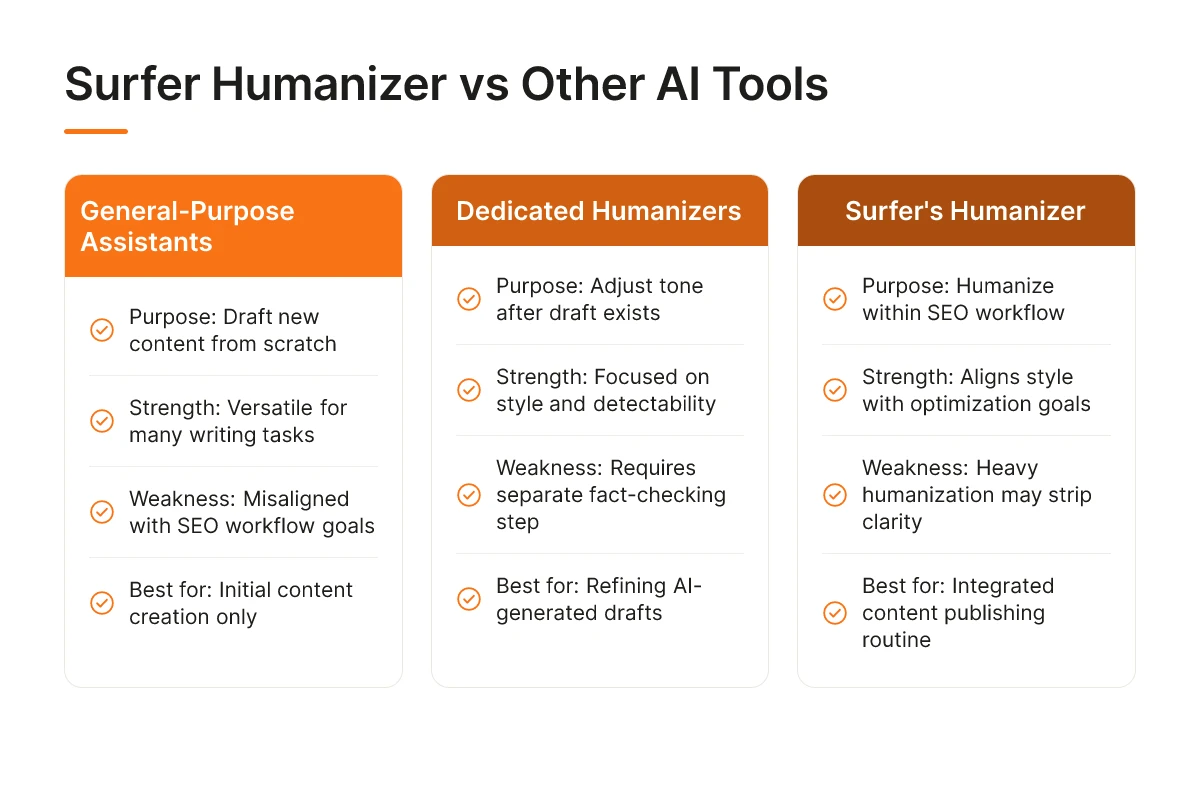
Surfer's Humanizer vs Other AI Humanization Tools for AI SEO
A general-purpose AI writing assistant drafts content; a dedicated humanizer rewrites what's already there to sound less machine-generated, they solve different problems at different stages.
Confusing the two is where most small business owners waste time, running finished blog posts through a generic paraphrasing tool that has no idea what keyword the page is supposed to rank for.
What Makes an SEO-Integrated Humanizer Different for SMBs?
A humanizer built inside an SEO workflow can adjust sentence rhythm and tone while keeping the target keywords, headers, and content structure the page needs to rank. Surfer's version, for example, sits alongside its content editor and keyword scoring, so the humanization pass happens in the same place where the SEO score is being tracked [3]. A standalone humanizer tool, by contrast, only sees the raw text, it has no visibility into search intent, competitor benchmarks, or the keyword density a page is targeting.
That gap matters for surfer seo ai humanizer use cases specifically. A shop owner running product descriptions through an isolated humanizer risks smoothing over the exact phrases customers search for, just to sound more natural. You can compare Surfer's own tool directly against generic alternatives using its free AI humanizer, which keeps SEO scoring visible during the rewrite.
The trade-off runs both ways. Heavier humanization often strips out the specific numbers, product names, and technical details that make content credible to both readers and AI systems, the same specificity that helps a page get cited by ChatGPT or Perplexity in the first place. Surfer's own documentation frames the tool as preserving "original intent and style" during rewrites [3], but any automated rewrite still needs a human pass afterward to confirm nothing load-bearing got smoothed away.
No humanizer, including Surfer's, guarantees getting past every detector every time. Detection models retrain constantly, and humanization tools adjust in response, it's an ongoing back-and-forth rather than a solved problem. Surfer's own AI detector product exists partly because that arms race keeps moving [2], which is a reasonable admission that no single pass of humanization is a permanent fix.
For businesses trying to build durable AI search visibility rather than sneak one article past a checker, the more reliable path is content built to sound credible from the first draft, with citations, specificity, and structure a detector never needed to flag.
Can You Bypass AI Detection While Keeping Content Useful for AI Search?
No, not reliably, and chasing that goal can actively work against getting cited. A humanizer that scrubs "AI-sounding" phrasing doesn't make your content more useful to ChatGPT or Perplexity; those are two different problems with two different fixes.
The detection side is a moving target. AI detectors retrain regularly to catch the patterns that humanizer tools produce, so text that passes a checker today can get flagged in three months without a single word changing. Treating any surfer seo ai humanizer output as permanently "safe" misunderstands how these tools work, you're optimizing against a score, not a fixed standard.
When Do AI Humanizers Fail to Fool Detection Tools?
Humanizers tend to fail right when they succeed too well at their stated job: smoothing out sentence structure until the content reads as generic rather than as generated. That's the trade-off. Text engineered to dodge detection often gets vaguer, softer verbs, hedged claims, fewer specifics, because specificity is exactly the kind of "confident, structured" pattern detectors were trained to flag as machine-made.
That same vagueness is what makes AI search engines less likely to quote you. ChatGPT and Perplexity pull answers from content that states something concrete and checkable, a number, a named example, a clear step. A paragraph rewritten to sound softer and more "natural" often loses those anchors, which means it becomes less citable at the exact moment it becomes harder to detect.
For a business trying to get recommended in AI search results, usefulness should outrank undetectability. Specific answers, real examples, and a clear structure earn citations. A passing score on one detector earns nothing if the sentence underneath doesn't say anything worth quoting.
A practical check before publishing: read the humanized paragraph aloud and ask whether it still sounds like something a person who runs this business would actually say. If it reads like it's dodging a test rather than answering a question, rewrite it for clarity first and worry about detection scores second. Moonrank's daily content generation is built around that priority, publishing structured, specific answers about your business rather than optimizing sentences to slip past a detector that will look different next quarter.
Building AI Humanization Into a Daily SEO Workflow
Humanization only helps if it sits inside a repeatable routine, draft, humanize, fact-check, format for direct answers, publish, monitor, not a one-time fix before hitting publish.
Treat each piece of content as passing through six checkpoints:
- Draft with an AI writing tool based on your keyword and competitive research.
- Humanize with a tool like a surfer seo ai humanizer to smooth robotic phrasing and vary sentence rhythm, this is the step most SMBs mean when they search for a surfer seo ai humanizer setup, since a Surfer subscription bundles the humanizer with its content editor [3].
- Fact-check every claim, statistic, and product detail, humanizers rewrite style, not accuracy, so this step catches errors the tool won't.
- Restructure the top of the article so it answers the core question directly, since AI engines pull concise, well-formatted answers over buried prose.
- Publish the finished piece.
- Monitor how the piece performs in both Google rankings and AI search mentions.
Should Humanization Be Part of an Automated Daily Content Workflow?
Yes, but only as one step among several, because consistent daily publishing matters more for AI search visibility than any single perfectly humanized article.
AI search engines like ChatGPT and Perplexity favor sites that show sustained topical coverage over time, not a single standout post. A store owner who publishes three solid, humanized articles a week for six months builds far more citation opportunities than one who spends weeks polishing a single piece. Humanization keeps each article from reading as obviously machine-written, but volume and regularity are what build the footprint AI engines actually draw from.
Weighing the cost of a humanization tool against the time it saves is worth doing honestly. Budget-friendly tools handle basic rewrites but often need manual review. Mid-range tools catch more of the robotic patterns automatically. Premium options bundle humanization with detection scoring and editing suggestions, cutting review time further. For a solo founder, the real cost isn't the subscription, it's the hours spent manually rewriting, fact-checking, and formatting every post by hand.
That's the bottleneck worth automating first. Moonrank handles the drafting, humanization-adjacent editing, fact-checking against your business details, direct-answer formatting, publishing, and visibility monitoring as one daily automated sequence, so the workflow runs without you touching each step manually, at a fraction of what a typical agency retainer costs for comparable output.

Frequently Asked Questions
What's the ROI of investing in AI humanization tools compared to other AI SEO tactics?
Humanizing text alone rarely moves visibility on its own; technical trust signals and consistent publishing tend to matter more for AI search results. A tool like Surfer's humanizer [1] can smooth out awkward phrasing cheaply, but it does nothing for schema markup, citations, or llms.txt configuration, the elements AI engines actually use to verify a business is real and trustworthy. Budget for humanization as a small polish step, not your primary AI visibility investment.
Is there a trade-off between making content undetectable and keeping it useful for AI search rankings?
Yes, over-optimizing for detector-evasion can strip out the specific, factual detail that makes content citable by AI search engines. Surfer's own documentation notes the humanizer aims to preserve "original intent and style" while keeping SEO elements intact [3]. Prioritize accuracy and concrete detail over sounding maximally human.
Do AI search engines like ChatGPT actually check content against AI detectors before citing it?
There's no public evidence that ChatGPT or Perplexity run submitted pages through AI-detection software before citing them. Detectors like Surfer's [2] are built to flag AI authorship for human reviewers, editors, teachers, publishers, not as a filter inside a search engine's retrieval pipeline. What these engines do check is whether a page's facts, structure, and citations look trustworthy, which is a separate question from detector scores.
How often should SMBs re-check humanized content against detection tools?
Check new pages once before publishing, then re-check only after major rewrites or when detector models update. Detection algorithms change frequently, so a page that passed six months ago may score differently today. Ongoing rechecking matters less than making sure the content stays factually accurate and useful.
Can a surfer seo ai humanizer replace the need for a human editor entirely?
No. A surfer seo ai humanizer adjusts tone and sentence rhythm, but it can't verify facts, confirm your business details are accurate, or judge whether the content actually answers what a searcher needs. Treat it as a drafting assistant that still requires a human pass for accuracy, structure, and whether the piece earns a citation on its own merit.

Conclusion
Passing an AI detector doesn't guarantee ChatGPT or Perplexity will recommend your business, those engines look for accurate, well-structured, verifiable content, not "human-sounding" prose. Treat humanization as a light polish step, and put real budget behind technical trust signals: schema markup, llms.txt, citations, and consistent publishing. If manually managing all of that sounds like another part-time job, Moonrank runs it on autopilot, including AI search visibility tracking across ChatGPT, Gemini, Claude, and Perplexity. Start by checking how your business currently shows up in those tools this week.
Sources & References
- Positive Surfer - Free AI Humanizer
- Positive Surfer - Free AI Detector
- Surfer's Humanizer and AI Detector | Surfer
Recommended Articles
Explore more from our content library:
- How SEO Writer AI Tools Help SMBs Get Cited by ChatGPT
- What Is Citation Velocity and Why It Matters for AI Search
- A Practical Guide to How to Optimize for AI Search Engines
- How Small Businesses Get Recommended by ChatGPT, Perplexity
- Find the Best SEO Agency in Paris, France for Your Business