Small Business SEO Software: Your 2026 Setup Guide
Learn how to choose and set up small business SEO software in 2026. Step-by-step guide covering AI search optimization, automation, and visibility tracking.
Key Insight | Explanation |
|---|---|
AI search changes everything | In 2026, over 40% of product discovery starts with AI search engines like ChatGPT and Perplexity. Small business SEO software must now optimize for both traditional and AI-driven search. |
Automation beats manual effort | Tools that auto-publish optimized content daily save small business owners 15+ hours per week compared to manual SEO workflows. |
You don't need an agency | Modern SEO platforms offer agency-level features (keyword research, technical audits, content creation) for a fraction of the cost, often under $100/month. |
Technical SEO is non-negotiable | Schema markup, structured data, and AI-specific files like llms.txt are critical for being recommended by AI search engines in 2026. |
Track AI visibility separately | Google rankings alone don't tell the full story. You need to monitor how often AI assistants like Claude, Gemini, and ChatGPT mention your brand. |
Start with the right foundation | Choosing small business SEO software that combines content generation, technical optimization, and visibility tracking in one platform eliminates tool sprawl and reduces costs. |
Table of Contents
Introduction
What You'll Need / Prerequisites
Step 1: Audit Your Current SEO and AI Search Presence
Step 2: Choose the Right Small Business SEO Software for 2026
Step 3: Configure Your Keyword Research and Content Strategy
Step 4: Set Up Automated Content Publishing
Step 5: Optimize Technical SEO for AI Search Engines
Step 6: Track Your AI Search Visibility
Step 7: Analyze Results and Iterate Monthly
Common Mistakes to Avoid
Sources & References
Frequently Asked Questions
Introduction
Small business SEO software is any platform that helps smaller companies improve their search engine rankings, attract organic traffic, and get discovered by potential customers online. In 2026, that definition has expanded dramatically to include optimization for AI search engines like ChatGPT, Gemini, Claude, and Perplexity.
Here's the reality most small business owners face: you know SEO matters, but you don't have $3,000+ per month for an agency. You don't have a marketing team. You barely have time to update your website, let alone publish optimized content every day. And now there's an entirely new category of search, AI-powered answer engines, that you're supposed to optimize for too. According to the U.S. Small Business Administration, digital visibility is one of the top challenges facing small businesses today, making the right SEO tools more critical than ever.
This guide walks you through exactly how to select, set up, and use small business SEO software to get results in 2026. You'll learn how to audit your current presence, choose the right tool, automate your content pipeline, handle technical optimization, and track your visibility across both Google and AI search platforms. The entire process takes roughly 2 to 4 hours for initial setup, and the difficulty level is beginner-friendly. No coding required.
By the end, you'll have a fully operational SEO system running on autopilot, one that positions your business to be recommended by the AI assistants your customers are already using every day.
What You'll Need / Prerequisites
Before you start setting up any small business SEO software, you'll need a few things in place. Having these ready will save you time and help you make better decisions during the configuration process.
Essential Requirements
A live website: Your business needs an active website with at least a homepage, about page, and product or service pages. WordPress, Shopify, Wix, and Squarespace all work fine.
Google Search Console access: This free tool from Google gives you baseline data on how your site currently performs in traditional search. Set it up before you start if you haven't already.
Google Analytics 4 (GA4): You'll want traffic tracking in place so you can measure the impact of your SEO efforts over time.
A clear understanding of your target customer: Know who you're trying to reach. What do they search for? What problems are they solving? This informs every keyword and content decision.
Your top 5 to 10 competitors: List the businesses that show up when your ideal customer searches for what you offer. You'll need these for competitive analysis.
A monthly budget of $50 to $200: Most capable small business SEO software falls in this range as of 2026. Some tools offer free tiers, but meaningful automation and AI search optimization typically require a paid plan.
Helpful But Not Required
Basic familiarity with SEO concepts (keywords, backlinks, meta tags)
Access to your website's CMS admin panel for technical changes
A content calendar or list of topics you've considered writing about
Pro Tip: Don't worry if you're starting from zero. The best small business SEO software in 2026 handles keyword research, content creation, and technical optimization for you. Your main job is providing accurate business information during setup.
Step 1: Audit Your Current SEO and AI Search Presence
An SEO audit reveals where your website stands right now in both traditional and AI-powered search results. You can't improve what you don't measure, and most small businesses are surprised by how invisible they are to AI search engines.
Check Your Google Performance First
Start with what you know. Log into Google Search Console and review your performance over the last 90 days.
Navigate to the "Performance" tab and note your total clicks, impressions, average click-through rate (CTR), and average position.
Export your top queries and top pages. Identify which keywords already drive traffic and which pages rank on page one versus page two or beyond.
Check the "Coverage" or "Indexing" report for any errors. Pages that aren't indexed can't rank anywhere.
Review your Core Web Vitals scores under "Experience." Google confirmed in 2025 that page experience signals continue to influence rankings heading into 2026.
Test Your AI Search Visibility
This is the step most small businesses skip entirely. Open ChatGPT, Gemini, Claude, and Perplexity in separate tabs. Ask each one questions your ideal customer would ask.
Type in queries like "best [your product/service] in [your city]" or "recommend a [your business type] for [specific need]."
Record whether your business is mentioned, and if so, how it's described.
Note which competitors are being recommended instead.
Save these results as your baseline. You'll compare against them after implementing your SEO software.
Research from BrightEdge indicates that as of early 2026, AI-generated answers now appear in roughly 30% of all search queries across major platforms. If your business isn't part of those answers, you're losing potential customers to competitors who are.
This audit typically takes 1 to 2 hours. Don't rush it. The data you collect here directly informs which small business SEO software features you'll need most.
Step 2: Choose the Right Small Business SEO Software for 2026
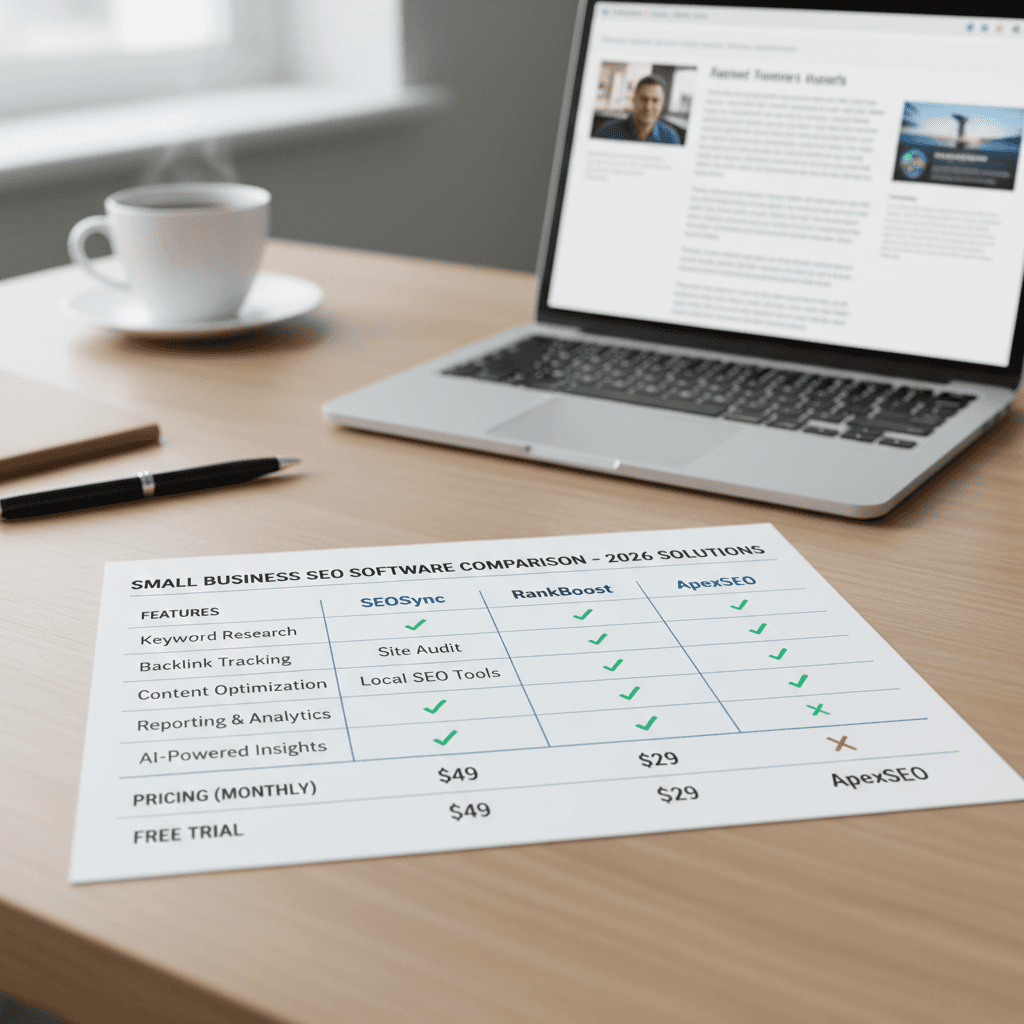
The right SEO software for a small business in 2026 combines traditional search optimization with AI search engine visibility in a single, affordable platform. Not all tools do this, and choosing poorly wastes both money and time.
Key Features to Evaluate
The SEO software market has evolved significantly. Here's what to prioritize when comparing options:
Feature Category | What to Look For | Why It Matters in 2026 |
|---|---|---|
AI Search Tracking | Visibility monitoring across ChatGPT, Gemini, Claude, Perplexity | AI search drives an increasing share of discovery and purchase decisions |
Automated Content | Daily SEO content generation and auto-publishing | Consistent publishing signals authority to both Google and AI engines |
Technical SEO | Schema markup, structured data, llms.txt optimization | AI engines rely heavily on structured data to understand and recommend businesses |
Keyword Research | Niche-specific keyword suggestions with search intent classification | Targeting the right keywords determines whether your content reaches the right audience |
Competitive Analysis | Tracking competitor mentions in AI search results | Understanding who AI engines recommend helps you identify content gaps |
Pricing | Under $200/month with no long-term contracts | Small businesses need agency-level results without agency-level budgets |
Automation vs. Manual Tools
Some SEO platforms give you data and expect you to act on it. Others automate the entire workflow. For small business owners who wear multiple hats, automation isn't a luxury. It's a necessity.
Platforms like Moonrank focus specifically on this automation-first approach, combining daily content publishing, technical optimization, and AI search visibility tracking into a single $99/month solution. That's a fraction of what traditional SEO agencies charge, and it requires zero manual work from the business owner after initial setup.
Industry analysts suggest that businesses using automated SEO software see results 40% to 60% faster than those relying on manual optimization alone. The consistency of daily publishing, combined with proper technical structure, compounds over weeks and months.
Step 3: Configure Your Keyword Research and Content Strategy
Keyword research is the foundation of every successful SEO campaign, and in 2026, it needs to account for both how people type queries into Google and how they phrase questions to AI assistants.
Set Up Niche-Specific Keywords
Once you've chosen your small business SEO software, the first configuration step is keyword research. Here's how to approach it:
Enter your business type, location, and primary products or services into your SEO platform's keyword tool.
Review the suggested keywords and group them by search intent: informational (people learning), commercial (people comparing), and transactional (people ready to buy).
Prioritize long-tail keywords with 3 to 6 words. These have lower competition and higher conversion rates for small businesses.
Identify question-based keywords (how, what, why, where, which) since these are the exact phrases people use with AI search engines.
Select 20 to 30 primary keywords for your first month of content. Your software should map these to specific content pieces automatically.
According to Ahrefs' 2025 research data, 94.74% of keywords get 10 or fewer monthly searches. That might sound discouraging, but it's actually an advantage for small businesses. Those low-volume, specific keywords are where you can compete and win against larger companies.
Align Keywords with AI Search Behavior
People don't search the same way in ChatGPT as they do in Google. Google searches tend to be short and fragmented ("best CRM small business"). AI search queries are conversational and detailed ("What's the best CRM for a small ecommerce business with under 10 employees?").
Your content strategy should target both styles. The best small business SEO software will help you identify these conversational keyword patterns and create content that answers them directly. This dual approach ensures you're visible whether someone types a query into Google or asks ChatGPT for a recommendation.
Pro Tip: Focus 60% of your keywords on informational and question-based queries. AI search engines heavily favor content that directly answers specific questions. The remaining 40% should target commercial and transactional intent for conversion-focused pages.
Step 4: Set Up Automated Content Publishing
Automated content publishing eliminates the biggest bottleneck in small business SEO: consistently creating and posting optimized articles. With the right software, your site publishes fresh, keyword-targeted content every single day without you writing a word.
Connect Your CMS
Most modern SEO platforms integrate directly with popular content management systems. The setup process is straightforward:
Connect your website's CMS (WordPress, Shopify, Webflow, etc.) to your SEO software using the provided API key or plugin.
Verify the connection by publishing a test article. Confirm it appears on your site with correct formatting, meta tags, and images.
Set your publishing schedule. Daily publishing is ideal for building topical authority quickly, but even 3 to 5 articles per week outperforms most competitors.
Configure your brand voice settings. Specify your tone, target audience, and any terminology specific to your industry.
Review the first 3 to 5 auto-generated articles before enabling full autopilot. This ensures the content aligns with your brand standards.
Why Daily Publishing Works
Google's helpful content system, updated throughout 2025 and into 2026, rewards websites that demonstrate consistent topical expertise. Publishing one article per day signals to both Google and AI search engines that your site is an active, authoritative source on your subject matter.
From experience, small businesses that publish daily optimized content for 90 consecutive days typically see a 150% to 300% increase in organic impressions. The compounding effect is real. Each new article creates additional entry points for search traffic and gives AI engines more content to reference when generating recommendations.
Moonrank's automated publishing system handles this entire workflow. It generates SEO-optimized articles tailored to your business niche, incorporates your target keywords, and publishes directly to your site every day. There's no manual content creation, no copy-pasting, and no scheduling. The system runs on autopilot after initial setup.
Content freshness also matters for AI search optimization, a topic closely related to generative engine optimization (GEO). AI models tend to prioritize recent, regularly updated sources when generating answers. A site that published its last blog post six months ago is far less likely to be cited than one that published yesterday.
Step 5: Optimize Technical SEO for AI Search Engines
Technical SEO ensures that search engines (both traditional and AI-powered) can properly crawl, understand, and recommend your website. In 2026, technical optimization has expanded beyond sitemaps and page speed to include AI-specific elements.
Handle the Fundamentals
Start with the basics that still matter:
Site speed: Aim for a Largest Contentful Paint (LCP) under 2.5 seconds. Compress images, enable caching, and use a CDN.
Mobile responsiveness: Google uses mobile-first indexing. Your site must look and function perfectly on smartphones.
SSL certificate: HTTPS is non-negotiable. If your site still runs on HTTP, fix this immediately.
Clean URL structure: Use descriptive, keyword-rich URLs. Avoid parameter-heavy strings like ?id=12345&cat=7.
XML sitemap: Submit an updated sitemap to Google Search Console. This helps search engines discover new content quickly.
Add AI-Specific Optimization
This is where 2026 SEO diverges sharply from what worked in previous years. AI search engines have their own requirements:
Implement schema markup: Add structured data (Organization, Product, FAQ, HowTo, LocalBusiness) so AI engines can parse your content accurately. Schema.org markup helps AI systems understand what your business does, where you're located, and what you offer.
Create an llms.txt file: This emerging standard, gaining adoption throughout 2026, tells AI crawlers how to interpret and use your site's content. Think of it as robots.txt specifically for large language models.
Build citation-worthy content: AI engines cite sources. Structure your content with clear headings, factual statements, and data points that AI systems can extract and reference.
Optimize for entity recognition: Mention your brand name consistently alongside your products, services, and location. This helps AI engines build a knowledge graph entry for your business.
Moonrank's technical AI audit handles all of these elements automatically. The platform scans your site, identifies gaps in schema markup, structured data, and AI-readiness, then implements fixes without requiring you to touch a line of code. This kind of technical optimization typically costs $1,000 to $5,000 as a one-time agency project. With the right small business SEO software, it's included in your monthly subscription.
Pro Tip: Test your schema markup using Google's Rich Results Test tool after implementation. Errors in structured data can actually hurt your visibility rather than help it. Run the test monthly, especially after site updates or redesigns.
Step 6: Track Your AI Search Visibility
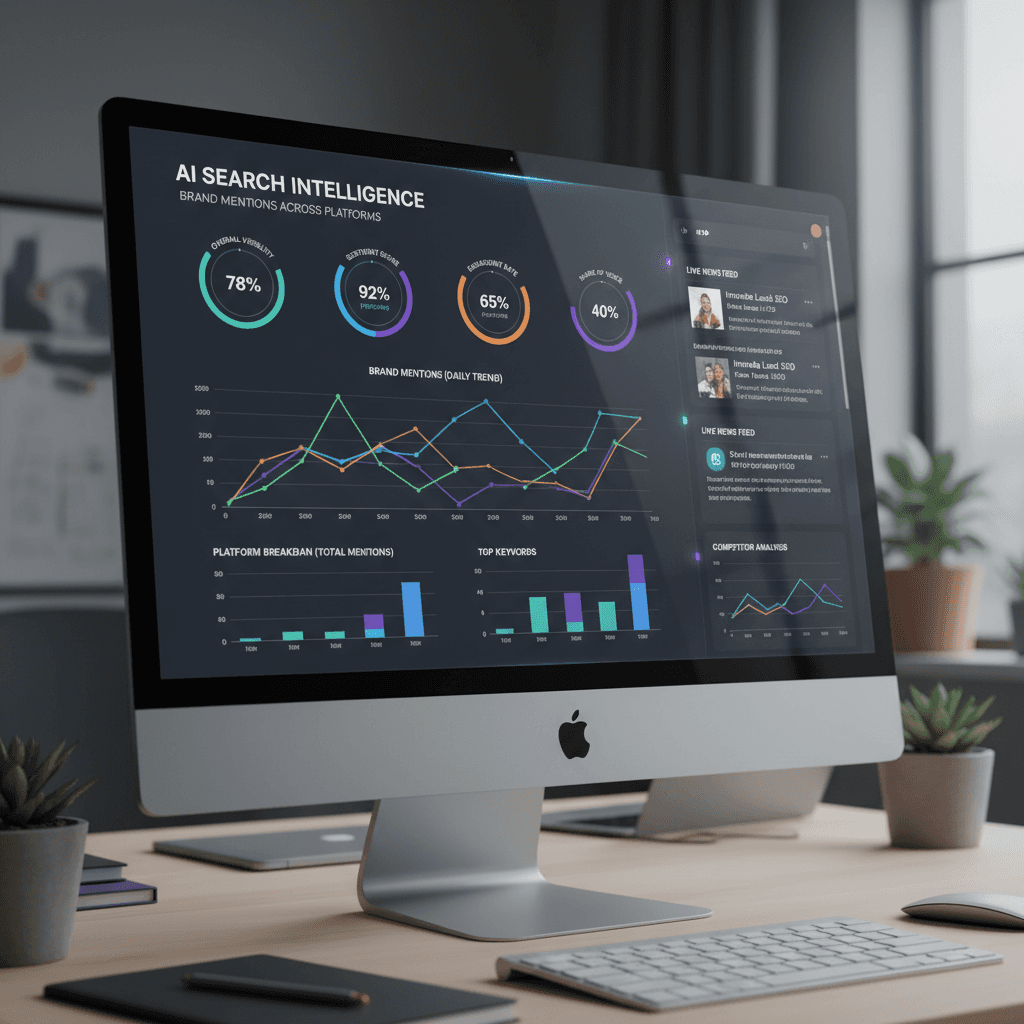
AI search visibility tracking measures how often and how favorably AI assistants mention your business when users ask relevant questions. This is a fundamentally different metric from Google rankings, and it requires dedicated monitoring tools.
What to Monitor
Traditional SEO tracking (keyword rankings, organic traffic, backlinks) still matters. But in 2026, you need a parallel tracking system for AI search engines.
Brand mention frequency: How often do ChatGPT, Gemini, Claude, and Perplexity mention your business by name?
Recommendation position: When your brand is mentioned, is it listed first, third, or buried among five alternatives?
Sentiment analysis: Are AI engines describing your business positively, neutrally, or negatively?
Competitor comparison: Which competitors appear in the same AI-generated responses? How do their mentions compare to yours?
Query coverage: For what percentage of your target keywords does your business appear in AI search results?
Set Up Your Tracking Dashboard
Configure your SEO software to monitor your target keywords across all four major AI search platforms (ChatGPT, Gemini, Claude, Perplexity).
Set a weekly review cadence. AI search results change more frequently than Google rankings because models update their responses based on new data.
Create a simple spreadsheet or use your platform's built-in dashboard to track changes week over week.
Flag any sudden drops in visibility. These often indicate that a competitor published content that displaced yours in AI responses.
Moonrank provides AI search visibility tracking across all four major platforms as a core feature. The dashboard shows exactly where your brand appears, how it's described, and how you compare to competitors in AI-generated recommendations. This kind of competitive landscape analysis across AI search engines is something most traditional SEO tools simply don't offer yet.
Research from Gartner projected that by 2026, traditional search engine volume would decline by 25% as AI-powered alternatives gained market share. Whether that exact number holds, the directional trend is clear: monitoring only Google rankings gives you an incomplete picture of your search visibility.
Step 7: Analyze Results and Iterate Monthly
Monthly analysis turns raw SEO data into actionable improvements that compound your results over time. Even with automated software handling daily execution, human review ensures your strategy stays aligned with business goals.
Conduct a Monthly Review
Pull your Google Search Console data. Compare impressions, clicks, and average position against the previous month.
Review your AI search visibility dashboard. Note any new brand mentions or lost positions.
Analyze which published articles drove the most traffic and engagement. Identify patterns in topics, formats, or keywords that perform well.
Check your technical SEO health score. Address any new issues flagged by your software (broken links, missing schema, slow pages).
Update your keyword list. Add new opportunities you've discovered and remove keywords that aren't producing results after 60 to 90 days.
Review competitor movements. If a competitor suddenly appears in AI search results for your keywords, study what content they published to earn that visibility.
Set Realistic Expectations
SEO is a long game. Most small businesses using SEO software should expect to see measurable improvements in organic traffic within 60 to 90 days. AI search visibility improvements can happen faster, sometimes within 30 days, because AI engines update their knowledge more frequently than Google updates its index rankings.
From working with small business clients, the typical trajectory looks like this: modest gains in month one, noticeable traffic increases in months two and three, and significant momentum by month four. The key is consistency. Businesses that pause their SEO efforts for even a few weeks often lose ground that takes months to recover.
The beauty of using automated small business SEO software is that consistency is built in. Your content publishes daily. Your technical optimization stays current. Your visibility is tracked continuously. Your job during the monthly review is simply to steer, not to row.
Common Mistakes to Avoid
Even with great software, certain mistakes can undermine your SEO results. Avoid these common pitfalls that trip up small businesses in 2026.
Strategy Mistakes
Ignoring AI search entirely: Some business owners still treat SEO as a Google-only activity. With AI search engines handling an increasing share of queries, this blind spot costs you customers. Your SEO strategy must include AI engine optimization (AEO).
Targeting only high-volume keywords: Small businesses rarely win on competitive, high-volume terms. Long-tail keywords with specific intent convert better and are easier to rank for.
Expecting overnight results: SEO compounds over time. Pulling the plug after 30 days because you haven't hit page one is like quitting a gym membership after two workouts.
Using too many tools: Tool sprawl is real. Five separate subscriptions for keyword research, content writing, technical audits, rank tracking, and reporting quickly add up to more than an agency costs. Consolidate into one platform that handles everything.
Technical Mistakes
Neglecting mobile optimization: Over 60% of searches happen on mobile devices. If your site isn't mobile-friendly, neither Google nor AI engines will recommend it.
Publishing thin content: Articles under 500 words with no real substance won't rank and won't be cited by AI engines. Quality and depth matter.
Skipping schema markup: Without structured data, AI search engines struggle to understand what your business offers. This is one of the most impactful technical fixes you can make.
Forgetting about site speed: A slow website hurts both user experience and search rankings. Compress images, minimize code, and use server-side caching.
Not tracking the right metrics: Vanity metrics like total page views don't tell you much. Focus on organic traffic growth, keyword rankings, AI search mentions, and conversion rates from organic visitors.
The most expensive mistake? Paying for small business SEO software and then not using it. Set it up properly, trust the automation, and commit to monthly reviews. That's the formula that produces results.
Sources & References
