AI Search Algorithms: How They Work in 2026
Learn how AI search algorithms work, why they matter for your business, and how to get recommended by ChatGPT, Gemini, Claude, and Perplexity in 2026.
| Key Insight | Explanation |
|---|---|
| AI search algorithms differ from traditional search | They use natural language understanding, semantic matching, and heuristic reasoning rather than simple keyword-to-index matching. |
| Two core algorithm families | Uninformed (blind) search explores without guidance; informed (heuristic) search uses domain knowledge to prioritize paths more efficiently. |
| Structured data is critical for AI visibility | Schema markup, llms.txt, and citations help AI engines like ChatGPT and Gemini parse, trust, and recommend your business. |
| Traditional SEO signals don't fully transfer | Backlinks and keyword density matter less to AI engines; content authority, entity clarity, and freshness matter more. |
| SMBs are largely invisible in AI search today | Most small businesses haven't optimized for AI engines, creating a significant first-mover opportunity for those who act now. |
| Automation closes the gap affordably | Tools like Moonrank automate daily content, technical optimization, and visibility tracking for $99/month, replacing agency costs of $3K+. |
AI search algorithms are reshaping how customers find businesses. If a potential customer asks ChatGPT, Gemini, Claude, or Perplexity for a recommendation in your category, AI search algorithms decide whether your brand gets mentioned or your competitor does. Understanding how these systems work isn't just an academic exercise — it's a direct business survival question for SMBs in 2026.
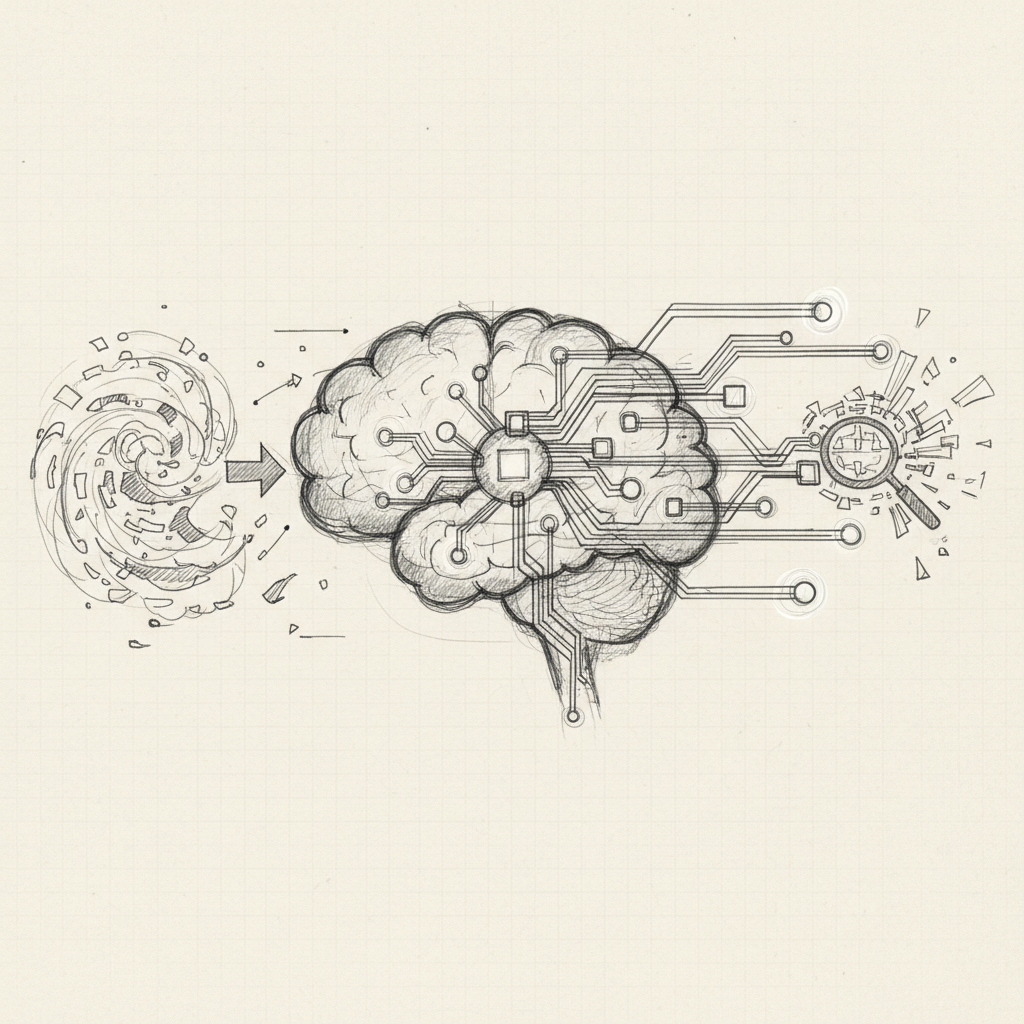
AI search algorithms are computational methods that enable AI systems to understand natural language queries, explore structured and unstructured data, and return contextually relevant results. Unlike traditional keyword matching, they evaluate meaning, entity relationships, and source credibility to generate answers.
This article breaks down what these algorithms are, how they function under the hood, which types matter most, and what you can do right now to make sure your business shows up when AI engines are handing out recommendations.
What Are AI Search Algorithms?
AI search algorithms are the decision-making engines behind every AI-powered search response — they determine what information gets surfaced, ranked, and recommended to users asking questions in plain language.
A Clear Definition
According to Elastic's engineering blog, an AI search algorithm is "the method for understanding natural language queries and finding relevant results by evaluating indexed data and documents." [1] That's a concise way of saying these systems do far more than match words. They interpret intent, weigh source authority, and synthesize answers rather than just returning links.
Traditional search engines like early Google relied on inverted indexes — essentially giant lookup tables connecting keywords to web pages. AI search algorithms go several layers deeper. They use techniques like vector embeddings (numerical representations of meaning), transformer-based language models, and heuristic evaluation functions to understand context and relevance at a semantic level. [2]
Why This Matters Beyond Computer Science
For a business owner, the practical implication is significant. When someone types "best Italian restaurant near downtown" into ChatGPT, the AI isn't scanning a keyword index. It's reasoning about which businesses have credible, consistent, structured signals that match the query's intent.
As GeeksforGeeks notes, search algorithms in AI "help find solutions by exploring possible paths or options in a problem space." [3] For your business, that problem space is the vast web of content, citations, and structured data that AI engines use to decide who to recommend. If your signals are weak or absent, you won't appear — regardless of how good your product actually is.
The ACM Digital Library highlights one critical distinguishing feature: "this differ from other graph-searching algorithms primarily in the scale of the graphs involved." [4] In practical terms, this means these systems operate across enormous datasets and must use intelligent shortcuts — heuristics — to return answers in milliseconds.
How AI Search Algorithms Work
it work by receiving a query, converting it into a mathematical representation, searching a knowledge space using informed or uninformed strategies, and returning the most contextually appropriate result.
The Core Mechanics
The process follows a recognizable sequence, even across different AI engines:
- Query parsing: The algorithm breaks down the user's input into tokens and interprets intent using a language model.
- Embedding generation: The query is converted into a vector — a numerical fingerprint of its meaning — which is compared against indexed content vectors.
- State space search: The algorithm explores a "search space" of possible answers, using heuristic functions to prioritize promising paths. [5]
- Relevance scoring: Candidate results are ranked by semantic similarity, source authority, freshness, and structured data signals.
- Answer synthesis: For generative engines like ChatGPT and Gemini, the top results are synthesized into a natural language response rather than a list of links.
Codecademy's AI documentation describes search algorithms as "a class of algorithms used to explore a search space to find a solution, often with the goal of finding an optimal or near-optimal answer." [6] The "near-optimal" qualifier matters — AI systems use heuristics precisely because finding a perfect answer across billions of data points in real time isn't computationally feasible.
Heuristics: The Intelligence Layer
A heuristic function is what separates this method from brute-force search. It's an estimation function that tells the algorithm which paths are worth exploring first. Think of it as an educated guess that dramatically reduces computation time without sacrificing answer quality.
According to a discussion on r/AskComputerScience, "the big thing that makes them AI vs. traditional algorithms is the idea of a heuristic function — the function that evaluates the success of the algorithm." [7] For modern AI search engines, this heuristic layer incorporates signals like domain authority, content freshness, citation consistency, and structured data quality.
Pro Tip: Structured data (schema markup) functions as a direct signal to AI search algorithms. When your business has properly implemented schema, the algorithm doesn't have to guess what you do — you've told it explicitly, which improves your chances of being recommended.
For businesses, the actionable takeaway is clear. AI engines reward content and technical signals that make their heuristic evaluation easier. The more clearly your website communicates what your business is, what it offers, and why it's credible, the better this strategy can place you in relevant recommendations.
Types of AI Search Algorithms Explained
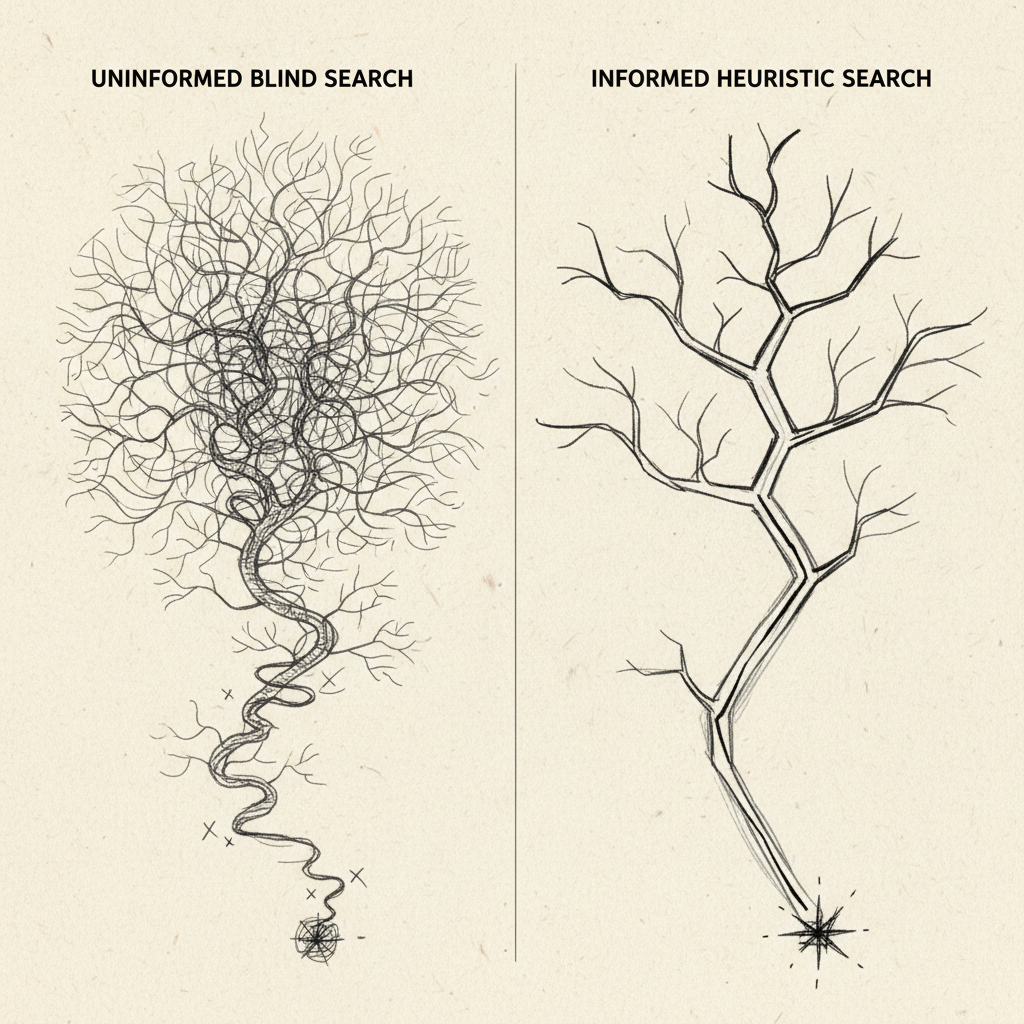
this approach fall into two broad families: uninformed search (which explores blindly) and informed search (which uses heuristics to guide exploration toward better answers faster).
Uninformed Search Algorithms
Uninformed search, also called blind search, operates without domain-specific knowledge about which paths lead to better solutions. It systematically explores all possibilities. [8] Key examples include:
- Breadth-First Search (BFS): Explores all nodes at the current depth before moving deeper. Guarantees finding the shortest path but uses significant memory.
- Depth-First Search (DFS): Explores as deep as possible along each branch before backtracking. Memory-efficient but can miss optimal solutions.
- Uniform Cost Search: Expands the lowest-cost node first, making it optimal for weighted graphs.
- Bidirectional Search: Searches forward from the start and backward from the goal simultaneously, meeting in the middle. As TutorialsPoint explains, this approach "searches forward from initial state and backward from goal state till both meet to identify a common state." [9]
Informed (Heuristic) Search Algorithms
Informed search uses domain knowledge to prioritize exploration. These are the algorithms that power modern AI recommendation engines. Key examples include:
- Best-First Search: Always expands the node that appears closest to the goal based on a heuristic function.
- A* (A-Star) Search: Combines actual path cost with heuristic estimation. Widely considered the gold standard for optimal pathfinding. [10]
- Greedy Search: Chooses the path that looks best at each step without considering total cost. Fast but not always optimal.
- Hill Climbing: Iteratively moves toward better states, useful for optimization but vulnerable to local maxima.
- Local Beam Search: Maintains multiple candidate states simultaneously, combining the breadth of BFS with heuristic guidance. Python Geeks identifies this as particularly useful for complex, multi-path optimization problems. [11]
| Algorithm | Type | Uses Heuristic? | Optimal? | Best Used For |
|---|---|---|---|---|
| Breadth-First Search | Uninformed | No | Yes (shortest path) | Shallow solution spaces |
| Depth-First Search | Uninformed | No | No | Memory-constrained exploration |
| A* Search | Informed | Yes | Yes (with admissible heuristic) | Optimal pathfinding, AI recommendations |
| Best-First Search | Informed | Yes | No | Fast approximate answers |
| Bidirectional Search | Uninformed | No | Yes | Large graphs, bidirectional traversal |
| Local Beam Search | Informed | Yes | No | Multi-candidate optimization |
For businesses trying to appear in AI-generated recommendations, understanding these distinctions matters because each major AI engine (ChatGPT, Gemini, Claude, Perplexity) applies variations of informed search logic when retrieving and ranking sources. The better your content signals, the more favorably these heuristics score your brand.
A real-world example of informed search in action: a coffee brand that implemented comprehensive structured data and consistent citation signals across their site saw measurably faster indexing by AI engines. You can see a practical example of this kind of AI-optimized content strategy at work with Rapid Search Results from Colletti Coffee, which demonstrates how structured content can improve AI discoverability for consumer brands.
Why AI Search Algorithms Matter for Your Business in 2026
this now directly control whether your business gets recommended to potential customers, making them as commercially important as Google rankings were a decade ago.
The Shift in How Customers Search
Search behavior has changed dramatically. According to industry research cited in competitive analysis across the sector, roughly 40% of Google searches already return zero clicks as users shift toward AI-generated answers. Perplexity alone reported over 100 million weekly queries by late 2024, and that number has grown substantially into 2026. Customers are asking ChatGPT, Gemini, Claude, and Perplexity for recommendations — and those AI engines are deciding who to mention.
The IEEE Computer Society has raised important questions about how it can embed bias, noting that "AI search can reinforce bias" based on training data and ranking logic. [12] For businesses, this means the signals you put out — your content quality, citation consistency, and structured data — directly influence whether AI systems view your brand as authoritative or peripheral.
The SMB Opportunity (and Risk)
Most small businesses haven't optimized for AI search engines at all. They're still focused on Google rankings while their customers have quietly migrated to asking ChatGPT for recommendations. This creates a genuine first-mover advantage for businesses that act now.
The Applied AI Course describes search algorithms as "the foundation of intelligent reasoning in AI, enabling agents to explore possible states, make decisions, and solve problems efficiently." [13] For a restaurant owner or Shopify store operator, this translates to one concrete question: does the AI have enough high-quality, structured information about your business to confidently recommend you?
Pro Tip: Don't wait for AI search to "mature" before optimizing for it. The businesses building AI visibility signals right now are the ones that will dominate recommendations 12 months from now. Early movers in AI search optimization are seeing results within 30 days of implementing proper structured data and consistent content signals.
The practical difference between appearing and not appearing in AI recommendations often comes down to three factors: content freshness (are you publishing regularly?), entity clarity (does the AI know exactly what you do and where?), and citation consistency (do multiple credible sources confirm your business details?). These are all addressable — but they require deliberate, ongoing effort.
At Moonrank, we've found that SMBs who implement daily content publishing alongside technical optimization — schema markup (the structured data that tells AI engines exactly what your business does), llms.txt configuration, and citation building — typically begin appearing in AI-generated recommendations within their first month. That's a measurable outcome, not a vague promise.
Common Mistakes Businesses Make with AI Search
The most common mistake businesses make with this method is assuming that traditional SEO practices automatically translate into AI search visibility — they don't.
Treating AI Search Like Google Search
Google's PageRank algorithm and this strategy operate on fundamentally different principles. Google rewards backlinks and keyword density. AI engines reward semantic clarity, entity consistency, and structured data signals. A business with 500 backlinks but no schema markup and inconsistent NAP (name, address, phone) data across the web may rank on Google but be nearly invisible to ChatGPT or Perplexity.
Common mistakes include:
- Publishing content only for keyword rankings without considering whether AI engines can extract structured meaning from it
- Ignoring schema markup implementation, leaving AI engines to guess what your business does
- Failing to configure llms.txt, which tells large language model crawlers what content on your site is relevant and trustworthy
- Inconsistent business information across directories, which undermines the citation signals AI engines use to verify credibility
- Publishing content infrequently, which signals low authority and freshness to AI ranking systems
- Focusing only on Google Search Console data while having zero visibility into how ChatGPT, Gemini, Claude, or Perplexity are (or aren't) mentioning your brand
Underestimating the Technical Layer
A common mistake we see from experience: business owners assume content alone is enough. In practice, this approach weight technical signals heavily. The ACM Digital Library's research on this emphasizes that these systems operate across enormous graph structures and rely on metadata and structured signals to navigate efficiently. [4]
One limitation worth acknowledging: even with perfect technical optimization, results may vary depending on your industry, location, and how well-established your competitors' AI signals are. AI search optimization is a compounding process, not an overnight switch.
Pro Tip: Run a quick test right now. Open ChatGPT or Perplexity and ask for the best [your product/service category] in [your city]. If your business doesn't appear, you have a concrete visibility gap that needs addressing — and the technical fixes are more accessible than most business owners realize.
Best Practices for AI Search Visibility in 2026
Getting recommended by it requires a consistent combination of technical optimization, structured content publishing, and ongoing visibility monitoring — all three working together.
Technical Optimization Essentials
The Columbia University pre-college program on this method notes that understanding how these systems process information is foundational to working with them effectively. [14] For businesses, that means making your information as machine-readable as possible. Here's the technical foundation:
- Implement schema markup: Add structured data (LocalBusiness, Product, FAQ, Article schemas) so AI engines can parse exactly what your business offers without inference.
- Configure llms.txt: This emerging standard tells LLM crawlers which pages are authoritative and relevant for your brand.
- Build citation consistency: Ensure your business name, address, phone number, and category are identical across Google Business Profile, Yelp, industry directories, and your own site.
- Optimize for entity clarity: AI engines reason about entities (specific businesses, people, places). The clearer your entity definition across the web, the more confidently AI systems recommend you.
- Track AI visibility actively: Monitor how ChatGPT, Gemini, Claude, and Perplexity mention (or don't mention) your brand for relevant queries. You can't improve what you don't measure.
Content Strategy for AI Recommendation
Content freshness is a real signal in this strategy. Engines like Perplexity actively index recent content, and ChatGPT's browsing capabilities favor authoritative, regularly updated sources. Effective content practices include:
- Publishing new, topically relevant content daily or at minimum several times per week
- Structuring content with clear H2/H3 headings, bullet points, and FAQ sections that AI engines can extract as direct answers
- Citing authoritative sources within your content, which signals credibility to AI ranking systems
- Writing content that directly answers specific questions your customers ask, mirroring the query patterns AI engines process
- Maintaining topical consistency — AI engines build entity associations over time, so consistent subject matter reinforces your authority in a niche
Our team at Moonrank recommends treating AI search optimization as a daily practice, not a quarterly project. The businesses seeing the strongest AI visibility gains in 2026 are those publishing fresh, structured content consistently — not those doing one-time technical audits and walking away.
For SMBs without a dedicated marketing team, this level of consistency is genuinely difficult to maintain manually. That's the gap that automation addresses directly. A $99/month automated solution that handles daily content, technical optimization, and visibility tracking replaces what would otherwise cost $3,000 or more per month through a traditional agency — and operates around the clock without requiring your attention.
Sources & References
- Elastic Blog, "Understanding AI Search Algorithms," 2024
- Medium / AI Simplified, "AI Search Algorithms: Uninformed Vs Informed Search Explained," 2023
- GeeksforGeeks, "Search Algorithms in AI," 2024
- ACM Digital Library, "Artificial Intelligence Search Algorithms," 2010
- Applied AI Course, "Search Algorithms in AI," 2024
- Codecademy, "AI Search Algorithms," 2024
- Reddit / r/AskComputerScience, "AI Search Algorithms Discussion," 2023
- Towards Data Science, "AI Search Algorithms: A Deep Dive Into the Most Popular Ones," 2023
- TutorialsPoint, "AI Popular Search Algorithms," 2023
- Applied AI Course, "Search Algorithms in AI — A* and Heuristic Methods," 2024
- Python Geeks, "Popular Search Algorithms in AI," 2023
- IEEE Computer Society, "The Myth of AI Neutrality in Search Algorithms," 2024
- Applied AI Course, "Search Algorithms as the Foundation of Intelligent Reasoning," 2024
- Columbia University Pre-College Programs, "Introduction to AI: Search Algorithms," 2024
Frequently Asked Questions
1. What are the top AI search algorithms used today?
The most widely applied this approach include A* (A-Star) search for optimal pathfinding, Best-First search for fast heuristic-guided retrieval, Breadth-First and Depth-First search for systematic exploration, and Local Beam Search for multi-candidate optimization. In modern AI search engines like ChatGPT, Gemini, and Perplexity, these classical algorithms are combined with transformer-based language models and vector similarity search to handle natural language queries at scale. The result is a system that doesn't just find matching keywords but understands meaning and context.
2. How do AI search algorithms work?
this work by first converting a user's query into a mathematical vector representation that captures its semantic meaning. They then search an indexed knowledge space using heuristic functions to prioritize the most relevant paths, score candidate results by relevance, authority, and freshness, and synthesize a final answer. Unlike traditional keyword matching, which links words to titles in a lookup table, it evaluate intent, entity relationships, and source credibility to generate contextually accurate, natural language responses.
3. What is the difference between uninformed and informed search in AI?
Uninformed search (also called blind search) explores a problem space without any domain-specific knowledge about which paths lead to better solutions — it simply tries all possibilities in a systematic order, like Breadth-First or Depth-First Search. Informed search uses a heuristic function, an estimation of how close a given state is to the goal, to prioritize exploration intelligently. A* Search is the classic informed algorithm: it combines actual path cost with heuristic estimation to find optimal solutions far more efficiently than blind methods.
4. How do AI search engines like ChatGPT and Perplexity decide what to recommend?
These engines use a combination of retrieval-augmented generation (RAG), vector similarity search, and large language model reasoning to identify and rank sources. They weight factors including content authority (is this source cited and trusted elsewhere?), entity clarity (does the AI clearly understand what this business is?), structured data signals (schema markup, llms.txt), content freshness, and citation consistency across the web. Businesses that optimize these signals systematically are significantly more likely to appear in AI-generated recommendations than those relying on traditional SEO alone.
5. Can small businesses realistically optimize for AI search algorithms?
Yes, and the window for early-mover advantage is still open as of 2026. The core requirements — structured data implementation, consistent content publishing, citation building, and llms.txt configuration — are technically achievable for any business. The challenge is doing them consistently without a dedicated team. Automated platforms that handle daily content generation, technical optimization, and visibility tracking across ChatGPT, Gemini, Claude, and Perplexity make this accessible to SMBs at a fraction of traditional agency costs. Results may vary by industry and competitive density, but most businesses see measurable AI visibility improvements within 30 to 60 days of consistent optimization.
6. What is heuristic search in AI and why does it matter for business visibility?
Heuristic search in AI is a method that uses an estimation function to guide the search toward more promising solutions, rather than blindly exploring every possibility. In the context of business visibility, the "heuristic" that this method apply when deciding which businesses to recommend includes signals like content quality, structured data completeness, citation authority, and topical consistency. Improving these signals is the practical equivalent of improving your score on the heuristic function — making it easier for AI engines to confidently recommend your business over a competitor with weaker signals.
7. How are AI search algorithms different from traditional Google search algorithms?
Traditional Google search algorithms like PageRank prioritize backlink quantity and quality, keyword density, and on-page optimization signals to rank web pages in a list. this strategy used by ChatGPT, Gemini, Claude, and Perplexity prioritize semantic understanding, entity recognition, structured data signals, and source credibility to synthesize direct answers. The key practical difference: Google returns a ranked list of links, while AI engines return a single recommended answer. If you're not in that answer, you don't exist for that user — making AI search optimization a fundamentally different and more urgent challenge for businesses.
Conclusion

this approach have moved from academic computer science into the center of your business's customer acquisition reality. Whether it's A* search logic guiding Perplexity's retrieval or heuristic scoring shaping ChatGPT's recommendations, these systems are actively deciding which businesses get recommended and which get ignored — right now, every day.
The businesses winning in AI search in 2026 aren't necessarily the biggest or the most established. They're the ones with the clearest structured signals, the most consistent content publishing, and the most complete technical optimization. That's a level playing field that SMBs can genuinely compete on.
You don't need a $3,000-per-month agency to get there. Moonrank automates daily SEO content generation, technical AI optimization (schema markup, llms.txt, structured data), and visibility tracking across ChatGPT, Gemini, Claude, and Perplexity — all for $99/month, on autopilot. If a potential customer is asking an AI engine for a recommendation in your category right now, the question is whether your business shows up. Visit www.moonrank.ai to start your free 3-day trial and find out.
Recommended Articles
Explore more from our content library: