How to Improve Domain Authority: A Step-by-Step Guide (2026)
Learn how to improve domain authority with proven tactics: earn quality backlinks, publish E-E-A-T content, and fix technical SEO issues for lasting gains.

Understanding how to improve domain authority is essential. To improve domain authority, focus on earning high-quality backlinks from reputable sites, publishing authoritative content that demonstrates E-E-A-T signals, and removing toxic links that drag your score down. Domain authority (DA) is a third-party metric, not a Google ranking factor, but it reliably correlates with organic visibility. Most sites see measurable DA gains within 3–6 months of consistent link-building and technical SEO work.
Understand How to Improve Domain Authority Before You Start
Domain authority is a third-party score, not a Google signal, but it reliably proxies the trust factors that do drive rankings, making it a useful planning tool.
Moz's Domain Authority (DA) and Ahrefs' Domain Rating (DR) both run on a 0–100 logarithmic scale, which means moving from 10 to 20 is far easier than moving from 60 to 70 [2]. The two scores measure slightly different things: DR weights the count of unique referring domains more heavily, while DA factors in link quality and MozRank, Moz's internal measure of link equity. Track whichever metric your existing SEO tool reports natively, but monitoring both gives you a fuller picture of where your link profile stands.
Google has confirmed repeatedly that it does not use DA or DR as direct ranking signals [2]. Both metrics correlate with rankings because they proxy the same underlying trust signals, link equity, site credibility, and topical relevance, that Google's own algorithms do measure. According to Moz's research on Domain Authority, sites that focus on earning editorially placed links from topically relevant domains see the most consistent score improvements over time.
Domain Authority vs Domain Rating: Which Metric Matters More in 2026?
| Metric | Tool | Primary Signal | Best Used For |
|---|---|---|---|
| Domain Authority (DA) | Moz | Link quality + MozRank | Comparing sites in the same niche |
| Domain Rating (DR) | Ahrefs | Referring domain count | Gauging raw link volume vs. competitors |
Realistic benchmarks vary by industry. E-commerce sites typically sit at DA 20–40 before any paid link campaigns; SaaS companies often reach DA 50–70 through product-led PR and digital press coverage; news sites can hit DA 70+ within two years by earning editorial links at scale [1]. Use these ranges to set targets before you start, not after.
How E-E-A-T Signals Beyond Backlinks Shape Your Score
Google's E-E-A-T framework, Experience, Expertise, Authoritativeness, and Trustworthiness, influences perceived authority through signals that go well beyond your backlink count [1]. According to Search Engine Journal's analysis of E-E-A-T, structured author credentials and brand entity signals are increasingly weighted in how search systems assess overall site credibility.
Named author credentials on published content, brand mentions in authoritative publications, and your entity relationships inside Google's Knowledge Graph all contribute to how search systems assess your site's credibility. Structured data markup, the code that tells Google exactly who you are and what your business does, strengthens those entity connections directly.
When planning how to improve domain authority, treat these signals as a parallel track alongside link-building. A site with 200 high-quality backlinks and clear author bios, consistent brand citations, and properly implemented schema markup will outperform a site with the same link count but none of those trust signals in place.
"Domain Authority is best understood as a competitive metric — it tells you how your link profile compares to others in your space, not how Google directly ranks you. The sites that improve DA fastest are those that earn links as a byproduct of genuinely useful content." — Cyrus Shepard, Former Director of Audience Research at Moz
Build High-Quality Backlinks That Actually Move the Needle
One contextual link from a DA 60 industry blog does more for your domain authority than 50 generic directory submissions, link quality, not volume, drives score movement [2].
According to Moz's research on improving Domain Authority, link quality accounts for the majority of DA score movement. Target domains with a DA of 40 or above in your specific niche, and prioritize links embedded in relevant editorial content over footer links, sidebar placements, or low-effort citation sites. Research from Semrush's website authority study found that pages ranking in the top three positions on Google have, on average, 3.8 times more backlinks than those ranking in positions four through ten — underscoring how dramatically link volume and quality separate top performers from the rest.
Three tactics worth your time, ranked by effort-to-impact ratio:
- Digital PR and data-driven studies, publish original research or survey data that journalists want to cite. High impact, high effort. A single feature in a trade publication can generate dozens of editorial backlinks.
- Broken link building, find dead links on authoritative pages in your niche using Ahrefs or Moz, then pitch your content as a replacement. Medium impact, low effort.
- Guest posting on niche-relevant sites, write for publications your target audience already reads. Medium impact, medium effort. Relevance matters more than raw DA here.
Link-Building Strategies by Industry: E-Commerce, SaaS, and News Sites
Different site types face different link-building constraints. E-commerce stores should target product review roundups and supplier "where to buy" pages, these links are topically tight and convert well. SaaS companies should pursue integration partner pages and tool directories like G2 and Capterra, where a listing doubles as a backlink and a lead source. News and media sites benefit most from HARO-style journalist outreach, where speed and credibility of the source determine whether you get cited.
How to Identify and Remove Toxic Backlinks That Harm Your DA
Run your backlink profile through Ahrefs' Toxic Score filter or Moz's Spam Score to flag links from link farms, scraped sites, or irrelevant foreign directories. Export the flagged URLs and review them manually, not every low-DA link is harmful.
Google's John Mueller has stated publicly that disavowing is rarely necessary unless your site is under a manual penalty. For most sites, Google's algorithm already discounts spammy links. Disavow only when you see a confirmed manual action or a sharp, unexplained traffic drop that correlates with a toxic link cluster.
Internal linking also plays a role in how to improve domain authority, it distributes link equity from your strongest pages across the rest of your site. If you're building your SEO foundation from scratch, our DIY SEO for Small Business guide covers internal linking structure in detail. For more information, see Enso.
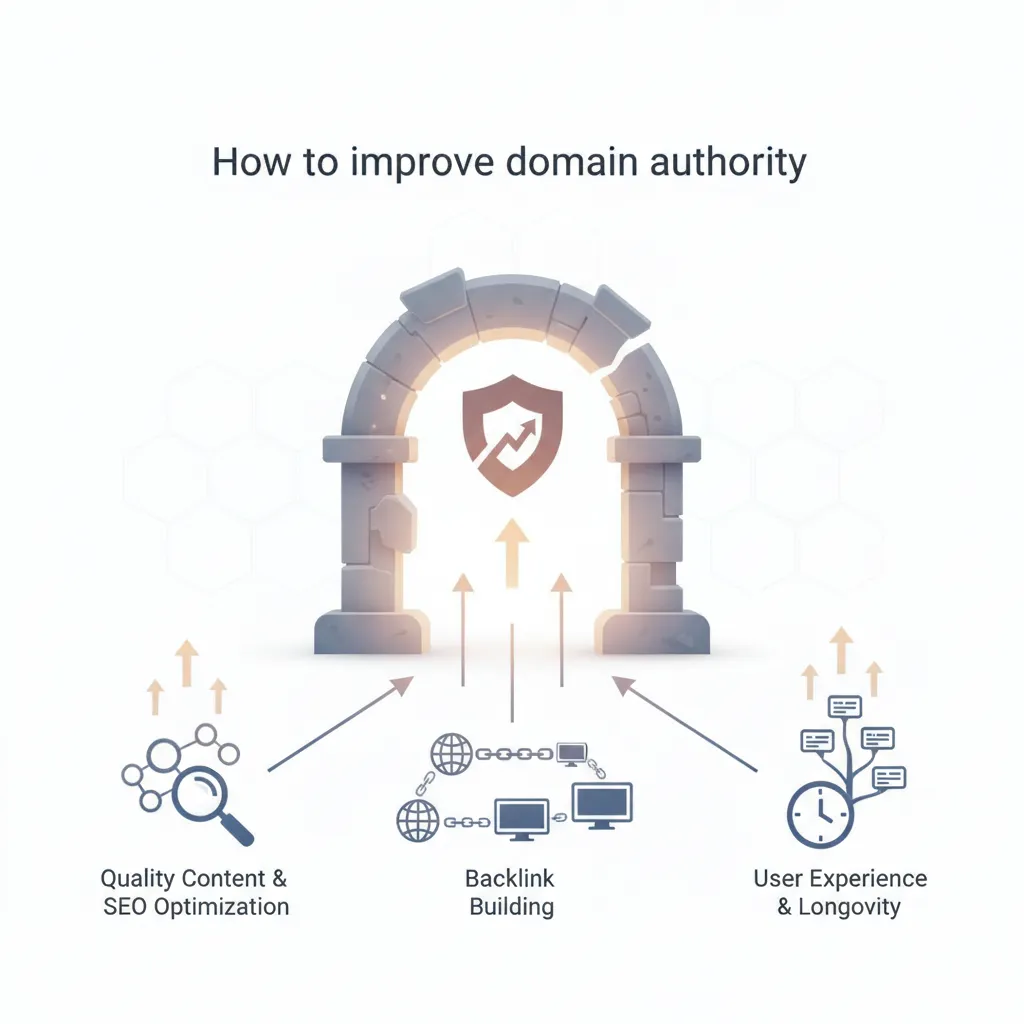
Publish Content That Earns Authority Signals Consistently
Publishing one authoritative, link-worthy piece per week compounds into measurable DA gains, sites that do this typically see a 5–15 point increase within 6 months.
Sites that publish thin content daily tend to plateau or decline. The reason is mechanical: Google's Helpful Content system rewards depth and expertise, not volume. A single well-researched post that earns 10 backlinks does more for your DA trajectory than 30 short posts that earn none.
The content formats that attract the most natural backlinks in 2026 are original research and statistics pages, comprehensive how-to guides, and free tools or calculators. These formats give other sites a concrete reason to cite you, a data point to reference, a method to recommend, or a tool to share with their audience. According to the Pew Research Center's journalism and media consumption studies, content backed by original data and clear sourcing consistently earns higher engagement and more inbound citations than opinion-based content alone.
On-page E-E-A-T signals determine whether your content earns those citations. Named expert authors with linked bio pages, original survey data, cited sources from authoritative domains, and schema markup, Article, Person, and Organization types, tell AI engines like ChatGPT and Perplexity exactly who produced the content and why it's credible [1]. Skipping these signals leaves authority on the table.
AI-generated content without expert review is increasingly flagged by Google's Helpful Content signals. Always add a human expert layer, a named author, a reviewed methodology, or a cited source, before publishing. Tools like Moonrank handle the daily content generation side, but the expert review layer remains your responsibility and your competitive edge.
"The sites that win in search over the long term are those that treat content as an asset, not a commodity. Every piece should be designed to earn a link, answer a question better than anyone else, or establish a data point that others will want to reference." — Rand Fishkin, Founder of SparkToro and Co-Founder of Moz
Realistic Timelines: How Long Does It Take to Increase Domain Authority?
A SaaS startup at DA 18 reached DA 41 in 9 months by publishing two original research posts per month and earning 34 referring domains in the process, a clear before/after case for how to improve domain authority through consistent, citable output.
- Months 1–2: DA moves little or not at all. Crawlers index new content, but referring domains haven't accumulated yet.
- Months 3–4: First backlinks arrive from early citations. DA begins a slow climb, typically 2–5 points.
- Months 5–6: Compounding kicks in. Each new referring domain raises the floor, and older posts accumulate secondary links. DA gains of 5–15 points become realistic [2].
- Months 7–9: Sites with consistent publishing and strong E-E-A-T signals see accelerated gains as domain trust solidifies across Google's index.
Patience is structural here, not optional. DA is a lagging indicator, it reflects link equity that has already been earned, crawled, and processed. Set a 6-month minimum before evaluating whether your content strategy is working.
Avoid Common Mistakes That Stall Domain Authority Growth
Most DA stagnation traces back to five specific errors, each one preventable once you know what to look for.
Mistake 1: Buying Links or Joining Private Blog Networks
Google's SpamBrain algorithm detects unnatural link patterns at scale, and a manual penalty can cut DA by 20–40 points overnight. Recovery typically takes 6–12 months of disavow work and reconsideration requests, time most SMBs cannot afford to lose.
Mistake 2: Ignoring Technical SEO Health
A site with crawl errors, slow Core Web Vitals, or broken internal links bleeds link equity even while earning new backlinks. Run a monthly crawl audit using Screaming Frog or a comparable tool to catch these issues before they compound.
Mistake 3: Over-Optimizing for the DA Number Itself
DA is a proxy metric, not a Google ranking signal [2]. When learning how to improve domain authority, focus on the underlying signals, quality links, strong content, a clean technical profile, and the score follows naturally.
Mistake 4: Panicking Over Short-Term Drops
Moz refreshes its index monthly, and DA can fluctuate ±3–5 points without any change on your end [2]. Only a sustained downward trend across 3 or more consecutive months warrants a full investigation.
Mistake 5: Neglecting Negative SEO Monitoring
Competitors can point spammy links at your domain to trigger a penalty. Set up Google Search Console link alerts and review your disavow file every quarter to catch toxic link campaigns before they register in Moz's next index refresh.
Track and Audit Your Domain Authority Progress Over Time
Monitor DA monthly across at least three tools, track referring domains as your lead metric, and tie score changes to organic traffic data from Google Search Console.
What Tools and Metrics Should You Track to Measure Real DA Progress?
Three tools give you the clearest read on how to improve domain authority over time: Moz Pro (Domain Authority), Ahrefs (Domain Rating), and Semrush Authority Score. Check all three monthly, scores can diverge by 10–20 points depending on each tool's link index, so relying on a single number gives you an incomplete picture.
Beyond the DA score itself, track these four supporting metrics:
- Referring domains, the single most predictive signal of DA growth; a rising unique-domain count consistently precedes score increases.
- Organic keyword rankings, confirms that DA gains are translating into actual SERP movement.
- Organic traffic (Google Search Console), the ground-truth check that score improvements are driving clicks, not just metric changes.
- Branded search volume, a proxy for real-world brand authority that DA scores alone can't capture.
Run this monthly audit workflow to keep the data actionable:
- Export your referring domains report from Ahrefs or Semrush.
- Flag any new domains with a Spam Score above 30 for disavow review.
- Check for lost backlinks from high-DA pages and prioritize reclamation outreach.
- Paste DA, DR, and Authority Score into a shared spreadsheet and compare week-over-week to spot trend breaks early.
Connecting score changes to business outcomes matters more than the number itself. A DA increase from 25 to 45 typically correlates with a 30–60% increase in organic impressions for competitive keywords, based on Ahrefs cohort data, a concrete benchmark worth tracking against your own Google Search Console impression curve.
If you want to automate parts of this workflow, our GEO tools 2026 and AI SEO tools pages cover platforms that pull these signals into a single dashboard without manual exports.
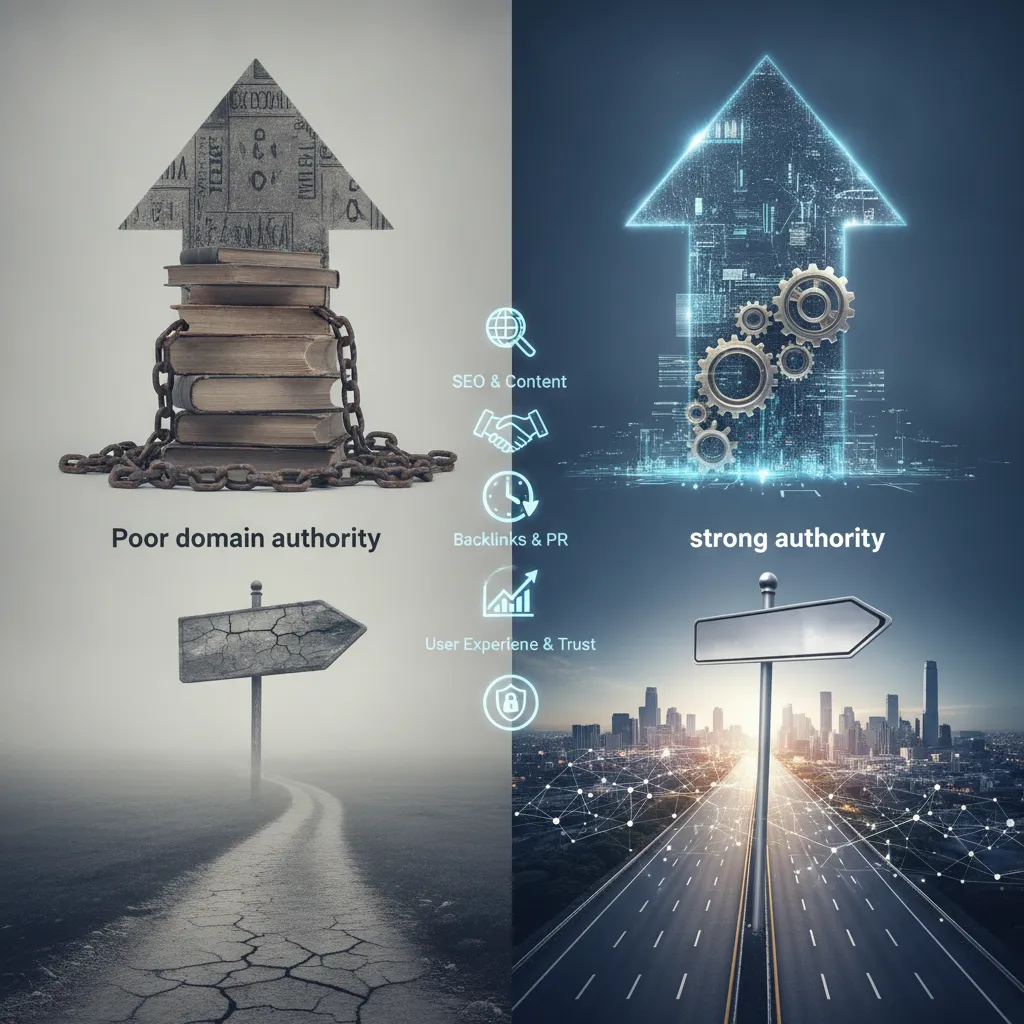
Frequently Asked Questions
Should you prioritize domain authority if Google says it isn't a real ranking factor?
Yes, not because the score itself moves rankings, but because the behaviors that raise it do [2]. Earning backlinks from reputable sites, publishing consistent content, and fixing technical issues all correlate with better search performance. Moz's Domain Authority and Semrush's Authority Score are proxies for link equity and trust signals, not levers Google pulls directly [2]. Treat a rising DA as confirmation that your site is doing the right things, not as the goal itself.
What's a good domain authority score for a new website?
A score between 20 and 30 is a realistic target in the first 12 months for a new site [1]. DA is a relative metric, so what matters more is whether your score exceeds the sites you're competing against in search results. A new local business outranking a DA 25 competitor at DA 22 is winning, even though both scores look modest in isolation.
How does domain authority differ between e-commerce and SaaS sites?
E-commerce sites typically build authority through product review links, affiliate coverage, and press mentions, while SaaS sites earn it through data-driven content, integration partnerships, and industry citations. SaaS companies often reach higher DA scores faster because their content attracts organic backlinks from other businesses. E-commerce sites compensate with volume, more pages, more products, more entry points, but each page needs structured data and clear topical focus to compete.
Can you increase domain authority without building backlinks?
Backlinks remain the strongest driver of DA, but technical improvements and content quality do contribute [1]. Fixing crawl errors, improving Core Web Vitals, and publishing well-structured content can lift your Authority Score incrementally. Without new inbound links, though, your ceiling is low, Google and the metrics that mirror its signals still weight external endorsements most heavily. Think of technical and content work as the floor; backlinks are what raise the ceiling.
How many backlinks do you need to see a meaningful domain authority increase?
There is no universal threshold, but data from Ahrefs suggests that acquiring links from at least 20–30 unique referring domains within a six-month period produces a measurable DA lift for most sites starting below DA 40. Quality matters more than raw count: five editorial links from DA 60+ domains will move your score more than 50 links from low-authority directories. Focus on diversifying your referring domain pool rather than accumulating links from the same handful of sources.

Conclusion
Domain authority improves when you do three things consistently: earn backlinks from sites that are already trusted, publish content that covers your topic with enough depth to attract those links naturally, and keep your technical foundation clean enough that search engines can read and index every page without friction.
Start with the gap that costs you the most right now. If your backlink profile is thin, prioritize one digital PR campaign or partnership this quarter. If your content is scattered across unrelated topics, map it to a tighter cluster before adding more pages.
If you also want your business to appear in AI-generated recommendations from ChatGPT, Gemini, or Perplexity, not just Google, run a free technical audit at moonrank.ai to see where your AI search visibility stands today.
Sources & References
Recommended Articles
Explore more from our content library: