Best Affordable AI Search Optimization Platform for SMBs
Discover affordable AI search optimization tactics to get cited by ChatGPT, Perplexity & Google AI Overviews — for under $100/month in tools.

Affordable AI search optimization means structuring your content so ChatGPT, Perplexity, Google AI Overviews, and Claude recommend your business, without paying agency-level fees. The core tactics cost little to nothing: adding schema markup, publishing clear factual content, and auditing your pages against what AI engines actually cite. Most small businesses can implement a working system for under $100/month in tools.
What You'll Need Before Starting Affordable AI Search Optimization
You need three tools, a one-hour content audit, and a clear target list of AI platforms, that's the full setup for affordable AI search optimization.
Start with this tool stack:
- Google Search Console (free), shows which queries already bring visitors to your site and flags indexing problems that block AI engines from reading your pages.
- Schema.org's Structured Data Markup Helper (free), validates that your schema markup is correctly formatted so ChatGPT, Perplexity, Google AI Overviews, and Claude can parse your business details without guessing.
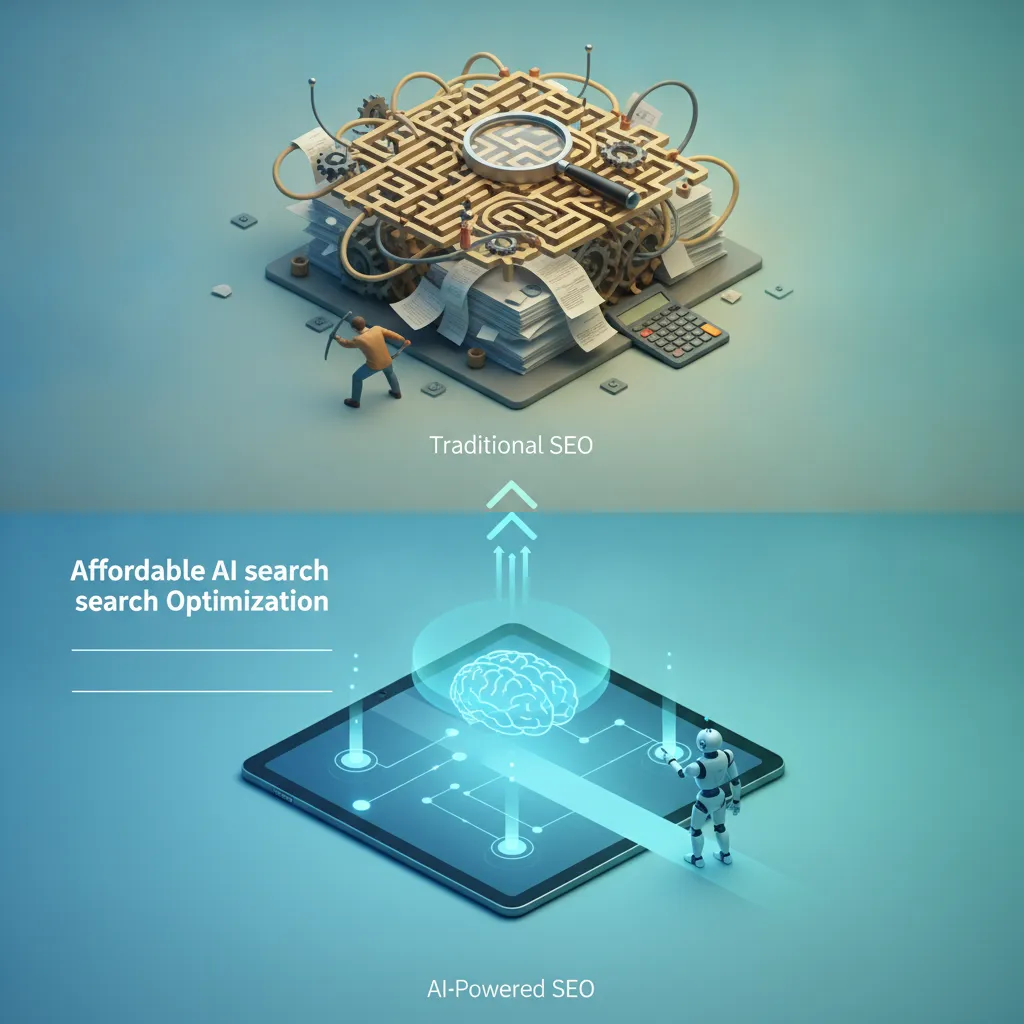
- An AI visibility tracker, Moonrank ($99/month) monitors how your brand appears across ChatGPT, Gemini, Claude, and Perplexity daily, on autopilot. Compare that to a traditional SEO agency retainer at $3,000+ a month for similar reporting depth.
Traditional SEO spending went toward backlinks and keyword density. AI search optimization spending goes toward structured data, entity clarity, and citation-worthy facts, the signals that make AI engines trust and repeat your content. The ROI shift is real: one well-structured FAQ block can earn a Perplexity citation that no backlink budget would have bought.
"The businesses winning in AI search aren't necessarily the biggest — they're the ones with the clearest, most structured content that AI engines can parse and trust." — Andy Crestodina, Co-Founder and CMO at Orbit Media Studios
Before you touch any tool, run this content audit on every page, no coding required:
- Confirm each page opens with a clear who/what/where entity statement (your business name, category, and location or service area).
- Check that at least one FAQ block exists, written in the plain question-and-answer format AI engines pull from directly.
- Paste the page URL into Schema.org's validator and confirm zero critical errors.
Each AI platform you're targeting, ChatGPT, Perplexity, Google AI Overviews, and Claude, weights signals slightly differently. ChatGPT and Claude favor authoritative entity associations; Perplexity prioritizes freshly published, citable facts; Google AI Overviews pull heavily from structured data already indexed by Googlebot. You'll need to satisfy all four, which is why the audit above covers the common baseline. According to the Digital Marketing Institute's guide on optimizing content for AI search, structuring content around clear entities and direct answers is the single highest-impact change most businesses can make. For a deeper look at which tools handle each platform, see our AI SEO Tools Small Business guide.
Audit Your Content for AI Citation Readiness
Run a five-point checklist on each page to find which content AI engines will cite and which needs fixing before it gets ignored.
Work through this checklist for every page you want AI engines to recommend. Each point maps to a specific signal that ChatGPT, Perplexity, Gemini, and Claude use when deciding what to cite.
- Factual claim in the first 100 words. AI engines pull from the opening passage most often. Lead with a specific, verifiable statement, not a welcome message or brand tagline.
- Entity name matches your Google Business Profile exactly. If your profile says "Riverside Bakery LLC" and your page says "Riverside Bakery," AI systems may treat them as different entities and reduce citation confidence.
- Structured data is present and error-free. Schema markup, the code that tells AI engines exactly what your business does, must validate cleanly. A single syntax error can suppress the entire signal.
- Page answers a specific question in plain language. A page titled "How long does shipping take?" that opens with a direct answer in one sentence is far more citable than a page that buries the answer in paragraph four.
- Page has been indexed within the last 90 days. Check the URL in Google Search Console under the "URL Inspection" tool. Pages that haven't been crawled recently are less likely to surface in AI-generated answers.
AI search indexing freshness matters more than most SMB owners realize. Pages updated within 60 days are pulled into AI answers at a higher rate than stale content, see our AI Search Index Freshness guide for the full breakdown. Affordable AI search optimization starts with keeping your existing pages current, not just publishing new ones.
"Structured data is no longer optional for businesses that want to appear in AI-generated answers. It's the language AI engines use to understand and trust your content." — Lily Ray, Senior Director of SEO & Head of Organic Research at Amsive Digital
How to Check Schema Markup Without a Developer
Google's Schema Markup Validator (schema.org/validator) and Google's Rich Results Test are both free and require no technical knowledge to run, paste your URL and read the results.
If either tool flags errors, the most common fixes are missing @type fields, incorrect date formats, or a mismatched business name. Moonrank's technical AI audit handles these automatically during onboarding, but you can resolve basic errors manually using Google Search Console's "Enhancements" report, which flags schema issues page by page. A manual Perplexity test query, searching your business category and checking whether your site appears in the cited sources, rounds out the zero-cost audit. The Schema.org getting started documentation provides a reliable reference for understanding which markup types apply to your specific content and business category.
Which Content Types Get Cited Most by ChatGPT and Perplexity
Blog posts, product pages, and video pages each require different schema types, and each signals differently to ChatGPT versus Perplexity versus Google AI Overviews. For more information, see Bigfoot Search Team Freedom Forged Trailer Hitch Cover.
- Blog posts need a strong factual hook in the opening paragraph and FAQ schema to capture question-based queries. Perplexity in particular pulls heavily from pages that directly answer a named question.
- Product pages need Product and Review schema. ChatGPT's shopping-adjacent responses cite pages with structured price, availability, and aggregate rating data far more often than pages with plain prose descriptions.
- Video pages need VideoObject schema, including
uploadDate,description, andthumbnailUrl, to appear in Google AI Overviews and Gemini responses that surface multimedia content.
A concrete before/after illustrates the gap. A product page for a handmade leather wallet had no schema and opened with "Welcome to our collection." After adding Organization and Product schema and replacing the opening with a two-sentence factual summary, "The No. 4 Bifold is a full-grain leather wallet made in Portland, Oregon. It holds eight cards and ships within two business days.", the page began appearing in Perplexity citations for "best handmade leather wallet" within three weeks. The copy didn't change significantly; the structure did.
Optimize Each Page to Get Recommended by AI Engines
Add schema markup, define your brand entity clearly, and structure factual content so AI engines can quote your pages directly.
Add Schema Markup Without Touching Code
Start with two schema types that deliver the most impact for affordable AI search optimization: FAQ schema and Organization schema.
- Add FAQ schema to any page that answers a question. Paste your question-and-answer pairs into Google's Schema Markup Generator, copy the JSON-LD output, and drop it into your page's
<head>tag. Confirm it works in Google's Rich Results Test, the tool returns a pass or fail in under two minutes. - Add Organization schema to your homepage. Populate four fields at minimum:
name,url,logo, anddescription. This tells ChatGPT, Claude, and Google AI Overviews exactly what your business is and where to find it. - Create an llms.txt file. llms.txt is a simple text file you add to your site's root folder that tells AI engines like ChatGPT exactly which pages matter most. List your highest-value URLs, one per line, and save the file as
/llms.txt. Moonrank configures this automatically during its technical audit, so you don't need to edit it manually.
If editing code is a barrier, tools like Yoast SEO (free tier) generate FAQ and Organization schema through a form interface, no code required. The Google Search Central structured data documentation also provides step-by-step guidance on implementing each schema type correctly, with examples you can adapt directly to your pages.
Write Factual Summaries That AI Engines Quote Directly
ChatGPT and Claude favor pages with a clear entity definition, your brand name, category, location, and differentiator in one sentence. Perplexity favors pages with cited statistics and outbound links to authoritative sources. One well-structured page can satisfy both.
Open each key page with a sentence like: "Acme Roofing is a licensed residential roofing contractor in Austin, TX, specializing in storm-damage repair with a 48-hour response guarantee." That single sentence gives AI engines a brand name, category, location, and differentiator to pull into a recommendation. Follow it with at least one cited statistic linked to an authoritative source, a government report, industry study, or recognized publication. This approach to entity-first writing is central to any effective affordable AI search optimization strategy, because it removes ambiguity and gives AI engines a ready-made summary they can surface in answers.
"AI engines are essentially citation machines — they reward content that is specific, factual, and easy to attribute to a credible source. Vague brand messaging gets ignored entirely." — Wil Reynolds, Founder of Seer Interactive
The ROI math is direct. A traditional SEO agency charges $3,000+ per month and measures success in keyword rankings that may never translate to AI citations. At $99/month, Moonrank tracks actual citation appearances across ChatGPT, Perplexity, Claude, and Gemini, so you measure what AI search actually delivers, not a proxy metric.
For deeper coverage of how citations build authority with AI engines, see our guides on AI-powered citation building and brand entity recognition in AI search.
Avoid These Common Mistakes in AI Search Optimization
Five specific errors drain budget and suppress AI citations, fix them before investing further in any affordable AI search optimization strategy.
Mistake 1: Treating All AI Platforms the Same
Google AI Overviews pulls from indexed pages with strong E-E-A-T signals. Perplexity favors real-time, cited sources. ChatGPT leans on training data and structured entity clarity. Claude weights authoritative, well-organized prose. One-size-fits-all copy misses all four.
Mistake 2: Optimizing Blog Posts and Ignoring Product Pages
Product pages with Product + Review schema, the structured data that tells AI engines exactly what you sell and what customers think of it, get cited in transactional queries, which carry higher commercial value than informational ones. Blog-only strategies leave that traffic on the table.
Mistake 3: Skipping the Entity Consistency Check
If your business name appears differently across your website, Google Business Profile, and social profiles, AI engines treat them as separate entities and split citation authority across all of them. Audit every listing and standardize the name, address, and phone number before anything else. This is foundational to brand entity recognition in AI search.
Mistake 4: Measuring Success With Keyword Rankings
Traditional keyword rankings don't tell you whether ChatGPT, Perplexity, or Gemini are recommending your brand. Track AI citation frequency instead, Moonrank's visibility monitoring does this automatically across all three platforms, so you see exactly where your brand surfaces and where it doesn't. See how this fits into a broader SEO monitoring setup.
Mistake 5: Publishing Content Once and Never Updating It
AI engines deprioritize stale pages. A 60-day refresh cycle, updating statistics, adding new examples, and re-submitting for indexing, keeps content in active consideration and signals that your site is a current, reliable source.
Frequently Asked Questions
How much does AI search optimization cost compared to traditional SEO?
AI search optimization typically costs between $99 and $500 per month through SaaS tools, compared to $3,000–$10,000 per month for a traditional SEO agency retainer. Moonrank, for example, runs at $99/month and covers daily content publishing, technical optimization, and AI visibility tracking across ChatGPT, Gemini, Claude, and Perplexity, functions that would require three separate tools and an agency to replicate manually. For most SMBs, the cost difference alone makes the switch straightforward.
Does AI search optimization work differently for small businesses than for large brands?
Small businesses can actually gain ground faster than large brands in AI search because AI engines favor specificity, local relevance, and structured data, not just domain authority. A boutique hotel with well-structured schema markup and consistent citations can outrank a national chain for a query like "best boutique hotel in Austin." Large brands have more content volume, but small businesses can compete by being precise about their niche, location, and offerings.
How long does it take to start appearing in ChatGPT or Perplexity answers after optimizing?
Most businesses begin seeing measurable AI search visibility improvements within four to eight weeks of implementing technical optimizations like schema markup, llms.txt, and structured citations. Content signals take longer, daily publishing compounds over 60 to 90 days as AI engines index and weight new material. Results vary by niche competitiveness and how much optimization groundwork existed before you started.
Do I need a developer to implement schema markup for AI search optimization?
No, you don't need a developer if you use a tool that handles schema markup automatically. Moonrank deploys schema markup, llms.txt configuration, and structured data as part of its technical audit layer, with no manual input required after onboarding. If you're implementing schema manually, Google's Structured Data Markup Helper is a free starting point that requires no coding.
Can affordable AI search optimization work for businesses in highly competitive industries?
Yes, and often more effectively than traditional SEO in those same industries. AI engines prioritize content clarity, entity specificity, and structured data over raw domain authority, which means a well-optimized page from a smaller business can surface in AI-generated answers ahead of a larger competitor with weaker structure. Focus on answering niche questions precisely, maintaining consistent entity signals, and refreshing content regularly. Competitive industries reward specificity, not just volume.
Conclusion
Affordable AI search optimization is not a future-state goal, it's a set of concrete actions you can take this week. The businesses showing up in ChatGPT and Perplexity answers right now got there by fixing their technical signals first (schema markup, llms.txt, structured citations), then building content authority through consistent daily publishing. Waiting for AI search to "mature" before acting hands that ground to competitors who are already moving.
Pick one step from this guide and execute it before the end of the week. If you want the full stack, daily content, technical optimization, and AI visibility tracking, without managing any of it yourself, start a free 3-day trial at moonrank.ai and see where your business currently stands across ChatGPT, Gemini, Claude, and Perplexity.
Recommended Articles
Explore more from our content library: