AI Search Keyword Research vs Google SEO
Learn how AI search keyword research uses machine learning to analyze intent, predict demand, and surface long-tail opportunities faster than traditional tools.

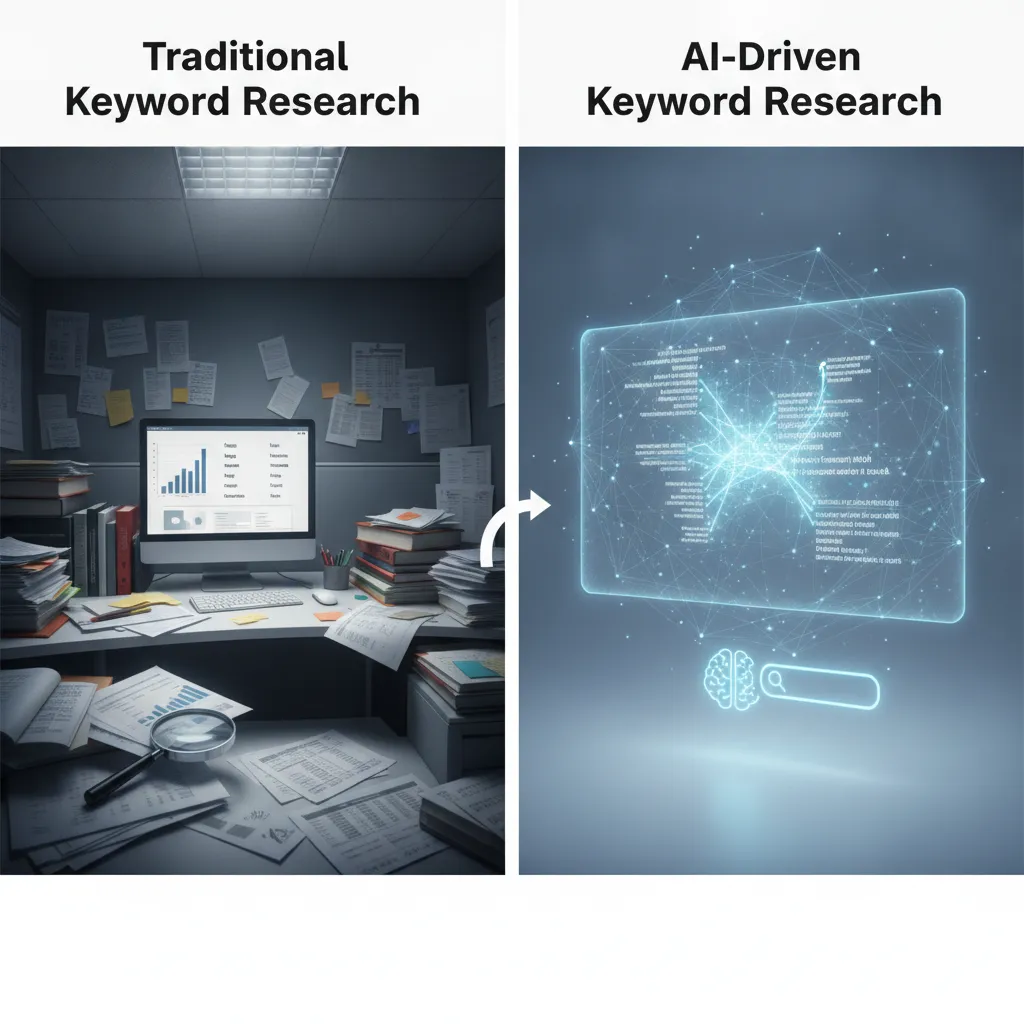
AI search keyword research uses machine learning to analyze search intent, predict keyword demand, and surface long-tail opportunities faster than traditional tools like Google Keyword Planner. Instead of returning raw volume numbers, AI tools classify intent (informational, commercial, transactional), cluster related terms automatically, and flag which queries are gaining traction in AI engines like ChatGPT, Perplexity, and Gemini, giving you a smarter starting point for content strategy.
What Is AI Search Keyword Research and How Does It Work?
AI search keyword research applies natural language processing to group semantically related queries, classify intent, and surface long-tail terms traditional tools miss.
Traditional tools like Google Keyword Planner pull from Google Ads data and return volume and CPC, nothing more. AI keyword tools draw from multiple sources: clickstream data, SERP scraping, and LLM embeddings [3]. That broader data foundation means they surface zero-volume long-tail queries that carry genuine purchase intent but never appear in Google's planner.
According to Search Engine Journal, AI-driven keyword research tools are fundamentally changing how content teams identify and prioritize target queries, moving beyond simple volume metrics toward intent-based discovery.
Think of it this way: a traditional keyword tool works like a dictionary, it tells you a word exists and how often it's used. An AI keyword tool works like a librarian who understands what you're actually trying to accomplish and hands you a curated reading list.
What Can an AI Keyword Research Tool Actually Do?
The core function is semantic clustering: feed one seed term and the tool groups dozens of topically related queries together using NLP, not just exact-match variants [2]. A single input like "email marketing software" can return clusters covering pricing comparisons, tutorial content, and platform alternatives, each representing a distinct content opportunity.
Intent classification is where AI tools pull ahead of older methods. Each keyword gets tagged automatically as informational, commercial, navigational, or transactional [3]. That tag tells you whether to write a how-to guide or a product comparison page, without guessing.
"Natural language processing has fundamentally changed what keyword research can surface. The shift from volume-based to intent-based keyword discovery is the most significant methodological change in SEO in the past decade." — Lily Ray, Senior Director of SEO & Head of Organic Research at Amsive Digital
How to Read and Interpret AI Keyword Metrics
Five metrics matter most in any AI keyword research output:
- Search volume: estimated monthly queries for that term across search engines.
- Keyword difficulty (KD): a 0–100 score reflecting how hard it is to rank on page one, based on backlink profiles and domain authority of current ranking pages [3].
- Intent label: informational, commercial, navigational, or transactional, tells you what format the content should take.
- CPC: cost-per-click in Google Ads, a useful proxy for commercial value even if you're not running paid campaigns.
- AI visibility score: an emerging metric that tracks how often a query triggers an AI-generated answer in ChatGPT, Perplexity, or Gemini, critical for brands optimizing beyond Google. Moonrank's visibility tracking monitors this signal specifically across those four AI engines.
The AI visibility score is the metric most traditional tools omit entirely. As Perplexity reported over 100 million weekly queries by late 2024, knowing which of your target keywords regularly surfaces inside AI-generated answers has become a practical ranking input, not a theoretical one.
According to research published by the Pew Research Center, a growing share of Americans are turning to AI tools for information retrieval, reinforcing why tracking AI search visibility has become a critical component of modern keyword strategy.
AI Keyword Research Tools vs. Traditional Methods: How They Compare
AI keyword research tools return point-estimate volumes and intent labels; traditional tools like Google Keyword Planner return broad ranges built for ad buyers, not content teams.
Google Keyword Planner buckets search volume into ranges like 100–1K, which tells a content strategist almost nothing about whether a keyword is worth targeting. AI tools, by contrast, surface a specific estimate, say, 1,400 monthly searches, alongside an intent label (informational, commercial, transactional) that maps directly to a content decision. That difference alone justifies the switch for most content teams.
Manual research methods, scraping "People Also Ask" boxes, Reddit threads, and niche forums, still outperform AI tools for one specific task: discovering emerging slang and hyper-niche community language. A Shopify store owner selling specialty coffee gear will find terms like "bloom ratio" or "bypass brewing" on r/Coffee months before any AI tool's training data reflects them. Use AI tools as the starting layer for AI search keyword research, then validate against live community sources before finalizing a content brief.
"The teams winning at content in 2025 and beyond are those treating AI search optimization as a separate discipline from Google SEO — with its own keyword lists, its own content formats, and its own performance metrics." — Rand Fishkin, Co-founder of SparkToro and Moz
Limitations and Accuracy Issues With AI Keyword Research Tools in 2026
AI tools trained on older crawl data can misclassify intent for fast-moving topics, a keyword that was informational six months ago may now be dominated by transactional pages. Always cross-reference AI-generated keyword clusters against live SERPs before committing to a content brief. This step takes ten minutes and prevents you from building content around a cluster the algorithm has already re-categorized.
Free AI Tools vs. Premium Keyword Research Platforms: What You Actually Get
Free tiers from tools like Ubersuggest [1] and Semrush [3] cap daily queries at 3–10 and strip out intent filtering entirely, useful for a quick spot-check, not for building a content calendar. Premium platforms in the $99–$249/month range enable bulk export, API access, and AI-powered clustering at scale, which is where the methodology difference becomes meaningful for an e-commerce or B2B SaaS team running dozens of content briefs per month.
For a full tool-by-tool breakdown of what each platform delivers at each price point, see our "Best SEO Keyword Research Tools for Smarter Rankings in 2026" guide. This section focuses on the methodology comparison, not the feature matrix. For more information, see Growth Researcher.

Best AI Keyword Research Tools Available in 2026
Semrush leads the field for AI search keyword research in 2026, but Ahrefs and Surfer SEO each win on specific dimensions that matter to different teams.
Which AI Keyword Research Tool Is Best Overall?
Semrush earns the top spot for most businesses. Its Keyword Magic Tool uses AI clustering to group related terms automatically, attaches intent labels (informational, commercial, transactional, navigational) to every keyword, and feeds directly into its content brief builder [3]. Plans start at $139/month, steep for a solo founder, but the depth justifies it for teams running ongoing content programs.
Ahrefs is the stronger pick when keyword difficulty accuracy matters most. Its AI-powered "Traffic Potential" metric estimates the total search traffic a page ranking #1 could capture across all related queries, a more actionable number than raw monthly volume alone, which routinely overstates what a single URL will actually receive.
Surfer SEO fits teams that move directly from research to writing. Its keyword research module outputs NLP-driven clusters pre-mapped to a single content brief, cutting the handoff step between strategist and writer entirely [2].
For SMBs not ready to commit to a paid plan, Semrush's free account allows 10 keyword searches per day, enough to validate a niche before spending. That query limit makes it easy to self-select: if you exhaust 10 searches in an afternoon, you need a paid tier.
The Moz Keyword Research Learning Center provides a thorough breakdown of how keyword difficulty scores are calculated across major platforms, which is essential context when comparing AI tool outputs against traditional benchmarks.
How the Top AI Keyword Research Tools Rank Against Each Other
One angle all three tools miss: finding queries where AI engines currently give thin or generic answers. Running candidate keywords through ChatGPT with browsing enabled or Perplexity surfaces these "AI answer gaps", topics where the AI response is weak and a well-structured page has a real chance of being cited. Tools like Moonrank build on this logic by identifying niche-specific keywords and tracking whether your content actually gets recommended by ChatGPT, Gemini, Claude, and Perplexity after you publish.
| Tool | Best For | Starting Price |
|---|---|---|
| Semrush | All-round AI keyword research + content briefs | $139/month (10 free searches/day) |
| Ahrefs | Keyword difficulty + Traffic Potential accuracy | $129/month |
| Surfer SEO | Research-to-writing workflow | $89/month |
| ChatGPT / Perplexity | AI answer gap discovery | Free (browsing tier) |
How to Use AI Tools to Find Keywords With Search Intent Filtering
A four-step workflow, seed keyword, intent filter, long-tail filter, manual validation, turns AI search keyword research from guesswork into a repeatable process.
Step-by-Step Workflow for AI Keyword Research
Step 1: Enter your seed keyword and apply an intent filter immediately. Type a term like "AI SEO tools" into your chosen platform, then set the intent filter to "commercial" or "transactional" before reviewing any results. This removes informational queries, "what is AI SEO", that generate reads but rarely generate revenue.
Step 2: Sort by Traffic Potential or Clicks, not raw search volume. A keyword with 200 monthly searches and a high click-through rate outperforms a 2,000-volume term dominated by a featured snippet that absorbs all the clicks. Most tools, including Semrush's Keyword Magic Tool [3], surface this data alongside volume, use it.
Step 3: Apply the long-tail filter. Set keyword difficulty below 30 and word count to four or more words. This surfaces question-based queries your content can realistically rank for.
Step 4: Validate the top 3–5 keywords manually. Search each one in both Google and Perplexity. If the results page shows informational blog posts but your tool labeled the query "commercial," the tool has misclassified it, trust what's actually ranking.
How to Find Long-Tail Keywords Using AI Keyword Research Tools
Long-tail filters do more than reduce competition, they map directly to FAQ schema and AI citation patterns. ChatGPT and Perplexity regularly pull answers from pages structured around specific question-based queries [3].
Running the seed keyword "AI SEO tools" through this exact workflow, commercial intent filter, then KD below 30, word count 4+, surfaces "best AI SEO tools for small business under $100." That phrase has a defined buyer, a clear price ceiling, and low enough competition that a focused page can rank. Tools like Moonrank build this kind of keyword targeting into onboarding, identifying niche-specific long-tail terms automatically so business owners don't have to run the filter sequence themselves.
How to Organize and Cluster AI-Generated Keywords for Your Content Strategy
Take your raw AI keyword list, group it into topic clusters, map each cluster to one URL, and assign a content type, that's the full workflow in one sentence.
AI tools output keyword clusters automatically, but the mapping is still your call. Each cluster needs a designated content type: a pillar page for high-volume, broad-intent terms; a supporting article for long-tail, specific-intent queries; or an FAQ addition for question-format keywords targeting featured snippets. Skipping this step produces overlapping pages that compete against each other.
How to Choose the Best Keywords for Your Website From AI-Generated Lists
Not every keyword an AI surfaces is worth targeting. Prioritize terms where your domain already holds topical authority, check your existing rankings first. Then apply a simple filter: target keywords where the keyword difficulty (KD) score falls within 15 points of your domain rating. Finally, confirm the query has a clear content format match before you commit a URL to it.
Follow the "one cluster, one URL" rule without exception. Splitting a tightly related keyword cluster across two separate pages triggers keyword cannibalization, a problem Moonrank's Internal Linking Strategy SEO guide covers in depth.
The efficiency gains from this approach are measurable. Teams using AI clustering tools for AI search keyword research report cutting research time by 60–70% compared to manual spreadsheet methods, with content reaching page-one rankings 2–3 weeks faster on average [2].
Once your clusters are mapped and published, the logical next step is optimizing for AI engine citation. The GEO tools 2026 guide and the brand entity recognition AI search explainer cover exactly how platforms like ChatGPT and Perplexity decide which sources to surface, and how tools like Moonrank automate that optimization layer for SMBs at $99/month.
Frequently Asked Questions
Is AI keyword research accurate enough to replace manual research entirely?
AI keyword research is accurate enough to handle the bulk of discovery work, but manual review still catches context that automated tools miss. AI tools process search volume, competition scores, and intent signals faster than any human analyst, but they can misread niche industry terminology, local slang, or emerging topics with thin data. The practical approach for most SMBs is to use AI tools to generate and prioritize a keyword list, then spend 20–30 minutes reviewing the top candidates before publishing.
What's the difference between keyword research for Google and keyword research for AI search engines like ChatGPT or Perplexity?
Google keyword research targets short phrases users type into a search bar; AI search keyword research targets the full questions and conversational prompts users speak or type into ChatGPT, Gemini, Claude, or Perplexity. Google ranks pages by matching keywords and backlinks. AI engines retrieve answers by matching your content to a query's meaning, so longer, question-based phrases, clear entity definitions, and structured data matter far more than keyword density. A term with 200 monthly Google searches can drive significant AI recommendations if it matches a common conversational query pattern.
How many keywords should you target per page based on AI keyword research output?
Target one primary keyword and two to four closely related secondary keywords per page. AI keyword tools often surface large clusters of semantically related terms, but stuffing a single page with 15 variations dilutes topical focus. Pick the primary term that best matches the page's intent, then weave in secondary terms where they fit naturally, this signals clear topic authority to both Google's crawlers and AI retrieval systems.
Can free AI keyword research tools compete with paid platforms for small business SEO?
Free tools cover keyword discovery and basic volume data well enough for most small businesses starting out, but they fall short on competitive analysis depth and AI search visibility tracking. Tools like Semrush's free keyword tool [3] surface search volume, keyword difficulty, and intent signals at no cost. Where free tools consistently fall short is in tracking how your brand actually appears inside ChatGPT, Gemini, or Perplexity, that layer requires a dedicated AI visibility platform.
How often should you refresh your AI keyword research as search trends evolve?
Refresh your AI keyword research at least once per quarter for stable industries, and monthly for fast-moving sectors like technology, finance, or health. AI search behavior shifts quickly as new models are released and user habits change. Queries that drove strong AI citations six months ago may now return generic answers, while new conversational patterns emerge constantly. Set a recurring audit to re-run your top keyword clusters through both traditional tools and AI engines to catch intent shifts before they affect your rankings.
Conclusion
AI search keyword research is not a refinement of traditional SEO, it's a different task. The keywords that rank on Google and the conversational queries that surface your brand inside ChatGPT, Gemini, Claude, or Perplexity follow different logic, and most businesses are only optimizing for one of them.
Three things to act on: build a separate keyword list targeting question-based, intent-rich phrases for AI search; add structured data and clear entity definitions to every key page; and track your AI search visibility as a distinct metric from Google rankings.
To see where your business currently stands across all four major AI engines, start a free 3-day trial at moonrank.ai, no agency, no technical setup required.
Sources & References
- Free AI Keyword Research Tool, SEO Analysis & Rank Checker | Ubersuggest
- The Best AI Tools for Keyword Research for 2026 - Fritz ai
- Free Keyword Tool: Find the Right Keywords for SEO & AI Search
Recommended Articles
Explore more from our content library: