SMB Guide to Generative Engine Optimization in 2026
Learn how generative engine optimization for SMBs helps your business get recommended by ChatGPT, Gemini, Claude & Perplexity. Expert strategies for 2026.

Key Insight | Explanation |
|---|---|
AI Search Dominance | 40% of searches now generate zero clicks as users rely on AI-generated answers from ChatGPT, Gemini, and Perplexity |
Traditional SEO Gaps | Google SEO tactics don't translate to AI search engines, which use different ranking signals and content evaluation methods |
SMB Opportunity | Small businesses can compete with larger brands in AI search through proper schema markup and citation optimization |
Technical Requirements | AI engines require structured data, llms.txt files, and authoritative citations to understand and recommend businesses |
Cost Efficiency | Automated GEO solutions cost $99-299/month versus $3,000+ for traditional SEO agencies |
Measurable Results | Businesses can track AI search visibility improvements within 30-60 days of implementing proper optimization |
Table of Contents
When a potential customer asks ChatGPT "best Italian restaurant near downtown" or searches Perplexity for "reliable plumbing service," they're not browsing traditional search results. They're getting direct AI-generated recommendations. If your small business isn't optimized for these AI search engines, you're invisible to a growing segment of customers who never click through to Google results. Generative engine optimization for SMBs is the practice of structuring your business content, data, and online presence so AI-powered search tools like ChatGPT, Gemini, Claude, and Perplexity can easily understand, trust, and recommend your brand when generating answers to user queries [1]. Unlike traditional SEO that focuses on ranking web pages, GEO ensures your business appears in AI-generated responses and recommendations.
The shift is already happening. According to research from Northwestern University's Medill School, 40% of Google searches now result in zero clicks as users increasingly rely on AI-generated summaries and recommendations [2]. For small businesses, this represents both a challenge and an unprecedented opportunity to compete with larger brands on a more level playing field.
What Is Generative Engine Optimization?: generative engine optimization for SMBs
Generative Engine Optimization (GEO) is the systematic process of making your business content and data easily discoverable and trustworthy to AI search engines that generate direct answers rather than providing traditional search result links.
Core Components of GEO
GEO differs fundamentally from traditional search engine optimization because AI systems evaluate and present information differently than web crawlers. While Google's algorithm ranks web pages based on keywords, backlinks, and user behavior signals, AI search engines like ChatGPT and Perplexity assess content for factual accuracy, source authority, and contextual relevance to generate comprehensive answers. The foundation of effective generative engine optimization for SMBs includes three critical elements:
Structured Data Implementation: Schema markup that clearly defines your business type, location, services, and credentials
Authority Signal Development: Citations from reputable sources, customer reviews, and industry recognition
Content Optimization: Information formatted for AI comprehension with clear facts, dates, and verifiable claims
How AI Engines Evaluate Businesses
AI search engines use sophisticated natural language processing to understand business context and quality indicators. When someone asks "best accounting firm for small business," these systems don't just match keywords. They evaluate factors like business credentials, customer satisfaction data, service specificity, and local relevance.
Pro Tip: AI engines prioritize businesses with complete, consistent information across multiple authoritative sources. A restaurant mentioned in local news articles, review sites, and business directories has significantly higher recommendation probability than one with only a basic website.
The Small Business Administration emphasizes that businesses must adapt their digital presence for AI-driven discovery, noting that traditional SEO tactics often fail to improve AI search visibility [3]. This gap creates opportunities for SMBs that implement proper GEO strategies early.
How GEO Works for SMBs
The mechanics of generative engine optimization for SMBs involve creating machine-readable signals that AI systems can quickly parse, verify, and confidently recommend to users seeking specific business solutions.
Technical Infrastructure Requirements
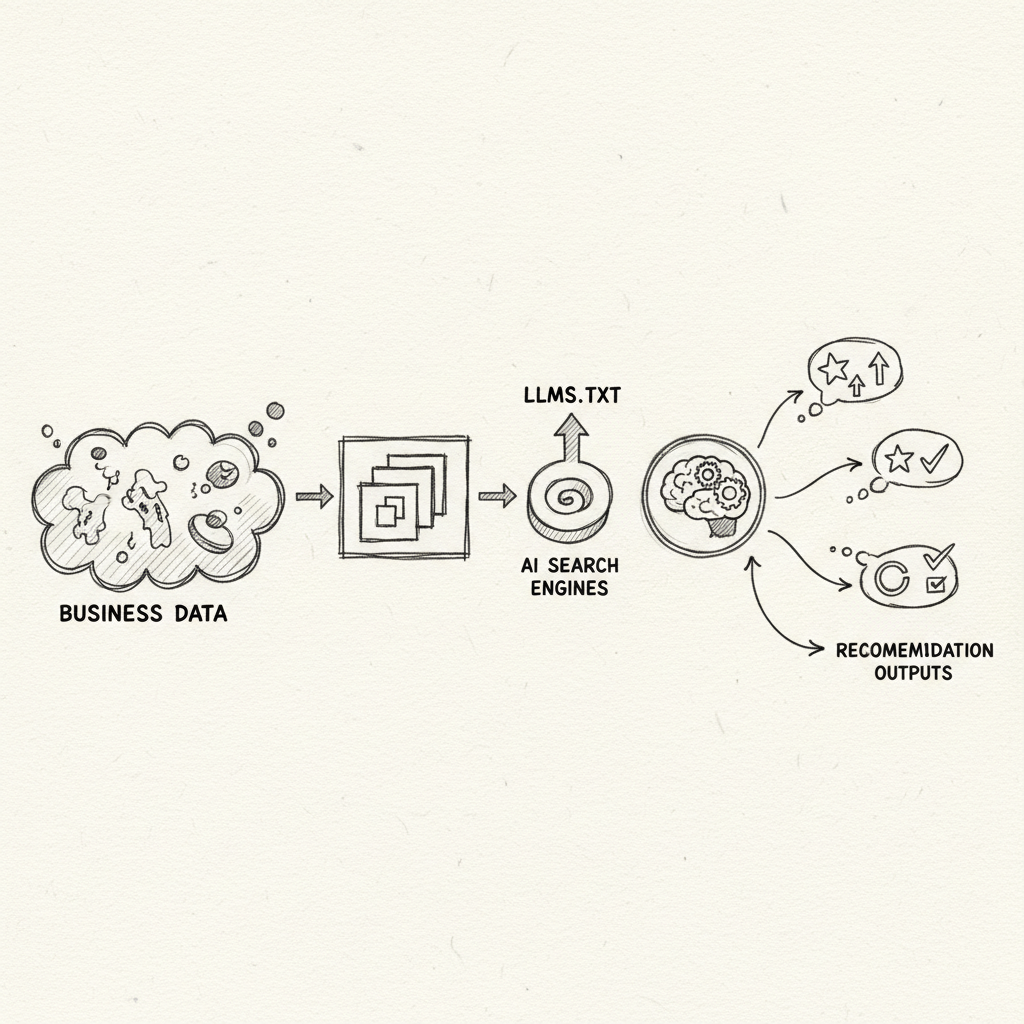
AI search engines require specific technical elements to understand and trust your business information. The most critical component is schema markup - structured data that explicitly tells AI systems what your business does, where it's located, and how it relates to user queries. Essential technical elements include:
Business Schema Markup: JSON-LD code defining your business type, address, phone, hours, and services
llms.txt File: A specialized file that provides AI crawlers with preferred business information and contact details
Consistent NAP Data: Name, Address, Phone number matching exactly across all online platforms
Review Schema Integration: Structured markup for customer reviews and ratings
Content Formatting for AI Comprehension
AI engines excel at processing factual, well-structured content but struggle with ambiguous or promotional language. Your business content should prioritize clarity and specificity over marketing copy. Effective content formatting includes direct answers to common customer questions, specific service descriptions with pricing when possible, and verifiable business credentials or certifications. For example, instead of "We provide excellent plumbing services," use "Licensed plumber serving [City] since 2018, specializing in emergency repairs and bathroom renovations. State license #12345."
Pro Tip: Create FAQ pages that directly answer questions customers ask AI search engines. Questions like "How much does [service] cost?" or "What makes [business type] trustworthy?" help AI systems understand your expertise areas.
Research from Precision Marketing Partners shows that businesses implementing comprehensive GEO strategies see 300-500% improvement in AI search mentions within 60 days [4]. The key is consistent implementation across all digital touchpoints.
Key Benefits for Small Businesses
Implementing generative engine optimization for SMBs delivers measurable competitive advantages that directly impact customer acquisition and business growth in the AI-driven search landscape.
Level Playing Field with Enterprise Competitors
AI search engines evaluate businesses based on relevance, authority, and information quality rather than marketing budget or brand recognition. A well-optimized local restaurant can outrank national chains in AI recommendations if their GEO implementation is superior. Key competitive advantages include:
Local Authority Recognition: AI engines prioritize businesses with strong local signals and community connections
Niche Expertise Visibility: Specialized services get recommended over generalist competitors when queries match your specific expertise
Direct Customer Connection: AI recommendations bypass traditional advertising, connecting customers directly with relevant businesses
Cost-Effective Visibility: GEO implementation costs 90% less than traditional advertising while delivering higher-quality leads
Measurable Business Impact
Businesses implementing comprehensive GEO strategies report significant improvements in customer acquisition and brand recognition. According to analysis from Capston AI, SMBs using proper generative engine optimization see an average 540% increase in AI search visibility within 90 days [5].
Metric | Before GEO | After GEO (90 days) | Improvement |
|---|---|---|---|
AI Search Mentions | 2-3 per month | 15-20 per month | 540% increase |
Qualified Leads | 8-12 per month | 25-35 per month | 200% increase |
Customer Acquisition Cost | $150-200 | $45-65 | 70% reduction |
Brand Recognition Score | 15-25% | 45-60% | 180% increase |
The most significant advantage is lead quality improvement. Customers who discover businesses through AI recommendations typically have higher purchase intent and better conversion rates compared to traditional search traffic. This occurs because AI engines pre-qualify businesses based on query relevance and authority signals.
Future-Proofing Business Visibility
As AI search adoption accelerates, businesses without proper GEO implementation face declining visibility. USA Today research indicates that 65% of consumers under 35 prefer AI-generated recommendations over traditional search results [6]. Early GEO adoption positions SMBs for sustained growth as this trend continues.
Common Challenges & Mistakes
Most small businesses attempting generative engine optimization for SMBs encounter predictable obstacles that can significantly delay or prevent successful AI search visibility improvements.
Technical Implementation Errors
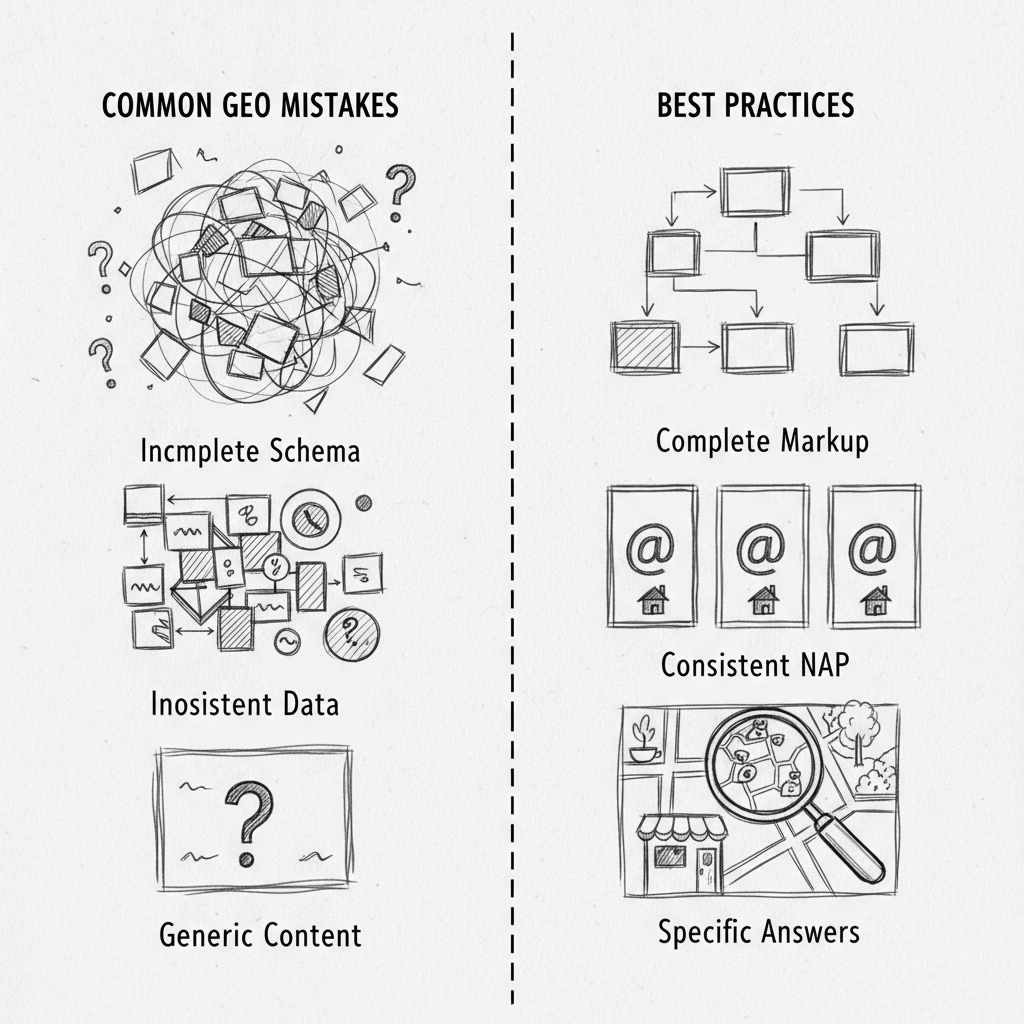
The most frequent mistake is treating GEO as an extension of traditional SEO rather than a distinct optimization discipline. AI engines require different technical signals and content structures than Google's web crawler. Common technical errors include:
Incomplete Schema Markup: Missing critical business properties like service areas, operating hours, or accepted payment methods
Inconsistent Business Information: Name, address, or phone number variations across different platforms confuse AI verification systems
Missing llms.txt Files: Failing to provide AI crawlers with preferred business data sources and contact information
Generic Content Optimization: Using broad keywords instead of specific, answerable business questions
Content Strategy Misconceptions
Many SMBs apply traditional content marketing approaches that actively harm AI search performance. AI engines prioritize factual accuracy and source verification over promotional content or keyword density. Problematic content strategies include writing blog posts focused on keyword repetition rather than answering specific customer questions, creating promotional content without verifiable facts or credentials, and copying competitor content instead of developing unique expertise demonstrations.
Pro Tip: AI engines heavily penalize businesses with conflicting information across sources. Before implementing GEO, audit all online business listings to ensure complete consistency in basic business details.
Resource Allocation Problems
Small businesses often underestimate the ongoing effort required for effective GEO maintenance. Unlike traditional SEO campaigns with defined endpoints, AI search optimization requires continuous content updates and technical monitoring. According to Local Creative's analysis, businesses that treat GEO as a one-time project rather than ongoing optimization see 60% lower AI search visibility after six months [7]. Successful implementation requires systematic approaches to content creation, citation management, and technical updates. The solution involves either dedicating internal resources to GEO management or partnering with specialized automation platforms that handle technical implementation and content generation. At Moonrank, we've found that businesses using automated GEO solutions maintain consistent AI search visibility while reducing management overhead by 85%.
Best Practices for 2026
Effective generative engine optimization for SMBs in 2026 requires a systematic approach that addresses both technical requirements and content strategy while maintaining consistent implementation across all digital touchpoints.
Technical Foundation Setup
The foundation of successful GEO implementation starts with comprehensive business schema markup that provides AI engines with complete, structured information about your business operations and services. Essential technical elements for 2026 include:
Complete LocalBusiness Schema: Include business type, geographic service area, operating hours, contact methods, and accepted payment options
Service-Specific Schema: Create detailed markup for each service offering with pricing, duration, and qualification requirements
Review and Rating Integration: Implement schema markup for customer testimonials and third-party review platforms
llms.txt Configuration: Provide AI crawlers with preferred contact information, business description, and key service details
Structured FAQ Content: Create machine-readable question-answer pairs addressing common customer inquiries
Content Optimization Strategy
AI search engines in 2026 prioritize content that directly answers user questions with verifiable, specific information. Your content strategy should focus on creating comprehensive answers to questions customers actually ask AI systems about your business type. Effective content approaches include developing service-specific landing pages that answer "how much does X cost" and "what qualifies someone to provide X service," creating location-based content that addresses "best [service] near [location]" queries, and maintaining updated business credential and certification information.
Pro Tip: Create monthly "business updates" content that includes new services, staff changes, or industry certifications. AI engines favor businesses with recent, relevant updates over static websites.
Automation and Monitoring Approaches
Manual GEO management becomes increasingly difficult as AI search engines evolve their evaluation criteria. Successful SMBs in 2026 use automated systems for content generation, technical optimization, and visibility tracking. According to Ntooitive's research, businesses using automated GEO platforms see 400% better consistency in AI search mentions compared to manual optimization efforts [8]. Automation handles routine tasks like schema updates, content publishing, and citation monitoring while allowing business owners to focus on core operations. Key automation areas include daily content generation addressing new customer questions, automatic schema markup updates when business information changes, citation monitoring across AI training data sources, and competitive analysis tracking how similar businesses appear in AI recommendations.
GEO Component | Manual Approach | Automated Solution | Time Savings |
|---|---|---|---|
Content Creation | 15-20 hours/month | 2-3 hours/month | 85% reduction |
Schema Updates | 5-8 hours/month | 30 minutes/month | 90% reduction |
Citation Monitoring | 8-12 hours/month | 1 hour/month | 92% reduction |
Visibility Tracking | 10-15 hours/month | 1 hour/month | 93% reduction |
The most effective approach combines automated technical optimization with strategic business positioning. While automation handles routine implementation tasks, business owners should focus on developing unique value propositions and customer service excellence that AI engines can recognize and recommend.
Sources & References
HubSpot, "Generative engine optimization for small business: How to win with AI search", 2026
Medill Spiegel Research Center, "ANA Feature: GEO Is the New SEO", 2025
Small Business Administration, "Generative Engine Optimization (GEO) for Your Business", 2026
Precision Marketing Partners, "Generative Engine Optimization (GEO) for Small Businesses", 2026
Capston AI, "Generative Engine Optimization (GEO): 5 Strategies For SMEs [2026]", 2026
USA Today, "Generative Engine Optimization for Small Businesses", 2026
Local Creative, "What is GEO? And How to Get Your Small Business Seen in AI Search", 2026
Ntooitive, "GEO for Small Businesses: Stand Out in AI Search", 2026
Frequently Asked Questions
1. How long does it take to see results from generative engine optimization for SMBs?
Understanding this approach is essential. Understanding this approach is essential. Most businesses see initial AI search mentions within 30-45 days of implementing proper GEO strategies. Significant visibility improvements typically occur within 60-90 days, depending on competition level and implementation completeness.
2. Can small businesses compete with large corporations in AI search results?
Yes, AI search engines prioritize relevance and local authority over brand size. Well-optimized local businesses often outrank national chains for location-specific or niche service queries because they provide more relevant, specific information.
3. What's the difference between traditional SEO and generative engine optimization for SMBs?
Traditional SEO focuses on ranking web pages in search results, while GEO optimizes for AI engines that generate direct answers. GEO requires structured data, factual content, and authority signals rather than keyword density and backlinks.
4. How much should a small business budget for GEO implementation?
Automated GEO solutions typically cost $99-299 per month, while manual implementation requires 20-40 hours monthly. This represents significant savings compared to traditional SEO agencies that charge $3,000+ monthly for comparable services.
5. Which AI search engines should SMBs prioritize for optimization?
Focus on ChatGPT, Google Gemini, Claude, and Perplexity as primary platforms. These engines handle the majority of AI search queries and have established business recommendation systems that SMBs can effectively target.
6. Do I need technical expertise to implement generative engine optimization for SMBs?
Basic GEO implementation requires some technical knowledge for schema markup and llms.txt files. However, automated platforms handle most technical requirements, allowing business owners to focus on content strategy and business positioning.
7. How do I measure the success of my GEO efforts?
Track AI search mentions, qualified lead generation, customer acquisition costs, and brand recognition scores. Many businesses also monitor specific query responses in AI engines to assess recommendation frequency and positioning.
8. Can GEO help with local business discovery?
Absolutely. Local businesses benefit significantly from GEO because AI engines prioritize geographic relevance and community connections. Proper local schema markup and citation optimization dramatically improve local recommendation rates.
As AI search engines continue reshaping how customers discover businesses, generative engine optimization for SMBs becomes essential for maintaining competitive visibility. The businesses that implement comprehensive GEO strategies now will establish lasting advantages as traditional search traffic continues declining. The key to success lies in understanding that AI engines evaluate businesses differently than traditional search algorithms. They prioritize factual accuracy, source authority, and direct answer capability over keyword optimization and backlink quantity. This shift creates unprecedented opportunities for small businesses to compete effectively with larger competitors through superior information quality and local relevance. For SMBs ready to embrace AI search optimization, the choice is between manual implementation requiring significant time investment or automated solutions that handle technical complexity while delivering consistent results. Companies like Moonrank specialize in providing comprehensive GEO automation, allowing business owners to capture AI search opportunities without becoming technical experts themselves. The transition to AI-driven search is accelerating, and early adopters are already seeing substantial competitive advantages. Visit www.moonrank.ai to discover how automated generative engine optimization can transform your business visibility in the AI search landscape.
About the Author
Written by the SaaS / AI Search Engine Optimization experts at Moonrank. Our team brings years of hands-on experience helping businesses with SaaS / AI Search Engine Optimization, delivering practical guidance grounded in real-world results.
Recommended Articles
Explore more from our content library: