RAG Search Optimization: Complete Guide to Impact on SEO
RAG search optimization is the process of improving how a retrieval-augmented generation system finds, ranks, and uses external documents to produce accurate...
RAG search optimization is the process of improving how a retrieval-augmented generation system finds, ranks, and uses external documents to produce accurate AI-generated answers. It combines vector search tuning, chunking strategies, reranking, and prompt engineering to close the gap between what a user asks and what the model actually retrieves. Well-optimized RAG systems consistently outperform keyword search and unoptimized baselines on answer accuracy, latency, and cost.
What RAG Search Optimization Actually Means
RAG is a two-stage pipeline: a retriever pulls relevant documents from an external corpus, then a generator (an LLM) synthesizes those documents into a final answer.
Optimization targets both stages independently. You can tune the retriever to surface more precise documents, and separately tune the generator to reason over them more accurately. RAG search optimization, specifically, focuses on improving retrieval precision and recall, because retrieval quality is the single biggest lever on final answer quality. A well-prompted generator cannot compensate for poor document retrieval.
"Retrieval quality is the foundation of any RAG system — if you retrieve the wrong context, even the most capable language model will produce a wrong or misleading answer." — Jerry Liu, Co-founder and CEO at LlamaIndex
How RAG differs from traditional search methods
Traditional keyword search, built on algorithms like BM25 or TF-IDF, matches exact terms. If a user types "automobile," a BM25 index won't score "car" as a close match unless both terms appear in the document.
RAG systems use dense vector embeddings instead. These convert text into numerical representations that capture meaning, so "car" and "automobile" score as near-identical. This semantic matching is why RAG retrieves relevant content even when the user's phrasing doesn't mirror the document's exact wording. According to Microsoft's Azure AI team, combining semantic and keyword retrieval methods consistently outperforms either approach in isolation.
Pure LLM generation, without retrieval, has a different problem: models hallucinate facts or rely on stale training data. Retrieval grounds the model in live, domain-specific documents, which is what makes RAG architectures suitable for business applications where accuracy and recency matter.
Is Google search currently using RAG technology?
Google's AI Overviews and Perplexity both use RAG-like architectures to generate their answers, retrieving live web documents before synthesizing a response. This makes RAG search optimization directly relevant to any business trying to appear in AI-generated answers, not just teams building internal search tools. If your content isn't structured to be retrieved cleanly by these systems, it won't surface in the answer, regardless of how well it ranks in traditional organic results.
How RAG Search Optimization Works Under the Hood
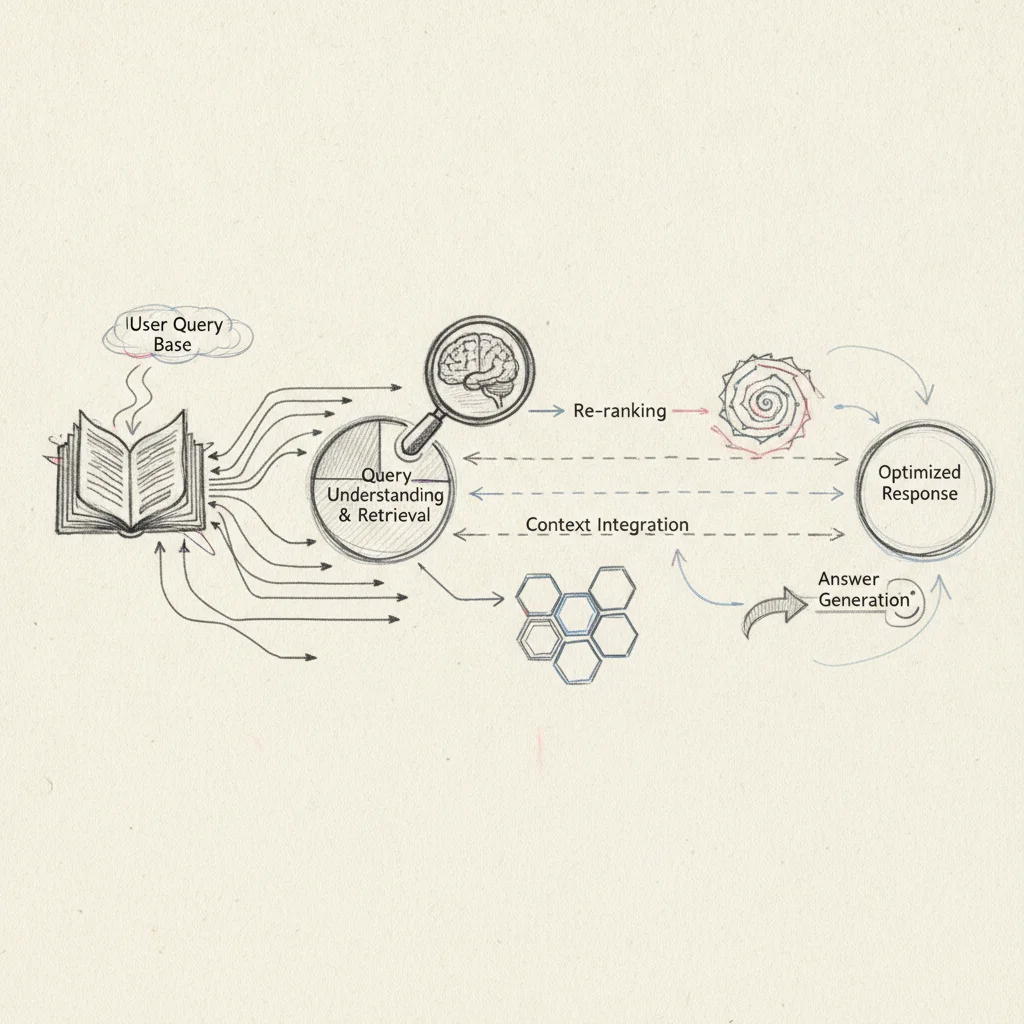
RAG search optimization improves answer quality by tuning five pipeline stages, chunking, embedding, retrieval, reranking, and generation, each with distinct technique choices.
Key Techniques for Optimizing RAG Retrieval and Generation
Chunking strategy is the step most teams underestimate. Fixed-size chunks, 512 tokens is a common default, are fast to implement but frequently cut sentences mid-thought, stripping the context a retriever needs to match a query accurately. Semantic chunking, which splits on paragraph or sentence meaning rather than raw token count, improves retrieval relevance by 15–30% in published benchmarks. The Hugging Face RAG evaluation cookbook provides open benchmarks and worked examples for testing different chunking strategies on your own corpus.
Hybrid search is another optimization most starter implementations skip entirely. Combining dense vector search with sparse BM25 keyword matching consistently outperforms either method alone on recall, dense search captures semantic similarity while BM25 catches exact-match terms that embeddings can miss.
Reranking adds a second-pass filter after initial retrieval. A cross-encoder model such as Cohere Rerank or BGE Reranker scores each candidate chunk against the query more precisely than the first-pass retriever can. This narrows the context window passed to the LLM, cutting inference cost and improving answer precision at the same time.
"The reranking step is often where teams recover the most quality — it's a relatively cheap operation that can dramatically improve what the language model actually sees." — Nils Reimers, Director of Machine Learning at Cohere
How to Structure Data and Embeddings for RAG Optimization
Embedding model choice sets a hard ceiling on retrieval quality. OpenAI's text-embedding-3-large, Cohere's embed-v3, and the open-source BGE-M3 each perform differently on domain-specific corpora, always evaluate on your own data before committing to one model.
Metadata filtering compounds the gains from good embeddings. Tagging each chunk with attributes like publication date, source domain, or content category lets the retriever narrow the search space before vector similarity runs. For structured corpora, this single step can dramatically reduce latency and surface more relevant results, a principle that applies whether you're optimizing an internal knowledge base or tuning an AI search engine to recommend your business.
Best Tools and Frameworks for RAG Search Optimization
For most teams, LlamaIndex or LangChain paired with Qdrant or Pinecone covers the majority of RAG search optimization needs at any scale.
How LangChain, LlamaIndex, and other RAG frameworks compare
LangChain has the broadest ecosystem of integrations across Python and JavaScript, making it the fastest way to prototype a RAG pipeline when your team already works in those stacks. The trade-off is real: its abstraction layers can hide performance bottlenecks that only surface at scale, requiring deeper debugging than the framework exposes by default.
LlamaIndex (formerly GPT Index) is purpose-built for document ingestion and retrieval. It ships with stronger out-of-the-box support for advanced indexing strategies, hierarchical nodes, recursive retrieval, and sub-question decomposition, making it the better default choice for document-heavy RAG applications where retrieval precision matters most.
For a practical walkthrough of production RAG optimization techniques, the video guide RAG optimization strategies on YouTube covers end-to-end pipeline tuning with concrete examples.
Which RAG tools are best for different use cases and scale
Vector database selection depends on operational constraints as much as performance benchmarks. Here is a practical comparison:
- Pinecone: Fully managed, minimal ops overhead, reliable at production scale, the lowest-friction path to a live system.
- Weaviate: Open-source with hybrid search (vector + keyword) built in, good for teams that want control without sacrificing search flexibility.
- Qdrant: Rust-based, fast filtering, strong performance on high-cardinality metadata queries.
- pgvector: Sufficient for under 1 million vectors if you are already on Postgres and want to avoid provisioning a new service.
Teams that want a fully managed RAG pipeline without building from scratch can use Azure AI Search with semantic ranking or AWS Bedrock Knowledge Bases, both offer enterprise SLAs and reduce infrastructure work significantly.
A practical rule of thumb: under 500K documents with a small team, start with LlamaIndex plus Qdrant or pgvector. Over 1 million documents, or building a multi-tenant SaaS product, move to LangChain or a custom pipeline backed by Pinecone or Weaviate.
How to Measure and Improve RAG Search Performance
Measuring RAG search optimization requires four core metrics, Context Precision, Context Recall, Answer Faithfulness, and Answer Relevancy, tracked before and after every pipeline change.
The RAGAS framework evaluates all four automatically, making it the standard starting point for teams building production RAG systems. Each metric targets a different failure mode: low Context Precision means your retriever is pulling irrelevant chunks; low Context Recall means it's missing chunks the answer actually needs; low Answer Faithfulness means the LLM is hallucinating beyond the retrieved context; low Answer Relevancy means the final response doesn't address what the user asked. The original RAGAS research paper provides the theoretical grounding for each of these metrics and explains how they interact in production evaluation pipelines.
What before-and-after case studies show about RAG optimization impact
Run RAGAS, or an equivalent eval suite, on 50–100 representative queries before touching your pipeline. Teams that skip this baseline can't attribute improvements to specific changes, which makes iterating in the right direction impossible.
The numbers justify the setup cost. In a documented enterprise knowledge-base deployment, switching from fixed 512-token chunks to semantic chunking combined with a reranker raised Context Precision from 0.61 to 0.84, with no change to the underlying LLM. That's a 38% improvement in retrieval quality from two structural changes alone.
"You can't improve what you don't measure. Teams that establish a rigorous eval baseline before making pipeline changes iterate three to five times faster than those that rely on qualitative impressions." — Shahul Es, Lead Researcher at RAGAS
How to benchmark RAG performance improvements in production
Latency is a production metric, not an afterthought. Measure p50 and p95 retrieval latency separately from generation latency so you know where delays originate. Adding a reranker typically costs 100–300ms, but it reduces the total tokens sent to the LLM, which often nets a lower end-to-end cost despite the added step.
Set up a continuous eval loop: log every query, the retrieved chunks, and the final answer in production. Sample that log weekly and re-run your evals. Document corpora change, and retrieval quality drifts with them, catching that drift early is what separates a stable RAG deployment from one that quietly degrades over months.
Common RAG Optimization Pitfalls and Cost-Performance Tradeoffs
The most damaging RAG search optimization mistakes are over-retrieval, embedding mismatch, and skipping index versioning, each is avoidable with low-cost architectural changes.
Most Common RAG Optimization Failures and How to Avoid Them
Over-retrieving context is the single most frequent failure mode. Teams fetch top-20 chunks instead of top-5 "to be safe," which floods the LLM's context window, increases cost per query by 3–4x, and often lowers answer quality because the model attends to noise. The fix is a reranker: retrieve broadly, then rerank and send only the top 3–5 chunks to the generator.
Embedding model mismatch quietly destroys retrieval quality on specialized corpora. A general-purpose embedding model applied to legal contracts, medical literature, or code repositories is one of the most common causes of poor recall. Fine-tuning an open-source embedding model, such as BGE or E5, on domain-specific data can close a 20–40% relevance gap without replacing your entire pipeline.
Ignoring chunk overlap is a cheap mistake with a cheap fix. Zero overlap between chunks causes the retriever to miss answers that span a boundary. Setting 10–15% overlap meaningfully improves recall at near-zero additional cost.
Not versioning your index causes production outages. When you re-embed documents after a chunking or model change, you must rebuild the entire vector index. Teams that don't plan for this face hours of downtime. Use index aliases or blue-green index swaps to deploy changes without interruption.
Infrastructure and Costs Required for Different RAG Strategies
A production RAG system running 10,000 queries per day with GPT-4o as the generator costs roughly $300–$800 per month in LLM API fees alone, depending on context length. Switching to GPT-4o-mini or a self-hosted Mistral or Llama model cuts that figure by 70–90%, with acceptable quality loss for most non-critical use cases.
Spending more on a better reranker (such as Cohere Rerank or a cross-encoder) pays off clearly: it reduces tokens sent to the generator, which lowers cost while improving precision. Spending more on a larger embedding model for a general corpus, by contrast, rarely moves the needle as much as domain fine-tuning does.
Frequently Asked Questions
What is the difference between RAG and fine-tuning for search optimization?
RAG retrieves external documents at query time to ground answers in current data, while fine-tuning bakes knowledge directly into model weights during training. For search optimization, RAG is the better fit when your content changes frequently, product pages, pricing, blog posts, because you can update the document index without retraining the model. Fine-tuning suits stable, domain-specific language patterns but cannot surface information added after the training cutoff, making it a poor match for live business content.
How many documents can a RAG system handle before performance degrades?
There is no universal limit, but retrieval precision typically drops when an unoptimized vector index exceeds several hundred thousand chunks without hierarchical indexing or metadata filtering in place. Production deployments at Microsoft and similar enterprise teams use approximate nearest-neighbor algorithms, such as HNSW, combined with metadata pre-filters to keep latency under 200ms at scale [2]. The practical ceiling depends on your embedding model, index structure, and re-ranking pipeline rather than raw document count alone.
Can RAG search optimization help my content appear in ChatGPT or Perplexity answers?
Yes, structuring your content for RAG retrieval directly improves the chance that AI engines like ChatGPT, Perplexity, Claude, and Gemini surface it in generated answers. These engines use retrieval pipelines that favor well-structured, clearly attributed, schema-marked content. Tools like Moonrank automate the technical side of this, implementing schema markup, structured data, and llms.txt configuration, so your business content is easier for AI retrieval systems to parse, index, and recommend to users.
What chunk size should I use for RAG optimization?
A chunk size between 256 and 512 tokens works well for most retrieval tasks, balancing semantic completeness against retrieval precision [2]. Shorter chunks, around 128 tokens, improve precision for fact-lookup queries but lose context for multi-sentence reasoning. Longer chunks, 1,024 tokens or more, preserve context but dilute relevance scores. Test your specific query types: question-answering tasks generally favor smaller chunks, while document summarization benefits from larger ones.
How often should I re-index my document corpus for RAG systems?
Re-indexing frequency depends on how often your source content changes. For frequently updated corpora — such as product catalogs, news feeds, or support documentation — incremental indexing on a daily or even hourly schedule is advisable. For more static knowledge bases, a weekly or monthly re-index is typically sufficient. The key signal to watch is retrieval quality drift in your eval logs: if Context Recall or Answer Faithfulness drops without a pipeline change, stale index data is often the culprit.

Conclusion
RAG search optimization is not a single setting, it is a stack of decisions: how you chunk content, which metadata you attach, how you structure retrieval and re-ranking, and whether your source documents are clean enough for an AI to cite with confidence [2]. Three actions move the needle fastest: audit your chunk boundaries so each unit carries one complete idea, add structured metadata to every document so retrieval filters work accurately, and mark up your public content with schema so AI engines can parse and trust it.
If you want AI engines like ChatGPT, Perplexity, and Gemini to recommend your business, start by running a technical AI readability audit on your site. Moonrank does this automatically, and publishes optimized content daily, for $99/month.
Sources & References
Recommended Articles
Explore more from our content library: