AI Search Indexing vs Google Crawling: A Complete Guide
Learn how AI search indexing vs Google crawling differ in bots, goals, and strategy—and what each means for your content's visibility in 2026.

Understanding AI search indexing vs Google crawling is essential. AI search indexing and Google crawling are fundamentally different processes with different goals. Google crawling uses Googlebot to discover and index pages so they appear in search results, a process you control via robots.txt and sitemaps. AI search indexing, used by ChatGPT, Perplexity, and Gemini, pulls content into training datasets or real-time retrieval systems to generate answers, not ranked links. The same page can be crawled by both, but optimizing for each requires a distinct strategy.
AI Search Indexing vs Google Crawling: What They Actually Are
Google crawling and AI search indexing are separate pipelines with different bots, different destinations, and different outcomes for your content.
Is Crawling and Indexing the Same Thing?
No, and the distinction matters more than most business owners realize. Googlebot discovers URLs by following links and fetching page content [1], but that fetch is only step one. Google's indexing pipeline then analyzes that content separately and decides whether to store it in the index so it can appear in ranked results [2]. A page can be crawled and still never rank, or even appear, if Google's systems judge it thin, duplicate, or low-quality.
The same logic applies to AI crawlers. GPTBot (OpenAI's training crawler) can ingest your page into a training dataset without your content ever surfacing in a ChatGPT response. Being crawled is a prerequisite, not a guarantee.
"Crawling and indexing are distinct processes — just because Googlebot visits a page doesn't mean it will appear in search results. Quality signals determine what actually gets indexed." — Gary Illyes, Analyst at Google Search
How AI Training Crawlers Differ from Search Indexing Crawlers
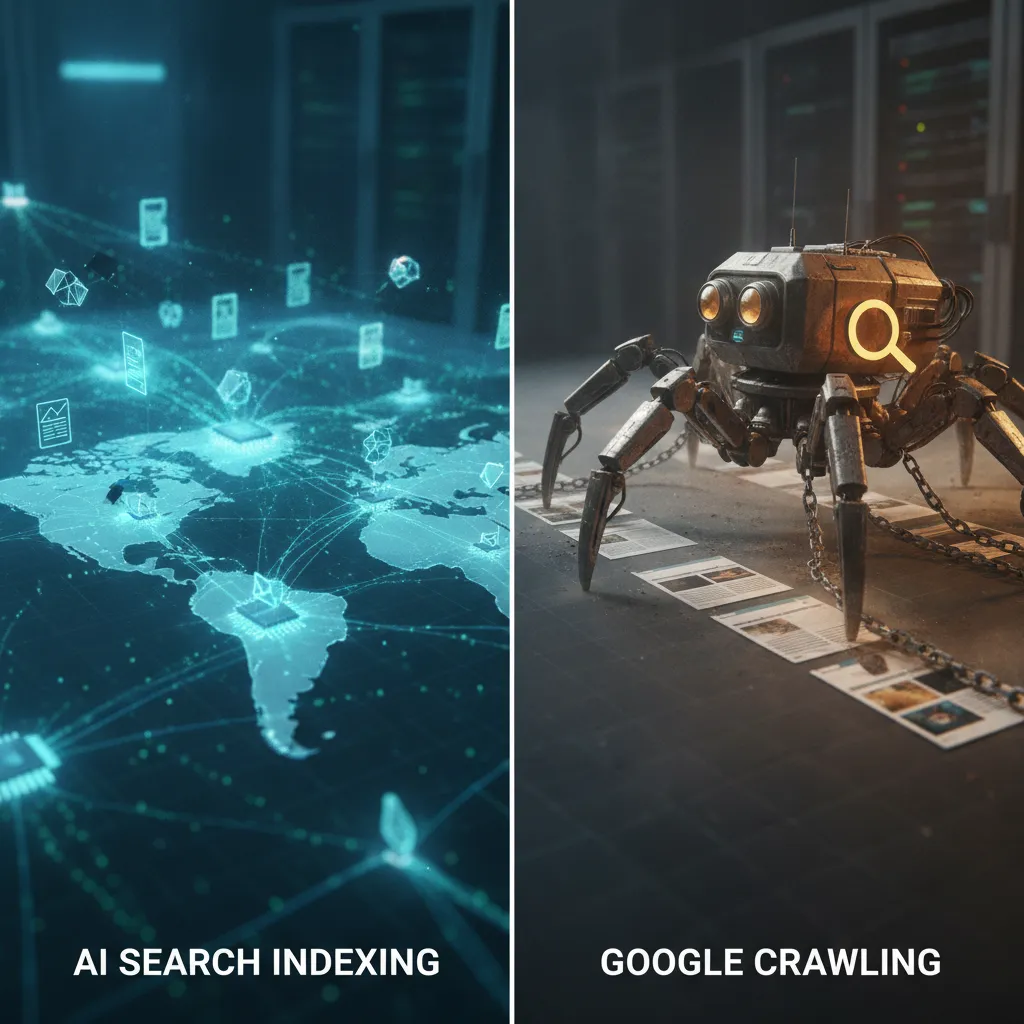
When comparing AI search indexing vs Google crawling, the clearest split is in what each bot does with the content it fetches. Google's pipeline ends in a ranked list of links. AI pipelines branch in two directions.
The first branch is training crawlers. GPTBot (OpenAI), ClaudeBot (Anthropic), Google-Extended, and CCBot harvest pages into static datasets used to train large language models. Content ingested this way shapes what a model "knows", but it enters a frozen snapshot, not a live index.
The second branch is real-time retrieval. Perplexity's PerplexityBot and Bing-powered ChatGPT fetch live pages at query time to generate cited answers. These bots behave more like search crawlers, but they're selecting content to quote directly in a response, not to rank in a list.
Each bot carries a distinct user-agent string you can allow or block in robots.txt. If GPTBot crawls your page but your content lacks clear structure, ChatGPT may ingest it without ever citing you. If PerplexityBot fetches it and finds well-organized, factual prose, your business can appear as a named source in a live answer.
According to W3C web standards documentation, well-structured, semantically marked-up content is more reliably parsed by automated systems — a principle that applies equally to AI retrieval bots and traditional search crawlers.
How Google's Crawling and Indexing Process Works in 2026
Google's pipeline moves content from URL discovery through crawling, rendering, and indexing before ranking, a multi-stage process that AI retrieval platforms bypass entirely at query time.
The process starts with URL discovery. Googlebot finds new pages through XML sitemaps, internal links, and external backlinks. Discovered URLs enter a crawl queue, where Google's systems prioritize them based on crawl budget, a finite allocation tied to your server's response health and each page's perceived importance.
Once Googlebot fetches a page's HTML, Google's Caffeine rendering engine processes any JavaScript on the page. Only after rendering does the content enter Google's index, where PageRank and quality signals, including E-E-A-T, Core Web Vitals, and link authority, determine where the page ranks in search results [1].
The key stages of Google's indexing pipeline are:
- URL Discovery: Googlebot finds new pages via sitemaps, internal links, and backlinks.
- Crawl Queue Prioritization: URLs are ranked by crawl budget, server health, and page importance.
- HTML Fetching: Googlebot retrieves the raw HTML of each prioritized page.
- JavaScript Rendering: Google's Caffeine engine processes dynamic content before indexing.
- Quality Evaluation: E-E-A-T, Core Web Vitals, and link authority signals are assessed.
- Index Storage and Ranking: Pages that pass quality thresholds are stored and ranked.
What Technical Differences Exist Between Googlebot for Search and Googlebot for AI Training?
Google now runs two distinct crawlers with separate purposes. Standard Googlebot crawls for Google Search. Google-Extended is a separate user-agent that crawls specifically for Gemini and Vertex AI training data. These are independent systems with independent opt-out mechanisms, blocking one does not block the other [1].
This distinction matters when thinking about AI search indexing vs Google crawling: content that ranks well in Search may still be excluded from Gemini's training corpus, or vice versa, depending on how your robots.txt file handles each user-agent.
"The emergence of separate AI training crawlers from major platforms means webmasters now need to think about access control at a much more granular level than ever before." — Lily Ray, VP of SEO Strategy at Amsive
How Do AI-Generated Answers from Platforms Like You.com Impact Traditional Indexing Workflows?
You.com and Perplexity do not rely on a pre-built index the way Google does. They run real-time retrieval at query time, re-fetching pages on demand when a user asks a question [2]. This changes what "freshness" means: a page updated an hour ago can surface in a Perplexity answer before Googlebot has even re-crawled it.
Crawl budget waste is a real cost in Google's pipeline. Large sites with thin or duplicate content consume budget on low-value pages, leaving high-priority pages uncrawled for days or weeks [2]. That problem does not disappear with AI platforms, it compounds.
JavaScript-heavy pages that slow Google's rendering pipeline are even more problematic for AI retrieval systems like Perplexity, which often skip JS rendering entirely and read raw HTML. If your key content lives inside a JavaScript component, AI platforms may never see it. Tools like Moonrank address this gap by implementing structured data and llms.txt configuration, signals that AI systems can parse from raw HTML without needing to execute a single line of JavaScript. For more information, see Google Castle Experiment.
Why Google Crawls Pages It Refuses to Index
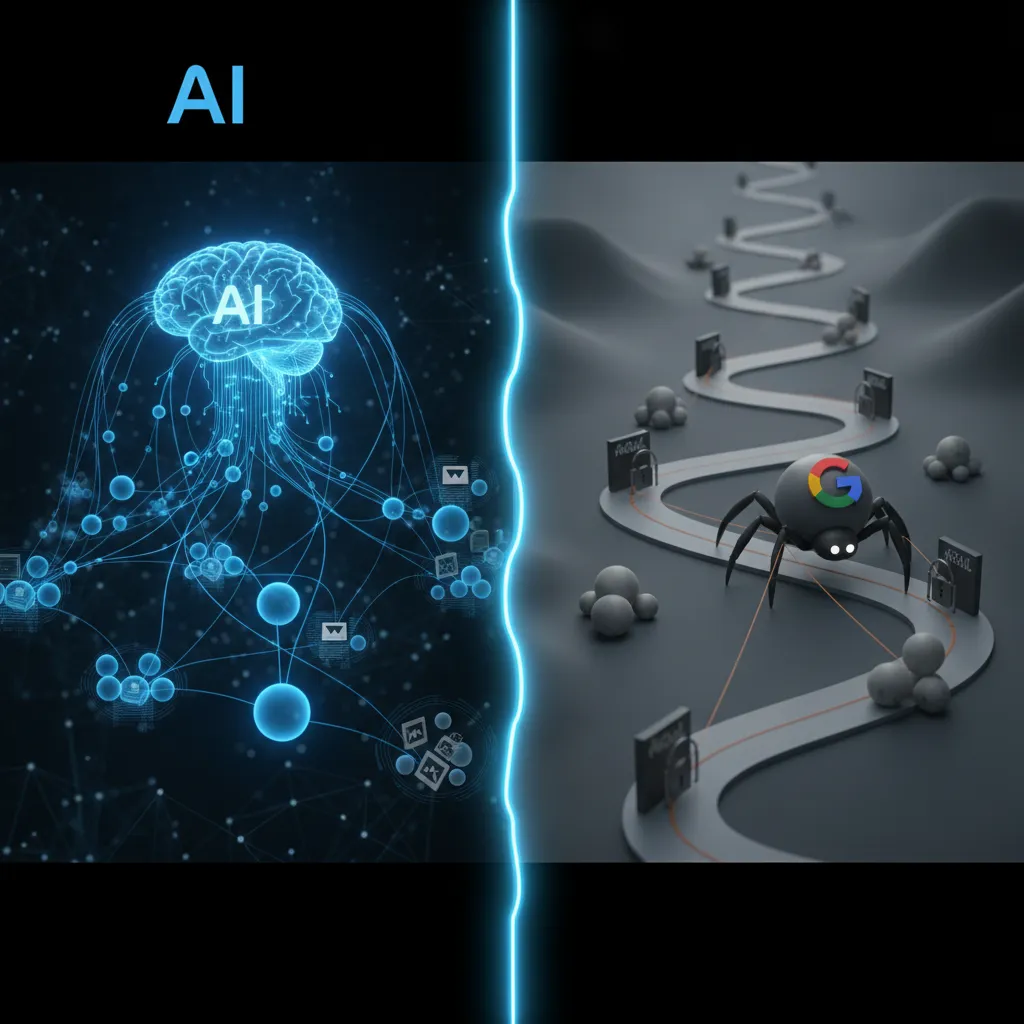
Google crawls a page to evaluate it, then withholds indexing when the page fails its quality threshold, a gap that directly shapes AI search indexing vs Google crawling outcomes.
In Google Search Console, six status reasons account for most "crawled, currently not indexed" reports: thin content, duplicate content caused by canonical misconfigurations, soft 404 errors, blocked rendering (JavaScript that Googlebot cannot process), low-quality signals flagged by the Helpful Content system, and manual spam actions applied by a Google reviewer.
Each reason reflects a deliberate quality gate. Google's Helpful Content system, updated repeatedly through 2023 and 2024, specifically targets sites that generate content at scale, FAQ farms, auto-generated product variant pages, and excludes them from the index even after Googlebot has fully crawled them.
According to Schema.org's structured data guidelines, implementing proper markup helps both search engines and AI systems understand the context and quality of your content — reducing the likelihood of misclassification as thin or low-value material.
What Are the Real-World SEO Impacts When Sites Are Crawled but Not Indexed Due to AI Training Data Collection?
GPTBot and CCBot do not apply Google's quality filters. Both crawlers ingest thin, duplicate, and soft-404-adjacent pages that Google refuses to index, meaning your weakest content can enter LLM training data while your strongest pages still struggle to rank.
E-commerce sites with large faceted navigation catalogs illustrate this clearly. Googlebot typically crawls more than 80% of those URLs but indexes fewer than 20% [1]. AI training crawlers harvest the same rejected pages indiscriminately, diluting the brand signal that models like ChatGPT and Perplexity use when generating recommendations.
The fix is not simply publishing more content, it is publishing content that clears both Google's indexing threshold and the quality bar that determines AI citation likelihood. For a deeper look at how training data quality affects which brands AI engines actually recommend, see our guide on AI training data and business visibility.
Tools like Moonrank address this at the source: the platform's technical AI audit identifies thin and duplicate pages, implements canonical tags and structured data, and ensures the content published daily meets the signal quality that both Google and AI crawlers reward, not just one or the other.
How AI Is Changing the Way Search Engines Crawl and Index Content
AI search engines don't crawl and index the web the way Google does, they retrieve, synthesize, and cite content at query time, which changes what "optimization" means entirely.
Is ChatGPT a Web Crawler and How Does It Compare to Google's Crawling Approach?
ChatGPT with web browsing enabled is a hybrid retrieval system, not a pure web crawler. It combines Bing's existing index with real-time page fetching through its own crawler, then prioritizes pages that carry clear entity structure and direct, quotable answers, not necessarily the pages sitting at rank position 1.
Perplexity operates differently again. Its crawler, PerplexityBot, fetches pages at query time and synthesizes answers from multiple sources simultaneously. That means freshness, structured headings, and concise factual statements carry more weight than backlink authority, a sharp H3 with a two-sentence answer can get cited over a 3,000-word article with stronger domain metrics.
The optimization target has shifted: the goal in AI search indexing vs Google crawling is no longer "rank position 1" but "get cited in the answer." A page sitting at position 7 with a clean, quotable answer block can outperform a position 1 page with dense prose in ChatGPT or Perplexity outputs.
"Generative AI systems don't reward the same signals as traditional search ranking. Clarity, factual density, and quotability now matter as much as domain authority when it comes to being cited in an AI-generated answer." — Aleyda Solis, International SEO Consultant and Founder of Orainti
Is AI Better Than Google Search for Discovering and Organizing Web Content?
Crawl budget allocation is diverging sharply. Google allocates crawl budget based on PageRank signals, established authority drives frequency. AI training crawlers like GPTBot allocate based on domain freshness and content novelty. A new authoritative post can be ingested by GPTBot within days even if Googlebot hasn't fully indexed it yet.
For SMBs publishing daily content, the approach Moonrank automates at $99/month, this shift is an opening. Fresh, structured content now has a faster path into AI-generated answers than into Google's top 10.
If you want to act on this shift, the next reads are AI search personalization and Retrieval Augmented Generation SEO, both cover how to structure content so AI engines cite it rather than skip it.
How to Control Which Crawlers Can Access Your Site
You can block AI training crawlers while keeping Google indexing fully intact by using separate robots.txt directives for each bot agent.
What robots.txt and Meta Tag Strategies Block AI Crawlers While Still Allowing Google Indexing?
The distinction between AI search indexing vs Google crawling becomes practical the moment you open your robots.txt file. Each crawler has its own user-agent string, so you can target them individually.
To block OpenAI's training crawler, add:
User-agent: GPTBot
Disallow: /
To block Google's AI training crawler without touching Google Search, add a separate directive:
User-agent: Google-Extended
Disallow: /
Googlebot, the one that drives your search rankings, is unaffected by either directive above, because it runs under a different agent name entirely.
For page-level control, meta tags give you finer precision. Adding <meta name="robots" content="noindex"> removes a page from Google's index. To keep a page indexed for search but exclude it from Google's AI training, use <meta name="googlebot-extended" content="noai"> in that page's <head>.
One mistake to avoid: blocking GPTBot does not stop ChatGPT from citing your content. If your pages are already in Bing's index and ChatGPT is using Bing retrieval, your content surfaces regardless. robots.txt controls the training crawler, not the live retrieval layer.
The decision comes down to a real trade-off. The main considerations when deciding whether to block AI crawlers are:
- Block AI training crawlers if your content is proprietary, paywalled, or competitively sensitive.
- Allow AI training crawlers if you want your brand cited in ChatGPT, Claude, and Perplexity answers.
- Use page-level meta tags for granular control over which specific pages enter AI training pipelines.
- Monitor server logs regularly to detect unexpected crawler activity from new or undocumented AI bots.
- Remember that blocking training crawlers does not prevent real-time retrieval through third-party indexes like Bing.
Tracking which bots are actually hitting your site matters as much as configuring the rules. An affordable AI search optimization platform can surface unexpected crawler activity, and pairing it with SEO monitoring tools lets you flag anomalies before they affect your visibility or data exposure.
For additional technical guidance on managing crawler access, the IETF's Robots Exclusion Protocol specification (RFC 9309) provides the authoritative standard that all compliant crawlers — including Googlebot and GPTBot — are expected to follow.
Frequently Asked Questions
Does blocking GPTBot in robots.txt stop ChatGPT from citing my content?
Blocking GPTBot prevents OpenAI from crawling your pages for training data, but it does not stop ChatGPT from citing content it has already indexed or sourced through Bing's index. ChatGPT's browsing feature and Perplexity both pull live web results through third-party indexes, not exclusively through their own crawlers. Blocking GPTBot in robots.txt may reduce future training exposure, but it won't erase existing citations or prevent real-time retrieval from search indexes your pages already appear in.
How do I check if my pages are being crawled by AI bots versus Googlebot?
Check your server access logs and filter by user-agent strings, Googlebot identifies itself as "Googlebot," while OpenAI's crawler uses "GPTBot" and Perplexity uses "PerplexityBot." Most hosting platforms (Cloudflare, Nginx, Apache) log every request with the user-agent included. Tools like Screaming Frog can also parse log files and segment visits by bot type, giving you a clear picture of which AI crawlers are actively hitting your site and how frequently.
Can a page rank on Google and also appear in Perplexity or ChatGPT answers at the same time?
Yes, Google ranking and AI search visibility are independent but often overlapping outcomes. A page that ranks well on Google has typically earned signals (backlinks, structured data, clear authorship) that also make it a strong candidate for AI citation. Perplexity, for example, draws heavily from web search indexes. That said, Google ranking alone does not guarantee AI visibility; you also need content structured so AI systems can extract a direct, quotable answer.
What is crawl budget and does it affect AI search indexing the same way it affects Google?
Crawl budget is the number of URLs a crawler will fetch from your site within a given timeframe, Google allocates this based on your site's authority and server capacity. AI crawlers like GPTBot and PerplexityBot operate on separate, independent budgets with no public documentation on their allocation logic. Unlike Google, AI crawlers don't publish crawl stats in a dashboard equivalent to Google Search Console, so you can't directly monitor or optimize their crawl budget the way you can with Googlebot.
How does structured data affect visibility in both Google search results and AI-generated answers?
Structured data, implemented via Schema.org markup, helps both Google and AI systems understand the context, entities, and relationships within your content. For Google, it can unlock rich results like FAQ snippets and review stars. For AI retrieval systems, structured data provides machine-readable signals that make your content easier to parse and cite accurately. Pages with proper structured data are more likely to be selected as authoritative sources by both traditional search engines and AI answer engines like Perplexity and ChatGPT.
Conclusion
Google crawling and AI search indexing follow fundamentally different logic, one ranks pages, the other retrieves answers. Treating them as the same problem is why many businesses appear on page one of Google yet go unmentioned when a customer asks ChatGPT or Perplexity for a recommendation.
Three things to act on now: audit your structured data so AI systems can parse your content without guesswork; add an llms.txt file to signal what your site covers; and start tracking your brand's actual visibility across ChatGPT, Gemini, Claude, and Perplexity, not just your Google rankings.
Moonrank automates all three at $99/month. Start a free 3-day trial at moonrank.ai and see where you currently stand in AI search results before your competitors do.
Sources & References
- Google Crawling and Indexing | Google Search Central | Documentation | Google for Developers
- Crawling vs. Indexing, The Quick Summary for Busy Marketers - Sure Oak
Recommended Articles
Explore more from our content library: