AI Search Training Data: Impact on Business Visibility
Learn how AI search training data shapes model accuracy and business visibility in ChatGPT, Gemini, and Perplexity. Improve your content strategy today.

AI search training data is the labeled, curated information used to teach AI models, like those powering ChatGPT, Gemini, and Perplexity, how to understand queries and surface relevant answers. Its quality directly determines whether an AI system returns accurate, unbiased results or confidently delivers wrong ones. High-quality training data improves model precision, reduces hallucinations, and shapes which sources AI engines treat as authoritative, making it a critical factor for any business trying to appear in AI-generated search results.
What Is AI Search Training Data and Why Does It Matter for Your Business?
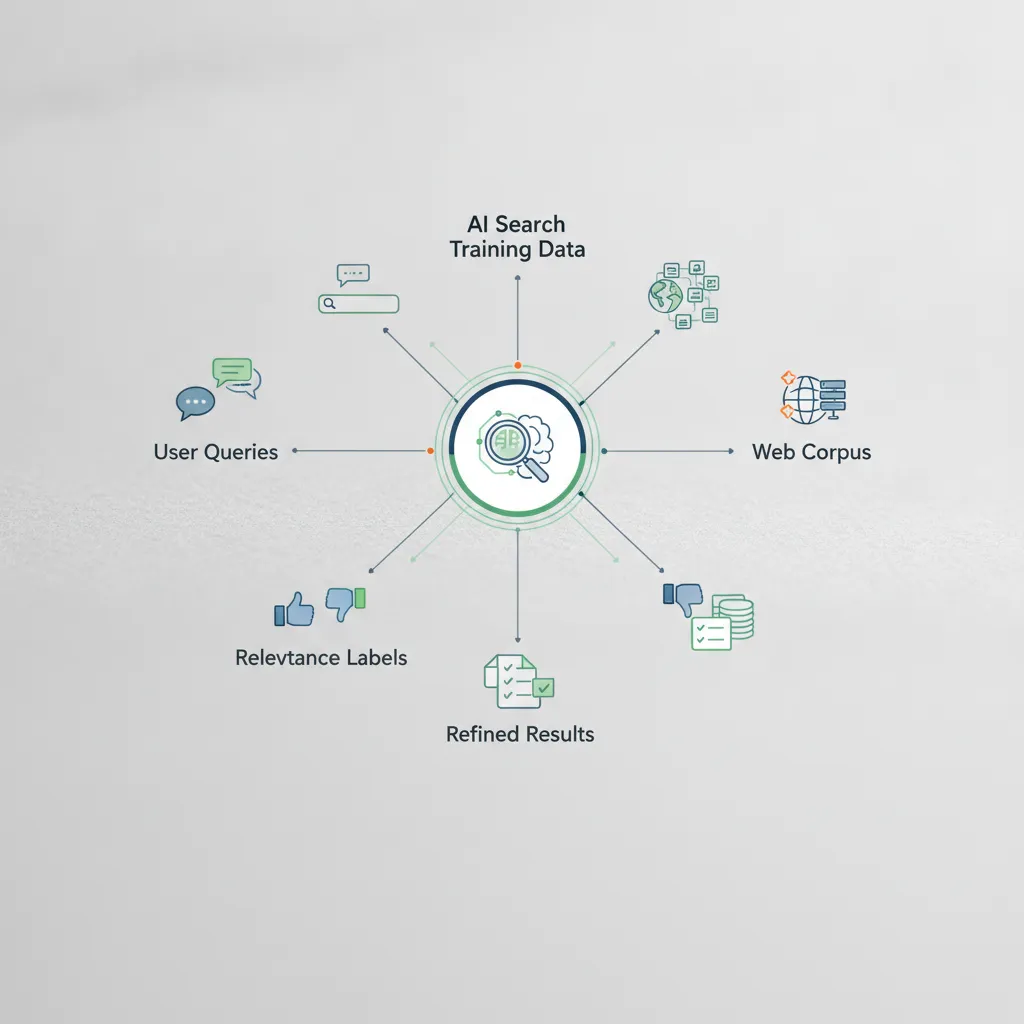
Training data is the labeled information fed to AI models so they learn to recognize patterns, answer queries, and rank sources, before any real user interacts with them.
This is distinct from inference data, which is what the model processes at runtime when a user types a question into ChatGPT or Perplexity. Training data shapes the model's internal knowledge and biases permanently; inference data is processed on the fly using that already-trained foundation. The two are fundamentally different, and conflating them leads businesses to misunderstand what they can actually influence.
According to the National Institute of Standards and Technology (NIST), the quality and representativeness of training data is one of the most significant factors affecting AI system trustworthiness and reliability.
What Are the Main Types of Training Data Used in AI Systems?
AI systems draw on three main categories of training data [3], each serving a different learning purpose.
- Supervised learning data: Labeled input-output pairs where the correct answer is provided, for example, a dataset of customer questions paired with verified answers, used to train a model to respond accurately.
- Unsupervised learning data: Unlabeled text or content where the model finds patterns on its own, for example, billions of web pages used to build a language model's general understanding of how sentences relate.
- Reinforcement learning data: Reward-signal feedback where human raters score model outputs, for example, OpenAI's RLHF (Reinforcement Learning from Human Feedback) process, which shaped ChatGPT's conversational behavior.
How Does Training Data Quality Affect AI Model Performance?
Low-quality AI search training data directly raises hallucination rates, models produce confident but factually incorrect answers at measurably higher frequency when trained on noisy or inconsistent sources [3].
Quality problems include mislabeled examples, duplicated content, and sources with conflicting facts. A model trained on these produces unreliable outputs even when its architecture is sound.
"The data used to train AI systems encodes assumptions about the world. When that data is incomplete or biased, those assumptions become embedded in every decision the model makes." — Timnit Gebru, Founder, Distributed AI Research Institute (DAIR)
For businesses, the downstream effect is concrete. AI engines like Perplexity and ChatGPT surface sources that appeared frequently and authoritatively in their training corpora. If your content was present in high-quality, widely-indexed datasets, your brand is more likely to be cited in AI-generated answers. If it wasn't, or if it appeared only on low-authority pages, the model has little basis to recommend you. For a deeper look at how source attribution mechanics work inside these models, see our article AI Model Training Data Search: How It Shapes Search Results.
How to Prepare and Validate AI Search Training Data for Machine Learning Projects
Preparing AI search training data follows five sequential steps: define requirements, collect, clean, label, and split, then validate before any model trains on it.
What Is the Step-by-Step Process for Preparing Training Data?
The pipeline is consistent across most machine learning projects, regardless of scale.
- Define the task and data requirements. Specify what the model must predict or generate, then identify what data types, volumes, and quality thresholds that task demands.
- Collect raw data from diverse sources. Pull from multiple channels, web pages, PDFs, structured databases, user-generated content, to reduce source bias [3].
- Clean and deduplicate. Remove duplicate records, fix formatting inconsistencies, and filter out noise. Dirty data at this stage compounds into larger errors downstream.
- Label or annotate. Human annotation is the most time-intensive step. Simple classification tasks average $0.01–$0.10 per label; complex NLP tasks, such as intent tagging or entity extraction, cost significantly more per item [3].
- Split into train, validation, and test sets. The standard ratio is 80/10/10: 80% for training, 10% for validation during development, 10% held out for final testing.
For businesses publishing content online, this pipeline has a direct implication. Well-structured content using schema markup and structured data, the kind Moonrank implements automatically, is far easier for AI crawlers to ingest as a clean, high-quality training signal than unformatted prose.
What Validation Techniques Confirm Training Data Is Model-Ready?
Three techniques are standard for confirming data quality before training begins.
- Holdout validation reserves a fixed slice of data the model never sees during training, then measures performance against it, a basic sanity check on generalization.
- K-fold cross-validation rotates the validation slice across k segments of the dataset, so every record gets tested at least once. This catches performance variance that a single holdout split can miss.
- Stratified sampling ensures each split (train, validation, test) contains proportional representation of every class or category, critical when one label appears far less often than others.
The single most common preparation failure is data leakage: test-set information bleeding into the training phase. Leakage produces accuracy scores that look strong in development but collapse when the model meets real-world data, a costly mistake to diagnose after deployment.
Synthetic vs. Real Training Data: Key Differences and When to Use Each
Synthetic data is algorithmically generated to mimic real-world distributions; real data captures actual events, and choosing between them depends on your task, budget, and risk tolerance.
When Should You Use Synthetic Training Data Instead of Real-World Data?
Synthetic training data is produced by GANs (generative adversarial networks), rule-based systems, or simulation engines, none of which touch actual user records. That privacy separation is its first major advantage. For more information, see Growth Researcher.
The second advantage is cost. Generating millions of synthetic examples carries near-zero marginal cost, while collecting and labeling large real-world datasets typically runs $50,000 to $500,000+ depending on domain complexity and annotation requirements [3].
Three scenarios favor synthetic data clearly: privacy regulations block access to real records, your model needs rare-event augmentation (a fraud pattern that appears once per 10,000 transactions, for example), or you're prototyping a model before committing a labeling budget to production.
What Are the Trade-Offs Between Synthetic and Real Training Data?
Real data wins in high-stakes domains. Medical diagnosis, legal document review, and financial fraud detection all depend on edge cases, the unusual presentation, the ambiguous clause, the novel attack vector, that synthetic generators routinely miss [3].
The leading AI labs have settled on a hybrid approach for AI search training data pipelines: pre-train on real web-scale text for broad coverage, then fine-tune with synthetic instruction-following data for control. Google DeepMind and OpenAI both follow this pattern, combining the breadth of real corpora with the precision of generated examples.
"Synthetic data is not a shortcut — it is a complement. The models that perform best in production are those trained on a carefully balanced mix of real-world examples and high-fidelity synthetic augmentation." — Andrew Ng, Founder, DeepLearning.AI and AI Fund
For most SMBs and product teams, the practical rule is straightforward: start synthetic to move fast, validate on real data before deploying anything that affects customers.
How to Measure Training Data Quality and Detect Bias in Your Datasets
Four metrics, completeness, consistency, accuracy, and coverage, form the standard framework for evaluating AI training data quality before a model ever trains on it.
What Metrics and Benchmarks Compare Training Data Quality Across AI Models?
Each metric targets a distinct failure mode. Completeness measures the percentage of non-null values across fields, a dataset with 30% missing labels will produce a model that generalizes poorly. Consistency checks format and schema uniformity; a date field that mixes "MM/DD/YYYY" and Unix timestamps introduces noise the model cannot resolve cleanly.
Accuracy measures ground-truth alignment rate, how often a labeled data point matches a verified external reference. Coverage checks whether all target classes or demographics appear in sufficient proportion. A dataset that covers only two of five product categories, for example, will produce a model blind to the other three.
Data cards and model cards, standardized documentation formats promoted by Google and Hugging Face, make these metrics auditable. They disclose dataset composition, known limitations, and intended use cases in a structured format that teams can compare across projects and model versions. According to the Federal Trade Commission (FTC), businesses deploying AI systems have a responsibility to ensure their training data is accurate, representative, and free from deceptive patterns.
How Do You Detect and Mitigate Bias in Training Datasets?
Representation bias enters a dataset when one demographic, language, or content type is over-indexed, and the model inherits that skew directly. Early facial recognition systems showed error rates up to 34% higher on darker-skinned faces [3] because the training images skewed heavily toward lighter skin tones. Research published through the Stanford Human-Centered AI Institute (HAI) confirms that dataset bias remains one of the most persistent and consequential challenges in deployed AI systems.
Three detection methods address this systematically. Statistical parity checks compare outcome rates across subgroups to surface unequal treatment. Embedding space audits visualize how the model clusters concepts, revealing whether certain groups or topics are conflated or marginalized. Red-teaming uses adversarial prompting to expose failure modes that standard benchmarks miss.
This quality calculus connects directly to AI search training data and visibility. Gemini and Claude increasingly weight source credibility and factual consistency when selecting content to surface, meaning accurate, well-structured content free of contradictions is more likely to be treated as a high-quality training signal, and more likely to appear in AI-generated recommendations.
Training Data Costs and ROI: What to Expect for Different ML Project Types
Training data costs range from $5K for basic image datasets to over $500K for domain-specific conversational AI corpora, and poor data quality multiplies those costs 4–10x.
How Do Training Data Costs Vary Across Machine Learning Project Types?
Three components drive every training data budget: acquisition (scraping, licensing, or purchasing raw data), annotation (human labeling or automated tagging), and maintenance (re-labeling as real-world conditions shift).
Cost benchmarks by project type break down roughly as follows:
- Image classification: $5K–$50K for 10,000 labeled images, depending on label complexity and whether you use crowdsourced or specialist annotators.
- NLP sentiment analysis: $10K–$100K, with annotation complexity, multi-class labels, ambiguous phrasing, domain jargon, driving the upper end.
- Conversational AI / LLM fine-tuning: Domain-specific corpora routinely exceed $500K, because high-fidelity dialogue data requires expert annotators and iterative quality review.
Maintenance is the budget line most teams underestimate. As language evolves, products change, and user behavior shifts, datasets need re-labeling, typically at 15–20% of the initial build cost every year.
What Is the ROI of Investing in High-Quality Training Data?
McKinsey research indicates that companies investing in strong data infrastructure see 2–3x faster model deployment cycles and 30–50% lower error-correction costs post-launch. The compounding effect is significant: a model that ships faster and fails less often recovers its data investment within the first production quarter.
The hidden cost of skipping data quality is steeper still. A model retrained after data quality failures costs 4–10x more than building a clean dataset from the start, factoring in compute bills, engineering hours, and delayed go-to-market.
For smaller businesses, the ROI question around AI search training data is more immediate and far less expensive to act on. Structured, schema-marked content acts as a low-cost data quality signal that improves citation rates in ChatGPT, Perplexity, and Gemini, the same engines your customers are already using to find product and service recommendations. Tools like Moonrank implement schema markup, structured data, and llms.txt configuration automatically, giving SMBs the technical data signals that AI engines favor without a five-figure annotation budget. For a deeper look at how this plays out in practice, see the site's articles on SaaS AI search visibility and AI search personalization.

Frequently Asked Questions
Can my business's published content become part of AI search training data?
Yes, any publicly accessible content on your website can be crawled and used to train AI models. Companies like Google have explicitly updated their policies to retain user-generated and published content for AI model improvement [1]. Structured, well-cited content tends to be more useful to these systems, which is why technical signals like schema markup and structured data matter: they make your content easier for AI crawlers to parse, increasing the chance it's included and attributed correctly.
How often do AI companies update or refresh their training datasets?
Major AI companies typically refresh or extend their training datasets every several months to a year, though the exact cadence varies by model and company. GPT-4, for example, has a training data cutoff that differs from the live retrieval layer that Perplexity or Bing use. Systems that rely on retrieval-augmented generation (RAG) pull live web content continuously, so those effectively update in near real time, making fresh, consistently published content more visible than static pages.
What is the difference between training data, fine-tuning data, and retrieval-augmented generation (RAG)?
Training data is the large corpus used to build a model's foundational knowledge from scratch [3]. Fine-tuning data is a smaller, targeted dataset applied after initial training to adjust the model's behavior for a specific task or domain, think of it as specialized coaching on top of a general education. RAG is different from both: instead of baking knowledge into the model's weights, it retrieves live documents at query time and feeds them into the response. For most businesses, RAG-based systems like Perplexity are the most immediately actionable, because fresh published content can surface in answers within days.
How do I opt out of having my content used as AI training data?
You can limit AI training use through a combination of robots.txt directives, platform-level privacy settings, and legal opt-out requests where available. Google's updated Search Services History settings, for instance, allow users to control whether their search-related data feeds AI model training [1]. For website owners, adding specific crawler-blocking rules (such as disallowing GPTBot or Google-Extended in robots.txt) signals that your content should not be used for training, though enforcement depends entirely on whether the AI company honors those directives.
Does the size of a training dataset always determine AI search performance?
Not necessarily. While larger datasets generally improve a model's breadth of knowledge, dataset quality and diversity matter more than raw size. A smaller, well-curated dataset with accurate labels and balanced representation often outperforms a massive but noisy corpus. For businesses, this means that publishing fewer, highly authoritative and well-structured pieces of content can be more effective for AI search visibility than flooding the web with low-quality pages.

Conclusion
AI search training data determines which businesses AI engines know about, trust, and recommend. Three things matter most: your content must be publicly accessible and machine-readable, it must be structured with signals like schema markup and citations that AI systems can parse, and it must be published consistently enough to stay current as models update and RAG systems pull live results.
If your business isn't appearing when customers ask ChatGPT or Perplexity for a recommendation, the gap is almost always technical and content-related, not a matter of luck. Start by auditing your site's structured data and publishing cadence. Or let Moonrank handle both automatically for $99/month, with daily content publishing and technical AI optimization built in from day one.
Sources & References
Recommended Articles
Explore more from our content library: