AI Training Data Attribution Matters for Business
AI training data attribution (also called training data attribution, or TDA) is the process of identifying which specific training examples most influenced a...
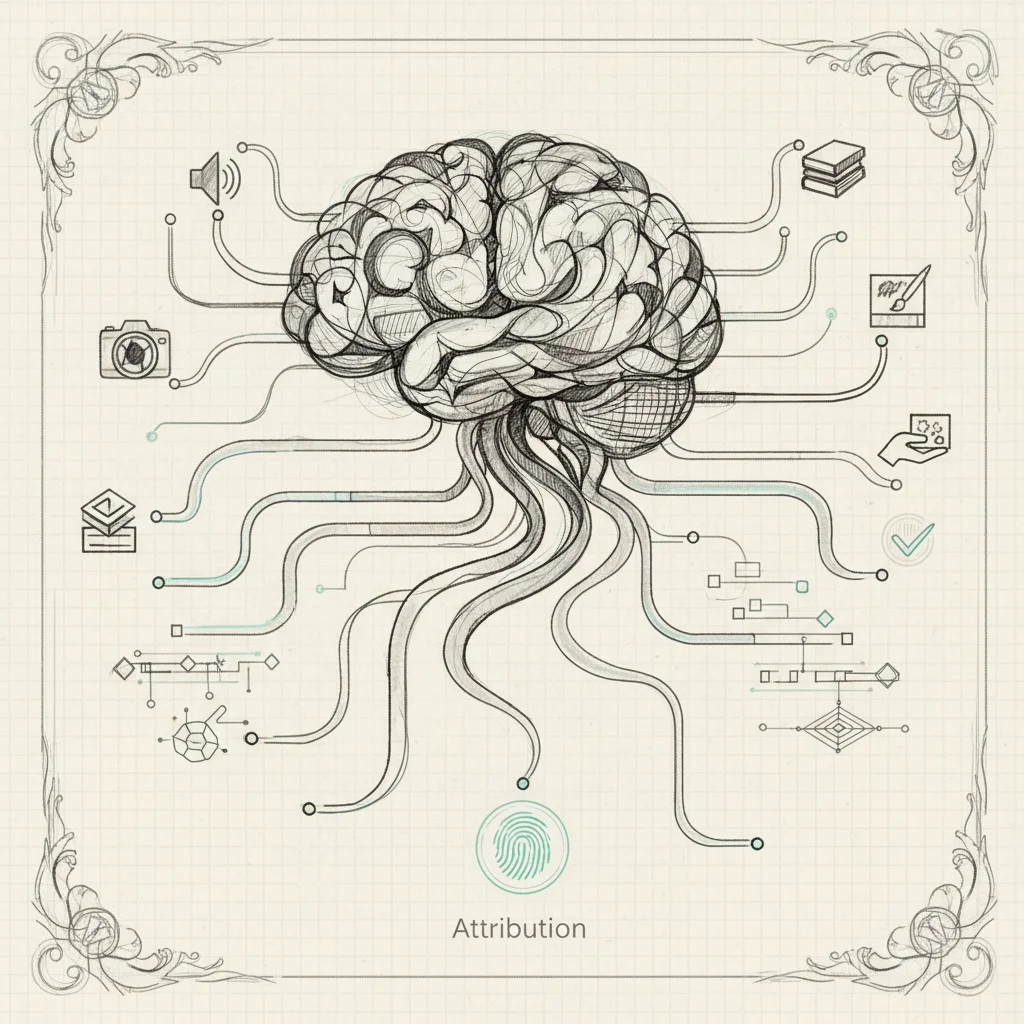
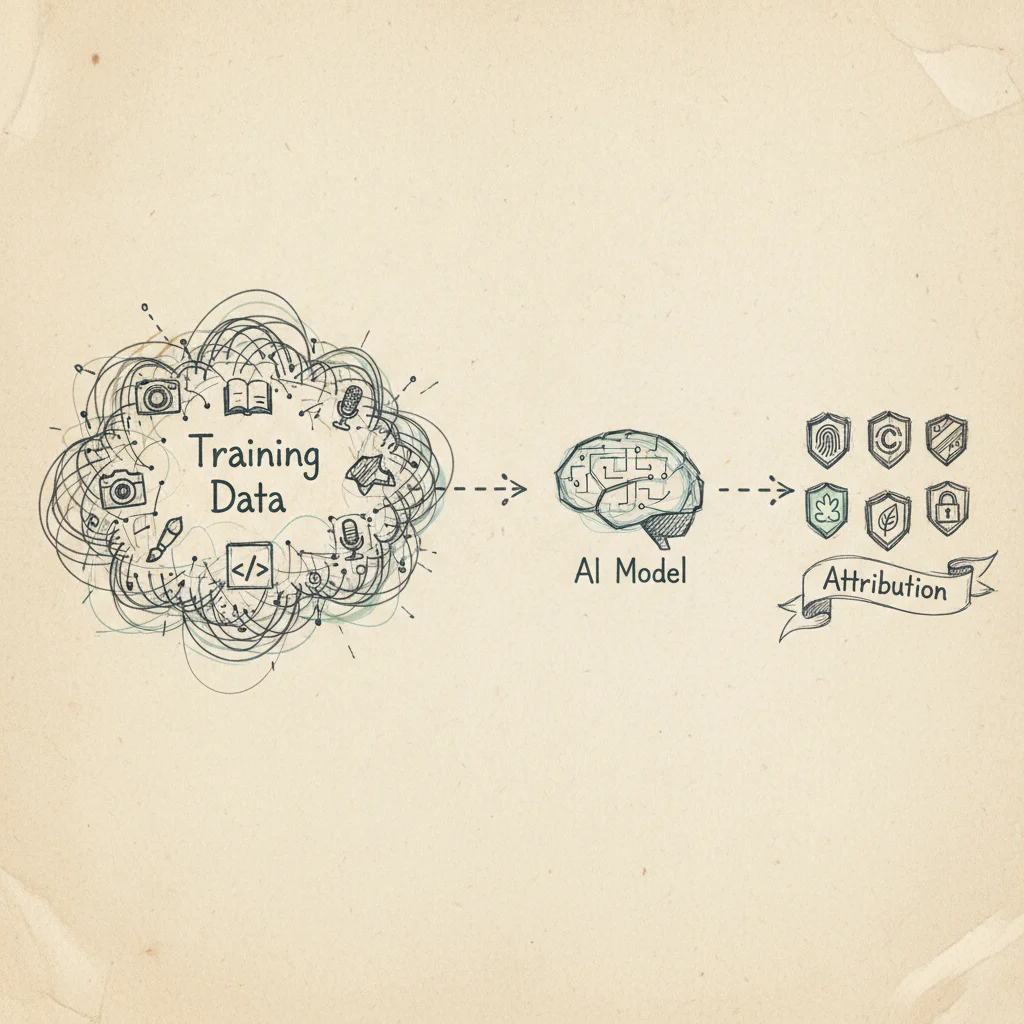
AI training data attribution (also called training data attribution, or TDA) is the process of identifying which specific training examples most influenced a model's output or behavior. It matters because it gives developers a way to audit model decisions, remove harmful or low-quality data, comply with emerging copyright regulations, and give credit to original data creators. As AI systems grow larger, TDA is becoming a core tool for responsible model development and legal risk management.
What Is AI Training Data Attribution and Why Does It Matter?
AI training data attribution is the practice of tracing a model's output back to the specific training examples that shaped it, a technical discipline with serious legal and ethical consequences.
When a large language model generates text, summarizes a document, or answers a question, that output reflects patterns learned from billions of training examples. TDA methods identify which of those examples had the most influence on a given output, not by inspecting the model's internal weights, but by connecting outputs to source data. This distinction matters enormously in practice.
How does data attribution differ from model interpretability and explainability?
Model interpretability asks "why did the model produce this output?", examining attention patterns, neuron activations, and internal representations. TDA asks a different question: "which training data made the model capable of producing this output at all?"
Research published by Google's team on scaling gradient-based attribution methods [1] highlights a subtle but critical point: the training examples that influence a model's knowledge of a fact are often not the same examples that directly state that fact. A model might learn that Paris is the capital of France from thousands of indirect references, not from a single authoritative source. That complexity is what makes TDA a distinct and technically demanding field.
TDA also serves a practical data quality function. By tracing outputs back to source examples, teams can identify mislabeled, duplicated, or toxic training samples that degrade model performance, and remove them before they cause downstream harm.
What are the legal and licensing implications of attributing copyrighted training data?
Attribution has moved from a research concern to a legal requirement. The EU AI Act, effective August 2026, requires high-risk AI providers to document training data provenance, making TDA a compliance obligation rather than an optional audit practice.
Copyright litigation has sharpened the stakes further. The New York Times v. OpenAI case has placed data attribution at the center of fair use and licensing liability debates: if a model reproduces content that closely mirrors a copyrighted training source, attribution methods are the primary tool for establishing whether that source was used and how heavily it was weighted.
As legal scholar Michael Weinberg has noted [2], the impulse to require attribution breaks down quickly when confronted with practical implementation questions, particularly when training data comes from open-license communities where attribution norms are strong but technically complex to enforce at scale.
How Different Data Attribution Methods Actually Work
The three main families of AI training data attribution, influence functions, gradient-based methods, and concept-based attribution, differ sharply in how they trace model behavior back to source data, and each involves a distinct trade-off between accuracy and compute cost.
What are the key differences between gradient-based, influence function, and concept-based attribution approaches?
Influence functions, rooted in robust statistics and adapted for machine learning by Koh & Liang in 2017, estimate how a model's loss would change if a specific training point were removed. The core idea is powerful: it gives a precise counterfactual answer to "what would this model look like without that data?" The catch is computational, the method requires inverting the Hessian matrix of the model's parameters, which becomes prohibitively expensive at the scale of modern large language models.
Gradient-based methods like TracIn (Pruthi et al., 2020) take a faster route. TracIn approximates influence by summing the dot products of gradients between a training example and a test point across multiple model checkpoints. This sidesteps the Hessian inversion entirely. Still, for billion-parameter models, storing and computing gradients across checkpoints remains memory-intensive, a constraint that limits practical deployment at the frontier.
Concept-based attribution, exemplified by TCAV (Testing with Concept Activation Vectors), works differently. Instead of tracing individual training examples, it identifies which high-level concepts in training data activate specific model behaviors. A non-engineer can interpret the output more easily, "this model's response is driven by examples containing legal language", but the method lacks the precision to pinpoint individual source documents.
How do attribution methods compare in terms of accuracy and performance benchmarks?
Influence functions score highest on accuracy benchmarks for linear models, but their performance degrades significantly on deep networks where the loss surface is non-convex and the Hessian approximation breaks down. TracIn trades some of that accuracy for a 10–100x speed improvement in practice, making it the more viable option when working with large datasets. Research scaling gradient-based attribution methods to an 8B-parameter LLM across a 160B-token corpus [2] confirms that speed gains come with a meaningful precision cost, particularly when the goal is identifying which training examples directly express a specific fact versus which ones indirectly influenced it.
| Method | Accuracy | Compute Cost | Best Use Case |
|---|---|---|---|
| Influence Functions | High (linear models); degrades on deep nets | Very high, requires Hessian inversion | Precise auditing on smaller models |
| TracIn (gradient-based) | Moderate, 10–100x faster with some accuracy loss | High, checkpoint gradient storage | Large-scale attribution with speed constraints |
| Concept-based (TCAV) | Lower precision on individual examples | Low to moderate | Interpretability for non-technical stakeholders |

Practical Limitations and Computational Costs of Attribution at Scale
For production LLMs, exact AI training data attribution remains largely infeasible, teams rely on approximations that are directionally useful but not forensically precise.
Which attribution methods are feasible for production use with large language models?
Full influence function computation breaks down fast at scale. Inverting the Hessian matrix for a 7B+ parameter model demands hundreds of GB of memory, a requirement that makes exact computation effectively impossible without approximations.
Two purpose-built methods address this directly. DataInf (2023) and TRAK (2023, Park et al.) both reduce compute by projecting gradients into lower-dimensional spaces. TRAK in particular achieves near-influence-function accuracy at a fraction of the cost, making it one of the few methods realistic teams actually deploy.
Retrieval-augmented attribution is an emerging workaround for teams that can't afford even approximate full-corpus runs. Instead of computing influence across the entire training set, you retrieve the top-k candidate examples using embedding similarity, then run attribution only on that subset, cutting compute dramatically while preserving directional signal.
Research from Google [1] scaled gradient-based attribution methods to an 8B-parameter model across a 160B-token corpus, and even that required significant engineering investment. For most teams, that scale remains out of reach.
What are the memory and compute requirements for different attribution techniques?
TracIn, which approximates influence by summing gradients across training checkpoints, requires storing those gradients at each checkpoint. On a 1B-parameter model, that easily consumes 50–200 GB of storage per attribution run.
Approximations like EK-FAC and LiSSA reduce memory pressure by avoiding full Hessian inversion, but they introduce their own accuracy trade-offs. The honest position is that no method today gives you exact attribution at production scale, you choose the approximation whose error budget fits your use case.
How Data Attribution Is Being Used in Real-World AI Projects Today
AI training data attribution has moved from academic theory into active deployment at Google DeepMind, Hugging Face, Stanford, and MIT, with measurable results.
What are concrete case studies of data attribution in industry and research labs?
Google DeepMind has applied influence-function-style attribution internally to detect poisoned and mislabeled examples before fine-tuning production models, catching data problems that standard validation metrics miss entirely.
Hugging Face and EleutherAI have built TDA into dataset auditing pipelines for open-source models including ROOTS and The Pile [2]. These pipelines flag near-duplicate documents and high-toxicity examples that carry outsized influence on model outputs, allowing maintainers to remove them before training runs begin.
In the legal domain, researchers have used TDA to show that specific copyrighted books rank as high-influence training points for particular LLM outputs [2]. That finding is directly relevant to ongoing copyright litigation, giving plaintiffs a technical basis to argue that their work shaped a model's behavior in traceable, measurable ways.
Stanford CRFM and MIT researchers are using TRAK to study memorization, specifically, which training examples a model reproduces verbatim versus generalizes from. Attribution scores correlate strongly with memorization risk, giving safety teams a way to identify and remove the examples most likely to cause verbatim regurgitation of sensitive content.
How are companies using attribution to improve model training and data quality?
AI startup teams are applying lightweight TDA approximations to rank every training example by its influence on validation loss. Teams then prune the bottom 10–20% of low-quality or harmful examples, often improving benchmark scores without sourcing any new data.
This approach treats training data as a ranked asset rather than a fixed input. The practical payoff is faster iteration: instead of collecting more data, teams clean what they already have, guided by attribution scores that show exactly which examples help and which hurt.
Tools and Libraries Practitioners Can Use to Implement Data Attribution
Three open-source libraries, TRAK, Captum, and ekfac-influence, cover the majority of practical AI training data attribution needs across model sizes and compute budgets.
What are the best open-source libraries and frameworks for implementing data attribution?
TRAK (Park et al., NeurIPS 2023) is the strongest starting point for large models. It is a Python library available on GitHub under the MIT license, built specifically for scalable training data attribution on models with hundreds of millions of parameters. TRAK supports PyTorch natively, includes built-in gradient projection to reduce memory overhead, and has been benchmarked on CIFAR-10 and ImageNet. Install it with pip install traker.
Captum, maintained by Meta's PyTorch team, is a broader interpretability library that includes TracIn and influence function implementations. It is the better choice for teams already working in the PyTorch ecosystem, the documentation includes tutorial notebooks that walk through attribution end-to-end.
ekfac-influence implements the EK-FAC Hessian approximation, which produces more accurate influence scores than TracIn on smaller deep networks. The setup cost is higher, but the accuracy gain is meaningful when you need precise per-sample attribution rather than ranked approximations.
How do you implement data attribution with code examples and step-by-step guides?
Choose your library based on model size and compute. For models above 100M parameters, use TRAK, its gradient projection keeps memory usage tractable at scale. For smaller models or when you need tighter PyTorch integration, use Captum's TracIn implementation. If compute is severely constrained, embedding-similarity retrieval works as a fast proxy: encode training examples and the target output into the same vector space, then rank by cosine similarity.
The TRAK paper (Park et al., NeurIPS 2023) and the Captum documentation are the two most practitioner-friendly entry points available today. Both include worked examples you can run against your own checkpoints without writing attribution logic from scratch.
Frequently Asked Questions
Can data attribution methods detect if a specific copyrighted book was used to train an AI model?
Current attribution methods can identify whether a specific text influenced a model's outputs, but they cannot confirm with legal certainty that a copyrighted book was used in training. Influence functions and retrieval-based methods can surface training examples that shaped a particular response, but as research on 8B-parameter models shows [1], the examples that influence a model's knowledge of a fact are often not the ones that directly express it, making clean one-to-one attribution to a specific book technically unreliable in most litigation contexts.
How accurate are influence functions compared to simply retraining the model without a data point?
Influence functions approximate the effect of removing a data point without the cost of full retraining, but their accuracy degrades at scale. Leave-one-out retraining remains the ground-truth benchmark, it directly measures how a model changes when a single example is removed, but it is computationally prohibitive for models with billions of parameters. At the scale of 8B parameters and 160 billion training tokens [1], influence function approximations introduce meaningful error that researchers are still working to reduce.
Is data attribution the same as data provenance?
Data attribution and data provenance are related but distinct concepts. Provenance tracks where data came from, its origin, chain of custody, and licensing status, before and during training. Attribution asks a different question: which specific data points causally shaped a trained model's behavior or outputs? Provenance is a data management concern; attribution is a post-training analysis problem. Both matter for AI accountability, but they require different tools and methods.
How does training data attribution relate to AI watermarking?
Training data attribution and AI watermarking address overlapping but separate problems. Watermarking embeds detectable signals into model outputs or training data so that generated content can be traced back to its source. Attribution, by contrast, works backward from a model's behavior to identify which training examples shaped it. Watermarking is a proactive tagging mechanism; attribution is a forensic analysis technique. Some researchers combine both approaches to build stronger content-origin verification systems.

Conclusion
AI training data attribution sits at the intersection of machine learning research, copyright law, and content creator rights, and none of those three areas has fully caught up with the others yet. Three things are clear from the current state of the field: influence functions are useful but imprecise at scale [1]; the line between attribution, provenance, and licensing compliance remains legally unsettled [2]; and any business publishing content online should treat AI discoverability as an active concern, not a passive one.
If your business depends on organic discovery, start by auditing what AI search engines actually know about you. Run your brand name through ChatGPT, Gemini, and Perplexity today, then visit moonrank.ai to see how automated technical optimization can close the gaps you find.
Sources & References
- Scaling Training Data Attribution | Tolga Bolukbasi
- Is There A Coherent Theory of Attributing AI Training Data?, Michael Weinberg
Recommended Articles
Explore more from our content library: