AI Search Optimization: How to Make Your Brand AI-Visible
AI search engines like ChatGPT, Gemini, and Perplexity recommend brands based on what they can find, verify, and understand across the web — not on paid...

Understanding AI Search Optimization is essential. AI search engines like ChatGPT, Gemini, and Perplexity recommend brands based on what they can find, verify, and understand across the web, not on paid placement or domain authority alone. They pull from indexed content, structured data, review sites, and sources with clear, consistent facts about what a business does. To become AI-visible, your brand needs to appear in the content these engines actually draw from, written in a way that's easy to extract and cite. This is a different game from ranking in Google's blue links, and it rewards clarity, consistency, and freshness over keyword density.
How Do AI Search Engines Decide Which Brands to Recommend and Cite?
AI search engines pull answers from a live index of web content, then favor brands whose facts are clear, consistent, and easy to lift into a response. The mechanics behind this matter more than any single tactic, because they explain why some businesses get named and others get skipped entirely.
What Is Retrieval-Augmented Generation, in Plain English?
Retrieval-augmented generation, or RAG, means the model searches or references indexed content in real time instead of relying only on what it learned during training. When someone asks ChatGPT or Perplexity for a recommendation, the system often runs a live retrieval step, pulling pages, snippets, and structured data, then generates an answer grounded in what it finds. This is why a business that didn't exist when a model's training data was collected can still show up in results: the engine looked it up fresh rather than recalling it from memory.
That retrieval step rewards content written as fact, not pitch. A sentence like "we serve mid-market retailers with same-day fulfillment" gets extracted more easily than "we're passionate about delivering excellence." AI Search Optimization starts with this distinction, stating what a brand does, who it's for, its pricing tier, and what sets it apart in language a model can quote directly, rather than burying those facts in adjectives [3].
Do Different AI Models Have Different Citation Preferences?
Yes, each engine sources answers differently, so visibility on one doesn't guarantee visibility on another. Perplexity leans heavily on live web results and surfaces citations in real time, acting more like a research assistant than a chatbot [2]. ChatGPT blends browsing with its trained knowledge base, so it may cite a current page or default to older internal knowledge depending on the query. Gemini draws on Google's index and Search integration, giving it a bias toward pages that already perform well in traditional search [2]. A business running AI Search Optimization efforts needs presence across all four surfaces, not a single-engine strategy.
Third-party mentions matter across every engine because they act as independent corroboration. A listing on a review site, a mention in a comparison article, or coverage in trade press tells the model that claims about a brand aren't just self-reported, they've been checked by someone else [4].
How Does Content Freshness Affect Whether AI Engines Cite Your Brand?
Freshness signals relevance, especially for time-sensitive or competitive topics where outdated information actively misleads buyers. Engines favor recently updated pages because stale pricing, discontinued features, or old comparisons produce answers that fall apart on follow-up questions [5]. This is one reason Moonrank publishes new, optimized content daily rather than leaving a static page to age, a brand that updates its facts regularly gives AI engines a reason to keep pulling from it instead of defaulting to a competitor's newer page.
How Is AI Search Optimization Different From Ranking in Google?
Google ranks pages for a query; AI engines write an answer and pull from several sources at once, which means your brand can be cited alongside competitors or left out entirely, there's no single winning page.
Traditional SEO is a contest for position. You pick a keyword, build a page, earn backlinks, and climb toward the top of a list a human scans top to bottom. AI Search Optimization works on a different mechanic entirely. When someone asks ChatGPT or Perplexity "best project management software for a 10-person team," the engine doesn't return ten blue links, it synthesizes one answer, often naming two or three vendors it judges most relevant and dropping the rest [2]. Your business either makes the cut or it doesn't; there's no page two to fall back on.
That also means there's no fixed "position one" to fight for. Ranking SEO rewards incremental gains, move from spot seven to spot three and traffic climbs predictably. AI visibility is binary per query: you're part of the synthesized answer or you're invisible to it, regardless of how polished your website looks [3]. A brand can be the most technically optimized site in its category and still get skipped if an AI engine can't easily extract a clear, structured answer from its content [4].
What Changes in Traffic and Conversion Behavior Between AI Citations and Search Rankings?
Search clicks bring a wide funnel of visitors at every stage of intent; AI citations bring fewer people, but they arrive having already been told your business is a good fit. Someone who clicks a Google result is often still comparing options. Someone who clicks through from an AI-generated recommendation has effectively been pre-sold by the engine's own summary, they're closer to a decision before they ever land on your site. This shift matters most for e-commerce brands and B2B SaaS companies, where qualified traffic matters more than raw volume. Expect smaller numbers in your analytics, but visitors who convert at a noticeably different rate than typical organic search traffic.
Why Is AI Visibility Becoming the Next Frontier Beyond Traditional SEO?
More buyers now open a chat window instead of a search bar when they start researching a purchase, which turns AI answers into a second discovery channel brands have to earn separately from Google [1]. Backlinks, clean site structure, and page speed still matter, they're table stakes AI engines use to judge trustworthiness. But they're no longer sufficient on their own. AI systems also weight whether your content states facts clearly, corroborates them consistently across the web, and answers the exact question being asked [5]. Moonrank builds for this reality directly: it runs technical optimization, schema markup and llms.txt, alongside daily content built to be the kind of clear, citable answer AI engines look for, rather than treating AI visibility as a side effect of Google rankings.
What Changes Should You Make to Get Cited by AI Search Engines?
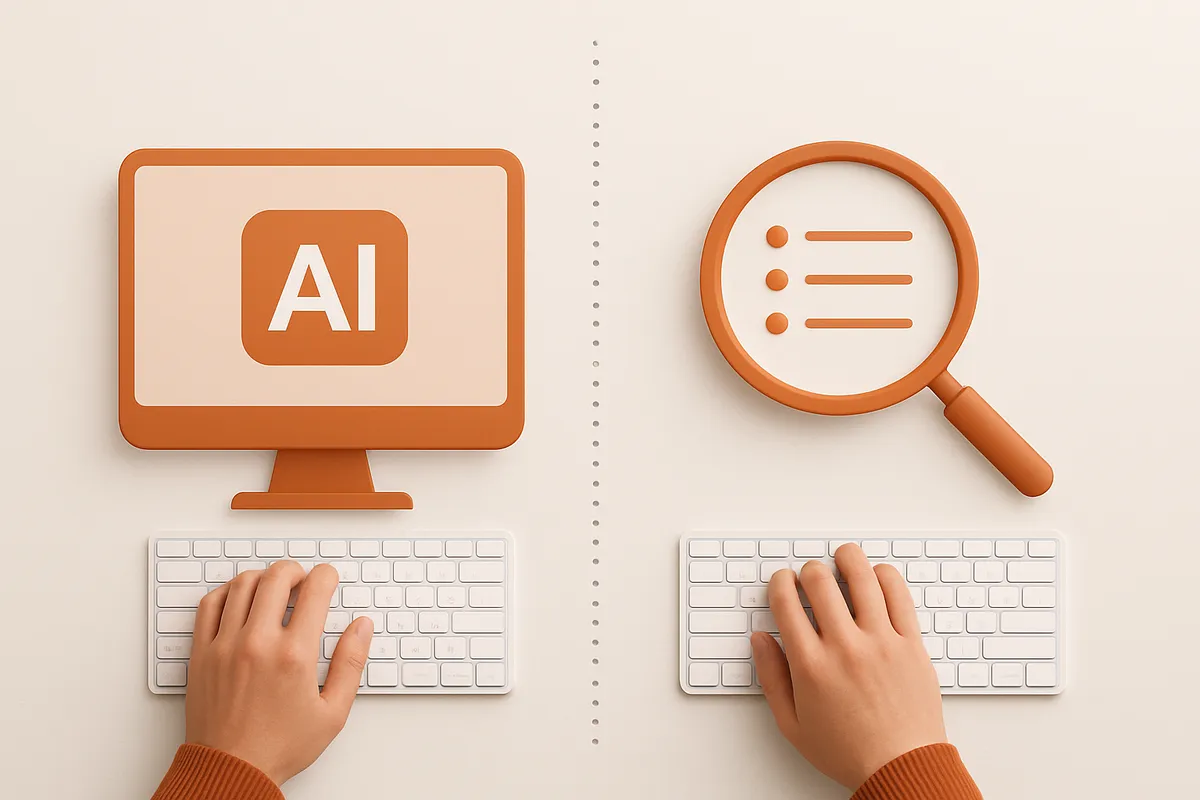
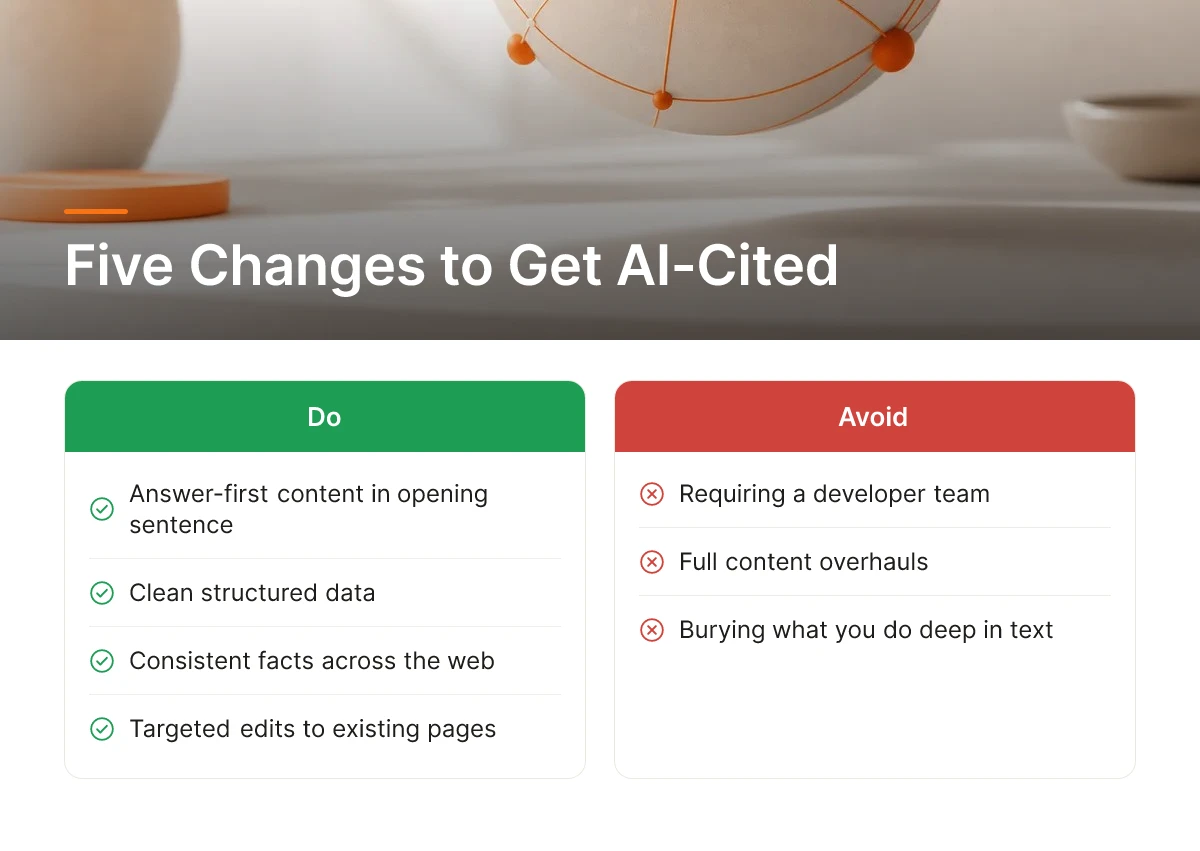
Five changes move the needle most: answer-first content, clean structured data, consistent facts across the web, targeted edits instead of rewrites, and third-party mentions. None of these require a developer team or a content overhaul, they're adjustments most SMBs can make to pages they already have.
Start with how you write. AI engines pull concise, structured answers rather than ranking full pages [3], which means the first sentence on your homepage or service page should state plainly what you do, who you serve, and what sets you apart. A hotel page that opens with "boutique 40-room property in downtown Austin with on-site parking and pet-friendly rooms" gives an engine something to quote. A page that opens with a paragraph about company history and values gives it nothing to extract. This is the core shift behind AI Search Optimization: writing for extraction, not just for reading. For more information, see Real Estate Cost Optimization Smart Strategies That Work.
What Structured Data Actually Helps With AI Search Visibility?
Structured data works like a labeled summary card attached to your page, it tells AI engines your business name, category, location, and offerings without forcing them to guess from prose. AI systems rely on these entity signals rather than keyword density to decide whether your business matches a query [3]. For an e-commerce store, that means marking up product names, prices, and availability clearly. For a B2B SaaS company, it means identifying your product category and core features in a way a machine can parse instantly, not just a human skimming the page. Moonrank handles this piece directly, its technical audit implements schema markup, llms.txt configuration, and structured data so AI systems can parse and trust a business's site without the owner touching a line of code.
Do You Need to Rewrite Existing Content for AI Search Engines?
No, most sites need targeted additions, not a rebuild. Adding a clear summary near the top of a page, an FAQ section that answers the questions customers actually type into ChatGPT or Perplexity, and refreshed facts (hours, pricing tiers, service areas) usually closes most of the gap. One connected system, crawlable pages, answer-first writing, clear entity data, and outside validation, determines whether engines name your brand or skip it [4].
Consistency matters as much as content. If your website says you're open seven days a week but your Google Business Profile says six, or your pricing page contradicts a directory listing, engines lose confidence and tend to cite a competitor with cleaner, matching facts instead. Finally, don't ignore the outside world: mentions on industry roundups, comparison pages, and review platforms act as corroborating evidence, and engines weight third-party validation alongside what your own site claims [3].
How Do You Measure Whether Your Brand Is Getting Recommended by AI Search Engines?
You measure it by asking the engines directly and tracking the answers over time, citation frequency, accuracy, competitor overlap, and referral traffic are the four signals that matter most.
Most SMB owners have never actually tested how ChatGPT or Perplexity describes their business. That's the first gap to close, and it costs nothing but time.
What Metrics and Tools Can SMBs Use to Track AI Search Visibility?
Start with manual prompt-testing. Open ChatGPT, Perplexity, and Gemini and ask the questions a real customer would ask, "best project management software for a 10-person team," "top cybersecurity vendor for a mid-size retailer," "boutique hotels in [city] with free parking." Note whether your brand shows up, what it's listed alongside, and whether the description is accurate. Run the same prompts weekly or biweekly, since answers shift as models update.
Four things are worth logging each time you test:
- Citation frequency, how often your brand appears across repeated runs of the same or similar prompts, not just a single lucky mention.
- Accuracy, whether the engine states your pricing, features, or service area correctly, since AI systems sometimes pull outdated or wrong details from stale pages.
- Competitive company, which competitors get named alongside you, and whether they appear first, last, or more often.
- Source attribution, which pages the engine references or links to when it cites you, which tells you what content is actually earning trust.
Manual checks work for spot-checking, but they don't scale past a handful of prompts. A category of AI-visibility tracking tools has emerged specifically to automate this: they run hundreds of prompts across ChatGPT, Gemini, Claude, and Perplexity on a schedule, log mention rates and sentiment, and flag when a competitor starts appearing where you used to [2]. This is one of the core categories Moonrank operates in, the platform tracks citation and recommendation performance across those four engines on an ongoing basis so a business owner isn't running manual prompt checks by hand every week.
Analytics data offers a second, more concrete signal. Check whether your site shows referral traffic from sources like chat.openai.com or perplexity.ai in Google Analytics. This traffic is still a small share of most sites' totals, but Adobe's data shows AI-referred shoppers are becoming a higher-value audience, converting better and browsing longer than typical visitors by March 2026 [4]. A rising trend line here is an early, measurable sign that AI Search Optimization efforts are translating into actual visits, not just mentions.
None of this is a one-time audit. Models retrain, new competitor content gets indexed, and answers that favored you last month can favor someone else next month, tracking has to run continuously to mean anything.
What's the Fastest Way to Start Getting Your Brand Seen by AI Search Engines?
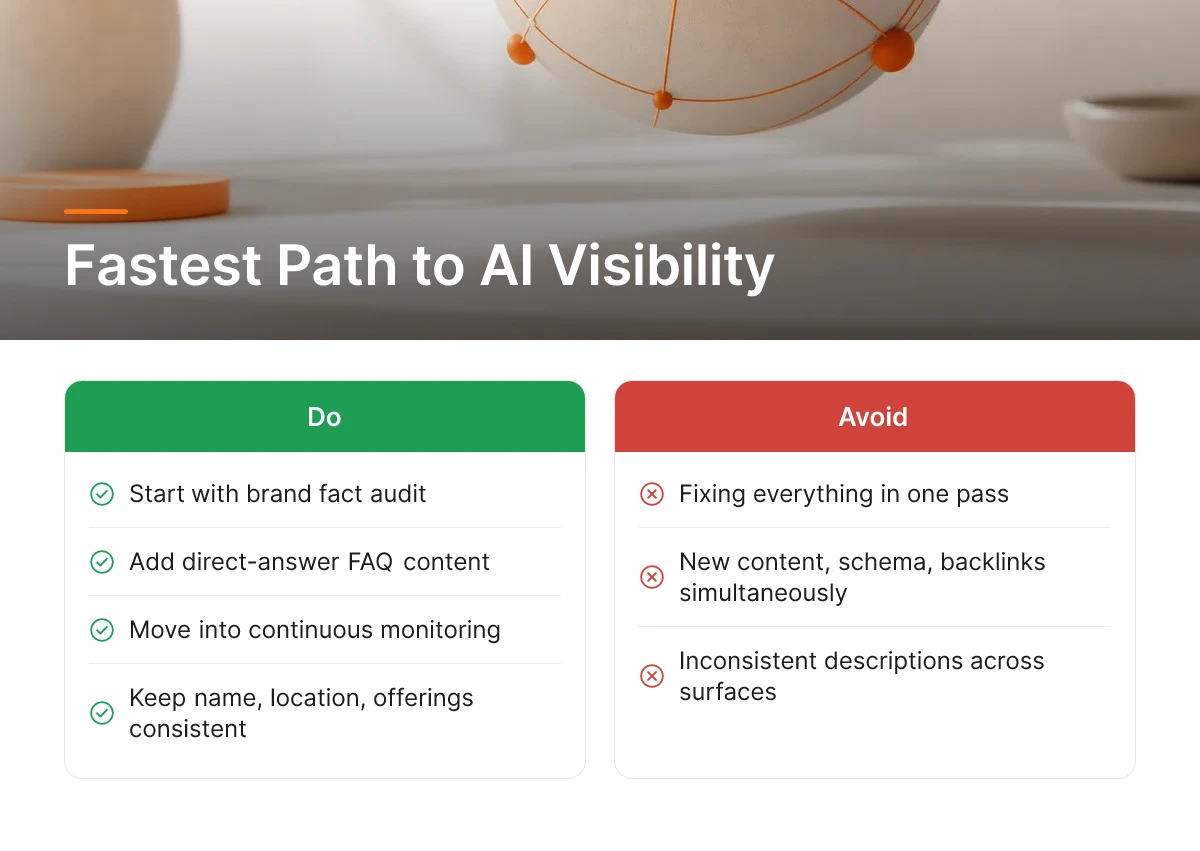
Start with a brand fact audit, add direct-answer FAQ content to your top pages, then move into continuous monitoring, in that order, not all at once.
Most SMB owners try to fix everything in one pass: new content, new schema, new backlinks, all in the same week. That's backwards. A chatbot can't recommend a business it describes inconsistently, so the first job is making sure every surface, your website, Google Business Profile, Yelp listing, industry directories, states your name, location, offerings, and what makes you different in the same words every time. AI systems cross-reference these sources to build confidence in an entity before citing it [3], and conflicting details (an old address, a dropped product line, a different company name on one directory) are enough to make an engine skip you in favor of a competitor with cleaner facts.
Once the facts match everywhere, add quick wins before attempting a full content overhaul. A clear FAQ section on your three or four highest-traffic pages, written to answer the exact question a customer would type into ChatGPT or Perplexity, gives AI engines something extractable. Direct-answer summaries, a two-sentence version of "what does this page say" placed near the top, work the same way [4]. This is faster and cheaper than rewriting your entire site, and it's the step most SMBs skip because it looks too simple to matter.
Can You Automate AI Search Optimization or Does It Require Manual Work?
Parts of it automate well, fact audits, prompt testing, and citation tracking, but messaging and positioning calls still need a human.
Checking whether your NAP data matches across twenty directories, or running a weekly batch of test prompts to see if ChatGPT mentions your brand, is repetitive and rules-based, exactly what software should handle. Deciding how to phrase your differentiator, or which competitor comparison to lead with, is a judgment call that still benefits from someone who knows the business. The practical split is: automate the monitoring and the publishing cadence, keep a human in the loop for strategy.
AI Search Optimization isn't a project you finish and close out. Models retrain, re-crawl, and re-rank on their own schedules, and a brand that looked solid in a query last month can quietly drop out of answers this month without any site changes at all [5]. That's why ongoing tracking matters as much as the initial setup.
Moonrank handles this sequence without requiring an agency retainer. It runs the technical audit, schema markup, llms.txt, structured data, automates daily content publishing, and tracks your visibility across ChatGPT, Gemini, Claude, and Perplexity continuously, all for $99/month. For an SMB with no marketing team and no time to manage prompt testing by hand, that's the fastest realistic path from invisible to recommended. Start at www.moonrank.ai.
Frequently Asked Questions
Does AI search optimization replace traditional SEO?
No, it builds on SEO rather than replacing it, since AI engines still rely on crawlable sites and clear technical signals. Traditional SEO gets your site indexed and understood. AI search optimization adds the layer on top: structured data, entity clarity, and citation-worthy content that help ChatGPT, Gemini, and Perplexity decide you're worth recommending [1].
How long does it take to start appearing in AI search answers?
Most businesses see early movement within 60 to 90 days, with citations building steadily as content and technical fixes accumulate. Consistency matters more than speed, engines favor brands that publish and maintain fresh, well-structured content over time, not one-time overhauls [4].
Can small businesses compete with large brands for AI citations?
Yes, AI engines cite the clearest, most specific answer to a question, not necessarily the biggest brand name. A boutique hotel or niche SaaS tool with precise, well-structured content about its exact specialty can out-cite a larger competitor whose site is vague or hard to parse [3]. Specificity and technical readability beat brand size in this context.
Do I need separate content for ChatGPT, Gemini, and Perplexity?
Not separate content, but you do need to understand how each engine sources answers differently. ChatGPT leans on training data and browsing, Perplexity cites live web sources directly, and Gemini draws on Google's index [2]. One strong, structured content foundation can serve all three if it's built for clarity and citation.
Conclusion
AI search optimization comes down to three habits: make your site easy for AI systems to crawl and parse, publish answer-first content that states facts the same way everywhere, and earn the third-party citations that engines already trust [5]. Skip any one of these and ChatGPT, Gemini, or Perplexity will recommend a competitor instead.
None of this requires a $3,000-a-month agency retainer or a content team. Moonrank runs the daily publishing, schema markup, and visibility tracking automatically for $99/month. Start a 3-day free trial at moonrank.ai and see where your brand stands in AI search today.
Sources & References
- AI Search Optimization: How to Make Your Brand AI-Visible | Walker Sands
- ChatGPT vs. Gemini vs. Perplexity for Business | Sproutbox
- How to Make Your Brand Visible in AI Search | Starfish
- How to Improve Brand Visibility in AI Search Engines | Kanopi Studios
- How to Improve AI Search Visibility: What Our Research Shows - Onely
Recommended Articles
Explore more from our content library: