10 Best SEO Automation Tools to Save Time and Boost Rankings
Discover the 10 best SEO automation tools for content, technical fixes, and visibility tracking so small businesses can compete without an agency budget.

Understanding 10 Best SEO Automation Tools is essential. The best SEO automation tools handle repetitive work, content optimization, technical fixes, and visibility tracking, so small businesses can get results without paying for a full agency retainer. They work by combining data collection (crawling, rank tracking, AI search monitoring) with rules or AI-driven actions (flagging issues, generating briefs, publishing fixes) that would otherwise take a human hours each week. For SMBs, the payoff is reclaiming that time and budget while still showing up in Google and AI engines like ChatGPT and Perplexity.
10 Best SEO Automation Tools for SMBs Without an Agency
This list ranks tools that actually do SEO work for you, not just tools that show you a dashboard and leave the fixing to your team. This is particularly relevant for 10 Best SEO Automation Tools.
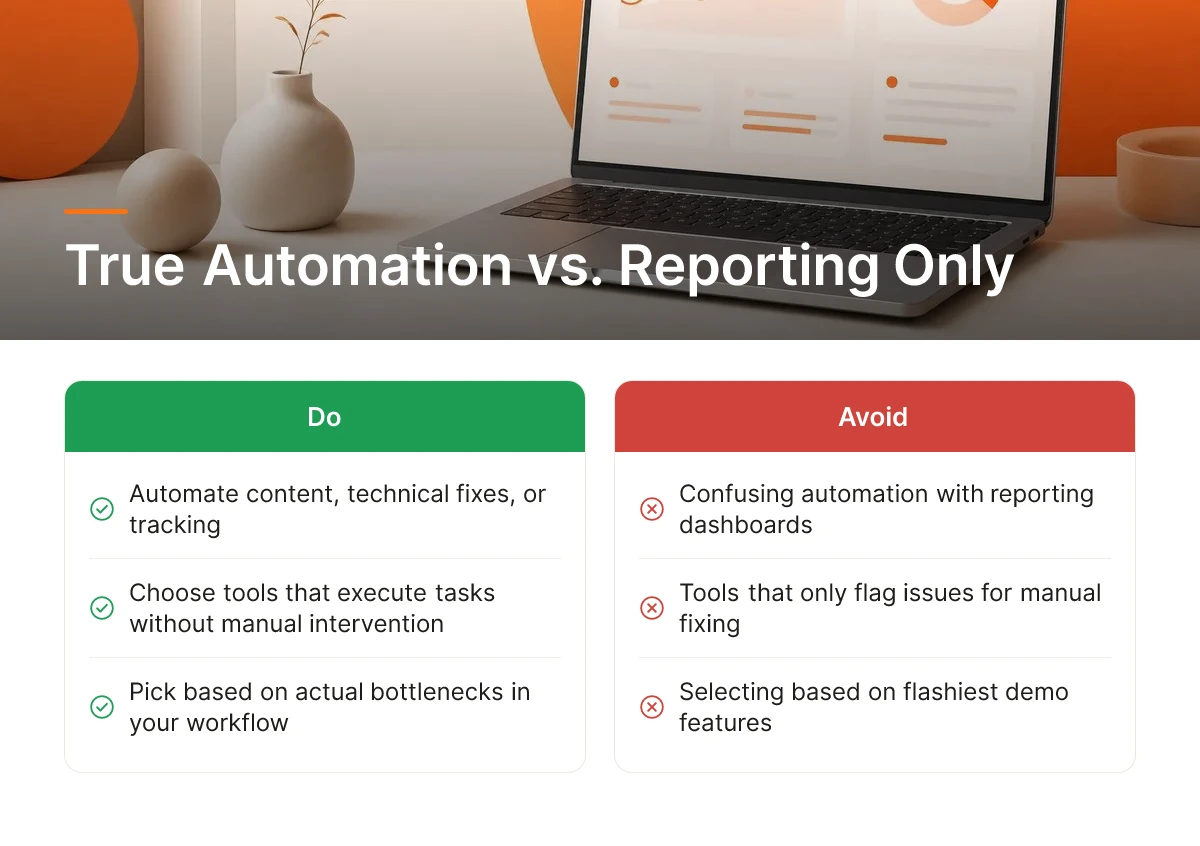
A lot of roundups confuse automation with reporting. A tool that tells you a page is slow isn't automating anything, a tool that fixes the page is. For a tool to make our 10 Best SEO Automation Tools list, it had to automate at least one of three things: content optimization, technical fixes, or visibility tracking, without requiring a person to execute the task manually every time.
We built this list around a specific reader: an ecommerce owner, a B2B SaaS founder, a cybersecurity vendor, or a hotel operator, businesses that compete for search visibility but don't have a dedicated SEO hire. For this audience, automation isn't a nice-to-have feature. It's the difference between showing up in search results and falling behind competitors who do have agency budgets or in-house teams. Every entry below includes one differentiator the other popular "best SEO automation tools" lists tend to skip, so you can tell which category each tool actually belongs to before you commit a budget line to it.
To make it easier to scan, here's what each category actually automates before diving into the detail:
- Moonrank: AI-engine visibility, content publishing, and technical fixes in one platform
- Content optimization automation platform: auto-generated briefs and draft scoring against top-ranking pages
- Technical SEO auto-fix tool: crawling plus automatic resolution of issues like broken links or missing schema
- Visibility tracking and alerting tool: continuous rank monitoring with automatic notifications
- Automated site audit scheduler: recurring crawls with prioritized issue reports
- AI-assisted content brief and draft generator: keyword-to-draft automation for scaled page production
- Automated backlink and citation monitor: ongoing link and brand mention tracking, including AI citations
1. Moonrank
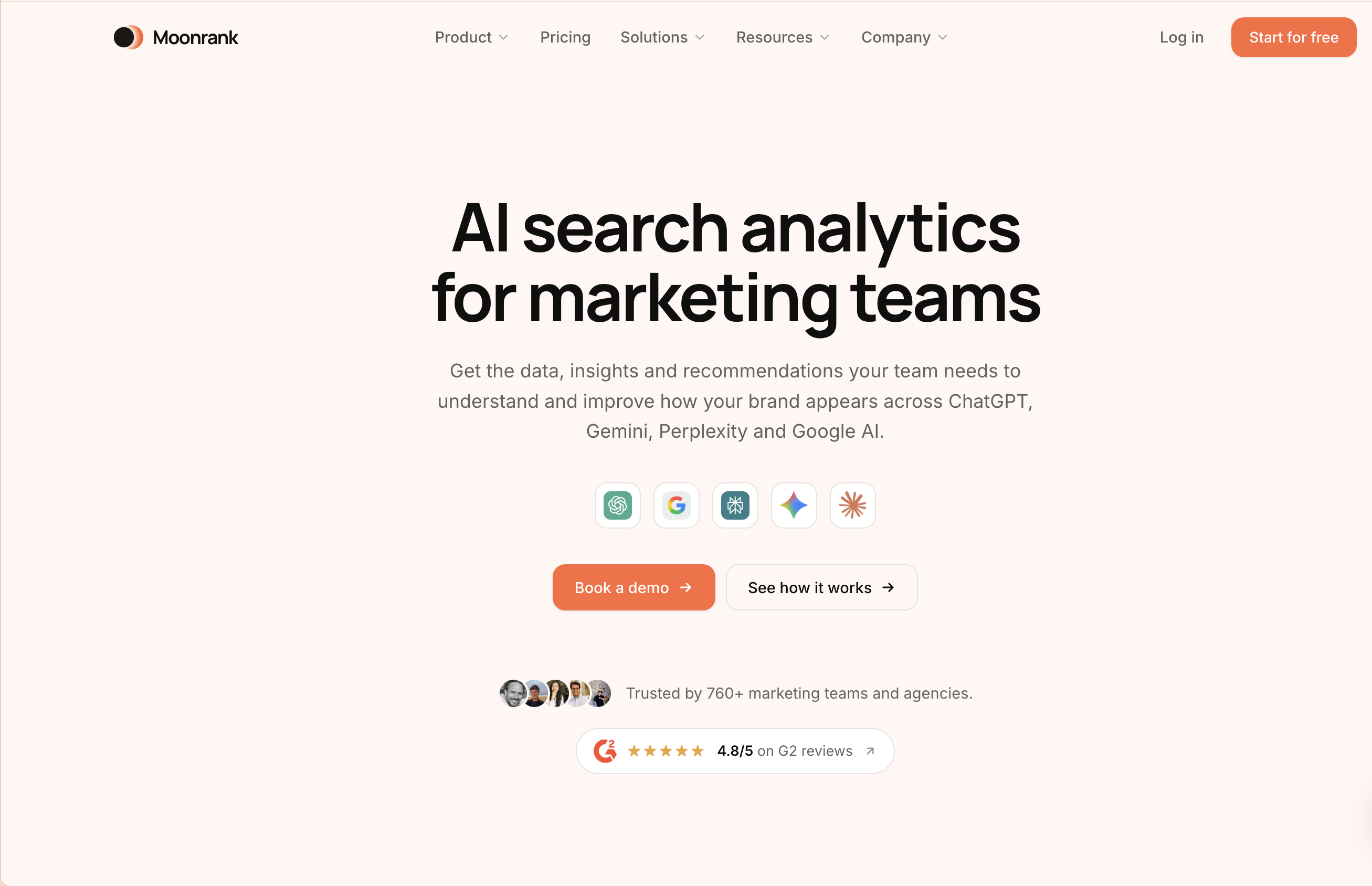
Moonrank automates content publishing, technical fixes, and visibility tracking specifically for getting recommended by AI search engines, not just ranked in Google.
Most SEO automation tools were built for an era when Google was the only search engine that mattered. Moonrank is built around a different premise: a growing share of buying decisions now start with a question typed into ChatGPT, Gemini, Claude, or Perplexity, rather than a Google search bar. Moonrank's automation runs daily, it generates and publishes SEO content on autopilot, applies technical fixes like schema markup, llms.txt configuration, and structured data so AI engines can parse and trust the business's content, and tracks how the brand shows up across all four major AI engines.
This makes Moonrank a fit for the exact readers this list targets: ecommerce stores, B2B SaaS companies, cybersecurity vendors, and hotels that need search visibility but have no SEO specialist on payroll. Moonrank is positioned as a budget-friendly alternative to agencies that typically charge a premium monthly retainer for comparable scope.
The differentiator most competing roundups miss: Moonrank tracks whether a business actually gets cited or recommended inside AI-generated answers, not just where a keyword ranks in a search results page. Keyword rank tells you nothing about whether ChatGPT mentions your business by name when a customer asks for a recommendation, Moonrank's visibility tracking is built to answer that question directly.
2. Content Optimization Automation Platform
A content optimization automation platform auto-generates briefs and scores drafts against top-ranking pages, cutting out manual competitor research.
These tools pull the top-ranking pages for a target keyword, extract common topics, headers, and term usage, and turn that into a content brief without a writer or strategist doing the legwork. The key benefit is time: instead of a marketer spending an hour reverse-engineering what five competing articles cover, the platform produces that analysis in minutes.
This category fits content-heavy operations best, ecommerce catalogs publishing dozens of product descriptions a month, or B2B SaaS blogs that need a steady publishing cadence to stay competitive. The catch is that static, one-time briefs go stale as soon as competitors update their pages or new entrants rank.
When evaluating tools in this category, prioritize platforms that auto-refresh briefs as the search results shift, rather than generating a report once and leaving it untouched. A brief built on last quarter's top-ranking pages is already out of date.
3. Technical SEO Auto-Fix Tool
A technical SEO auto-fix tool crawls a site, finds issues like broken links or missing schema, and applies fixes automatically instead of just flagging them. When considering 10 Best SEO Automation Tools, this point stands out.
Standard crawlers report problems and leave implementation to a developer. The auto-fix category goes further: it identifies issues such as missing schema markup, slow-loading pages, or broken internal links, then resolves them through one-click rules or automated scripts. That removes the recurring developer request that technical SEO issues usually generate.
This matters most for sites with large page counts, hotel sites with dozens of room types and seasonal landing pages, or ecommerce catalogs with thousands of SKUs, where manual audits simply don't scale to the volume of pages involved. For more information, see The Complete Hybrid Work Guide For 2026 Strategies Tools.
When comparing tools in this category, check whether fixes are actually applied automatically, not just surfaced in a report. A tool that lists 400 pages with missing alt text or redirect chains but requires manual cleanup on each one isn't automating the fix, it's automating the discovery, which is only half the job.
4. Visibility Tracking and Alerting Tool
A visibility tracking and alerting tool monitors keyword positions continuously and sends automatic notifications when rankings move significantly.
Instead of a marketer logging in every Monday to manually check rank positions, these tools run checks on a schedule and push alerts, email, Slack, or dashboard notifications, when a ranking drops, a competitor overtakes a target keyword, or a page loses visibility. The benefit is catching problems early, before a slow decline turns into a lost quarter of traffic.
This fits lean marketing teams well, particularly at B2B SaaS companies where one person often owns marketing, sales enablement, and content at the same time. Daily manual rank-checking isn't a realistic use of that person's time.
The differentiator worth looking for: tools that track visibility inside AI engine answers alongside traditional Google rank tracking. A tool that only alerts on Google position changes misses the fact that a customer asking ChatGPT or Perplexity for a recommendation never sees a traditional search results page at all, Google-only tracking is now an incomplete picture of visibility.
5. Automated Site Audit Scheduler
An automated site audit scheduler crawls a website on a recurring cadence and emails a prioritized list of issues without anyone pressing a button.
The benefit shows up over time rather than in one big cleanup. Scheduled crawls catch a broken link or a duplicate product page the week it appears, before it compounds into a ranking drop that takes months to diagnose [1]. Screaming Frog is commonly cited for this kind of scheduled technical crawling, though it requires someone to interpret the output and prioritize fixes manually [1].
This category fits cyber security firms and SaaS companies best, since both tend to ship new product and documentation pages weekly, each one a fresh opportunity for crawl errors or duplicate content. A single unflagged 404 on a pricing page or a security advisory can sit undetected for weeks without a recurring scan.
The differentiator to look for is severity-based prioritization. A small marketing team with no dedicated SEO hire doesn't have time to triage 200 flagged issues, the tool needs to rank them by actual ranking impact so the first fix is the one that matters, not the one that's easiest to find. For those exploring 10 Best SEO Automation Tools, this matters.
6. AI-Assisted Content Brief and Draft Generator
This tool category turns a target keyword into a structured content brief and a usable first draft automatically, cutting out the research phase entirely.
A writer with no SEO background can go from keyword to publishable draft in under an hour instead of spending a day on competitor research and outline building. That speed matters most for teams publishing location pages, city landing pages, or product variants at scale, the kind of repetitive page format where a human writer burns hours on structure that a system can generate consistently.
Hotel groups publishing dozens of location and amenity pages, and ecommerce brands adding new product listings weekly, get the clearest payoff here. Both need volume and consistency more than they need a single polished flagship article.
The differentiator worth checking for is entity and intent signal extraction, not just keyword density scoring. A brief built around raw keyword frequency produces thin, repetitive copy; one that pulls in related entities, questions, and search intent produces content that reads like it was written by someone who understands the topic, which also happens to be what AI search engines like ChatGPT and Perplexity reward when deciding what to cite [3].
7. Automated Backlink and Citation Monitor
An automated backlink and citation monitor continuously scans the web for new and lost links pointing to a domain, plus brand mentions that never happened to include one.
Instead of running a manual link audit every quarter, the tool surfaces new link opportunities and flags toxic or spammy links as they appear, so a small team can act on authority signals in near real time rather than discovering a problem six months late.
B2B SaaS companies and cyber security vendors depend on this more than most, since buyers in both categories research vendors heavily before contacting sales, and third-party mentions and backlinks function as trust signals that influence that research.
The differentiator that matters going forward is whether the tool also tracks citations inside AI-generated answers, being referenced by ChatGPT or Perplexity when someone asks for a recommendation is a visibility channel that traditional backlink trackers were never built to see, and it's growing fast enough that ignoring it means missing half the picture [2]. This is also where a tool built specifically for AI search monitoring, like Moonrank, differs from a backlink tracker retrofitted with an AI mention report: Moonrank's visibility tracking is built around monitoring how a business appears in recommendations across ChatGPT, Claude, Perplexity, and Gemini directly, rather than treating it as an add-on metric.
How to Choose the Right SEO Automation Tool for Your Business
Pick based on which task currently eats the most manual hours, content, technical fixes, or tracking, and automate that one first, not the one with the flashiest demo.
Among the 10 Best SEO Automation Tools covered here, the right fit depends less on feature count and more on matching the tool to an actual bottleneck. A solo ecommerce founder drowning in product page copy needs a content generator before a backlink monitor. A SaaS company with a lean dev team but no content output needs the opposite.
Use this quick checklist to narrow down the right fit before testing any tool:
- Identify which task eats the most manual hours each week: content, technical fixes, or tracking
- Confirm the tool automates the fix or output, not just the reporting
- Check whether it tracks visibility in AI engines like ChatGPT and Perplexity, not just Google
- Favor minimal setup and plain-language dashboards if there's no dedicated SEO hire
- Match the tool's cost tier, budget-friendly, mid-range, or premium, to business size and goals
How much of a learning curve do these tools have for beginners?
It varies widely, and that variance matters more than any single feature. Tools built for SEO specialists often require weeks of setup and configuration before they save any time at all, a cost that erases the benefit for a solo marketer or a two-person team. Favor tools with minimal setup and plain-language dashboards over ones that assume technical fluency with schema markup or crawl configuration. This directly impacts 10 Best SEO Automation Tools outcomes.
What's the difference between tools that automate versus tools that just report?
A reporting tool tells you what's wrong; an automation tool fixes it or produces the content without further input. Many platforms market themselves as "automated" but only generate a dashboard of recommendations someone still has to act on manually [1]. Confirm which category a tool actually falls into before buying.
Use qualitative cost tiers, budget-friendly, mid-range, premium, to match spend against business size, and confirm the tool tracks visibility across AI engines like ChatGPT and Perplexity, not Google alone, since that's where SMB discovery is increasingly happening [2]. Moonrank fits the budget-friendly, fully automated end of that spectrum, running daily content publishing and technical AI optimization without requiring the business owner to write or configure anything after onboarding. Compare it directly against the other options at moonrank.ai.

Frequently Asked Questions
How does automation in SEO differ from manual SEO work?
Automation replaces repetitive, hands-on tasks, keyword research, content drafting, publishing, rank tracking, with software that runs on a schedule. Manual SEO requires a person to research, write, audit, and update pages one at a time, which limits how many pages and keywords a small team can realistically cover each month.
Why are SMBs turning to automation instead of hiring agencies?
Agencies typically charge a substantial monthly retainer and still require the business owner to manage the relationship and approve work. Automation tools like Moonrank deliver daily content publishing and technical fixes at a fraction of that cost, with no account manager, contracts, or back-and-forth required to get work done.
What tasks still require human oversight even with automation?
Brand voice checks, legal or compliance review, and strategic decisions about which markets or products to prioritize still benefit from a human eye. Automated tools handle volume well, publishing content daily, tracking rankings, fixing schema, but a business owner should periodically review output for accuracy, especially in regulated industries like cybersecurity or hospitality.
Are SEO automation tools worth the cost for SMBs?
Yes, for most SMBs the math favors automation over manual work or agency retainers, provided the tool matches the business's actual needs. A tool that handles content, technical optimization, and visibility tracking in one subscription removes the need to stitch together multiple point solutions or pay agency overhead. The key is matching tool scope to goals, a Shopify store chasing AI search visibility needs different coverage than an enterprise team running backlink campaigns.
How do these tools track visibility across Google and AI search engines like ChatGPT and Gemini?
Most platforms track Google visibility through keyword rank position, while AI search visibility tracking works differently, monitoring whether a business actually gets mentioned or recommended inside chatbot answers. Moonrank, for example, monitors how a business appears in recommendations across ChatGPT, Claude, Perplexity, and Gemini specifically, which is a distinct tracking problem from traditional rank-position monitoring since there's no fixed results page to scrape.
Conclusion
The right SEO automation tool depends on what's eating your time: technical audits, content production, or visibility tracking across both Google and AI engines. SMBs without a marketing team get the most value from platforms that cover multiple tasks in one subscription rather than stitching together three or four point tools.
If AI search visibility is the gap, not knowing whether ChatGPT or Perplexity ever mention your business, that's a different tracking problem than traditional rank checking, and it's worth testing a tool built specifically for it. Start a free trial at moonrank.ai and see where your business currently stands in AI search recommendations.
Sources & References
- 10 Best SEO Automation Tools
- Best SEO Automation Tools for Small Businesses | BizAI SEO Intelligence
- Best SEO Automation Tools for Content Teams in 2026
Recommended Articles
Explore more from our content library: