How SMBs Can Find and Win Over the Best AI Search Engine
Discover the best AI search engine for your SMB—ChatGPT, Perplexity, Claude, or Gemini—and learn how to get recommended, not just ranked.

The best AI search engines for SMBs to optimize for right now are ChatGPT, Perplexity, Claude, and Gemini, because these are what your customers actually ask when researching purchases, and each pulls recommendations from a different mix of structured data, crawlable content, and third-party citations. Getting recommended means making your site easy for these systems to crawl, understand, and trust as a source, not just ranking it on Google. Prioritize clear content structure, up-to-date technical signals, and consistent mentions across the web that AI models can cite with confidence.
Which AI Search Engines Should SMBs Prioritize for Getting Recommended?
With limited time and no in-house SEO team, prioritize ChatGPT first, then Perplexity, then Gemini and Claude based on your industry's buyer research habits.
There's no single best AI search engine for every business, a hotel and a cybersecurity vendor need different platforms in different order. But resource-constrained SMBs can't optimize for all four equally on day one, so the sequence matters more than the scorecard. Deciding which is the best AI search engine for your specific category is less about picking a winner and more about matching platform behavior to how your customers actually search.
What's the Current Market Share and User Base for ChatGPT, Perplexity, Claude, and Gemini?
ChatGPT's sheer reach makes it the default first stop for almost any SMB, regardless of industry. AI platforms collectively generate an estimated 10 billion responses each month [1], and ChatGPT accounts for the largest share of that volume by a wide margin. If a customer types "best [your category] near me" or "top [niche] brand" into an AI tool, odds are it's ChatGPT. That scale alone justifies making it the first optimization target, before worrying about Claude or Gemini.
Perplexity is smaller in absolute user count but punches above its weight for considered, research-heavy purchases. Perplexity reported more than 100 million weekly queries by late 2024, and its answer format leans heavily on visible citations, which makes it a trust-building channel rather than just a traffic source.
Which AI Search Engines Drive the Most Traffic and Qualified Leads for SMBs Right Now?
For B2B SaaS and cybersecurity companies, Perplexity often matters more than its market share suggests. Buyers in these categories research vendors carefully, compare sources, and click through citations before booking a demo, Perplexity's format rewards businesses with clear documentation, case studies, and third-party mentions it can cite with confidence.
Gemini sits in a different bucket because of its tie to Google's index. Traditional SEO work, solid on-page structure, backlinks, local listings, partially carries over to Gemini in a way it doesn't for Claude or Perplexity, which rely more on independent crawling and citation signals [3]. That means Gemini optimization is partly a byproduct of SEO you may already have, while Claude and Perplexity need dedicated attention.
Industry changes the weighting further. Hotels and ecommerce brands deal with visual, local-intent questions ("best boutique hotel in [city]," "where to buy [product] online") where Google AI Overviews and Gemini carry outsized influence. B2B SaaS and cybersecurity buyers ask comparison and trust questions better served by ChatGPT and Perplexity. Moonrank's visibility tracking monitors all four engines simultaneously, so a hotel owner and a SaaS founder can each see which platform is actually sending them qualified interest, rather than guessing which is the best AI search engine for their category in isolation.
How Do AI Search Engines Decide Which Websites to Recommend?
AI engines build answers by blending training data, live web crawling, and licensed or indexed third-party content, then cite the sources that back up what they already believe to be true, they don't rank a list of links. That single difference explains why a business can own page one on Google and still never get mentioned by ChatGPT.
What Sources Do ChatGPT, Perplexity, and Claude Actually Pull From When They Recommend Websites?
Perplexity, ChatGPT Search, and similar tools pull from a mix of real-time crawls, partner data feeds, and the model's own training corpus, then synthesize a direct answer with citations rather than a results page [1]. Perplexity alone handles a massive volume of these queries every week, which means its crawler and retrieval layer are actively deciding, in real time, which sites count as trustworthy enough to quote [1].
Structured data plays a bigger role here than most business owners expect. Schema markup, llms.txt files, and clean entity signals, clear statements of what your business is, what it sells, and who it serves, give these models something concrete to extract instead of guessing from paragraphs of marketing copy. This is one reason Moonrank builds technical AI optimization (schema, llms.txt, structured data) into its daily automation, rather than treating it as a one-time setup task.
How Do AI Search Engine Ranking Factors Differ from Google's Ranking Signals?
Google still leans heavily on link authority, crawl history, and years of accumulated ranking signals, a system built around who links to you and for how long. AI engines weight something closer to corroboration: do independent sources, your own site, review platforms, local directories, and press mentions, all agree on the same facts about your business [2]? A single powerful backlink matters less here than ten consistent, accurate mentions across different domains.
That shift is why choosing the best ai search engine strategy today means optimizing for agreement and clarity across the web, not just link volume. Identifying which platforms a brand gets cited on, and how often competitors show up in the same answers, has become its own measurable discipline [2]. Businesses that treat AI visibility as a separate tracking problem from traditional SEO tend to spot these gaps before their competitors do.
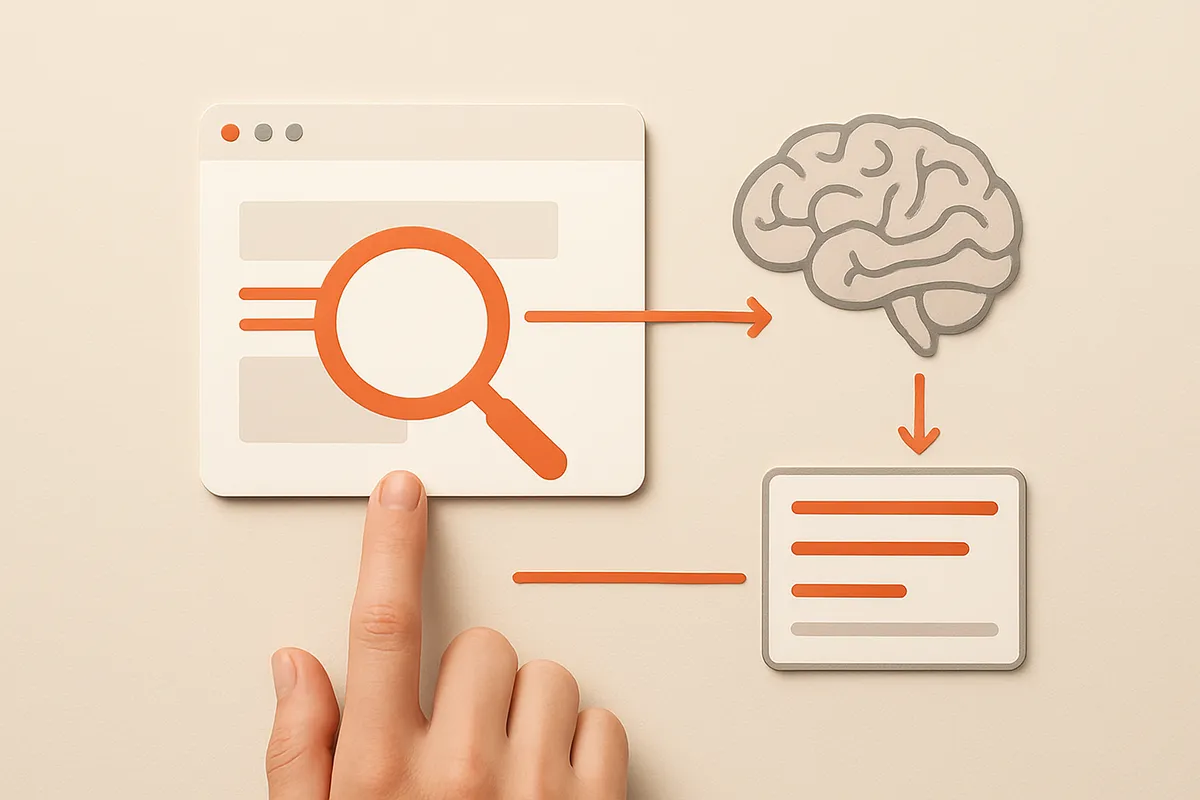
How Are AI Search Engines Different from Traditional Search Engines for SMB Visibility?
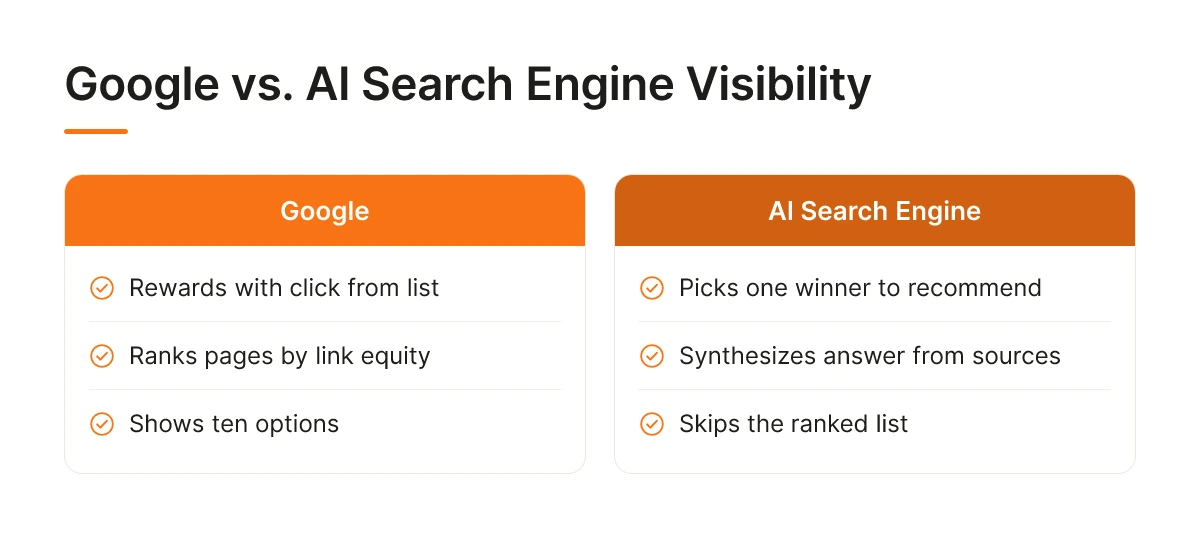
Google rewards you with a click from a list of ten options; an AI search engine skips the list and picks one winner to recommend. That difference changes what "visibility" means for your business entirely.
Why Can't SMBs Just Rely on Google SEO to Get Recommended by AI Systems?
A page-one Google ranking tells you your site has link equity and matches a keyword, it doesn't tell an AI model your business is the clear, corroborated answer to a specific question. AI search engines like ChatGPT, Perplexity, and Gemini synthesize an answer from multiple sources rather than ranking pages, and they weigh clarity, structured data, and consistency across the web differently than Google's link-based algorithm does [3]. A business can rank well on Google for years and still never get mentioned in a ChatGPT or Perplexity response, because the AI isn't scoring backlinks, it's scoring whether your content is clear enough and corroborated enough to cite confidently [1].
How Is Being Recommended by an AI Search Engine Different from Appearing in Google Search Results?
Picture a hotel that ranks first on Google for its city name, strong historical SEO, decent backlink profile, solid local pack placement. That same hotel can be completely absent when a traveler asks Perplexity for "a business hotel near the convention center." The AI isn't matching a city keyword; it's matching intent, proximity, and amenity details, and it needs those specifics stated clearly somewhere it can find and trust them [3]. Google visibility earns a click. AI visibility earns the recommendation itself, no click required, no competing list, just one name surfaced as the answer.
This is why asking which is the best ai search engine to chase isn't the right framing, the real task is treating AI visibility as an additional layer on top of Google SEO, not a swap. Google traffic still converts customers today, and most SMBs can't afford to walk away from it. But winning AI recommendations requires its own signals: structured data, schema markup, and content written in a way models can parse and cite [1][2]. Moonrank builds that layer, tracking visibility across ChatGPT, Gemini, Claude, and Perplexity while publishing the daily content and technical fixes that give AI engines a reason to recommend you specifically.
How Do You Optimize Your Website to Get Picked Up by AI Search Engines?
AI engines need two things from your site: a technical path to read it, and content written in a format that answers questions directly. Miss either one and even the best ai search engine can't find a reason to cite you.
What Technical Optimizations Help AI Search Engines Crawl and Index Your Content Better?
Start with llms.txt, a simple text file at your site's root that tells AI crawlers what your business does, in language built for machines rather than humans. Think of it as a label on the outside of a box: without it, an AI model has to guess what's inside your site before deciding whether to trust it.
Structured data, also called schema markup, works the same way at the page level. It's code embedded in your HTML that explicitly states facts, this is a product, this is its price, this is a hotel room, this is its capacity, instead of leaving the AI to infer those facts from paragraph text [1].
Crawlability matters just as much as labeling. AI crawlers generally behave like fast, impatient readers: pages that load slowly, bury text inside JavaScript that only renders in a browser, or wrap content in heavy pop-ups often get skipped entirely [3]. Clean, server-rendered HTML with your core content visible in the raw page source gives every AI engine, ChatGPT, Gemini, Claude, Perplexity, something concrete to parse and cite [5].
How Should SMBs Structure Content Differently to Get Recommended by AI Versus Google?
Google rewards pages that rank for a keyword over time. AI engines reward pages that answer a specific question in the first sentence, because that's the sentence they're most likely to quote [1]. Write headings as the literal question a customer would type into ChatGPT, follow immediately with a direct two- or three-sentence answer, then add supporting detail and an FAQ section that mirrors how people actually phrase questions in conversation.
What this looks like depends on the business:
- Ecommerce: List exact product specs, materials, dimensions, compatibility, instead of marketing copy, so an AI engine can confidently answer "does this fit X?"
- B2B SaaS: Describe pricing tiers in plain qualitative terms (starter, mid-range, enterprise) and what each tier includes, so AI engines can accurately compare you against alternatives.
- Cyber security: State certifications and compliance standards you hold (SOC 2, ISO 27001, GDPR) explicitly on the page, not buried in a PDF.
- Hotels: Spell out amenities, exact location details, and nearby landmarks in text, since AI engines can't infer this from a photo gallery.
This is the kind of technical and content work Moonrank automates daily, publishing answer-first content, building out schema markup and llms.txt, and tracking whether ChatGPT, Gemini, Claude, and Perplexity actually pick it up, without requiring a business owner to touch code.
What Metrics Should SMBs Track to Measure AI Search Visibility?
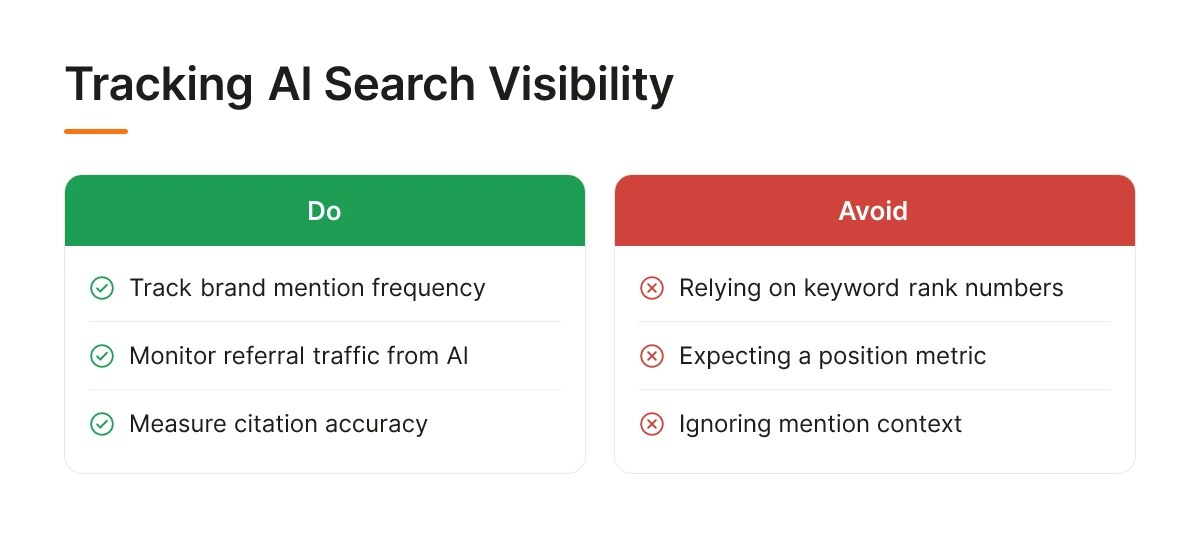
Track brand mention frequency across AI chat responses, referral traffic from AI platforms in your analytics, and citation accuracy, whether the AI gets your business right.
Traditional SEO gives you a tidy number: keyword rank. AI search doesn't work that way, since there's no ranked list, only a conversational answer that either includes your business or doesn't [5]. That means the core metric shifts from "where do I rank" to "how often do I get mentioned, and in what context." A business that shows up in 3 out of 10 relevant ChatGPT answers has a visibility rate worth tracking over time, even without a position number attached to it.
How Do You Monitor Whether Your Website Is Being Recommended by ChatGPT, Perplexity, and Other AI Systems?
Run the same set of customer-style prompts across ChatGPT, Perplexity, and Claude on a fixed schedule, and log whether your business appears. If you run a boutique hotel, that might mean testing "best boutique hotel in [city] for a weekend trip" weekly and noting which properties the AI names. For a B2B SaaS company, it's prompts like "best [category] software for a 20-person team." Keep the prompt list consistent, changing the wording each time makes the results impossible to compare. This manual spot-check mirrors what AI visibility platforms do at scale: they query multiple AI platforms repeatedly and track which brands get cited, how often, and alongside which competitors [2].
What Tools and Dashboards Can SMBs Use to Track AI Search Engine Visibility and Traffic?
Check your website analytics for sessions originating from chat interfaces, Perplexity, ChatGPT, and Copilot increasingly pass referral data, and a rising trend line there is a real signal your content is getting surfaced and clicked [1]. But frequency alone isn't enough. If an AI engine describes your hotel as "budget" when you're positioned as upscale, or lists your SaaS product with an outdated feature set, that inaccuracy undercuts the mention even though it technically counts as a citation [1]. Accuracy checks should be part of every tracking cycle, not an afterthought.
Manual prompt-testing works, but it doesn't scale once you're tracking multiple keyword clusters across four AI engines every week. This is the gap Moonrank's visibility tracking layer is built for, it monitors how your business appears across ChatGPT, Claude, Perplexity, and Gemini on an ongoing basis, while its daily content publishing and technical optimization work in the background to improve what gets found. For an SMB owner deciding which AI search engine actually matters for their category, Moonrank turns that question into a dashboard instead of a weekly manual task.
Frequently Asked Questions
Do SMBs need to optimize for every AI search engine, or can they focus on just one?
Focus on ChatGPT and Perplexity first, then expand to Gemini and Claude as resources allow. ChatGPT Search and Perplexity currently drive the most referral activity for SMBs, with Perplexity alone handling over 100 million weekly queries by late 2024. Covering all four with structured data and consistent citations still matters long-term, since each engine pulls from different sources and weights them differently [3].
Can a small business with limited budget realistically compete for AI search visibility?
Yes, AI search visibility depends more on content structure and citation signals than ad spend or domain age. A restaurant or Shopify store with clean schema markup and regularly published content can outrank a larger competitor that ignores technical AI-readability. This is why budget-friendly tools built for SMBs, rather than agency retainers, have become a realistic path to visibility.
How long does it take to see AI search engines start recommending your business?
Most businesses see initial citations within 4 to 8 weeks of consistent technical fixes and content publishing. AI engines need to recrawl and re-index your site, and some, like Perplexity, refresh their indexes more frequently than others. Full visibility across all four major engines, ChatGPT, Gemini, Claude, and Perplexity, typically takes longer, often 3 to 6 months of sustained, daily content output and citation building.
Does having a strong Google ranking help your chances with AI search engines too?
It helps, but it's not sufficient on its own, AI engines use different selection criteria than Google's ranking algorithm. Google AI Overviews and ChatGPT Search often pull from sites with strong topical authority and structured data, even if those sites don't rank #1 traditionally [1]. Google visibility is a foundation, not a guarantee.
Is there really a single best AI search engine SMBs should trust long-term?
No, and chasing one "winner" is the wrong goal. ChatGPT, Perplexity, Gemini, and Claude each pull from different sources and serve different buyer intents, so the best AI search engine for a hotel differs from the best AI search engine for a cybersecurity vendor. The sustainable approach is tracking all four and adjusting investment as usage patterns shift.
Conclusion
AI search visibility isn't a single-engine bet, ChatGPT, Perplexity, Gemini, and Claude each pull from different sources and reward different signals, so the businesses that show up consistently are the ones publishing fresh content and fixing technical gaps like schema markup and llms.txt across the board. Waiting for an agency engagement or a one-time audit won't keep pace with how often these engines recrawl and re-rank sources.
Start by auditing whether your site even has structured data AI engines can parse, then commit to a content cadence you can sustain. If that sounds like more than you have time for, Moonrank runs that entire process automatically, see what it finds at moonrank.ai.
Sources & References
- Master AI Search Tracking for Brand Visibility Across AI Engines | Frase
- How do you rank in AI? Top AI Visibility Tools Overview
- AI SEO 2026: How to Rank in Perplexity, ChatGPT & Gemini
- Top AI Search Engines for 2026 | Slack
Recommended Articles
Explore more from our content library: