What Is AI Search Optimization and Why It Matters for SMBs
What is AI search optimization? It's structuring content so ChatGPT, Gemini, Claude, and Perplexity can find, understand, and recommend your business.

Understanding what is ai search optimization is essential. AI search optimization is the practice of structuring your content and technical SEO so that AI engines like ChatGPT, Gemini, Claude, and Perplexity can find, understand, and recommend your business in their answers, rather than just ranking a link on a Google results page. It depends on clear, factual content, structured data like schema markup, and strong third-party mentions, since AI engines pull from multiple sources to build an answer instead of just crawling and ranking pages. For SMBs, this matters because buyers increasingly ask AI tools for recommendations before they ever open Google.
What Is AI Search Optimization and How Does It Differ From Traditional SEO?
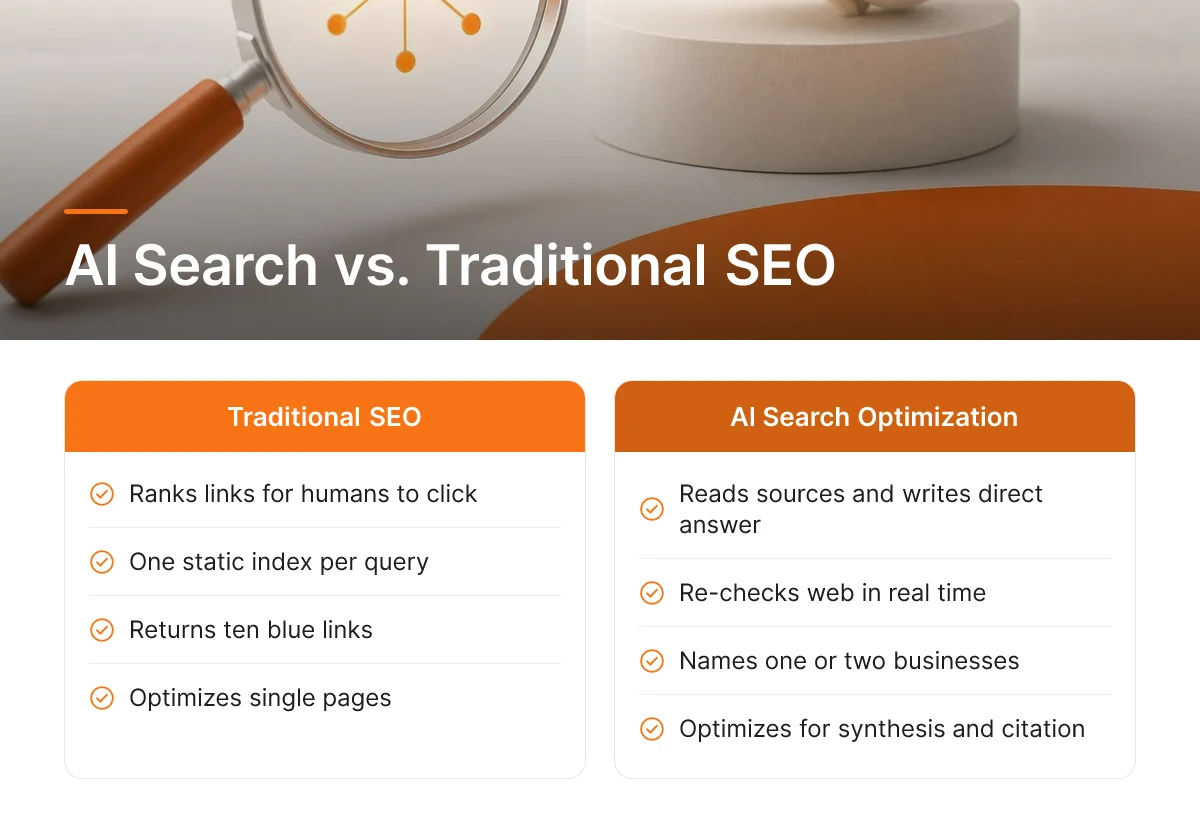
The mechanical difference comes down to this: Google ranks links for a person to click, while AI engines read many sources and write a direct answer that names a business by name.
Traditional SEO was built around a simple contract. You optimize a page, Google's crawler indexes it, and if your signals are strong enough, your link shows up on page one for a human to click. Answering what is AI search optimization requires unlearning that model first. ChatGPT, Gemini, Claude, and Perplexity don't hand someone ten blue links, they synthesize an answer from several sources at once and often recommend one or two businesses by name, inside the chat window, with no list to scroll through [3].
That synthesis step changes what "getting found" even means. If Perplexity cites your hotel or your SaaS product while answering a user's question, that user may never visit your website at all, the recommendation already happened inside the answer [2]. BrightEdge describes this shift as AI engines prioritizing intent and context over indexing, generating answers that cite webpages rather than simply ranking them [3]. A citation with zero clicks can still be the entire sale. That's a hard concept for business owners used to counting organic traffic as the proof that SEO is working.
Why Is AI Search Optimization Becoming Critical for SMBs Right Now?
Buyers are increasingly opening a chat window before they open a search bar, which means a business absent from AI answers is invisible at the exact moment someone is deciding who to call. Walker Sands frames this directly for B2B buyers: they're no longer searching, they're conversing, and AI chatbots are shaping vendor shortlists before a prospect ever lands on a company's site [2]. The same pattern shows up for e-commerce shoppers asking Perplexity to compare products and for hotel guests asking Claude for a recommendation near a specific neighborhood.
This is also why ROI tracking has to change. Traditional SEO success is measured in keyword rankings, impressions, and click-through rate, metrics tied to a results page. AI visibility is measured in something different: how often a brand gets mentioned, cited, or recommended across model outputs, which requires watching the AI engines themselves rather than a rankings dashboard. Moonrank was built around that distinction, tracking how a business shows up across ChatGPT, Gemini, Claude, and Perplexity directly, rather than reporting on Google positions that no longer tell the full story of how customers are finding a brand.
How Do AI Search Engines Find and Cite Your Content?
AI engines blend two sources when answering a question: what they learned during training and what they pull from the live web at the moment of your query. Understanding this mix is the starting point for what is ai search optimization actually requires, you're not optimizing for one static index, you're optimizing for a system that re-checks the web in real time and decides, sentence by sentence, whether your page deserves a mention.
Google explains that its generative AI features in Search, including AI Overviews and AI Mode, are built on the same core ranking and quality systems as traditional Search [1]. That means the foundational SEO work, crawlable pages, clear site structure, accurate metadata, still matters before an AI layer ever touches your content [1]. ChatGPT, Perplexity, Gemini, and Claude work similarly in spirit: they retrieve candidate pages through crawling or search APIs, then generate a summary that cites or paraphrases the sources judged most relevant and trustworthy.
What separates a cited page from an ignored one usually comes down to clarity. A page that states "Our return policy allows returns within 30 days of purchase, no questions asked" gives a model a clean fact to extract and quote. A page that says "We're committed to making our customers happy at every step of their journey" gives it nothing usable. Fact-dense, plainly written pages, specific pricing tiers, specific features, specific numbers, are simply easier for a language model to lift and attribute correctly.
Do ChatGPT, Gemini, and Perplexity Have Different Citation Preferences?
Yes, each engine weighs real-time web retrieval against indexed, pre-trusted sources differently, so a page can perform well in one and barely appear in another. Perplexity leans heavily on live web results and tends to cite a wider spread of sources per answer. Google's AI features stay closer to its existing Search index and ranking signals [1]. Gemini and ChatGPT sit somewhere in between, pulling from browsing plugins or connected search tools depending on the query. None of these behaviors are fixed, engines update retrieval logic often, so treating any one engine's rules as permanent is a mistake.
What Role Do Off-Page Signals and Domain Authority Play in AI Citations?
Off-page mentions function as a trust signal for AI engines much the way backlinks did for traditional SEO. A business named repeatedly across review platforms, industry directories, and third-party articles gives an AI model independent confirmation that the business exists, does what it claims, and is worth recommending. One line on your own homepage saying you're "the top choice" carries little weight; ten unrelated sites describing you the same way carries a lot. This is a core piece of Moonrank's technical work, building citations and structured data alongside daily content so a business accumulates the kind of third-party signal AI engines look for, not just on-page copy.

What Technical and Content Changes Improve AI Search Visibility?
Four changes move the needle most: structured data that explains your business, content written to be quoted, a file that tells AI crawlers what matters, and a site that loads fast enough for a bot to actually read it. Answering what is ai search optimization at the practical level means treating these as a checklist, not a theory.
- Schema markup: structured data that tells AI engines what your business does, where it operates, and who it serves.
- Direct-answer content: headings phrased as questions, answered in the first sentence that follows.
- An llms.txt file: a plain-text map that tells AI crawlers which pages matter most.
- Fast, crawlable pages: server-rendered content that loads quickly enough for a bot to read it cleanly.
Start with schema markup. It's structured data added to your site's code that tells an AI engine exactly what your business does, where it operates, and who it serves, a restaurant's hours, a SaaS product's pricing tier, a hotel's location and amenities. Google's own guidance confirms that generative AI features on Search still rely on the same core ranking and quality systems as traditional search, which means structured signals that help Google parse a page also help it surface that page in an AI-generated answer [1].
What Specific Content Tactics Actually Work for AI Search Engines?
Write headings as the exact question a customer would type, then answer it in the first sentence that follows. AI answer engines are built to filter and summarize content before a user ever clicks through, so a page that buries its answer in paragraph four rarely gets quoted [2]. FAQ-style sections work especially well because they're already formatted the way a chatbot wants to lift an answer, short, direct, self-contained.
This applies whether you're an e-commerce store answering "does this fabric shrink" or a B2B SaaS company answering "does this integrate with Salesforce." Generative engines focus on intent and context rather than keyword matching, pulling in pages that answer a specific question clearly rather than ones that rank for a broad term [3].
How Should You Structure Technical SEO Differently for AI Search?
Technical priorities shift from keyword density and backlink volume toward speed, crawlability, and text accessibility. An AI crawler needs to read your page quickly and extract text cleanly, if your product details or pricing live inside a JavaScript widget that doesn't render in a basic fetch, the crawler often never sees them.
This is where llms.txt comes in: a plain-text file, similar in spirit to robots.txt, that tells AI crawlers which pages on your site matter most, your core service pages, your pricing, your about page, so they don't waste time on thin or duplicate content. Pair that with fast page loads and server-rendered (not purely client-rendered) content, and crawlers can actually parse what you offer.
What to avoid is just as important. Stuffing keywords into headers no longer helps, since generative systems weight intent and clarity over repetition [3]. Hiding key facts, pricing, service areas, specs, behind JavaScript tabs or accordions that require a click to load is the single most common reason AI engines skip a page entirely. Moonrank handles this stack automatically: schema markup, llms.txt configuration, and daily published content built around direct-answer structure, without requiring a business owner to touch a line of code.
How Do You Measure and Track Visibility Across AI Search Engines?
You measure it by tracking how often your brand gets mentioned and cited inside AI-generated answers, not by checking keyword rank positions. This is the measurement shift that most SMB owners trying to figure out what is ai search optimization get wrong first: there's no position #1 to chase, because ChatGPT, Gemini, Claude, and Perplexity don't return ranked lists. They return a synthesized answer that either names your business or doesn't.
Traditional rank trackers were built to watch ten blue links move up and down a results page. AI engines don't work that way, so a tool built for Google rankings simply has nothing to measure on a ChatGPT answer. The relevant questions become: Did the AI mention your business at all? Did it cite your website as a source? How did it describe you compared to competitors? Those answers only show up through direct observation of the AI's output, not through a crawler report.
What Tools Can You Use to Monitor AI Search Visibility?
The most basic method costs nothing: run the prompts your customers would actually type, "best project management software for small teams" or "top boutique hotels in Charleston", directly into ChatGPT, Gemini, Claude, and Perplexity, and record whether your business shows up and what the AI says about it. Doing this weekly across a handful of prompts per engine gives you a rough signal, though it's manual and doesn't scale past a few queries before it becomes a part-time job.
Google Search Console now includes reporting on how pages perform in AI Overviews and AI Mode, which is worth checking as one data point [1]. It's not complete, since it only covers Google's own generative features and says nothing about Perplexity or Claude, but Google has stated that foundational SEO signals still influence whether a page gets surfaced in these generative results [1], so Search Console data remains useful context even if it can't capture the full cross-engine picture.
For a fuller view, a dedicated AI visibility tracking platform automates the prompt-testing and citation-monitoring work across all four engines simultaneously, running the queries, logging mentions, and flagging competitor citations on an ongoing basis. Moonrank builds this monitoring into its core product, tracking how a business appears in recommendations across ChatGPT, Claude, Perplexity, and Gemini so an owner isn't manually re-running prompts every week to find out if anything changed.
What's the Fastest Way to Implement AI Search Optimization for Your Business?
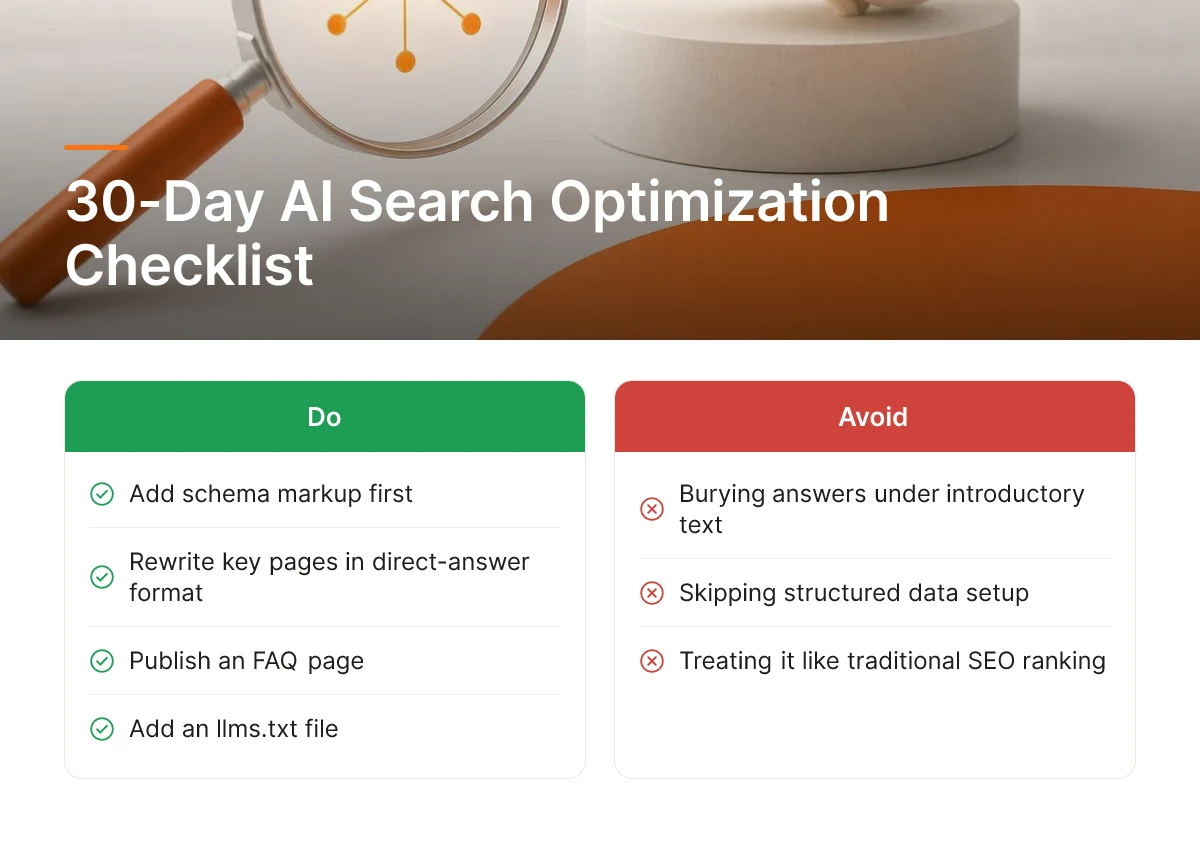
The fastest path is a 30-day checklist, tackled in this order:
- Add schema markup to your core pages.
- Rewrite your most important pages in direct-answer format.
- Publish a dedicated FAQ page using real customer questions.
- Add an llms.txt file to guide AI crawlers to your priority content.
Start with schema markup because it is the lowest-effort, highest-impact fix: structured data tells AI engines exactly what your business sells, where it's located, and what it's called, without them guessing from unstructured text [1]. Next, rewrite your three or four most important pages, homepage, product or service pages, about page, so the first two sentences answer the obvious question a customer would ask, rather than burying the answer under a paragraph of brand history. Then publish a dedicated FAQ page using the real questions customers ask, since AI answer engines tend to pull direct, well-structured answers over marketing copy [2]. Finally, add an llms.txt file, a simple text file that gives AI crawlers a clean map of your site's most important content, similar in spirit to a robots.txt file but built for language models rather than search bots.
Can You Automate AI Search Optimization or Does It Require Manual Work?
Most of the technical and repetitive work can be automated, but final review for accuracy and brand voice still benefits from a human check.
Schema generation, daily content publishing, and visibility tracking across ChatGPT, Gemini, Claude, and Perplexity are mechanical, rules-based tasks a platform can handle without you touching code or a CMS every day. What still deserves a human glance: making sure product claims are accurate, pricing is current, and the tone sounds like your business and not a generic template. This is the same split Moonrank is built around, it runs the daily content generation, schema markup, llms.txt setup, and cross-engine visibility monitoring on autopilot, while you spend a few minutes a month confirming the output reflects your business correctly.
Doing all of this manually, or hiring an agency to do it, eats hours every week and typically costs far more than most SMBs want to commit to an experimental channel [2]. That's the gap automated platforms close: instead of a premium-priced retainer, you get the same technical groundwork, schema, structured FAQs, llms.txt, ongoing tracking, at a cost built for a solo founder or small e-commerce team, not an enterprise marketing budget.
If you'd rather not manage this by hand, Moonrank automates the tracking and optimization side of what is ai search optimization so you can stay focused on running the business instead of monitoring four different AI engines.
Frequently Asked Questions
Does AI search optimization replace traditional SEO?
No, it builds on traditional SEO rather than replacing it. Google has confirmed that core ranking and quality systems still underpin its generative features, so foundational practices like clean site structure, fast load times, and quality content still matter [1]. AI search optimization adds a layer on top, structured data, citations, and content formatted for AI engines to quote directly.
Can AI search optimization hurt my organic click-through rate?
It can, but the bigger risk is ignoring the shift already happening to click behavior. Almost 60% of searches now end without a click as AI overviews answer questions directly on the results page [2]. Optimizing for AI search doesn't cause that shift, it positions your business to still get mentioned or recommended even when the user never visits a traditional results page.
How long does it take to see results from AI search optimization?
Most businesses start seeing early signals within 4-8 weeks, with stronger visibility building over 2-3 months. AI engines need to re-crawl your site, index new structured data, and build enough citation signals to trust your content before recommending it. Consistent daily publishing speeds this up compared to one-off content updates.
Is AI search optimization worth it for a small business with a small website?
Yes, often more so than for large enterprises with established brand recognition elsewhere. Small businesses lose the most when a competitor gets recommended by ChatGPT or Perplexity instead of them, since they lack other ways to stay visible. Tools like Moonrank are built specifically for this gap, bundling technical optimization and daily content publishing into one accessible subscription instead of a premium-priced agency retainer.
What's the biggest mistake businesses make with AI search optimization?
Treating it as a one-time project instead of an ongoing process. AI engines re-crawl sites, update retrieval logic, and reassess trust signals continuously, so a business that adds schema markup once and stops publishing new content tends to lose visibility within months. Consistent content output and periodic re-checks of how you appear across engines matter more than a single setup push.
Conclusion
AI search optimization isn't a replacement for SEO, it's the next layer on top of it, built around getting cited and recommended inside ChatGPT, Gemini, Claude, and Perplexity rather than just ranked on a results page. Three things matter most: clean technical signals (schema markup, llms.txt, structured data), consistent content published often enough for AI engines to trust, and ongoing visibility tracking so you know whether it's working.
Start by checking how your business currently shows up: ask ChatGPT or Perplexity the exact question a customer would ask about your niche. If a competitor shows up and you don't, that's your starting point, and what Moonrank was built to fix.
Sources & References
- Google's Guide to Optimizing for Generative AI Features on Google Search | Google Search Central | Documentation | Google for Developers
- AI Search Optimization: How to Make Your Brand AI-Visible | Walker Sands
- What Exactly Is AI in SEO? | BrightEdge
Recommended Articles
Explore more from our content library: