How Do Small Businesses Get Found by ChatGPT and AI Search
Small businesses get found by ChatGPT and other AI search engines when their business information is consistent, structured, and backed by credible.., learn...
Understanding how do small businesses get found by chatgpt and other ai search engines is essential. Small businesses get found by ChatGPT and other AI search engines when their business information is consistent, structured, and backed by credible third-party sources across the web. AI engines like ChatGPT, Gemini, Claude, and Perplexity don't crawl the web live the way Google does, they rely on training data, structured data (schema markup), and real-time retrieval from sources like reviews, directories, and your own website. If your business name, services, location, and offerings match cleanly across all of these, you're far more likely to be cited and recommended.
What Do AI Search Engines Like ChatGPT Actually Index and Recommend About Small Businesses?
AI engines answer business questions using two different mechanisms: knowledge baked into the model during training, and live lookups pulled from the web at the moment you ask.
Training data is static. It's the massive snapshot of web text a model like GPT or Claude learned from before a certain cutoff date, and it doesn't update itself when your business changes hours or opens a new location. Real-time retrieval is different: tools like ChatGPT's browsing mode, Perplexity's search layer, and Google AI Overviews actively pull current pages, citations, and directory listings when they generate an answer. Understanding how do small businesses get found by ChatGPT and other AI search engines starts with recognizing that both layers matter, the model needs to have seen your business somewhere, and the retrieval layer needs fresh, consistent data to confirm it.
Why Do Some Businesses Show Up in AI Answers While Others Don't?
Businesses go missing from AI answers for a handful of concrete, fixable reasons rather than bad luck.
The most common cause is a thin or outdated web presence, a site with no blog, no service pages, and no recent updates gives an AI model almost nothing to retrieve or cite [1]. The second cause is missing structured data: without schema markup, AI systems have to guess what your business does instead of reading it directly from the page [4]. The third, and often the most damaging, is conflicting information, a different phone number on your website than on your Google Business Profile, or a service listed on Yelp that isn't mentioned anywhere else [3]. Name, address, services, and category need to match cleanly everywhere an AI system might encounter them, because consistency is what lets these systems treat your business as a verified entity rather than a guess.
Reviews, directories, and third-party write-ups now carry more influence in AI-generated answers than they ever did in classic keyword search, since AI models treat independent confirmation as a trust signal rather than just a ranking input [2][3].
How Do ChatGPT, Perplexity, Claude, and Google AI Overviews Differ in What They Crawl and Cite?
Each engine weighs training data and live retrieval differently, which changes what gets a small business cited.
Perplexity leans heavily on real-time citations, actively surfacing links from recent pages and directories at answer time [5]. Claude has more limited browsing and depends more on prior training knowledge, making your presence in widely syndicated sources more valuable. Google AI Overviews pulls from its existing indexed web pages and Knowledge Graph entries, so standard SEO fundamentals still carry weight there [1]. ChatGPT sits in between, blending training knowledge with plugin-based browsing when available. Moonrank tracks exactly how a business appears across all four systems, so you can see where the gaps are instead of guessing.
How Do You Optimize Your Business Information So AI Search Engines Can Find and Cite You?
AI engines need structured data, consistent facts, and quotable content on your site, without these three things, they cannot confidently recommend you.
That's the real answer to how do small businesses get found by ChatGPT and other AI search engines: it comes down to making your business information unambiguous enough for a machine to parse, trust, and repeat to a customer.
What Specific Technical Changes Do You Need to Make for AI Indexing?
Start with schema markup, a small block of code added to your website's HTML that spells out, in a format machines read reliably, what your business does, where it's located, and what it sells. Think of it as a label on a can versus a photo of the contents: AI engines and search crawlers often bypass visual inspection entirely and read the label directly [4].
Five schema types matter most for small and midsize businesses:
- LocalBusiness schema, name, address, phone number, hours, and category
- Organization schema, your legal business name, logo, and official site
- Product schema, pricing, availability, and descriptions for ecommerce catalogs
- FAQ schema, question-and-answer pairs marked up so engines can lift them directly
- Review schema, ratings and testimonials formatted for machine reading
Structured data like this, paired with citation-worthy content elsewhere on the site, is part of what AI platforms draw on when generating conversational answers instead of a list of links [4]. An emerging companion signal is llms.txt, a simple text file placed at your site's root that tells AI crawlers which pages matter most, similar to how a robots.txt file guides search bots. It is not yet universally adopted, but it costs little to add and gives AI systems a clearer map of what to prioritize.
How Do You Fix Conflicting Business Information Across Google Business Profile, Directories, and Your Website?
AI models pull from public sources like business listings, review sites, and blog mentions, so contradictory details across those sources create doubt instead of clarity [3]. Pull up your Google Business Profile, your top five directory listings, and your own site side by side, then check name, address, phone number, hours, and category for exact matches.
Even small mismatches, a suite number dropped on one directory, an old phone number lingering on another, can make an AI system hedge or skip your business for a competitor with cleaner records. Fixing this is manual, repetitive work: updating each listing one at a time, then rechecking quarterly as directories drift out of sync again.
A clear FAQ page or About page, written in plain language with direct answers to real customer questions, gives AI engines something quotable to cite rather than paragraphs they must interpret. This is also where the technical audit work compounds: Moonrank handles the schema markup, llms.txt configuration, and citation building automatically as part of its daily optimization layer, so business owners do not have to track directory consistency or write FAQ copy by hand.

What's the Difference Between Getting Found in Traditional Search Versus AI Search?
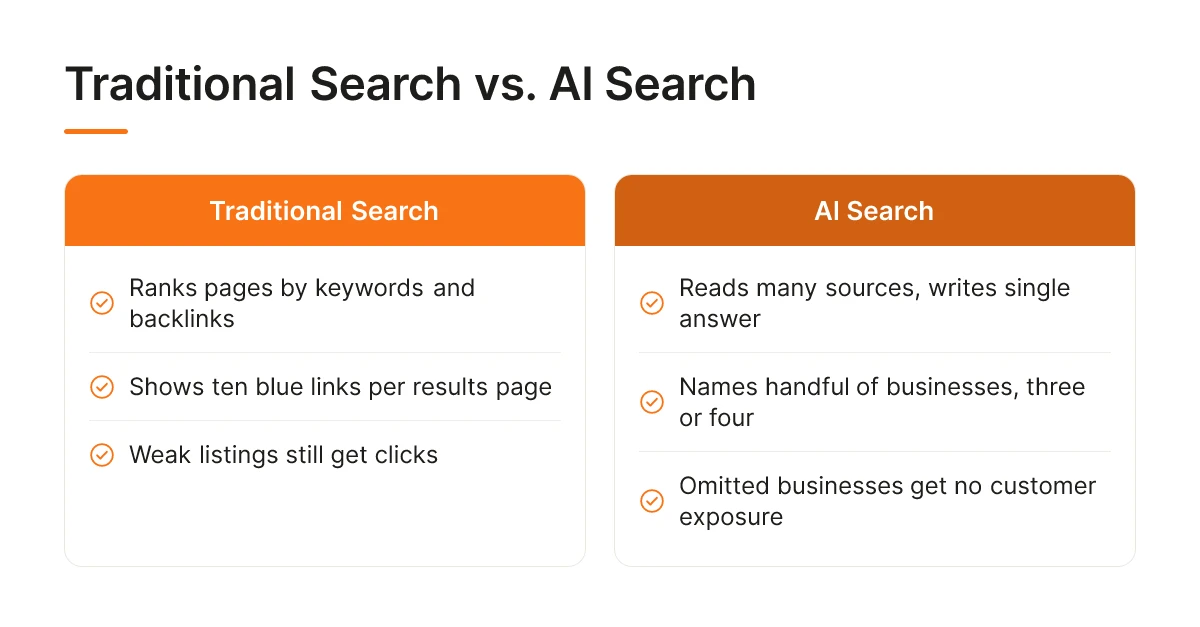
Google ranks pages by matching keywords and counting backlinks; AI search engines read across many sources, then write a single answer and decide which businesses earn a mention inside it. That's the core shift behind how small businesses get found by ChatGPT and other AI search engines, the competition isn't for position four on a results page, it's for a sentence in a synthesized answer [1].
A Google results page gives you ten blue links and room for a weak listing to still get a click. An AI answer usually names a handful of businesses, sometimes three or four, and if you're not one of them, the customer never scrolls past you to find you anyway [5]. That compresses the opportunity and raises what's at stake for every business trying to be one of the few named.
Why Does Your Website Matter More for AI Search Than It Did for Google Alone?
Your website becomes the primary fact-check source AI engines use to confirm what they pull from directories and reviews, which makes it more important, not less [3]. AI platforms draw from business listings, blogs, and recommendation content, but they still need a clear, structured source to verify pricing, services, and location details before repeating them as fact [3]. A thin "brochure" site with vague copy gives an AI model nothing solid to cite, even if your Google Business Profile looks strong. This is part of why Moonrank's technical optimization work, schema markup, llms.txt configuration, and structured data, exists specifically to give AI engines something unambiguous to parse on your own site, rather than leaving them to guess from secondhand sources.
Should Service Businesses Prioritize AI Search Visibility Differently Than Product Businesses?
Yes, service businesses need to prove expertise and trust, while product businesses need clean, structured data about what they sell and at what price. A cybersecurity consultancy or a B2B SaaS company gets recommended when its content demonstrates specific expertise and when third-party mentions back up its claims of authority [3]. An ecommerce store, by contrast, is more often surfaced through accurate product feeds, structured data, and consistent details across the sites AI models already trust, including the retailer's own listings [2]. Moonrank's keyword research and content generation are built around this distinction, targeting the trust-building angle for service and SaaS brands while keeping product and pricing data structured for ecommerce clients. Treating both the same way, one generic content strategy regardless of business type, is a common reason visibility efforts underperform. For more information, see Search.
How Do You Measure Whether AI Search Engines Are Actually Sending You Customers?
Track branded search increases, direct-traffic spikes, and conversion lift after AI mentions, since standard analytics tools rarely label the source as "ChatGPT" outright.
What Metrics Prove That AI Search Visibility Is Driving Real Traffic and Conversions?
Most analytics platforms were built for link-based referrals, and AI chat interfaces don't always pass that information along cleanly. When ChatGPT or Gemini recommends your business, the customer often copies your name into a new browser tab rather than clicking a tracked link, which means the visit lands in Google Analytics as "direct traffic" instead of "AI referral" [2]. A sudden rise in direct visits, paired with an uptick in branded search for your business name, is often the clearest signal that an AI platform mentioned you somewhere.
Some traffic does arrive with identifiable referral domains from chat interfaces, so it's worth checking your analytics for sources tied to chat.openai.com, perplexity.ai, or similar domains. But treat these as a partial picture, not the full count, Squarespace's research across millions of websites and a large citation study with Peec AI found that AI referral patterns are inconsistent and still maturing compared to traditional search [2].
The more reliable test is manual: open ChatGPT, Perplexity, and Gemini, and ask the exact questions a prospective customer would type, "best [your category] in [your city]" or "who sells [your product]." If your business doesn't appear, or appears with outdated details, that's a direct answer to how do small businesses get found by chatgpt and other ai search engines, and it tells you where the gap is [3].
For conversions, don't stop at traffic volume. Watch for branded search lift in the days following a known AI mention, and track whether direct bookings, form submissions, or phone inquiries rise in that same window [5]. That correlation matters more than raw sessions.
Manual spot-checks don't scale well once you're tracking several AI engines and dozens of query variations weekly. This is the category gap that AI search visibility monitoring tools now fill, automatically running representative prompts and logging citation frequency over time. Moonrank builds this tracking into its platform, monitoring how a business appears across ChatGPT, Claude, Perplexity, and Gemini alongside its daily content and technical optimization work, so owners see visibility trends without doing the querying by hand.
What Should Small Business Owners Do Right Now to Get Ahead in AI Search?
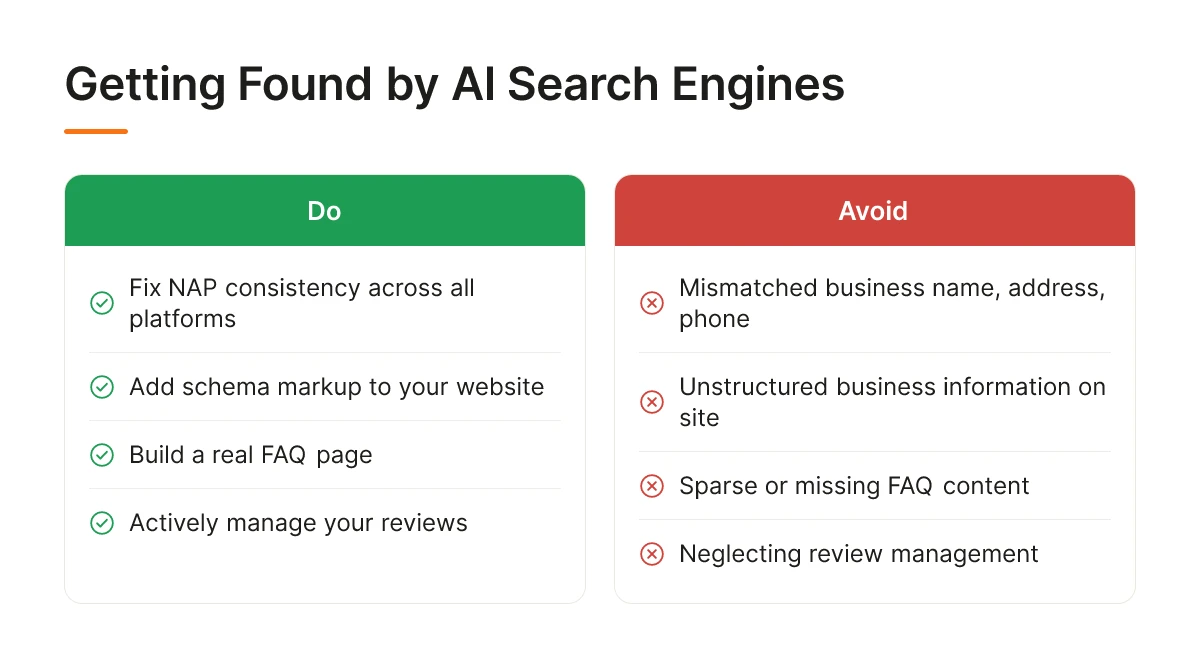
Four actions move the needle fastest: fix your NAP consistency, add schema markup, build a real FAQ page, and actively manage reviews.
These four steps answer the practical half of this approach, because every one of them gives AI systems a cleaner, more trustworthy signal to pull from. Here's the order that makes sense for a business tackling this alone.
The priority checklist
- Fix NAP consistency first. Your business name, address, and phone number need to match exactly across your website, Google Business Profile, directories, and social accounts. AI tools cross-reference these listings to confirm a business is real and current [3].
- Add schema markup. This is structured data in your site's code that tells AI engines exactly what you sell, where you're located, and what you charge, in a format machines parse instantly rather than guess at from paragraphs of text [4].
- Build a clear FAQ page. Write it in question-and-answer format with direct, specific answers. This structure mirrors exactly what AI engines look for when pulling content into a generated response [5].
- Request and monitor reviews. AI platforms weigh review volume and recency as a trust signal, not just a star rating. A thin or stale review profile makes a business harder to recommend [3].
For a single-location shop with one product line, this checklist is a weekend project. You can audit your own listings, write your own FAQ copy, and check your schema with a free validator tool without much trouble.
The work scales badly, though. Add a second location, a seasonal menu, a growing SKU catalog, or a multi-service offering, and each of those four tasks multiplies. NAP consistency now means checking listings across every location. Schema markup means updating structured data every time a product or price changes. The FAQ page needs constant expansion as new questions come in from customers and from AI chatbots pulling different angles on your business.
When Is It Time to Stop Doing This Yourself and Use a Tool to Automate AI Search Optimization?
The tipping point arrives when you're spending hours each week checking what ChatGPT and Perplexity say about your business instead of running it.
Signs you've crossed that line: you're manually re-checking AI answers after every menu or inventory update, you're chasing down inconsistent listings across five or more directories, or you've noticed a competitor showing up in AI recommendations where you don't, and you don't have time to figure out why. At that point, the hours lost to manual monitoring start costing more than the task is worth.
This is where automation earns its place. Moonrank runs the entire cycle without requiring your daily attention: it tracks how your business shows up across ChatGPT, Gemini, Claude, and Perplexity, fixes the technical gaps, schema markup, llms.txt, structured data, that keep AI engines from trusting your site, and publishes fresh, optimized content every day. You don't write anything or touch a line of code.
Cost-wise, think of it as a budget-friendly subscription that replaces what a premium agency retainer would otherwise charge to do a fraction of the work manually. For an owner who'd rather run the business than audit listings, that trade is usually worth making. You can see what that looks like at moonrank.ai.
Frequently Asked Questions
Can a small business appear in ChatGPT answers without having a website?
Yes, but a website makes it far easier and more reliable. ChatGPT and Perplexity often cite directories, review sites, and social profiles [4], so a strong Google Business Profile and consistent listings can get a business mentioned. Still, a website gives AI systems a structured source to pull facts from directly, which improves accuracy and frequency of mentions.
Do Google Business Profile updates affect how AI search engines describe your business?
Yes, Google Business Profile data feeds directly into how AI engines describe a business [3]. Keeping hours, services, categories, and photos current helps AI tools generate accurate summaries. An outdated profile risks AI engines repeating wrong details or skipping the business for a better-documented competitor.
How long does it take for AI search engines to start citing a business after changes are made?
Most businesses need roughly 90 days of consistent effort before citations show up reliably [5]. AI engines re-crawl and re-index sources on their own schedules, so changes don't appear overnight. Moonrank's daily publishing and technical optimization are built to keep feeding fresh signals during that window rather than making a single one-time fix.
Does AI search optimization replace the need for traditional SEO?
No, it works alongside traditional SEO rather than replacing it. AI search engines still rely partly on indexed web content and ranking signals, and Google search hasn't disappeared alongside AI answers [1]. Businesses that maintain basic SEO fundamentals while adding AI-specific signals tend to perform best across both channels.
What happens if my business has outdated information on directories like Yelp or Google?
Outdated directory listings can cause AI engines to cite wrong hours, prices, or services, or skip the business entirely. Consistent name, address, and phone details across directories matter because AI pulls from these public sources to build its answers [3]. Fixing mismatches improves both accuracy and the odds of being recommended.
Conclusion
Getting found by ChatGPT, Gemini, and Perplexity comes down to three things: accurate structured data, consistent information across every public source, and a steady stream of content that answers real customer questions. None of this is a one-time project, AI engines reward businesses that keep showing up with fresh, well-structured signals over months, not days. Start by auditing your Google Business Profile and directory listings for mismatches this week, since that's the fastest fix with the most direct effect on how AI engines describe your business. For the ongoing work of publishing and technical optimization, see how Moonrank automates it at www.moonrank.ai.
Sources & References
- How to Show Up in AI Search: GEO & AEO for Small Business
- AI Visibility: A Guide to AI Search for Business Owners, Squarespace
- How Small Businesses Can Appear in AI Search Results
- How to Get Your Small Business in Search Results on Google Gemini, ChatGPT, and Other AI Platforms
- How small businesses are getting found in ChatGPT, Perplexity, and Google AI Overviews (the 90-day playbook) - BUILTbyBackspace Blog
Recommended Articles
Explore more from our content library: