What Tools Do SMBs Use to Automate SEO Without an Agency
SMBs automate SEO without an agency using three types of tools: AI-native platforms that handle content and technical optimization together, standalone.....

Understanding what tools do smbs use to automate seo without hiring an agency is essential. SMBs automate SEO without an agency using three types of tools: AI-native platforms that handle content and technical optimization together, standalone rank/position trackers, and site-health crawlers that flag technical issues automatically. Instead of paying for an agency's hours, SMBs pay for software that runs on a schedule, publishing optimized content, monitoring rankings, and fixing technical signals without a person managing each task manually. The right mix depends on how much hands-on control the business wants versus how much it prefers to run on autopilot.
What Tools Do SMBs Use to Automate SEO Without Hiring an Agency?
Most small businesses pull from three tool categories, content automation, technical monitoring, and rank tracking, instead of paying a retainer for a person to manage each one manually.
That shift is happening because the economics of agency work never favored small operators. A $150K-revenue ecommerce shop or a five-person B2B SaaS company can't justify a five-figure annual agency contract for work that software now does on a schedule.
What are the main limitations SMBs face when relying on traditional SEO agencies?
Agencies bill a fixed monthly retainer regardless of how much work actually gets done that month. A business owner might pay the same amount in a slow month with one blog post as in a busy month with ten technical fixes and a content calendar, there's rarely a direct link between spend and output.
Turnaround is the second problem. Content drafts, schema markup updates, and technical fixes often sit in a queue for weeks because the agency is juggling other accounts. Reporting makes it worse: many SMB owners receive a monthly PDF with traffic charts but no clear account of which tasks were completed, which were skipped, or why rankings moved.
How has AI-powered automation changed what's possible for in-house SEO?
AI-native tools now handle the tasks that used to require a dedicated account manager, drafting content, generating schema markup, and flagging technical issues, without a human doing each step by hand [2]. Automation has compressed work that once took hours into tasks that run in minutes, which is the core reason DIY and semi-automated SEO has become viable for small teams [2].
This is the real answer to what tools do SMBs use to automate SEO without hiring an agency: a combination of software built to run specific SEO functions continuously, rather than a single person checking in once a month. Content generation and publishing tools draft and post optimized pages on a schedule. Technical SEO monitoring tools crawl a site to catch broken links, missing schema, or indexing errors. Rank and visibility tracking tools watch keyword positions and, increasingly, how often a brand shows up in AI-generated answers.
Most SMBs stitch two or three of these tools together, one for content, one for technical audits, one for tracking, unless they adopt a platform like Moonrank, which is built to run content publishing, technical optimization (schema markup, llms.txt, structured data), and AI search visibility tracking from a single system. That matters because the right combination isn't universal: an ecommerce store usually prioritizes technical and product-feed automation, a hotel needs local citation consistency, a cybersecurity vendor needs content that builds topical trust, and a B2B SaaS company leans heavily on content depth and citation building to get recommended by name.
What Specific SEO Tasks Can SMBs Actually Automate?
Six core SEO functions now run largely unattended: keyword research, content drafting, on-page optimization, structured data markup, rank tracking, and technical crawl alerts.
That's the practical answer to what tools do SMBs use to automate SEO without hiring an agency, a stack that covers research through reporting, not just one piece of it. For an ecommerce store or a B2B SaaS company with no in-house SEO hire, each of these tasks used to mean either a freelancer invoice or a weekend lost to spreadsheets.
- Keyword research and content briefs: Tools pull search volume, competitor gaps, and topic clusters, then generate briefs without a strategist manually building a spreadsheet.
- Draft content generation: AI models now write first-pass blog posts, product descriptions, and landing page copy based on the brief and target keyword.
- On-page optimization: Software checks headers, meta titles, meta descriptions, and internal link placement against best practices as content gets published.
- Schema and structured data markup: Platforms add the code that tells search engines and AI systems what a page is actually about, without the owner editing a template file.
- Rank tracking: Dashboards monitor keyword position changes daily instead of a manual Google search each week.
- Technical crawl alerts: Automated crawlers flag broken links, slow-loading pages, and indexing errors as soon as they appear.
Which SEO tasks are hardest to automate, and when do SMBs still need help?
Three areas still reward a human eye: brand voice consistency, backlink outreach relationships, and complex technical migrations.
Automated drafts can sound generic until someone familiar with the brand reviews tone and specificity, a hotel's "boutique, family-run" voice reads differently than a SaaS company's technical confidence, and software doesn't always catch that nuance on its own. Backlink building still depends on relationships, a journalist who covers your industry, a partner site willing to link back, that no script can negotiate. And a site migration, like moving a Shopify store to a new domain or replatforming a SaaS marketing site, involves enough interdependent redirects and tracking setup that most owners still want a second set of eyes before launch.
Can SMBs automate content creation, technical optimization, and tracking all with one tool?
Yes, some platforms now combine content generation, technical fixes, and visibility tracking in a single dashboard instead of three separate subscriptions.
Moonrank, for example, runs daily automated content generation alongside technical optimization, schema markup, llms.txt configuration, citation building, and tracks how a business appears across ChatGPT, Gemini, Claude, and Perplexity, all from one system after onboarding. Internal linking shows how the mechanics work in practice: the tool scans every published page, identifies topic relevance between them, and suggests or inserts links automatically, a task that used to mean manually auditing a site's content library page by page.

How Do SMBs Choose Between Different SEO Automation Tools?
Match the tool to how much manual work you're willing to keep doing, not to its feature list, the fewer steps left for you to run, the more it actually replaces an agency.
Most SMB owners researching this method run into the same problem: every product claims to "automate" something, but the word means different things depending on the category. A clear decision framework matters more than a feature comparison chart.
What should SMBs look for in an automation tool?
Four criteria separate tools that save real time from tools that just add another dashboard to check.
- Setup time: Can you get meaningful output in a day, or does it require weeks of configuration before you see any result?
- Scope of coverage: Does it handle content, technical optimization (schema, structured data, llms.txt), and visibility tracking together, or only one of the three?
- Manual review load: After setup, how much editing, approving, or publishing still falls on you every week?
- CMS integration: Does it connect cleanly to what you already run, Shopify, WordPress, a custom site, or does it require migrating platforms?
Checklists built for this exact decision tend to group tools into "what to look for" categories around ease of use, data depth, and budget fit [1], which is a reasonable starting filter before you compare anything else.
How do automation capabilities differ across tools, and which fits which business type?
Three broad categories cover most of the market. Plugin-based tools live inside your CMS, cost little, and handle narrow jobs like on-page checks, but you still configure and publish everything yourself. Standalone platforms offer deeper keyword and backlink data with more reporting power, at the cost of a steeper learning curve and more hours spent interpreting dashboards. AI-native all-in-one tools, Moonrank among them, automate the full pipeline, daily content generation, technical fixes, and visibility tracking, with far less manual setup, which is the structural reason they come closest to replacing an agency rather than just assisting one.
The automation gap matters as much as the category label. Some tools automate reporting and send alerts but leave content creation entirely manual, which keeps your time cost high even after the subscription is paid for [2]. Others automate the content pipeline itself, publishing without you writing a draft.
Business type should drive the choice. Ecommerce stores need product-page and feed automation at catalog scale. B2B SaaS companies selling on long cycles need steady content and citation-building that compounds over months. Hotels need technical consistency across multiple location pages. Cybersecurity firms need credibility-focused content and citations that establish authority before a prospect ever calls. Test one category, start with technical monitoring alone, before committing budget to a full platform.
What's the Real Cost Difference Between DIY Automation Tools and Hiring an Agency?
Agencies bill for hours and scope regardless of what gets published, while automation tools charge a flat subscription that scales with usage rather than headcount. That structural difference is the whole story once you look past the sticker price.
A typical agency retainer locks you into a monthly fee tied to a defined set of deliverables, a certain number of blog posts, a monthly audit, a reporting call. If your needs shrink, the retainer usually doesn't. If your needs grow, you renegotiate scope, which means another round of calls and a new contract line. Automation platforms, by contrast, tend to price in tiers, budget-friendly, mid-range, premium, based on how much content or tracking you need, not on how many hours a strategist spends on your account [4].
What's the actual return on investment of switching from an agency to automation tools?
The ROI shows up as time recovered, not just dollars saved. Agencies carry hidden costs that rarely appear in the retainer line item: onboarding calls to explain your business, revision cycles when a draft misses the mark, and reporting delays because a human has to compile the data before you see it [2]. Automation tools remove most of that friction because they run continuously, content publishes on a schedule, audits happen in the background, and visibility reports update without a meeting on the calendar.
For SMBs asking this strategy, the honest answer is that the ROI comes from compounding frequency. A tool that publishes daily and checks technical signals every day iterates faster than a service built around monthly deliverables, simply because it isn't waiting on a billing cycle to produce the next piece of work [2].
How much can an SMB realistically save by automating SEO instead of paying agency fees?
Savings come from eliminating the labor markup agencies charge for strategy, writing, and reporting, not from the tool being free. A subscription like Moonrank, priced at $99 a month, replaces several of the functions an agency bundles into a retainer that commonly starts well above $3,000 a month: content generation, technical optimization, and visibility tracking across ChatGPT, Gemini, Claude, and Perplexity [1].
That said, automation isn't zero effort. Someone still needs to review output, confirm the keyword strategy fits the business, and check in on results occasionally. The realistic comparison isn't "hands-on work" versus "zero work", it's reduced owner hours and a lower recurring bill versus high recurring cost with hours handed off entirely.
Which Automation Tools Work Best for SMBs With Limited Technical Expertise?
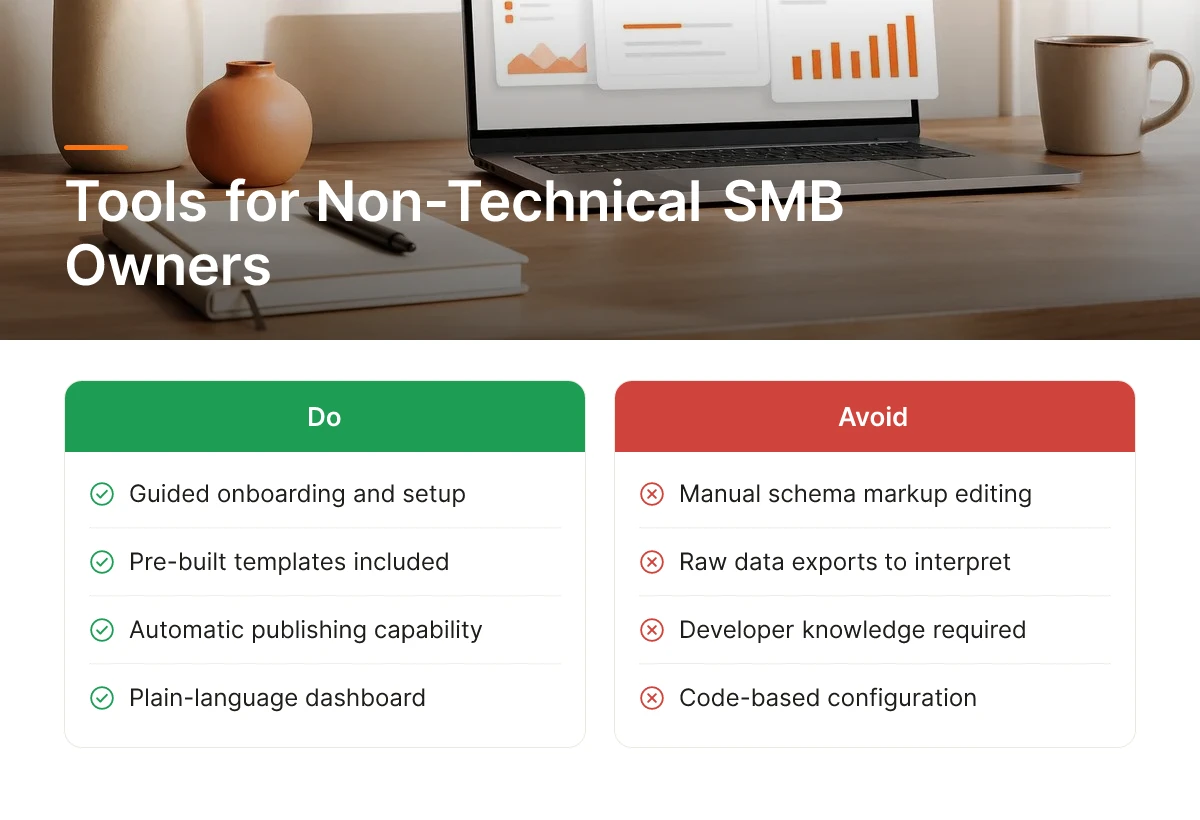
The best fit is a tool with guided onboarding, pre-built templates, automatic publishing, and a plain-language dashboard, no code and no developer required.
When SMB owners ask this approach, the honest answer depends less on feature count and more on how much setup the tool demands. A platform built for marketing teams with in-house developers often assumes you can edit schema markup by hand or interpret a crawl report full of raw data exports. A platform built for a solo founder or shop owner should do that translation for you, showing "your pages aren't indexed yet" instead of a spreadsheet of status codes.
Look for four traits before committing to any tool: a setup wizard that asks about your business rather than requiring a technical brief, content templates tied to your actual niche and keywords, publishing that happens automatically to your CMS without manual uploads, and reporting written in outcomes, rankings, indexed pages, AI mentions, rather than raw metrics only an analyst would parse [1]. For more information, see 5 Ways Consumer Engagement Tools Drive Sales.
What's the simplest step-by-step setup process for SMBs new to SEO automation?
- Connect your website or CMS. Shopify, WordPress, or a custom site, the tool should authenticate and pull existing pages automatically.
- Set target topics or keywords. Point the tool at your niche, products, and location rather than picking keywords from a generic list.
- Let it run an initial content and technical audit. This surfaces missing schema markup, thin pages, and gaps competitors already cover.
- Review and approve the first batch. Check tone and accuracy once, then let daily automation take over.
This sequence mirrors what the research on DIY SEO describes as the shift from expert-dependent work to tool-dependent work, automation handles in minutes what used to take hours of manual research and formatting [2].
Do real SMBs see measurable results from automation tools?
Yes, but on a realistic timeline, expect weeks of consistent automated publishing and monitoring before ranking shifts or AI-answer visibility become noticeable, not overnight.
Indexed page count, keyword movement, and mentions in AI-generated answers all compound with consistency. A single optimized page rarely moves the needle; a steady cadence of technically sound, relevant pages does.
Moonrank was built for exactly this reader: an e-commerce owner or B2B SaaS founder who wants agency-level output, daily content, schema markup, llms.txt configuration, and visibility tracking across ChatGPT, Gemini, Claude, and Perplexity, without managing an agency relationship or learning technical SEO. At $99/month against agencies charging $3,000 or more, it's priced for the exact business this section describes. See it running on a real site at www.moonrank.ai.
Frequently Asked Questions
Can a small business fully replace an SEO agency with automation tools?
Yes, for most SMBs, especially those without complex multi-market SEO needs, automation tools now cover what a standard agency retainer used to handle [2]. Content production, technical fixes, and visibility tracking can all run on autopilot. The gap that remains is custom strategy for unusually competitive or regulated industries, where a specialist still adds judgment a tool can't replicate.
Do automation tools work for competitive niches or only low-competition markets?
They work in competitive niches too, but results depend more on consistency and technical accuracy than on the tool alone. A daily publishing cadence and clean schema markup matter in crowded categories like SaaS or e-commerce, where competitors are also optimizing constantly. Tools won't manufacture a differentiated offer, they execute the mechanics of visibility, not the underlying business positioning.
How long does it take to see results from SEO automation tools?
Expect early technical fixes to show impact within weeks, with content-driven visibility gains typically taking a few months to compound [1]. AI search visibility, appearing in ChatGPT or Perplexity recommendations, tends to move faster than traditional Google rankings once citations and structured data are in place, but it's rarely instant.
What happens if an automation tool makes a technical SEO mistake on my site?
Reputable tools stage or version changes so a mistake is reversible, not catastrophic. Most schema and structured data updates are additive rather than destructive, meaning they rarely break existing site functionality. Still, it's worth confirming any tool offers rollback options or change logs before letting it publish or edit your site without manual review.
Conclusion
SMBs no longer need a $3,000-a-month retainer to compete on search, they need the right combination of automated content, technical fixes, and visibility tracking, applied consistently [2]. The tools covered here handle pieces of that stack; few handle all three for AI search specifically.
Start by auditing whether your site even appears when customers ask ChatGPT or Perplexity for recommendations in your category, that single test reveals more than any keyword report. Moonrank runs that check as part of its $99/month autopilot system, built specifically for AI search visibility rather than Google rankings alone. Visit moonrank.ai to see where your business currently stands.
Sources & References
- Mega · 13 Best AI SEO Tools for Small Businesses
- SEO Without an Agency: Can Small Businesses Manage? - WiloAI
- 24 Best Small Business Marketing Tools for 2026
Recommended Articles
Explore more from our content library: