How to Build an Effective SEO for AI Search Strategy
SEO for AI search means adapting content and technical setup so engines like ChatGPT, Gemini, Claude, and Perplexity can understand, trust, and cite you.

SEO for AI search means adapting your content and technical setup so engines like ChatGPT, Gemini, Claude, and Perplexity can understand, trust, and cite your business when answering questions, a different process from ranking in Google's blue links. AI search engines favor clear, well-structured answers, verifiable facts, and consistent information across the web over backlink volume or keyword density. Traditional SEO still matters as a foundation, but getting recommended by AI search requires structured data, direct answers near the top of your pages, and credibility signals AI models can verify quickly.
How Is SEO for AI Search Different from Traditional SEO?
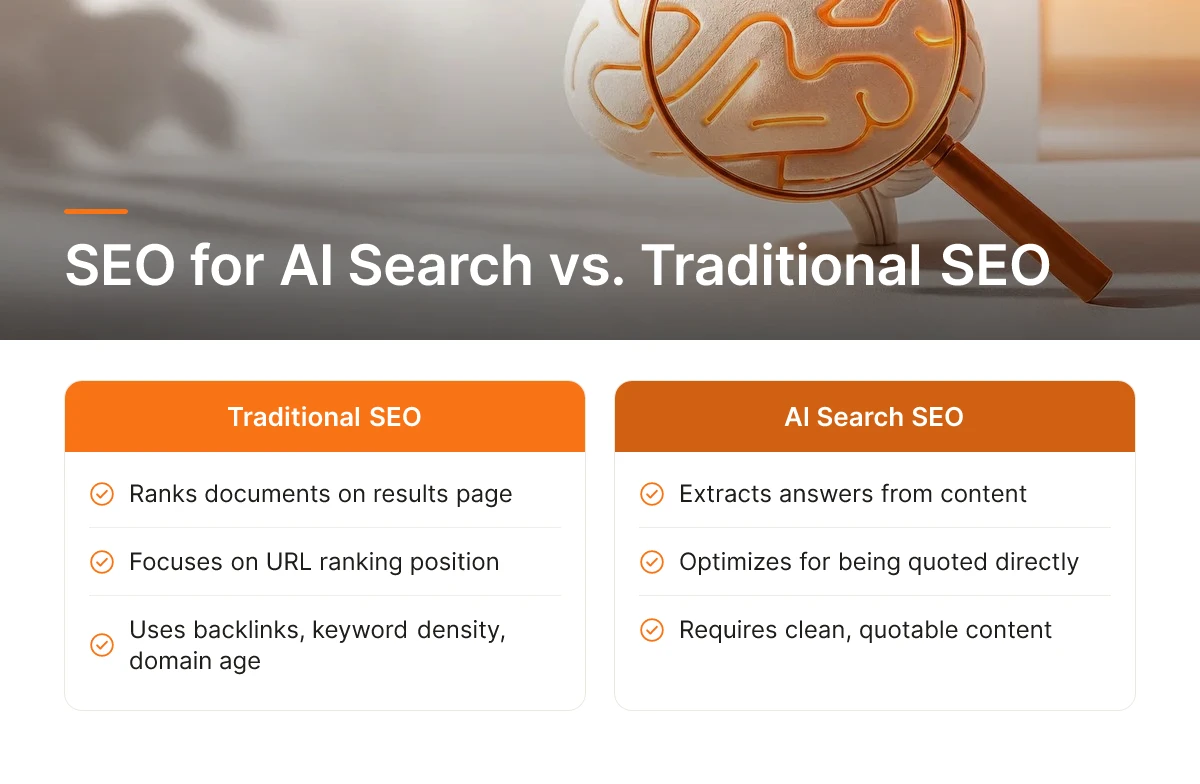
Google ranks documents; AI engines extract answers, so seo for ai search means optimizing for being quoted, not just being listed on a results page.
Traditional SEO built an entire industry around ranking a URL higher than ten other URLs. Backlinks, keyword density, and domain age all fed a scoring system designed to sort links. Generative engines like ChatGPT, Gemini, Claude, and Perplexity work differently: they pull a sentence or paragraph out of your page, check it against other sources, and present it as a direct answer. Google itself acknowledges this shift while maintaining that core ranking and quality systems still underpin its AI features [1]. The difference is what happens after a page qualifies, it gets summarized, not just surfaced.
Why Do AI Search Engines Prioritize Different Signals Than Google Does?
AI engines reward content they can lift cleanly and verify quickly, which means clarity and factual consistency now outrank keyword density or link volume.
A generative model has to decide, in milliseconds, whether a sentence can stand alone as a trustworthy answer. That favors pages with direct statements near the top, consistent facts across your site and the web, and structure a machine can parse without guesswork. Industry analysis of AI search behavior describes this as a shift toward structured data, strong visual and textual clarity, and sources AI systems have learned to trust over time [3]. Keyword density and backlink counts don't factor into that judgment the way they did for classic ranking algorithms.
What SEO Practices That Worked for Google Might Hurt Your AI Search Visibility?
Keyword stuffing, thin volume-chasing pages, and mismatched clickbait headlines can actively hurt how AI engines judge your content's trustworthiness.
Stuffing a page with repeated keywords once nudged rankings; now it reads as noise and makes it harder for a model to extract a clean answer. Thin pages built purely to capture search volume rarely contain the specific, well-supported detail an AI engine needs to cite confidently. Headlines that promise one thing and deliver another create factual mismatches models can flag as unreliable. None of this means traditional SEO is obsolete, fast load times, clear site structure, and genuinely authoritative content remain the base that AI search optimization builds on top of [1][4]. Moonrank's technical audit layer focuses on exactly this handoff: fixing schema markup, llms.txt configuration, and structured data so the foundation you already have becomes something AI engines can actually read and trust.
What Technical and Content Changes Help You Get Recommended by AI Search Engines?
Getting recommended comes down to two things: writing content AI models can lift cleanly, and exposing technical signals that prove your business is real and trustworthy. Most of seo for ai search is less about new tactics and more about removing the friction that stops a language model from quoting you.
What Does It Mean to Make Your Content 'AI-Ready'?
AI-ready content answers the reader's question in the first sentence, then supports it with clear structure an AI model can scan without guesswork. Google's own guidance confirms that generative AI features build on core ranking and quality systems, so the foundational habits, clear writing, genuine expertise, direct answers, still carry weight [1].
Skip the long narrative intro. If a visitor, or a model, has to read three paragraphs of backstory before finding your return policy or your service area, you've already lost the citation to a competitor who put it in the first line. Use descriptive H2 and H3 headers that mirror real questions ("What does shipping cost?" not "Our Logistics Philosophy"), and break facts into short paragraphs or bullet lists rather than burying them in prose. AI systems are scanning for meaning and structure, not just keywords, and reward content that shows depth and a clear hierarchy [4].
Which Technical Setup Changes Have the Biggest Impact?
Three technical changes move the needle most for seo for ai search: structured data, bot-friendly crawl access, and consistent facts across the web.
- Schema markup. This is structured data in your site's code that tells AI engines exactly what you do, your hours, services, product pricing tier, and review scores, without them having to infer it from paragraphs of text. Structured data that machines can interpret without guesswork is one of the core pillars of AI search visibility [3].
- llms.txt and crawlability. AI bots like GPTBot and PerplexityBot don't crawl the same way Googlebot does, and many sites block or ignore them by default. An llms.txt file acts as a plain-language map telling these bots what to read and trust, which matters because a site invisible to Googlebot can still be invisible to AI crawlers for entirely separate reasons.
- Fact consistency. AI models cross-check your name, address, phone number, and product details against third-party listings, review sites, and directories. Contradictions between your homepage and your Google Business Profile or a review site read as a trust problem, and models tend to favor sources they already trust over pages that merely rank [3].
- Quotable summaries. Add a short, direct-answer block near the top of key pages, two or three sentences an AI engine can lift verbatim into its response, the same way a featured snippet works.
Moonrank builds these pieces automatically: schema markup, llms.txt configuration, and citation consistency checks run in the background while it publishes new content daily, so none of this requires a developer or an agency retainer.

How Do ChatGPT, Gemini, Claude, and Perplexity Choose Sources Differently?
Each engine pulls information through a different pipeline, so a page that gets cited in Perplexity might get ignored by Claude. Understanding these mechanics is the real work behind seo for ai search, there's no single switch to flip, because there's no single system on the other end.
What Unique Ranking Factors Does Each AI Search Engine Use?
Perplexity runs on live web retrieval, pulling fresh pages at query time rather than relying mainly on a static training set [3]. It favors content that's been updated recently and pages dense with citations and sourced claims, the more your page reads like something a researcher would reference, the more likely Perplexity is to pull it in.
ChatGPT works differently depending on mode. Its baseline answers draw from training data, while browsing-enabled queries pull live pages, meaning your brand can show up two ways: referenced from what the model already "knows" about you, or actively browsed and cited in real time [4]. Getting referenced requires a consistent, well-documented presence across the web; getting browsed requires the technical signals that let a crawler parse your page cleanly on the spot.
Gemini sits closest to traditional search because it draws on Google's index and core ranking systems, and Google has said directly that its generative AI features are rooted in the same quality and ranking systems as standard Search [1]. That overlap means established SEO fundamentals, like clear site structure and earned authority, still matter for Gemini, but it isn't a one-to-one match with classic blue-link rankings, since the generative layer adds its own synthesis step on top.
Claude behaves more conservatively. It leans toward well-established, clearly authoritative sites rather than newer or less-verified sources, which makes sense for a model built with heavier guardrails around accuracy. For a smaller brand, this means earning mentions on trusted third-party sites may matter as much as optimizing your own domain.
Should You Optimize Differently for Each AI Search Engine?
Build one strong foundation first, then let engine-specific tactics sit on top of it. Structured data, clear factual writing, and frequent content updates serve all four systems at once [3], since every one of them is ultimately trying to extract clear, trustworthy answers from your pages.
Layering in specifics, fresher publishing for Perplexity, crawlable technical markup for ChatGPT's browsing mode, authoritative backlinks for Claude, is a refinement, not a replacement. Moonrank's platform handles this by running daily content publishing alongside technical work like schema markup and llms.txt configuration, then tracking how each engine actually responds, so the foundation and the fine-tuning happen in parallel instead of competing for your time.
How Do You Measure Whether Your AI Search Optimization Is Working?
You measure it by combining four signals: manual prompt tests, AI referral traffic in your analytics, brand mention tracking, and Google Search Console's AI Overview data.
Standard rank trackers were built for a results page with ten blue links. They don't know what to do when the answer is a paragraph generated by ChatGPT with no URL attached. That's the core problem with seo for ai search: the tools SMB owners already own, Yoast, basic Google Analytics dashboards, a rank tracker, weren't designed to see whether an AI engine mentioned you at all. You need a different measurement stack, and most of it is manual or semi-manual today.
What Metrics Should You Track to Measure ROI from AI Search Visibility?
Start with manual prompt testing: ask ChatGPT, Gemini, Claude, and Perplexity the exact questions your customers would ask, "best hotel in [city] for business travel," "top [product category] brand for small teams", and log whether your business appears, how it's described, and which competitors show up instead. Run the same prompts weekly or biweekly, since AI answers shift as models retrain and re-crawl sources.
Next, check referral traffic from AI engines directly in your analytics. GA4 now separates traffic from chatgpt.com, perplexity.ai, and similar domains into visible referral sources, so you can see session volume without guesswork. The real work is connecting that traffic to outcomes, inquiries, demo requests, add-to-carts, bookings, rather than stopping at session counts, which tell you an AI engine sent someone your way but nothing about whether it mattered to the business. A B2B SaaS company might tag AI-referred sessions in its CRM; an e-commerce store might watch conversion rate specifically for that traffic segment.
How Do You Monitor Citations and Recommendations Across AI Search Engines?
Brand mention and citation monitoring is the AI-search equivalent of backlink tracking in traditional SEO, instead of counting who links to you, you're counting who an AI engine cites or names as a source when answering a relevant question. This matters because these systems favor content from sources they already trust [3], so a rising mention count across prompts is a leading indicator before referral traffic catches up.
Google Search Console's AI Overview data offers a partial but genuinely useful proxy here, it reports impressions and clicks specifically tied to AI Overview appearances, even though it only covers Google's own generative features [1]. It won't tell you anything about Perplexity or Claude, but paired with manual prompt logs, it rounds out the picture. Moonrank's visibility tracking layer automates much of this cross-engine monitoring, checking how a business appears across ChatGPT, Gemini, Claude, and Perplexity on an ongoing basis rather than requiring an owner to run manual prompts every week.
What's the Fastest Way to Start Optimizing for AI Search Without an Agency?
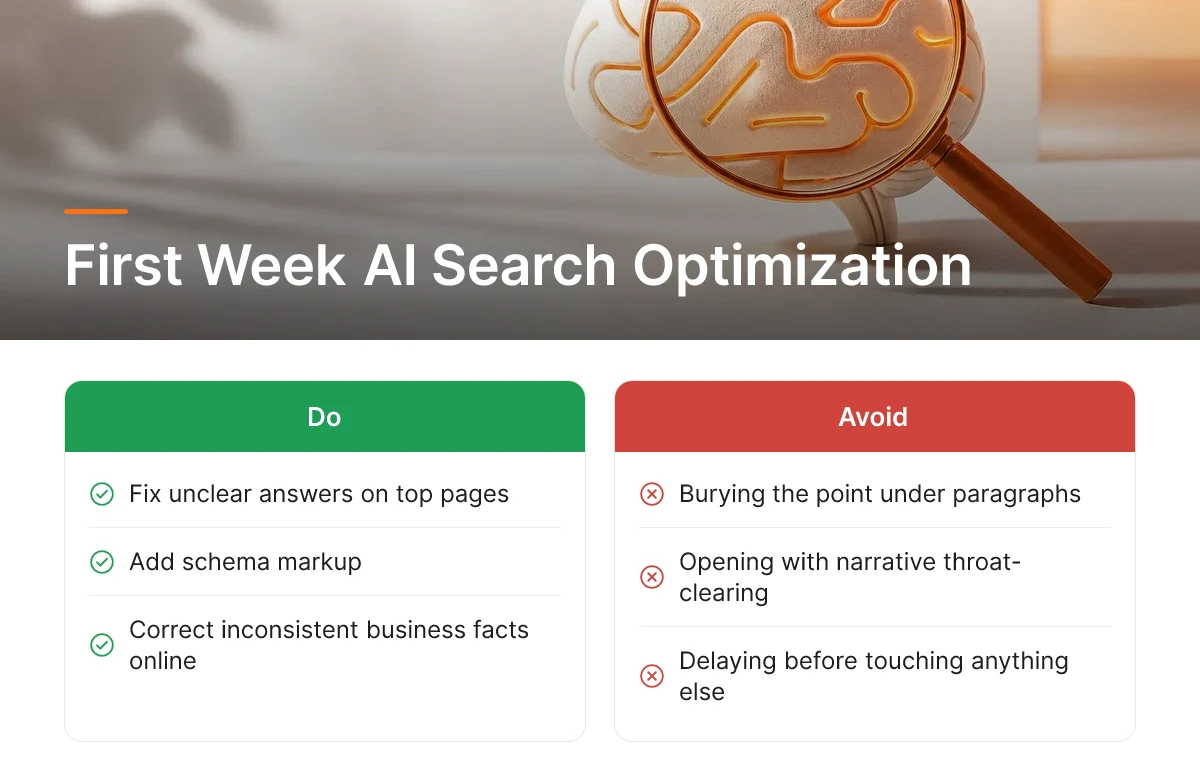
Spend your first week on three things: fixing unclear answers on your top pages, adding schema markup, and correcting inconsistent business facts across the web. That alone moves the needle before you touch anything else.
Start with an audit of your five to ten highest-traffic pages. Read each one and ask: does this answer a specific question in the first two sentences, or does it bury the point under three paragraphs of throat-clearing? AI engines pull direct answers, not narrative build-up, so a product page that opens with "we've been passionate about quality since 2014" loses to a competitor who opens with the price, the材料, and the use case.
Next, add schema markup, the structured data that tells AI engines exactly what your business does, where it's located, and what it sells, to your homepage, product pages, and location pages. Then check your business facts for consistency: your address, hours, and product details should match across your website, Google Business Profile, and any directories you're listed in. Conflicting facts are one of the fastest ways to get excluded from an AI-generated answer, since the model has no way to know which version is current.
Can You Optimize for Google and AI Search at the Same Time, or Do They Conflict?
They don't conflict, the same foundational work (clear writing, structured data, credible sources) supports both Google rankings and AI recommendations. Google has said directly that core SEO best practices remain relevant for generative AI features because those features are built on the same ranking and quality systems as traditional search [1]. The difference is emphasis: Google still rewards backlinks and keyword relevance, while AI engines weigh clarity, trustworthiness, and whether your content directly answers a question [3]. Treat them as one investment with two outputs, not two separate budgets.
Where this gets hard is volume. Manual seo for ai search work means publishing new content regularly, keeping schema current as pages change, and checking how your brand appears across ChatGPT, Gemini, Claude, and Perplexity, four separate interfaces with no shared dashboard. Doing that by hand every week is realistic for about a month before most SMB owners quietly stop.
This is the gap automation platforms fill. Moonrank runs daily content publishing, schema and llms.txt upkeep, and cross-engine visibility tracking on autopilot, built specifically for businesses that want AI search visibility without hiring staff or learning technical SEO. Agencies that offer comparable monitoring typically charge premium, retainer-based rates; Moonrank is priced for SMBs as a budget-friendly monthly subscription instead. For an e-commerce store or B2B SaaS team already stretched thin, that's the difference between optimizing for AI search once and maintaining it indefinitely.
Frequently Asked Questions
Does optimizing for AI search hurt my traditional Google rankings?
No, the same foundations that help Google rank your site also help AI engines trust it. Google itself says core SEO best practices remain relevant because its generative AI features are built on the same ranking and quality systems as traditional search [1]. Clear structure, credible content, and clean technical setup benefit both at once.
How long does it take to see results from AI search optimization?
Most businesses notice early signals, citations or mentions in AI answers, within a few weeks of consistent publishing and technical fixes. Full visibility gains build over months, since AI engines need repeated, trusted signals before they cite a source regularly.
Do I need separate content for ChatGPT versus Perplexity versus Gemini?
Not separate content, but you do need content structured so each engine can parse it. ChatGPT, Perplexity, and Gemini pull from sources they trust rather than ranking links the way Google does [3], so clear structure, direct answers, and strong citations tend to work across all three without a dedicated version for each.
What are real before-and-after results from automating AI search optimization?
Results vary by business, but agencies running structured AI-visibility programs have reported sharp traffic jumps from AI platforms, one agency reported a 404% increase from Gemini and a 1,078% increase from ChatGPT in 2025 after running prompt engineering and structured data work for clients [5]. Individual results depend on starting visibility, niche competition, and publishing consistency.
Is schema markup required to get cited by AI search engines?
It is not strictly required, but it significantly improves your odds. Structured data is one of three pillars AI search optimization relies on, alongside AI-ready content and trust signals, because it removes guesswork for machines trying to interpret your pages [3].
Conclusion
AI search rewards the same things Google already values, clear structure, credible sources, and content built for direct answers, just read by a different audience [1][3]. Any serious approach to seo for ai search comes down to publishing consistently, fixing technical gaps like schema and llms.txt, and tracking how your business shows up across ChatGPT, Gemini, Claude, and Perplexity rather than guessing.
You don't need an agency retainer to do this well. Moonrank runs daily content publishing, technical optimization, and cross-engine visibility tracking on autopilot for a budget-friendly monthly subscription, start with the free trial at moonrank.ai and see where your business currently stands in AI search results.
Sources & References
- Google's Guide to Optimizing for Generative AI Features on Google Search | Google Search Central | Documentation | Google for Developers
- Optimizing for AI search: The SEO trifecta | Rio SEO
- How to Optimize Your Site for AI Search: The AI SEO Playbook
- AI SEO Services | AI-Driven Search Engine Optimization Strategy
Recommended Articles
Explore more from our content library: