How My Paris, France Small Business Gets Found on AI Search
Your Paris small business gets found on AI search engines by having clear, structured, up-to-date content about what you do, where you're located, and who.....

Understanding how can my small business in paris france get found on ai search engines is essential. Your Paris small business gets found on AI search engines by having clear, structured, up-to-date content about what you do, where you're located, and who you serve, plus the technical signals (schema markup, crawlable pages, consistent business listings) that let ChatGPT, Gemini, and Perplexity confidently cite you as an answer. Unlike Google, these engines pull from a mix of your website, reviews, and third-party mentions to form a recommendation, so visibility depends on being clearly described and consistently referenced across the web, not just ranked. French-language clarity and accurate local details (arrondissement, neighborhood, service area) matter heavily for Paris-based queries.
How Can My Small Business in Paris France Get Found on AI Search Engines?
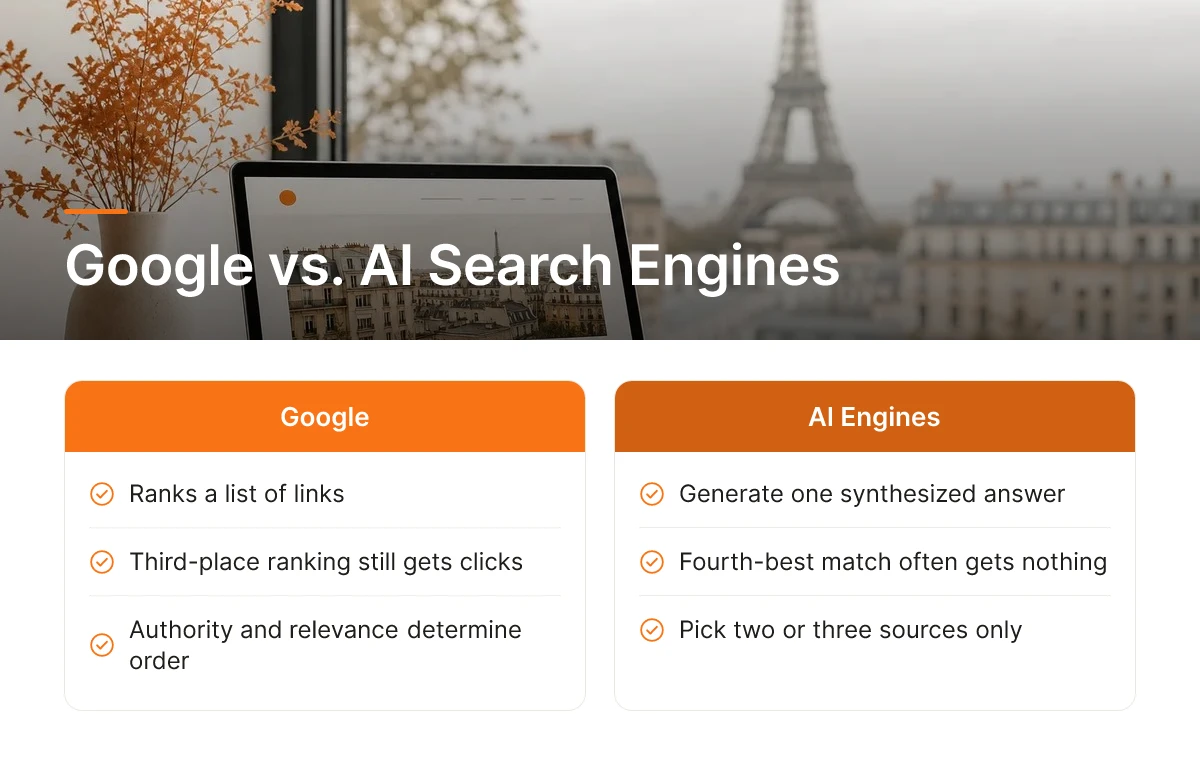
AI engines decide what to recommend by pulling facts from several sources at once, not by ranking a list of links the way Google does.
When someone asks ChatGPT or Perplexity for a café near the Canal Saint-Martin, the model doesn't crawl a results page and pick the top-ranked site. It synthesizes an answer from whatever it can find: your website, Google Business Profile, TripAdvisor reviews, a mention in Le Fooding, maybe a local blog post from last year. Google's own documentation on AI features describes this as surfacing relevant information to help people get to an answer quickly, often pulling from a wider mix of sites than a classic search result would show [1]. That changes the real question business owners should be asking. The question isn't just how can my small business in Paris France get found on AI search engines through one well-optimized page, it's whether your business is described consistently and clearly across every place an AI model might look.
This is also why backlinks alone, the currency of traditional SEO, carry less weight here. A directory listing with your correct address, a press mention with your actual specialty, and a review that confirms your hours all function as independent confirmations a model can cite. One strong website with zero outside corroboration gives the AI less to work with than a modest site backed by five consistent third-party mentions.
Why Does Content Quality and Freshness Matter More for AI Search Engines Than Traditional SEO?
AI models favor content that states facts plainly and was updated recently, because they extract and verify claims rather than match keywords.
A page that buries your opening hours in a paragraph of marketing copy is harder for a model to extract than a page that lists them in a clean block. A menu updated last month signals the business is active; one last touched in 2022 gets treated with more caution. This is the mechanism behind Moonrank's approach for SMBs: daily content refreshes paired with structured data give AI engines unambiguous, current facts to pull from, rather than relying on a one-time site build that goes stale.
How Do Language and Localization Affect Whether AI Engines Recommend French-Language Content?
AI engines match the language and regional intent of the query, so French-only prompts tend to skip businesses with only English content.
A Paris boulangerie with an English-only "About" page may never surface when a local resident asks "meilleure boulangerie dans le 11e" in French. A B2B SaaS company based in Paris selling to French enterprise buyers faces the same gap if its product pages, case studies, and schema markup exist only in English, the model has nothing French-language to cite, so it defaults to a competitor who does.
Picture a Paris café versus a Google search: Google might show a map pin and five blue links. An AI engine might instead write two sentences naming the café, its neighborhood, and a signature pastry, stitched together from the website, a Yelp review, and a local press piece [5]. A B2B SaaS company sees the same shift: instead of ranking for "project management software Paris," it either gets named in a synthesized comparison or left out entirely.
What's the Difference Between Getting Found on Google and Getting Recommended by AI Search Engines?
Google ranks a list of links by authority and relevance, while AI engines skip the list and generate one synthesized answer that cites only a handful of sources.
That difference changes the entire game for a boulangerie, a boutique hotel, or a SaaS company based in Paris. Ranking third on a Google results page still gets you clicked. Being the fourth-best match for an AI engine's answer often means you get nothing, the model picks two or three sources, writes a summary, and moves on. Google itself describes AI Overviews and AI Mode as surfacing links to help people "explore content they may not have discovered before" [1], but the mechanic underneath is retrieval and synthesis, not a ranked list a user scrolls through. For anyone asking how can my small business in paris france get found on ai search engines, this distinction is the starting point: you're no longer optimizing to appear on a page, you're optimizing to be one of the few sources an AI model trusts enough to quote.
Which AI Search Engines Send the Most Traffic to Small Business Websites?
Each major AI engine behaves differently, and the gap matters more than most business owners expect. ChatGPT answers conversationally and often cites sources inline or at the end of a response, but the citation can be easy to miss if a user doesn't click through. Perplexity is the most transparent of the group, it shows a visible, numbered source list alongside its answer, which makes it easier to track whether your business got mentioned at all. Gemini draws heavily on Google's own index, so sites with strong traditional SEO and clean structured data have a head start there. Claude tends to cite more conservatively, favoring fewer, higher-authority sources per answer. None of this is static, these products change their citation behavior frequently, and no independent, verified traffic benchmarks exist yet for small business sites specifically. Treat engine-by-engine differences as directional, not fixed.
Do the Same SEO Tactics That Work for Google Also Work for AI Search Engine Visibility?
Partly. Structured, factual, well-organized content helps both Google and AI engines, because both systems need to parse what your page actually says before deciding to use it.
Where the tactics diverge is weighting. Backlink volume, long a cornerstone of Google ranking, carries less influence on whether an AI engine cites you, these models care more about whether your content answers a specific question cleanly. Clear entity information matters more instead: your business name, exact location in Paris, hours, services, and pricing tier need to be unambiguous and consistent across your site and any directories that list you. This is the gap Moonrank was built to close, it runs technical optimization like schema markup and llms.txt configuration specifically so AI engines can parse and trust a business's entity data, on top of daily content publishing, for $99/month [2].
How AI Overviews Blur the Line
Google's AI Overviews sit inside the traditional search results page but function like an AI engine's synthesized answer rather than a ranked list [1]. That overlap means your Google SEO work and your AI visibility work are no longer fully separate projects, they share infrastructure, but they don't share the same win condition.
What Steps Should a Small Business in Paris Take to Improve AI Search Visibility?
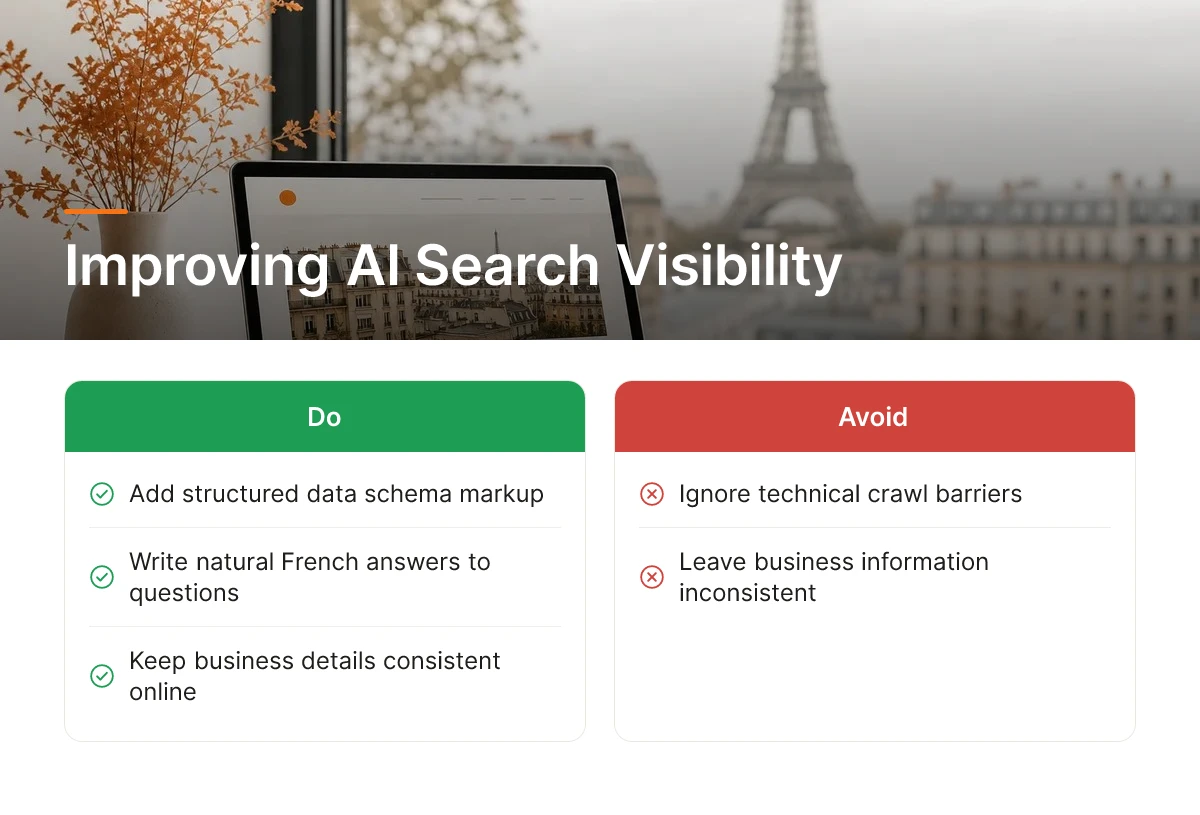
A Paris business improves AI search visibility by adding structured data, writing natural French answers to customer questions, fixing technical crawl barriers, and keeping business details consistent everywhere online.
These four steps are the practical core of this strategy, and they apply whether you run a boutique hotel near the Marais, a B2B SaaS platform, or a cybersecurity consultancy serving French enterprises. Start with structured data, the schema markup that tells AI engines exactly what your business does, where it's located, and what it offers. Google's own guidance confirms that AI features in Search rely on crawlable, well-structured content to surface relevant links to users [1], and the same crawlability logic applies to how ChatGPT, Gemini, and Perplexity select sources to cite.
How Should a Paris-Based Business Optimize Content for French-Speaking AI Search Users?
Write original French answers to the questions your customers actually ask, don't translate your English SEO copy word-for-word. A literal translation reads awkwardly to both humans and AI models, and it rarely matches the natural phrasing a French speaker would type into ChatGPT or use when asking Perplexity for a recommendation.
Think in terms of real questions: "quel hôtel près du Marais a une piscine?" or "quel logiciel de cybersécurité convient aux PME françaises?" Build short, direct pages or FAQ sections that answer these in plain French, using the vocabulary your customers use rather than keyword-stuffed phrases borrowed from an English template. This matters across every target sector, ecommerce brands selling to French shoppers, SaaS companies pitching French procurement teams, and cybersecurity firms explaining compliance in terms French buyers recognize.
What Technical Changes Help AI Engines Crawl and Recommend a Website?
AI engines need to crawl your site cleanly, so fix anything that blocks or slows that process before worrying about content volume. A clean llms.txt file, fast page loads, clear HTML heading structure, and content that isn't hidden behind heavy JavaScript rendering all make it easier for AI crawlers to extract and trust what your site says.
Sector examples make this concrete:
- Hotels: list amenities, neighborhood, and nearby landmarks in plain HTML text, not just inside an image gallery or JavaScript-rendered map widget.
- B2B SaaS companies: state your use case and integrations directly on the homepage, "integrates with Salesforce and HubSpot" reads clearly to both humans and AI models.
- Cybersecurity firms: name your certifications (ISO 27001, SOC 2) and the client industries you serve, rather than burying them in a downloadable PDF.
Finally, keep your business name, address, and description identical across your website, Google Business Profile, directories, and review sites, AI engines corroborate facts across multiple sources before recommending a business, so inconsistency undermines trust. Moonrank handles this stack automatically for $99/month: it runs daily content generation in the language and tone your customers use, configures llms.txt and schema markup, and tracks how your business appears across ChatGPT, Gemini, Claude, and Perplexity, without requiring you to touch a line of code.
How Do You Measure Whether Your AI Search Visibility Efforts Are Working?
Track referral traffic from AI engine domains, watch for direct brand searches after a citation, and manually prompt-test ChatGPT, Gemini, Perplexity, and Claude on a schedule.
Most small business owners asking this approach skip this step entirely, they optimize, wait, and hope. Measurement is what separates businesses that can prove a return from those just guessing.
What Metrics Should Small Businesses Track to Prove ROI from AI Search Visibility?
Three numbers matter most. First, referral traffic tagged from AI engine domains, your analytics tool can segment visits arriving from chatgpt.com, perplexity.ai, gemini.google.com, and claude.ai, the same way you'd segment Google or Bing referrals.
Second, watch for direct brand-name searches that spike after an AI citation. A pattern worth logging: someone asks an AI assistant for a recommendation, gets your business name, then searches your brand directly on Google a day or two later rather than clicking through the AI answer itself. This shows up as a direct traffic bump with no obvious referral source, which is a known quirk of how AI-driven discovery converts.
Third, compare conversion rate from AI-referred visitors against your organic search baseline. If a Shopify store sees AI referral traffic convert at a similar or higher rate than Google organic, that's a strong signal the citations are reaching people with real purchase intent, not just casual browsers.
How Can You See Which AI Search Engines Are Actually Recommending Your Business?
Manually prompt each engine with the questions your real customers would ask, and log the results. For a boutique hotel near the Marais, that might mean asking ChatGPT and Perplexity "best boutique hotel in the Marais, Paris" and recording whether your property appears, in what position, and what's said about it.
Unlike Google, no AI engine currently offers a Search Console-style dashboard showing exactly how often you're cited or for which prompts [1]. That gap means manual spot-checks and reviewing your own server logs for AI-bot crawl activity are the closest thing to visibility data available today. This is also the specific job Moonrank's AI search visibility tracking handles, running these checks across ChatGPT, Gemini, Claude, and Perplexity on an ongoing basis and reporting whether and how your business gets mentioned, instead of leaving you to run prompts by hand every week.
Connect the dots between citations and outcomes by matching spikes in direct traffic, phone inquiries, or reservation requests to the days your spot-checks confirmed a mention. A B2B SaaS company might notice demo requests cluster the same week a Perplexity answer started naming them for "best [category] tool for small teams", that correlation is your evidence the work is paying off.
What Tools and Services Help a Paris Small Business Automate AI Search Visibility?
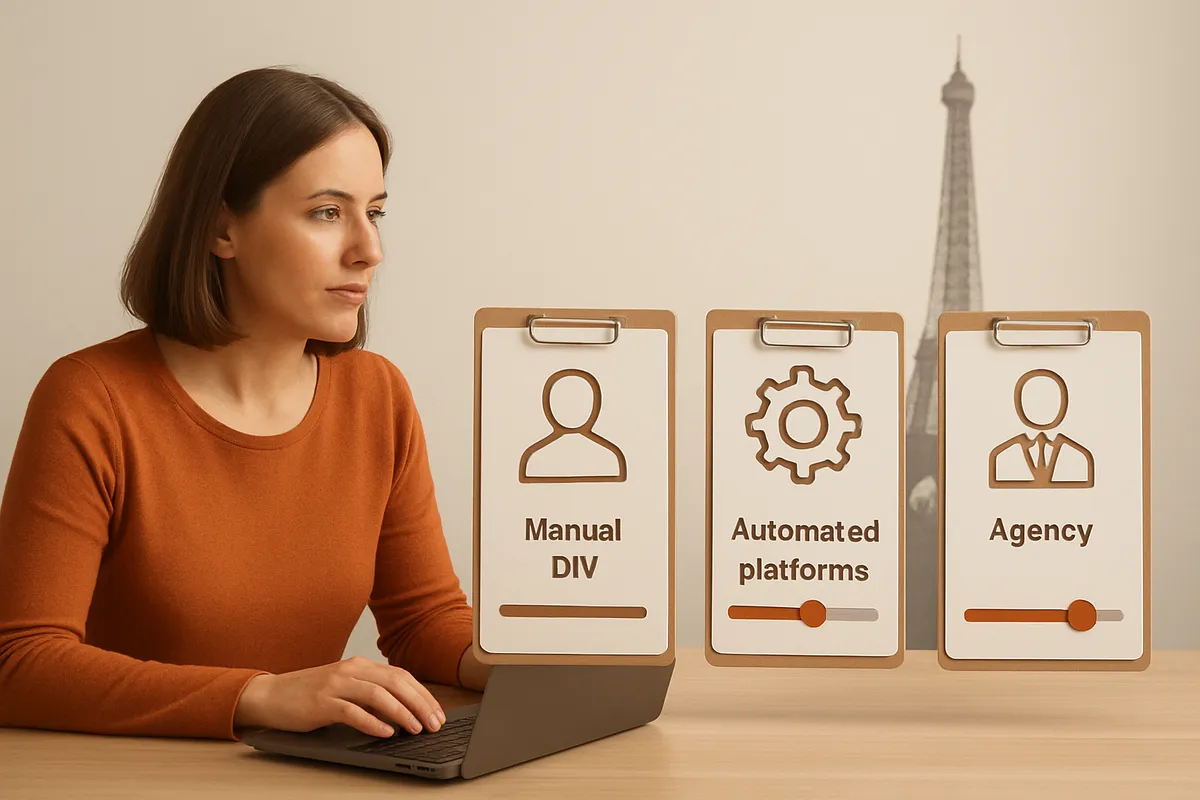
Three paths exist, manual in-house work, a hired agency, or an automated platform, and each trades time, money, and control differently.
Doing it yourself costs the least in cash but the most in hours. You research keywords, write pages, add schema markup, and manually track what ChatGPT or Perplexity says about your business, work that competes with running the business itself. Agencies solve the time problem but introduce new ones: retainers, monthly check-in calls, scope negotiations, and pricing built for companies with marketing budgets most independent shops in Paris don't have. Automated platforms sit between the two, they run daily without supervision, at a fraction of agency cost, which is why a growing number of small business owners asking how their small business in Paris, France can get found on AI search engines are turning to them first.
What's a Realistic Budget for AI Search Optimization for a Small Business in France?
Expect a budget-friendly tier for DIY (mostly your own time), a premium tier for agencies, and a mid-range tier for automated software that replaces both the manual grind and the agency retainer.
French SEO agencies that offer AI search optimization list project-based pricing starting in the low thousands [3], which puts them out of reach for a solo boutique owner or a three-person SaaS team. DIY is free in cash terms but demands consistent weekly output, new pages, updated structured data, ongoing citation checks, that most owner-operators can't sustain alongside daily operations. An automated platform is priced to sit permanently in the budget rather than as a one-off project, which matters more once you realize AI visibility needs continuous upkeep, not a single optimization pass.
How Do Automated AI SEO Platforms Compare to Hiring an Agency?
Automated platforms publish and monitor continuously without the retainer calls, scope creep, or delays typical of agency relationships.
An agency engagement usually starts with an audit, moves to a content plan, and only then begins publishing, a sequence that can take weeks before anything goes live [4]. A platform skips that cycle: it researches your niche's keywords, writes and publishes content daily, and reports back on visibility without needing a meeting to approve the next sprint. Moonrank runs this exact model for $99/month, it tracks how your business appears across ChatGPT, Gemini, Claude, and Perplexity, publishes optimized content automatically, and handles the technical layer (schema markup, llms.txt, structured data) that helps AI systems parse what your business actually does. For an ecommerce brand or a B2B SaaS team based in Paris with no dedicated marketing hire, that's the difference between chasing visibility manually and letting a system handle it in the background. Visit www.moonrank.ai to see how it tracks and builds AI search presence without requiring you to write a single page yourself.
Frequently Asked Questions
Can a small business in Paris appear in AI search results without a website?
Rarely, most AI engines pull answers from crawlable web pages, so a business with no website has almost nothing for them to cite. A Google Business Profile or marketplace listing might surface in a local pack, but to get recommended in ChatGPT or Perplexity answers, you need at least a basic site with clear, structured information about what you do.
Do AI search engines prioritize businesses with Google Business Profiles?
A Google Business Profile helps with local visibility but isn't a direct ranking factor for tools like ChatGPT or Claude. It feeds Google's own AI features [1], but engines like Perplexity rely more on indexed web content, reviews on third-party sites, and citations elsewhere online.
How long does it take to see results from AI search optimization?
Most Paris businesses start seeing early citations within a few weeks, with meaningful visibility gains building over two to three months. AI engines need time to crawl your updated site, trust your new content, and start citing it in response to buyer queries, one agency reported early visibility movement within about seven weeks of consistent publishing [4]. Consistency matters more than a single optimization push.
Should a Paris business publish content in both English and French for AI engines?
Yes, especially if you serve both local French customers and international visitors or B2B clients. AI assistants answer in the language of the query, so French-language pages help you get recommended for "restaurant près de moi"-style prompts, while English content captures tourists, expats, and global buyers researching before they travel or purchase [4].
Is AI search optimization worth it for a very small or solo-run business?
Yes, often more so, solo businesses can't compete with agency budgets, but automated tools level the playing field. A platform like Moonrank runs daily content publishing and technical fixes for $99/month, which fits a solo founder's time and budget far better than a $3,000+/month retainer.
Conclusion
Getting recommended by ChatGPT, Gemini, or Perplexity comes down to three things: a crawlable site with structured data, content that directly answers what your customers are asking, and consistency maintained over months, not days. Paris businesses competing for tourists, expats, and B2B buyers need both French and English content to capture the full range of queries AI engines handle.
Skip the manual guesswork. Start a free trial at Moonrank and let automated daily publishing and technical optimization build your AI search visibility while you run your business.
Sources & References
- AI Features and Your Website | Google Search Central | Documentation | Google for Developers
- Top 25 AI search engine optimization platforms based in France
- Best AI Search Optimization Agencies for Small Business in France 2026 | Semrush
- AI SEO company in France for AI search | Snoika
- How to Show Up in AI Search: GEO & AEO for Small Business
Recommended Articles
Explore more from our content library: