A Practical Guide to Choosing the Best AI SEO Tools for SMBs
AI SEO tools help SMBs automate content creation, technical optimization, and visibility tracking without the cost of a full agency retainer.

Understanding ai seo tools for smb is essential. AI SEO tools help SMBs automate content creation, technical optimization, and visibility tracking at a fraction of what an agency retainer costs, without needing an in-house specialist. They handle the repetitive, time-intensive parts of SEO: drafting optimized content, scanning for technical issues like broken schema or slow pages, and monitoring rankings across Google and AI engines like ChatGPT and Perplexity. For most SMBs, this means a small team can maintain the consistent output that used to require a full agency retainer or a dedicated hire, freeing budget for other growth priorities.
Why Do SMBs Need AI SEO Tools Instead of Hiring Agencies?: ai seo tools for smb
The math doesn't work: agencies charge premium rates and lock you into multi-month contracts, while AI SEO tools for SMBs run month-to-month at a fraction of that cost. That gap is why so many owner-operators are rethinking who, or what, does their SEO work.
How Much Does It Cost to Hire an SEO Agency Versus Using an AI Tool?
A typical SEO agency retainer sits in the premium-to-enterprise pricing tier, and most require a contract term of several months before you see meaningful ranking movement [1]. That price covers a bundle: a strategist, a writer, a link-building contact, and someone compiling a monthly report. You're paying for the team, not just the output.
AI SEO tools break that bundle apart. Instead of paying for a roster of specialists, you pay for software that performs the same tasks, keyword research, content drafting, technical audits, on a recurring schedule, usually at a budget-friendly to mid-range monthly cost with no long-term lock-in. Moonrank, for example, is positioned specifically against agencies charging premium monthly retainers for comparable output, offering a short free trial to test the difference. For a Shopify store owner or a solo B2B SaaS founder, that difference is often the deciding factor between doing SEO consistently and not doing it at all.
Can AI SEO Tools Replace the Need for an In-House SEO Specialist?
AI tools absorb the repetitive execution work, writing, publishing, technical fixes, but they don't replace the judgment a business owner brings to strategy and brand voice. Think of it as division of labor: the software handles volume and consistency, you handle direction. A tool can draft and publish a blog post every day without prompting, but deciding whether your brand should sound playful or formal, or which product line deserves the next content push, still benefits from a human who knows the business.
The deeper structural issue is capacity. Agencies are constrained by billable hours, every client competes for the same finite pool of writer and strategist time, which is part of why output slows as agencies scale their client rosters [4]. AI tools aren't limited by headcount. A platform that publishes content and runs technical audits on autopilot can serve one account or a thousand without adding staff, which is why the economics look so different from a traditional retainer.
This plays out differently depending on the business. An ecommerce store might need daily product and category content; a B2B SaaS company needs fewer but more technical posts; a cybersecurity firm needs authoritative, trust-building content; a boutique hotel needs steady local and seasonal updates. AI tools adjust to that volume without renegotiating a contract.
What's not covered by most AI tools: outbound PR, high-touch backlink outreach, and complex multi-market strategy still tend to need a human specialist or agency involvement.
What Can AI SEO Tools Do for Content Creation and Technical Optimization?
AI SEO tools for SMB owners handle two separate jobs: writing and optimizing content, and finding and fixing technical problems on your site. Treating these as one job is where a lot of confused buying decisions start.
How Do AI Tools Automate Daily Content Creation While Maintaining Quality?
Give these tools a keyword or topic, and they draft the article, meta description, or product page copy without a writer starting from a blank page. Platforms reviewed by Whatagraph, including Writesonic and AirOps, build full drafts from a single input and then let a human or an automated review pass check the result before it publishes [2].
The quality problem shows up fast if that review step gets skipped. Generic AI output reads the same whether it's describing a boutique hotel or a cybersecurity vendor, which is why style guides and brand voice settings matter as much as the generation itself. Moonrank addresses this by running daily automated content generation paired with personalized keyword research tied to a business's specific niche, rather than applying one keyword template across every customer, so a Shopify store and a B2B SaaS company don't end up sounding identical.
For an e-commerce brand, that might mean product descriptions that reflect actual inventory and seasonal promotions. For a B2B SaaS company, it means blog content that references the product's real feature set instead of generic category language. Either way, the editorial pass, human or rules-based, is what separates usable content from filler.
What Technical SEO Issues Can AI Tools Find and Fix Automatically?
AI-powered audits scan a site and flag the technical issues that quietly suppress visibility: broken or missing schema markup, missing alt text, duplicate title tags, slow page load times, and crawl errors that keep pages out of search results entirely. Mega's review of small business tools notes that this category of automation gives owners without an SEO background access to diagnostics that used to require a technical specialist [1].
The bigger shift is what happens after detection. Instead of a report that a developer has to interpret and implement, many tools now generate fix-suggestions or apply fixes directly, cutting out the back-and-forth that normally stalls a project for weeks. Moonrank's technical audit layer applies schema markup, configures llms.txt, and builds structured data and citations automatically, which matters specifically for AI search engines: ChatGPT, Gemini, Claude, and Perplexity rely on clean structured data to understand and trust what a business actually does.
Content tools and technical tools solve different problems, and most SMBs need both running at once rather than picking one.
How Do You Choose the Right AI SEO Tool for Your Budget and Tech Stack?
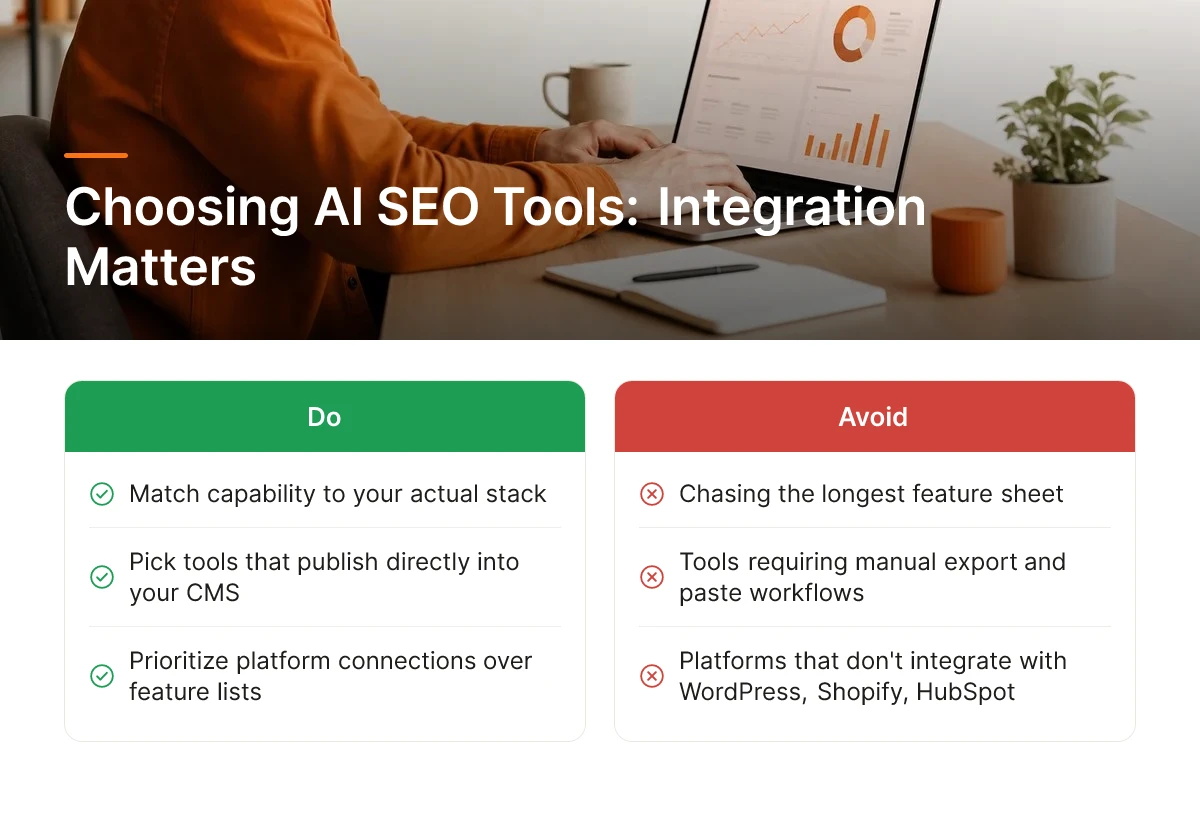
The right fit depends less on feature lists and more on how well a tool connects to the platform you already run and how much it consolidates for your spend. Picking among ai seo tools for smb budgets means matching capability to your actual stack, not chasing the longest feature sheet.
What Integrations Matter Most for SMBs Using WordPress, Shopify, or HubSpot?
A tool that doesn't publish directly into WordPress, Shopify, or HubSpot creates friction that kills adoption within weeks, even when the underlying content quality is strong. If a platform makes you export drafts and manually paste them into your CMS, that extra step is exactly where busy owners quit. Before comparing anything else, confirm the tool pushes content and schema markup straight into your existing site rather than handing you files to upload yourself.
What's the Difference Between Free and Paid AI SEO Tools for Growing Businesses?
Free tiers typically cap how much content you can generate, limit the number of keywords you can track, and exclude visibility tracking across AI engines like ChatGPT, Gemini, Claude, and Perplexity entirely. Paid tiers enable daily automation, broader keyword and competitor monitoring, and the technical layer, schema, llms.txt configuration, citation building, that free versions rarely touch. For a business trying to compete with better-funded competitors, the free tier is a trial run, not a real strategy.
Before committing, run through a short checklist:
- How much content do you actually need published per week or month?
- How many sites or domains require coverage, one storefront, or several brand sites?
- How big is your team, and who will review or approve output, if anyone?
- Does the tool track visibility across AI search engines, or only traditional Google rankings?
For budget-friendly and mid-range spend, prioritize a tool that consolidates content generation, technical optimization, and visibility tracking into one subscription rather than stacking three or four single-purpose tools that each need separate logins and separate monthly charges. Moonrank, for example, bundles daily content publishing, schema and llms.txt optimization, and AI-engine tracking into a single subscription, built specifically so an SMB doesn't need to assemble that stack piece by piece.
Industry context matters too. An ecommerce store needs product-page schema that helps AI engines understand pricing and availability. A B2B SaaS company needs documentation and feature pages optimized so AI tools can accurately describe what the product does. A hotel needs local and booking-intent content that surfaces when someone asks an AI assistant for a place to stay nearby.
What's the Real ROI of AI SEO Tools Versus Freelancers or Agencies?
ROI comes from comparing fixed, predictable costs against output volume and time saved, not from chasing an overnight traffic spike that was never realistic to begin with.
What Traffic and Visibility Gains Can SMBs Realistically Expect Early On?
Search engines and AI models both need time to crawl, index, and trust new content and technical fixes, so ranking movement in month one is rare regardless of which tool or agency you hire. A more honest way to judge the first 30 days: how many pieces got published, how many technical issues got resolved (broken schema, missing llms.txt, thin metadata), and whether your site became easier for both Google and AI crawlers to parse.
Owners evaluating ai seo tools for smb use cases should treat month one as a setup phase. Traffic and AI mentions typically build in the following months as indexed content accumulates and technical signals compound.
How Do You Measure Whether an AI SEO Tool Is Actually Delivering Results?
Build a simple scorecard: cost per published piece, hours saved versus doing audits manually, number of technical issues fixed, and visibility tracked across both Google and AI engines like ChatGPT and Perplexity. That last point matters more each quarter, a tool that only reports Google rank position is measuring half the picture, since customers increasingly ask AI assistants for recommendations before they ever open a search bar [2]. A freelancer's ROI mechanism is paid-per-piece and capacity-limited, you get good content, but output caps at whatever hours they have. An agency charges a premium for strategy and account management, but iteration cycles slow down because revisions route through a team and a retainer scope. An AI SEO tool flips the mechanism: fixed monthly cost, output that scales without needing to renegotiate anything. Moonrank, for example, runs daily automated publishing and technical optimization at a flat monthly cost, a structure built around volume and consistency rather than hourly billing.
Whatever tool you pick, tie usage to business metrics that matter to your bottom line: qualified leads, booking inquiries, product page traffic, demo requests. A climbing keyword count means nothing if it doesn't translate into inquiries. Track AI engine visibility alongside Google rankings, and judge ROI by what showed up in your pipeline, not by vanity metrics that look good in a dashboard but don't pay the bills.
Which AI SEO Tools Work Best for SMBs Ranking on Google and AI Search Engines?
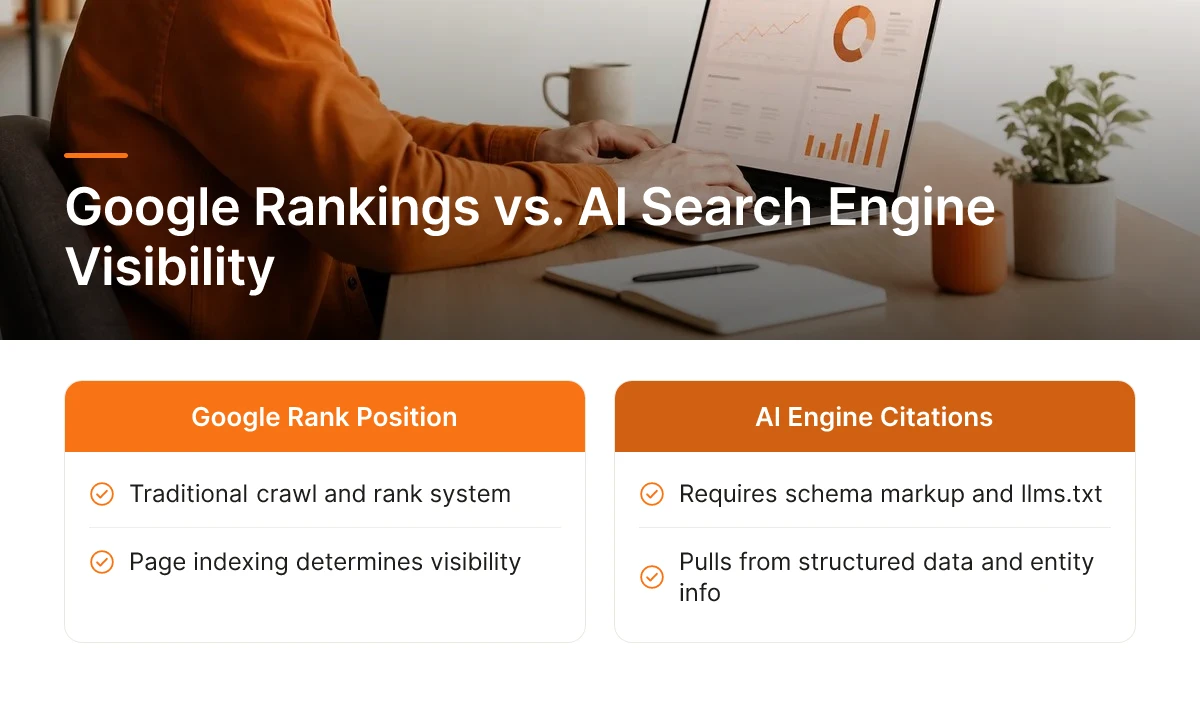
The best ai seo tools for SMB owners track two things at once: traditional Google rank position and how often AI engines cite or recommend the brand.
Ranking on Google used to be the whole game. It isn't anymore. ChatGPT, Gemini, Claude, and Perplexity don't crawl and rank pages the way Google does, they pull from structured data, clear entity information, and content that answers a question directly, then decide whether your business is worth mentioning in a response. A page that ranks #3 on Google can be invisible to Perplexity if it lacks schema markup or a crawlable llms.txt file telling AI systems what the business actually does. That's a gap most legacy SEO tools were never built to close.
Which Tools Help SMBs Get Recommended by ChatGPT, Gemini, Claude, and Perplexity?
A tool worth paying for needs to report on both channels side by side, not just one. Look for three capabilities together: visibility tracking across AI engines (are you showing up when someone asks "best hotel in [city]" or "top project management software for small teams"), technical optimization that fixes the structured data and citation signals AI systems rely on, and enough content output to keep both Google and AI crawlers finding fresh, relevant pages. Most platforms in this market, including the incumbents reviewed in broader buyer's guides [5], were built for keyword rank tracking first and bolted AI visibility on as an afterthought. For an ecommerce store or a B2B SaaS company competing on product and feature intent, that's a meaningful blind spot.
How Do You Set Up an AI SEO Tool in Your First 30 Days?
The first month determines whether the tool earns its keep. A practical sequence looks like this:
- Week 1: Connect your site and let the tool run its initial technical audit, schema markup, structured data, and crawlability gaps surface here.
- Week 1-2: Set your content cadence based on your niche and competitive gaps, not a generic template.
- Week 3: Review the first batch of published content for accuracy and tone before it compounds.
- Week 4: Check early visibility tracking data, Google position changes come slower, but AI citation frequency can shift within weeks once technical fixes land.
This is the exact problem Moonrank was built to solve. It runs the technical audit automatically, fixing schema markup, llms.txt configuration, and citation signals, while publishing SEO content daily and tracking how often your business gets surfaced across ChatGPT, Gemini, Claude, and Perplexity alongside your Google performance. There's no manual setup beyond onboarding and no agency retainer required to get started.
Hotels and ecommerce brands see this pay off fastest, since purchase and booking decisions increasingly start with a direct AI recommendation rather than a search results page. If you're ready to see where you stand, start at www.moonrank.ai.
Frequently Asked Questions
Do AI SEO tools work for service businesses like hotels, not just ecommerce?
Yes, AI SEO tools work for hotels and other service businesses, though the keywords and content angles differ from retail.
A boutique hotel benefits from content built around local intent ("best place to stay near X") and schema that marks up amenities, reviews, and booking details. Moonrank's keyword research adapts to niche and location rather than applying one generic template across every business type.
Can a small team run AI SEO tools without any technical SEO background?
Yes, most AI SEO platforms, including Moonrank, are built so a non-technical owner never has to touch code.
Tasks like schema markup and llms.txt configuration, the file that tells AI systems what your site contains, run automatically in the background. You set your niche and keywords once; the system handles publishing and technical fixes without ongoing input.
How often should an SMB publish AI-generated content to see results?
Daily publishing gives AI search engines the fresh, consistent signal they need to notice and trust a small business site.
Sporadic posting, once a month, say, rarely builds enough topical depth for ChatGPT, Gemini, or Perplexity to cite a brand confidently. Moonrank publishes new content every day automatically, which removes the burden of maintaining that cadence manually.
Is it risky to rely on AI-generated content for SEO?
The risk is low when the content is accurate, well-structured, and backed by proper technical optimization rather than published blindly.
Generic AI text with no citations or structure can underperform, but tools that pair content generation with schema markup, structured data, and visibility tracking reduce that risk substantially. The bigger danger for most SMBs isn't AI content, it's publishing nothing at all while competitors show up in AI answers instead.
How long does it take to see measurable results from an AI SEO tool?
Most SMBs start seeing meaningful movement within two to three months, since both Google and AI engines need time to crawl, index, and build trust in new content and technical signals.
The first month is largely setup: initial audits, schema fixes, and the first wave of published content. Visibility gains, both in Google rankings and AI citation frequency, tend to build steadily afterward as the body of indexed, well-structured content grows.
Conclusion
AI search visibility now depends on three things working together: daily content, clean technical signals, and ongoing tracking across ChatGPT, Gemini, Claude, and Perplexity. Most tools on the market handle one piece of that, a writer, a tracker, or a technical audit, leaving the owner to stitch the rest together.
If you're a Shopify store, hotel, or B2B SaaS team without time to manage three separate subscriptions, start by checking how your brand currently shows up in AI search results today. Then try Moonrank's free trial to see the full stack, content, technical fixes, and tracking, run on autopilot.
Sources & References
- Mega · 13 Best AI SEO Tools for Small Businesses
- We Tested the 15 Best (& Underrated) AI SEO Tools in 2026 | Whatagraph
- I tested dozens of AI SEO tools for small business: Here are the 6 that actually work in 2026 | eesel AI
- 9 Best SEO Tools for Small Businesses in 2026
Recommended Articles
Explore more from our content library: