A Guide to Building AI SEO Visibility for Local Businesses
Learn how AI search engines like ChatGPT and Perplexity recommend local businesses using structured data, reviews, and consistent citations.
Understanding AI SEO Visibility for Local Businesses is essential. AI search engines like ChatGPT, Gemini, and Perplexity recommend local businesses based on consistent, structured information they can verify across the web, not just backlinks or keyword density. They pull from your website's structured data, review signals, citation consistency across directories, and clear factual answers to questions like "what do you do" and "who do you serve." A local business gets recommended when AI models can confidently confirm what it offers, where it operates, and that other sources agree. Winning this visibility costs far less than traditional SEO agency work because it relies on fixable technical and content signals, not ongoing paid campaigns.
How Do AI Search Engines Like ChatGPT and Perplexity Decide Which Local Businesses to Recommend?
AI engines treat a recommendation like a fact-check: they look for agreement across multiple independent sources before naming a business by name.
Unlike classic Google ranking, which weighs backlinks and keyword density heavily, large language models behave more like a cautious researcher. They want to confirm a claim, "this is the best bakery in Austin", against several points of evidence before repeating it to a user. That shift is the core mechanic behind AI SEO Visibility for Local Businesses, and it rewards businesses whose information is verifiable, not just well-marketed.
What Data Signals Do AI Search Engines Use to Rank and Recommend Local Businesses Over Competitors?
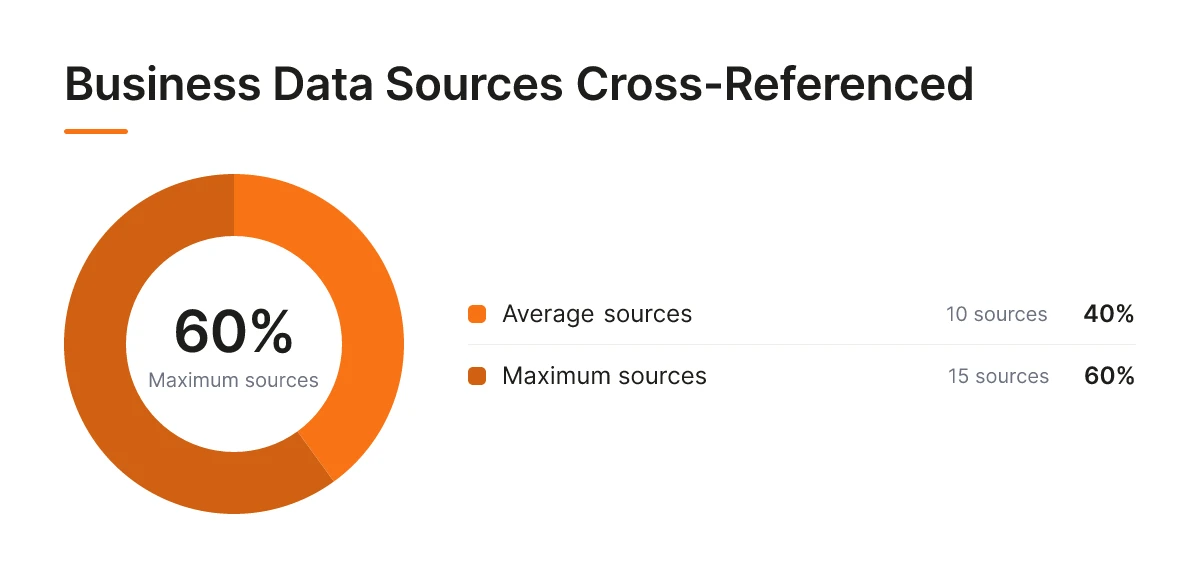
AI systems cross-reference a business's own website against directories, review platforms, and social profiles to build confidence before stating a fact. Uberall's research found that AI systems cross-reference data from an average of 10 to 15 sources per response, and that over 80% of businesses have inconsistent information across AI models [4], a gap that directly undermines whether a model trusts what it finds.
Name, address, phone number, and service details that match everywhere, your website, your Google Business Profile, Yelp, industry directories, function as a trust signal distinct from backlinks. Backlinks tell a crawler that other sites vouch for you. Consistency tells a language model that the fact itself is probably true, because independent sources agree without being asked to. Reviews reinforce this further: Uberall notes that most AI responses don't even cite the business's own domain, leaning instead on third-party reviews, PR mentions, directory listings, and fresh content across platforms [4].
How Do AI Agents and LLMs Actually Find and Evaluate Local Business Information?
Many AI agents now retrieve live web data through search plugins and retrieval systems rather than relying only on what they learned during training. That means a business's current, crawlable content, not a stale page from two years ago, matters directly. Uberall found that 95% of ChatGPT citations come from content published within the last 10 months, with engagement and social signals increasingly factored into what gets recommended [4].
This has a practical consequence: fresh, specific, structured answers are easier for a model to extract and quote than marketing copy. A page that plainly states "we repair residential HVAC systems in Denver, same-day service available" gives an AI model a clean fact to pull. A page built around brand taglines and vague promises gives it nothing to cite. Businesses optimizing for local AI search visibility increasingly structure their content, service pages, FAQs, schema markup, around direct, answerable statements rather than persuasive prose, because that is what retrieval systems can actually use.
Why Isn't Traditional Local SEO Enough for AI SEO Visibility for Local Businesses?
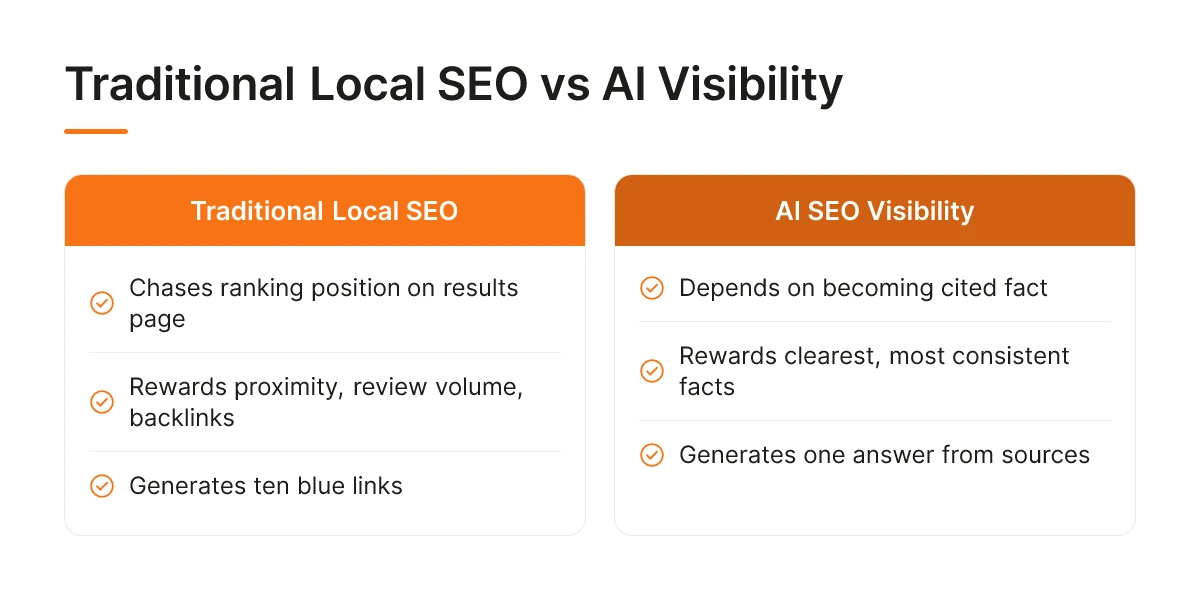
Traditional local SEO chases a ranking position on a results page, while AI SEO Visibility for Local Businesses depends on becoming the fact an AI model chooses to cite.
Those are two different games with two different scoreboards. A Google Maps "Local 3-Pack" slot rewards proximity, review volume, and backlink authority, all things a business can build over years of steady SEO work [1]. But ChatGPT, Gemini, and Perplexity don't rank ten blue links. They generate one answer, pulling from whichever sources give them the clearest, most consistent facts to repeat.
What's the Difference Between Optimizing for Google Search and Optimizing for AI Search Visibility?
Google SEO optimizes pages for crawlers scanning for ranking signals; AI optimization structures information for direct extraction into a generated answer.
A keyword-stuffed landing page built to climb Google's algorithm often buries the one sentence an AI model actually needs, hours, service area, pricing tier, or specialty, under paragraphs of persuasive copy aimed at human skimmers and search engine crawlers. AI systems, by contrast, favor direct, structured answers: a clear statement of what the business does, who it serves, and why, supported by schema markup and consistent facts across the web [2]. Uberall's research found that AI systems cross-reference business data from an average of 10 to 15 sources per response, and over 80% of businesses have inconsistent information across those sources [4], which means a page written for ranking, not extraction, can get passed over even when it reads well to a person.
What Happens to Local Businesses That Only Focus on Traditional SEO While Competitors Optimize for AI Discovery?
They risk being skipped entirely, even with strong Maps rankings, while a competitor with clearer structured data gets the recommendation instead.
A business can hold the top Local Pack spot and still lose the AI recommendation to a competitor whose service descriptions, hours, and offerings are stated plainly and consistently across its site, directory listings, and review profiles. Review volume and star rating alone don't fix this: if the underlying business information is vague, outdated, or contradictory from one source to the next, an AI model has no stable fact to cite, so it moves to the next option. This is the exact gap Moonrank's technical audit targets, fixing schema markup, llms.txt, and citation consistency so AI engines can parse and trust what a business actually offers, rather than leaving that trust to chance.
What Changes Do Local Businesses Need to Make to Their Websites and Content for AI Visibility?
Local businesses need structured, fact-based website content and consistent business data everywhere online, AI engines reward clarity, not persuasion copy, when deciding who to recommend. For more information, see State Local Government.
Most small business websites are written to persuade a human who's already on the page. AI engines don't need persuading, they need facts they can extract, verify, and repeat confidently to someone who hasn't visited the site at all. That shift in audience changes what good content looks like. Key priorities for this shift include:
- Writing service pages as direct, factual statements rather than persuasive marketing copy
- Matching business name, address, phone number, and hours exactly across every directory and platform
- Publishing fresh content on a regular schedule so AI crawlers see an active, current source
- Adding schema markup so AI systems can parse offerings without guessing from prose
- Building review volume on Google and relevant directories to reinforce third-party trust signals
How Do You Optimize for ChatGPT, Gemini, Claude, and Perplexity Differently, or Do They All Want the Same Thing?
The four major AI engines share the same core requirements: clear facts, consistent data, and pages their systems can actually crawl and parse. A business that writes plainly about what it does, where it operates, and who it serves gives every one of these engines the same clean signal to work with.
One difference is worth noting. Perplexity leans more heavily on live web retrieval at the moment a question is asked, rather than relying only on pre-trained knowledge [4]. That makes freshness matter more for Perplexity specifically, a services page that hasn't been touched in two years is a weaker citation candidate than one updated recently. Citation data backs this up: a large share of what ChatGPT cites tends to be content published within the last several months rather than older pages [4]. Businesses chasing AI SEO Visibility for Local Businesses should treat content freshness as an ongoing task, not a one-time setup.
What Role Does Schema Markup, Content Structure, and Technical SEO Play in AI Search Visibility?
Schema markup is structured data embedded in a webpage's code that tells AI engines exactly what a business does, where it's located, and who it serves, without forcing the system to guess from marketing prose. Instead of an AI model inferring from a paragraph that a business is "a family-owned Italian restaurant in Austin open for dinner," schema states it directly in a format machines read without ambiguity.
Service pages should follow the same logic. Replace vague, adjective-heavy copy with direct statements: what you offer, who it's for, and where you operate. A plumbing company's page should say it handles emergency repairs in a specific metro area for residential customers, not that it delivers "unmatched quality service."
Consistency matters just as much as clarity. Business hours, service lists, and locations need to match exactly across the website and every directory listing, Google Business Profile, Yelp, industry directories. AI systems cross-reference data from multiple sources before answering, and inconsistencies across listings are a known problem: studies show the majority of businesses have mismatched details across AI models [4]. A contradiction between a website and a directory reads as uncertainty, and uncertain businesses don't get recommended.
How Do You Measure Whether Your Local Business Is Actually Getting Found by AI Search Engines?
Track it by manually prompting ChatGPT, Gemini, and Perplexity with real customer questions, logging the answers, and watching for a lift in direct mentions and bookings over time.
There's no equivalent of Google Search Console for AI chat answers. No dashboard shows you a keyword ranking position inside ChatGPT. That doesn't mean visibility is unmeasurable, it means the measurement process looks different, and most local business owners simply haven't built the habit yet.
What Metrics and Tools Can Local Businesses Use to Track Their Visibility Across Different AI Search Platforms?
Start with manual testing. Open ChatGPT, Gemini, and Perplexity and ask the exact questions a customer would ask: "best boutique hotel in [city]," "who does emergency plumbing near [neighborhood]," "top-rated Italian restaurant downtown." Log whether your business appears, where in the answer it sits, which sources the AI cites, and which competitors show up instead. Repeat this weekly or biweekly and you'll start to see patterns, a citation source that keeps feeding the AI's answer, or a competitor who consistently outranks you in the response.
This manual check works, but it's slow and easy to abandon after the first few weeks. That's the gap that a category of AI visibility monitoring tools has emerged to fill, software that automatically runs these prompts on a schedule, tracks which domains and directories get cited, and reports mention frequency across ChatGPT, Gemini, Claude, and Perplexity over time [2]. This kind of ongoing tracking matters because AI systems pull from an average of 10 to 15 sources per response, and over 80% of businesses have inconsistent information across those sources [4], a gap you can only find by checking regularly, not once.
How Do You Calculate ROI on AI Visibility Improvements Compared to Traditional Local SEO Spending?
Weigh it against the alternative you're already paying for. A traditional SEO retainer charging a premium monthly rate buys you keyword reports and backlink audits built for Google's old ranking system [1]. An automated AI visibility tool typically sits at a more budget-friendly cost and focuses specifically on how your business appears in AI-generated answers, tracking, schema markup, and daily content publishing bundled into one predictable monthly plan instead of three separate line items. Moonrank, for example, handles the technical optimization and visibility tracking without requiring the business owner to write or manage anything.
The clearest ROI signal doesn't come from a dashboard at all, it comes from your own front desk or register. When a new customer says "I asked ChatGPT and it recommended you," that's a real, attributable result. Train staff to log it at the point of sale or booking, the same way you'd log a referral source. Measuring AI SEO Visibility for Local Businesses ultimately means connecting prompt-testing data to that spoken signal, not chasing a ranking number that doesn't exist.
What's the Fastest Way to Build AI SEO Visibility for Local Businesses Without Hiring an Agency?
The fastest path runs through four repeatable steps: audit your listings, add structured data, rewrite your service pages, then test with real AI prompts, no agency required.
- Audit your business name, address, phone number, and hours across your Google Business Profile, Yelp, Facebook, and industry directories, then check them against each other.
- Add schema markup to your site so AI crawlers can see exactly what you sell, where you're located, and what makes you different.
- Rewrite your top three or four service pages so they answer direct questions in plain language: what you do, who it's for, and why someone should choose you.
- Test your work by asking ChatGPT, Gemini, and Perplexity the exact questions a customer would ask, then track whether you show up and adjust accordingly.
AI systems cross-reference business data from an average of 10–15 sources per response, and more than 80% of businesses have inconsistent information across AI models [4], which means a mismatched phone number or an old address can quietly knock you out of consideration before an AI tool ever weighs your reviews or content. AI engines also pull from fresh, specific content far more than they pull from vague brand copy; 95% of ChatGPT citations come from content published within the last 10 months [4].
What Are the Best Affordable Tools and Platforms for Local SMBs to Improve AI Visibility on Their Own?
Look for a tool that handles structured data, listing consistency, and content publishing together, rather than three separate subscriptions that don't talk to each other. Most local business owners don't have a developer on staff to maintain schema markup or fix a directory mismatch every time it drifts, so the tool needs to do that work automatically, not just flag it in a dashboard.
Can Automation Replace Expensive Agency Work for Getting Local Businesses Found by AI Search Engines?
Much of this work is mechanical and repeats on a schedule, audit, fix, publish, recheck, which is exactly the kind of task software handles well without a human billing by the hour. Agencies charge premium retainers partly for strategy, but a large share of what they actually deliver each month is structured data updates and content output that a system can run continuously once it's configured correctly.
This is the gap Moonrank was built to close. It runs daily content publishing, fixes technical signals like schema markup and llms.txt, and tracks how your business appears across ChatGPT, Gemini, Claude, and Perplexity, all on autopilot, at a fraction of what an agency retainer costs. If you're ready to build AI SEO Visibility for Local Businesses without managing any of it yourself, visit www.moonrank.ai and start the free trial.
Frequently Asked Questions
Do I need a developer to add schema markup for AI visibility?
No, not if you use a tool built to handle it automatically. Schema markup, the structured data that tells AI engines exactly what your business does, where it's located, and what it offers, usually requires editing code by hand. Moonrank generates and publishes this markup for you as part of its technical audit, so you never touch a line of code.
Will improving AI visibility also help my Google Maps and local search rankings?
Yes, largely because the signals overlap. Consistent business information, fresh content, review volume, and structured data all feed both AI answer engines and Google's local algorithm [5]. Fixing gaps for one typically improves the other, since both systems pull from the same underlying trust signals.
How long does it take to see a local business show up in AI search recommendations?
Most businesses see early movement within four to eight weeks, though full visibility can take longer. AI systems weigh content recency heavily, 95% of ChatGPT citations come from content published within the last ten months [4], so daily publishing speeds up how quickly a business becomes citable.
Can a local business with no reviews still get recommended by AI search engines?
It's possible, but much harder, since AI systems rely on third-party signals like reviews and directory listings over brand-owned content [4]. A new business should prioritize building review volume on Google and relevant directories alongside any content and technical optimization work.
What's the biggest mistake local businesses make when trying to improve AI search visibility?
The most common mistake is treating AI visibility like a one-time project instead of an ongoing practice. Businesses fix their schema markup once, update a few directory listings, and stop, while AI engines continue favoring fresh, frequently updated content and recheck consistency over time. Without regular publishing and periodic audits, visibility gained early tends to fade as competitors keep their information current.
Conclusion
AI search visibility for local businesses comes down to three things: technical readiness (schema markup, structured data), consistent third-party signals (reviews, directories, citations), and fresh content published often enough for AI systems to trust it [4]. Skipping any one of these leaves a business invisible to customers asking ChatGPT, Gemini, or Perplexity for a recommendation instead of searching Google directly.
Most local business owners don't have time to manage all three manually. Start by auditing whether your business even appears when you ask ChatGPT or Perplexity for a recommendation in your category, then visit moonrank.ai to see how automated daily publishing and technical optimization can close the gap at a budget-friendly monthly cost.
Sources & References
- The Best Local SEO Agencies for Small Businesses That Actually Move the Needle
- AI Search Visibility Platform | GrowthPro AI
- AI Search Optimization & Staying Visible | Uberall
- How to stay visible across search everywhere
Recommended Articles
Explore more from our content library: