Low-Budget Generative Engine Optimization for Small Business
Generative engine optimization (GEO) for small business means structuring your content and technical signals so AI engines like ChatGPT, Perplexity, and...

Understanding Generative engine optimization for small business is essential. Generative engine optimization (GEO) for small business means structuring your content and technical signals so AI engines like ChatGPT, Perplexity, and Claude cite and recommend you, without paying agency fees that run into the thousands per month. Small businesses can compete here because GEO rewards clear, well-structured, factual content and clean technical signals (schema markup, structured data) more than it rewards raw domain authority or ad spend. Automated tools now handle the technical setup and monitoring that used to require a dedicated specialist.
What Is Generative Engine Optimization for Small Business, and How Does It Differ from SEO?
Generative engine optimization (GEO) is the practice of structuring your content so AI engines like ChatGPT, Perplexity, and Claude can lift it, cite it, and recommend your business by name. Unlike a traditional search engine that returns a list of ten blue links, a generative engine reads across many sources, synthesizes an answer, and names only a handful of businesses in that answer. Generative engine optimization for small business is about earning one of those few mentions.
Is Generative Engine Optimization Different from SEO, and Do I Need to Do Both?
GEO and SEO share the same foundation, clear site structure, credible content, and a technically clean website, but GEO adds a sharper focus on extractability: writing in a way a machine can quote directly, not just rank. HubSpot frames GEO as an evolution of existing marketing work rather than a separate discipline requiring a full overhaul [1].
Small businesses still need both. SEO drives the traditional search traffic that still makes up half of how buyers find vendors, while GEO captures the growing share who ask an AI assistant instead of typing a query into Google [2]. One industry analysis tracking citation patterns across fifty B2B and B2C sites found that buyer research is splitting roughly down the middle between classic search and AI chat interfaces [2]. Dropping either channel means leaving a real segment of potential customers unreached.
How Do Generative Engines Decide What Content to Cite and Recommend?
Generative engines favor content that states facts plainly, answers a question directly near the top of the page, and backs that up with structured data the engine can parse without guesswork. Research into AI visibility requirements points to three recurring factors: credible backlinks, question-based content that answers directly within the first few sentences, and schema markup that defines what the business actually is and does [3]. Consistent business information across the web, your name, services, location, and credentials stated the same way everywhere, also helps an engine trust what it's citing [3].
This is the part of generative engine optimization for small business that favors the underdog. Citation in an AI answer depends more on clarity and structure than on backlink volume or decades of domain authority, which means a well-organized local shop or a niche SaaS tool can out-cite a much bigger competitor that never bothered to clean up its technical signals. Moonrank builds on this by handling the schema markup, llms.txt configuration, and structured data setup automatically, then tracking how the business shows up across ChatGPT, Gemini, Claude, and Perplexity, the groundwork most small teams don't have time to do by hand.
Why Should Small Businesses Prioritize AI Search Visibility Right Now?
Early movers get cited repeatedly, and that repetition trains AI engines to treat them as the default answer in their category, waiting means competing against an answer that's already locked in.
AI engines build what amounts to a mental model of a brand from the content they can parse and the citations they can verify. Once ChatGPT or Perplexity starts citing the same business for the same query, that pattern tends to persist, because the engine has already decided the source is reliable. Generative engine optimization for small business works on this logic: the sooner a business publishes structured, citable content, the sooner it enters that reinforcement loop.
What Measurable Business Impact Can Small Businesses Expect from Generative Engine Optimization?
A direct AI recommendation skips several steps of the buying funnel that a traditional search listing never could. When ChatGPT tells someone "try this hotel" or "this SaaS tool handles that," the recommendation arrives with implicit trust, the user isn't comparing ten blue links, they're acting on a single suggestion. Research tracking citation patterns across B2B sites found that AI search optimization increasingly determines which vendors get mentioned in procurement conversations and which get left out entirely [2]. For a small business, that's the difference between being on the shortlist and not existing in the conversation at all.
How Does Generative Engine Optimization Affect Visibility Across Platforms Like ChatGPT, Perplexity, and Claude?
Visibility on one engine doesn't transfer to another, because each pulls from different sources and refreshes on a different schedule. A business well-cited in Perplexity might be invisible in Claude, and the 50-site study referenced above found that ranking factors shift by engine even within the same industry [2]. That means businesses need a presence built on structured data and consistent citations across the board, not a single optimization trick aimed at one chatbot.
The risk of waiting compounds. Competitors who establish citable content now become harder to displace later, since AI engines reinforce patterns already in place rather than searching for new sources every time. For small businesses without agency budgets, this shift is good news in one respect: it rewards structured, well-organized content over ad spend, narrowing the gap with larger, better-funded competitors, provided the content gets published and optimized before category positions solidify.

How Do You Optimize Content to Get Recommended by ChatGPT, Perplexity, and Other AI Engines?
Generative engine optimization for small business comes down to three mechanics: answer the question immediately, prove your facts are consistent, and give each topic exactly one canonical page. For more information, see Real Estate Cost Optimization Smart Strategies That Work.
AI engines pull snippets the way a time-pressed reader skims, they grab the clearest sentence near the top of a page, not the one buried under three paragraphs of backstory. Put the direct answer to your page's main question in the first 50 words, then use the rest of the page to support it with detail, examples, and context [3]. If someone asks ChatGPT "what's the best dog groomer in Austin with same-day appointments," the engine needs a page that states that fact plainly, not one that opens with a story about how the business got started.
Schema markup matters here too, it's the structured data in your site's code that tells AI engines exactly what your business does, which services you offer, and where you're located, without the engine having to guess from prose [3]. Pair that with an llms.txt file, which gives AI crawlers a clean map of your most important pages, and you've made your site easier to parse and harder to misread.
What Are the Best Practices for Writing Content Generative Engines Will Recommend?
Write headings as questions, lead with specific facts, and cut any introduction that doesn't answer something.
- Question-framed headings: "What does X cost?" or "How long does Y take?" mirror how people phrase prompts to ChatGPT and Perplexity.
- Factual specificity: Name prices, timeframes, locations, and certifications instead of vague claims like "affordable" or "fast."
- Original expertise signals: First-party data, case examples, or a named expert's input gives engines a reason to trust and cite you over a generic competitor.
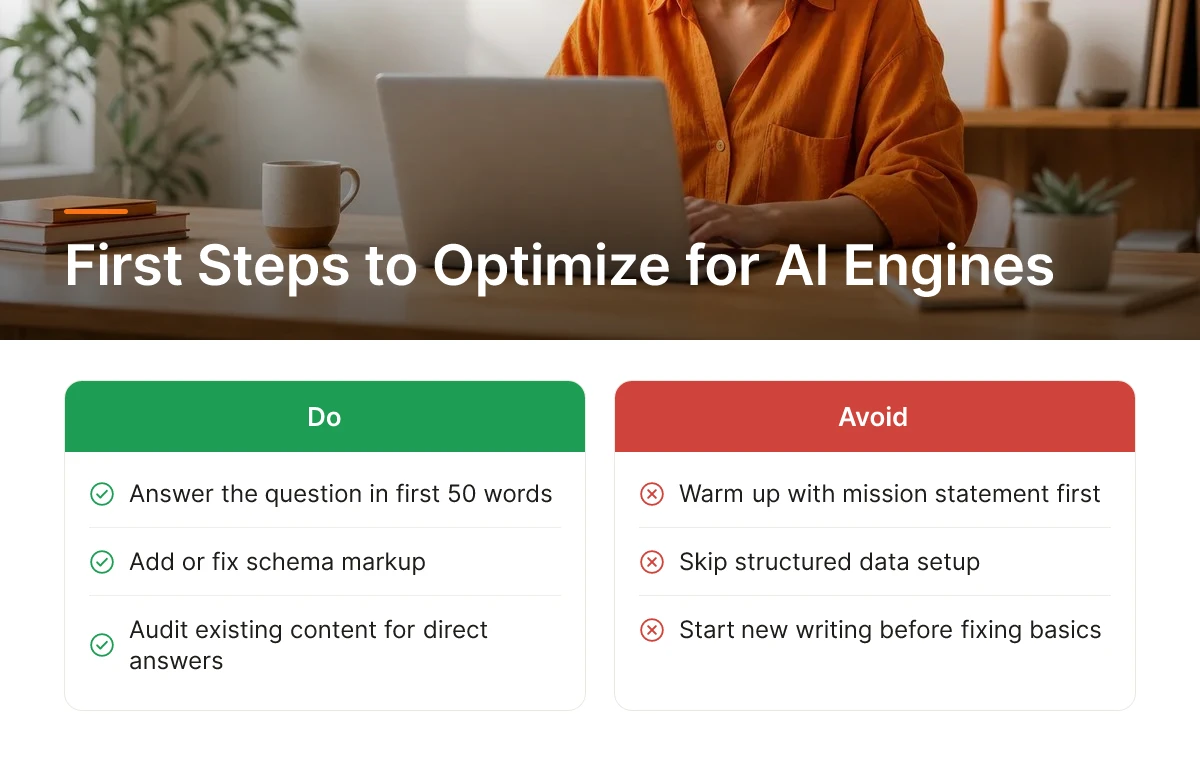
- No filler intros: Skip the warm-up paragraph. Readers and AI extraction models both reward content that gets to the point in the first sentence.
Brand consistency plays a quieter but equally important role. If your website lists one phone number, your Google Business Profile lists another, and a directory still shows your old address, AI engines have conflicting signals and often default to silence rather than risk citing a wrong detail. Keep your business name, services, location, and core claims identical across your site, directories, and any third-party mentions.
What Content Cannibalization Risks Should You Watch for Across SEO and GEO?
Publishing near-duplicate pages, one stuffed with keywords for Google, another rewritten in conversational phrasing for AI engines, confuses both systems instead of pleasing either one.
Search engines struggle to decide which page to rank, and AI engines struggle to decide which version reflects your actual answer, sometimes citing neither. Build one canonical page per topic that answers the question plainly and let it serve both audiences. Moonrank's daily content engine is built around this principle, it generates and publishes one authoritative page per keyword target rather than fragmenting your site's authority across duplicates, while its technical layer handles the schema and llms.txt work in the background.
What's the Fastest Way for a Small Business to Implement Generative Engine Optimization?
The fastest path runs through three fixes first, clear answers in your existing content, working schema markup, and consistent brand facts everywhere you're listed, before any new writing starts.
Before touching anything else, run this checklist:
- Audit existing content for direct answers. Open your top five pages and ask: does the first 50 words answer a real customer question, or does it warm up with a mission statement? AI engines favor pages that answer the question fast [3].
- Add or fix schema markup. Schema is the structured data that tells AI systems exactly what your business does, where it operates, and what it sells, without it, an AI engine has to guess.
- Confirm brand facts are consistent across the web. Your name, address, hours, and service descriptions should match across your site, directories, and review platforms. Inconsistent facts erode the trust signals AI engines use to decide who to cite [3].
What Quick-Win Tactics Can a Small Business Execute in 30-90 Days?
Treat the first 90 days as three distinct sprints, not one long to-do list.
- Weeks 1-2: Technical cleanup. Fix schema markup, resolve any broken or missing structured data, and correct brand facts anywhere they drift.
- Weeks 3-6: Rewrite your highest-traffic pages into direct-answer format, lead with the answer, follow with detail. This is also where Generative engine optimization for small business starts paying off, since rewritten service and FAQ pages are what AI engines pull from first.
- Weeks 7-12: Monitor which AI engines start citing you, and iterate on the pages that aren't getting picked up yet.
Service pages and FAQs outperform blog volume in this window because they match the exact phrasing of buyer questions, "best [service] in [city]" or "does [product] do X", that AI engines are actually fielding [2]. A stack of blog posts without that intent match takes longer to earn a citation.
Where Should a Small Business Start If They're New to Generative Engine Optimization?
Pick one AI engine to monitor, ChatGPT, Perplexity, or Gemini, rather than tracking all of them at once. Then fix the three or four pages most tied to your core services, confirm they answer a real question in the opening sentences, and expand outward from there once those start showing results.
Done manually, this cycle of auditing, schema generation, and citation monitoring eats hours every week, which is exactly the gap automation is built to close.
What Tools Can Small Businesses Use to Automate Generative Engine Optimization Without an Agency?
Automated platforms now handle the three jobs that used to require a specialist on retainer: writing schema markup, tracking citations across AI engines, and rewriting content to match how chatbots phrase answers.
Before automation, a small business needing generative engine optimization for small business had two choices: pay an agency to do this work by hand, or skip it entirely. Agencies bill for exactly the tasks that repeat weekly, checking whether ChatGPT still mentions your brand, adjusting structured data when a page changes, writing another batch of question-and-answer content. None of that work is conceptually hard. It's just tedious enough that doing it manually, every week, for every AI engine, doesn't scale for a business owner who also runs the business.
How Much Should Generative Engine Optimization Cost for a Small Business?
Cost is the main reason most small businesses have avoided GEO until now, and the gap between the two options is large. A traditional agency retainer sits in premium territory, the kind of monthly spend that only makes sense once a business has dedicated marketing budget and headcount to manage the relationship. A dedicated automated platform sits at the opposite end: a budget-friendly monthly subscription built for solo founders and small teams, with no setup fees, contracts, or hourly billing for routine updates.
Moonrank runs at $99 a month, with a 3-day free trial, positioned against agencies that typically charge $3,000 or more for comparable work. That gap is not a rounding error, it is the difference between GEO being a line item a bootstrapped e-commerce store or B2B SaaS founder can justify and one that only well-funded companies can afford.
Can Small Businesses Do Their Own Generative Engine Optimization, or Do They Need Professional Help?
Most small businesses can run generative engine optimization themselves once an automated platform handles monitoring, schema, and publishing, the parts that used to require a specialist.
Moonrank tracks whether ChatGPT, Perplexity, Gemini, and Claude recommend your business, publishes optimized content automatically every day, and keeps schema markup and structured data current without manual upkeep. That covers the recurring technical and content work a GEO specialist would otherwise bill for. Professional help still makes sense for businesses in heavily regulated industries, healthcare, finance, legal, where content needs compliance review beyond what any automated tool should handle alone. For most e-commerce stores, hotels, and B2B SaaS companies, the automated path covers the work that matters.
Start tracking and improving your AI search visibility at www.moonrank.ai.

Frequently Asked Questions
Do small businesses actually need generative engine optimization, or is it only for large brands?
Small businesses need generative engine optimization at least as much as large brands, often more, because they can't afford to lose referrals to AI engines the way an enterprise with brand recognition can. Perplexity alone was handling more than 100 million weekly queries by late 2024 [this is a general market shift, not tied to brand size]. A local hotel or boutique ecommerce store that never shows up when someone asks ChatGPT for a recommendation loses that customer before a website visit ever happens.
How is generative engine optimization different for ecommerce versus B2B SaaS or hotel businesses?
The channels and buyer questions differ, but the underlying mechanics, clear entity signals, structured data, and direct answers, stay the same across all three. Ecommerce brands need product-level schema and review content that AI engines can cite for "best [product] for [use case]" queries. B2B SaaS companies win citations through comparison pages and documentation that answer specific implementation questions [2]. Hotels depend on consistent location, amenity, and policy data that matches what's published elsewhere, since AI engines cross-check for consistency before recommending a business.
Can generative engine optimization work alongside my existing Google Business Profile and local SEO efforts?
Yes, generative engine optimization builds on local SEO rather than replacing it, since AI engines often pull from the same structured data and citation sources Google already uses. Keeping your Google Business Profile, directory listings, and website details consistent strengthens the entity signals that both traditional search and AI engines rely on [3]. Think of GEO as an added layer on top of the local SEO work you're already doing, not a separate project.
How long does it take to see a small business recommended by an AI engine after starting GEO?
Most small businesses see initial visibility changes within a few weeks, with meaningful citation gains building over two to three months. Timelines depend on how much technical cleanup your site needs and how consistently new content publishes. Businesses that publish fresh, structured content daily tend to build AI citations faster than those updating sporadically.
Conclusion
Getting recommended by ChatGPT, Gemini, or Perplexity comes down to three things: content that answers real questions directly, technical signals like schema markup and llms.txt that help AI engines trust your site, and consistency maintained over time rather than as a one-off project. Small businesses that treat this as ongoing infrastructure, not a single campaign, are the ones showing up when customers ask for recommendations. The practical next step: audit whether your site currently has basic schema markup and a llms.txt file, then check how your business appears when you ask ChatGPT or Perplexity about your own category. If the answer is "it doesn't," Moonrank automates the daily content, technical fixes, and visibility tracking needed to close that gap for $99/month, without hiring an agency.
Sources & References
- Generative engine optimization for small business: How to win with a small budget in 2026
- How to Rank in ChatGPT, Gemini, and Perplexity in 2026: Patterns From 50 B2B Sites Across Industries
- The Small Business Guide to Generative Engine Optimization (GEO) in 2026
Recommended Articles
Explore more from our content library: