The Best SEO Tools for Startups: A Complete 2026 Guide
Discover the best SEO tools for startups in 2026. Build a full keyword, audit, and ranking stack for under $150/month and see results in 3–6 months.

The best SEO tools for startups in 2026 are Google Search Console, Ahrefs (free tier), SEMrush (free tier), and Screaming Frog, used together, they cover keyword research, technical audits, and rank tracking without requiring a developer or a large budget. Most startups can build a functional SEO stack for under $150/month. With consistent execution, early organic traffic gains typically appear within 3–6 months.
The Best SEO Tools for Startups on a Tight Budget
Six tools cover the full SEO baseline for startups: Google Search Console, Google Keyword Planner, Ahrefs Webmaster Tools, SEMrush free tier, Screaming Frog, and AnswerThePublic.
Google Search Console shows which queries bring users to your site, flags indexing errors, and reports Core Web Vitals, all at no cost. Pair it with Google Keyword Planner for search volume data and you have a working foundation without spending a dollar. For non-technical founders, these two tools alone are enough to start.
Ahrefs Webmaster Tools adds backlink analysis and site health auditing for free. AnswerThePublic surfaces the questions real users type around your keywords, useful for content ideas when you have no research budget.
Screaming Frog's free version crawls up to 500 URLs [1] and identifies broken links, duplicate titles, and missing meta descriptions. For most early-stage sites, 500 URLs is sufficient. SEMrush's free tier caps keyword tracking at 10 keywords and limits domain analytics to 10 reports per day, tight, but workable for a first audit.
"For early-stage startups, the biggest mistake is over-investing in tools before you've validated your keyword strategy. Start with free tools, prove the model, then upgrade." — Rand Fishkin, Founder of SparkToro and Moz
What Are the Free Tier Limitations Across Ahrefs, SEMrush, and Google Tools?
Ahrefs Webmaster Tools restricts users to 10 queries per day and blocks competitor data entirely, you can audit your own site but cannot run a gap analysis against a rival. SEMrush's free plan caps keyword tracking at 10 keywords and 10 domain analytics reports daily. Google's tools carry no hard query limits but offer no competitor intelligence by default.
When a startup reaches the growth stage, paid upgrades change the picture. Ahrefs Lite at $129/month and SEMrush Pro at $139.95/month both enable competitor gap analysis, full backlink data, and unlimited keyword tracking, the features that matter most once you're trying to outrank established players rather than just fix your own site.
The right upgrade depends on who's doing the work. A solo founder running SEO alongside five other jobs gets more value from SEMrush Pro's all-in-one dashboard. A startup with one dedicated marketer can go deeper with Ahrefs Lite's backlink and content gap tooling.
How Can Non-Technical Founders Implement SEO Tools Without a Developer?
The best SEO tools for startups are designed to surface clear tasks, fix this title tag, submit this sitemap, add this keyword, without requiring code changes. Google Search Console's Coverage report lists exact URLs with errors and explains each one in plain language.
Screaming Frog exports issues as a spreadsheet you can hand to a content writer or VA. SEMrush's On-Page SEO Checker generates a prioritized list of improvements ranked by estimated traffic impact. None of these actions require a developer; most require only access to your CMS.
If your site runs on Shopify or WordPress, built-in SEO plugins handle the technical layer, meta tags, sitemaps, canonical URLs, so the tools above stay focused on strategy and auditing rather than implementation. According to the U.S. Small Business Administration, small businesses that invest in digital infrastructure early, including SEO, see stronger long-term growth outcomes than those that delay.
Free vs. Paid SEO Tools: What You Actually Get as a Beginner
Free SEO tools for startups cover the basics, but paid plans enable the data depth that prevents wasted effort on keywords you can't realistically rank for.
The gap between free and paid becomes concrete fast. Paid tools enable four capabilities that free tiers block:
- Unlimited keyword tracking — monitor rankings for every target term, not just 10
- Full backlink profile exports — see every referring domain pointing to your site or a competitor's
- Competitor keyword gap reports — identify terms rivals rank for that you don't yet target
- Historical ranking data — access 12+ months of ranking trends to spot seasonal patterns and algorithm impacts
Free plans typically cap all four of these capabilities significantly.
The clearest example is keyword volume data. Google Keyword Planner shows search volume as a range, "1K–10K", which tells you almost nothing about whether a keyword gets 1,200 or 9,800 monthly searches. SEMrush Pro gives you the exact monthly search volume, a keyword difficulty score, and CPC data in the same row. That difference matters when you're deciding which of ten possible blog topics to write first.
A practical upgrade trigger: if your startup is publishing more than 4 pieces of content per month and targeting competitive keywords, keyword difficulty scores from a paid tool prevent you from spending weeks on content that has no realistic chance of ranking. At $139/month, SEMrush costs less than one hour of agency consulting time, and runs every query you need, any time.
"Keyword difficulty scores are the single most underused metric by startup founders. Knowing you can't rank for a term before you write 3,000 words about it saves months of wasted effort." — Brian Dean, Founder of Backlinko
Which Free Tools Deliver the Most Value for Early-Stage Startups?
Google Search Console, Ahrefs Webmaster Tools, and HigherVisibility's free SEO tools [1] are the strongest free options. HigherVisibility is a lesser-known pick worth testing specifically for local or niche keyword research, where broad-market tools often miss long-tail terms that matter to a specific geography or vertical.
Use free tools to validate your site's technical health and spot obvious keyword opportunities. Switch to paid when your content output and competitive targets outgrow what ranges and sample data can support.
How to Stack SEO Tools for a Lean Startup Team
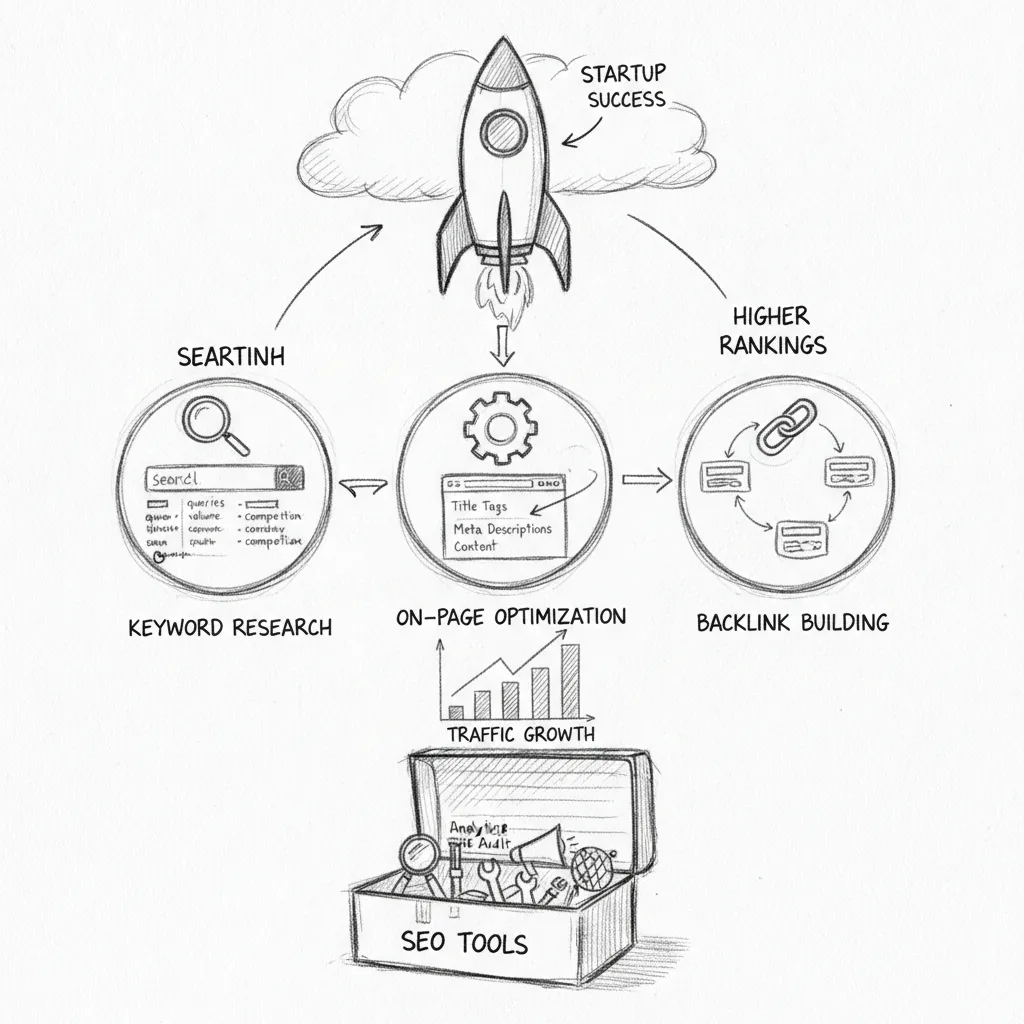
A solo founder or single-marketer startup needs three core SEO tools for startups, a fixed weekly rhythm, and a hard cap of four tools total.
The baseline stack costs nothing: Google Search Console monitors indexing status and click data, Ahrefs Webmaster Tools tracks backlinks and runs site audits, and either SEMrush's free tier or Google Keyword Planner handles keyword research. Combined, these three tools cover the full cycle of technical health, authority signals, and content opportunity, at $0/month.
What Is the Ideal Tool Integration Workflow for a Startup with One Marketer?
Run the same three-day cadence every week. On Monday, open Search Console and check for crawl errors, coverage issues, and any new impressions on pages published the previous week. On Wednesday, pull keyword rankings and scan for content gaps, queries where you appear on page two or three but have no dedicated page targeting that term. On Friday, review backlink changes in Ahrefs Webmaster Tools to catch lost links or new referring domains before they affect rankings.
One integration most solo founders skip: connect Screaming Frog to Search Console via its built-in API. This surfaces technical issues, broken internal links, slow pages, missing meta descriptions, alongside the actual traffic data for those URLs, so you fix problems that hurt real clicks rather than hypothetical ones.
AnswerThePublic pairs well with SEMrush to map question-based queries directly to content briefs. For a one-person team, this combination cuts keyword research time by roughly 40% per brief.
Stop at four tools. Startups running five or more SEO tools simultaneously without a dedicated SEO hire typically hit data overload, conflicting metrics, duplicate reports, and no clear action. More tools do not produce better results; a consistent workflow with fewer tools does.
How Long Does It Take to See ROI from SEO Tools on a Startup Budget?
Most startups targeting low-competition keywords see first-page rankings in 3–6 months; high-competition niches typically take 9–18 months to show meaningful returns.
That timeline assumes consistent weekly publishing and keywords with a difficulty score under 30. Skip either condition and the clock resets. The good news: the ROI math works even at modest traffic volumes.
A startup spending $150/month on SEO tools for startups that drives 500 additional organic visitors per month, at a 2% conversion rate and a $100 average order value, generates $1,000/month in new revenue. That's a 6.7x return on the tool investment alone, before accounting for compounding traffic growth over time.
For a $300/month tool stack, the break-even threshold is roughly 3–5 new customers per month from organic search. For most B2B SaaS products priced above $60/month, that target is achievable by month 4–6 once content and technical foundations are in place.
What Actual Traffic and Revenue Results Have Startups Achieved with Budget Tool Stacks?
One SaaS startup case study documented on Ahrefs' blog [2] grew organic traffic from 0 to 28,000 monthly visits in 14 months using a $200/month tool stack built around long-tail keyword content, no paid ads, no agency.
The single biggest ROI accelerator in the first 30 days isn't publishing new content, it's fixing what's already broken. Running a Screaming Frog crawl to identify crawl errors, slow page speed, and missing meta tags can lift existing rankings before a single new article goes live.
Technical fixes cost nothing beyond the tool subscription and deliver results faster than any content calendar. Treat month one as an audit, not a publishing sprint.
Is SEO Still Worth the Investment for Startups in 2026?
SEO remains the highest-volume unpaid acquisition channel available to startups, driving 53% of all website traffic globally as of 2024 (BrightEdge). According to research published by the Pew Research Center's Internet & Technology division, the majority of consumers now begin product discovery through online search, reinforcing why organic visibility remains a critical growth lever for early-stage companies.
The "SEO is dead" narrative doesn't hold up against the numbers. SEO-driven leads cost 61% less than paid search leads on average (HubSpot), which makes organic search especially attractive for startups running lean ad budgets. Paid campaigns stop the moment the budget runs out; a well-ranked page keeps delivering traffic for months or years.
"Organic search is the only marketing channel where the asset appreciates over time. Every dollar you invest in SEO compounds — paid ads stop working the moment you stop paying." — Neil Patel, Co-Founder of NP Digital
How Is SEO Evolving in 2026 and What Does That Mean for Startup Strategy?
The biggest shift in 2026 is that AI engines, ChatGPT, Perplexity, Gemini, and Claude, now pull answers directly from indexed, well-structured content. A startup that ranks on Google is increasingly likely to be cited inside AI-generated answers too, which doubles the return on every piece of optimized content you publish.
That creates a new technical layer startups must address: structured data and clear entity signals. Schema markup tells AI engines exactly what your business does, who it serves, and where it operates. Free tools like Google's Rich Results Test and Merkle's Schema Markup Generator are practical starting points, and platforms like Moonrank automate this implementation entirely, applying schema markup and llms.txt configuration without requiring any manual input from the business owner.
When evaluating SEO tools for startups, the right framework in 2026 treats Google rankings and AI search visibility as a single goal, not two separate strategies. Startups should direct at least 60% of their content budget toward SEO-optimized content that satisfies both traditional crawlers and AI retrieval systems simultaneously, because the audience reading those answers is the same customer either way. The W3C's Semantic Web standards underpin much of how structured data is interpreted by both search engines and AI systems, making schema implementation a foundational technical priority for startups in 2026.
Frequently Asked Questions
What is the minimum budget a startup needs to get started with SEO tools?
A startup can begin with $0 using free tiers from Google Search Console and Google Analytics, both of which provide keyword and traffic data at no cost. Paid tools like Ahrefs start at around $29/month for entry-level plans. For startups that also want AI search visibility, appearing in ChatGPT, Gemini, or Perplexity results, tools like Moonrank cover technical optimization, daily content publishing, and AI visibility tracking for $99/month, replacing a stack that would otherwise cost several hundred dollars across separate tools.
Can a non-technical founder realistically manage SEO tools without hiring a specialist?
Yes, most modern SEO tools are built for non-specialists, with guided workflows, plain-English recommendations, and dashboards that don't require coding knowledge. Google Search Console flags issues in plain language, and platforms like Moonrank handle technical tasks, schema markup, structured data, llms.txt configuration, automatically, so a solo founder never needs to touch the underlying code. The steeper learning curve applies to tools like Screaming Frog, which are better suited to developers or technical SEO hires.
Which single SEO tool gives startups the most value if they can only afford one?
Google Search Console delivers the most value for free, it shows exactly which queries drive traffic to your site, flags indexing errors, and surfaces pages losing clicks. It won't help with competitor research or AI search visibility, but for a startup with zero budget, it's the highest-signal starting point. Once revenue allows, adding a keyword research or AI visibility tool closes the gaps Search Console can't address.
How do successful startups use SEO tools differently from established companies?
Startups typically use SEO tools to find and own narrow keyword gaps rather than compete on high-volume terms that established brands already dominate [2]. Where a large company might target "project management software," a startup targets "project management software for freelance designers", a lower-competition term with higher conversion intent. Startups also move faster: they test content ideas weekly rather than quarterly. The constraint of limited resources pushes them toward tools that automate execution, not just surface recommendations.
How should a startup measure whether its SEO tools are actually working?
Track three core metrics monthly: organic impressions and clicks in Google Search Console, keyword ranking movement for your top 10 target terms, and organic-attributed conversions in Google Analytics. If impressions are rising but clicks are flat, your titles and meta descriptions need improvement. If rankings are improving but conversions aren't, the issue is likely landing page relevance or offer clarity. SEO tools surface the data; connecting that data to revenue outcomes is what separates startups that scale from those that stall.
Conclusion
The right SEO tools for your startup depend on where you are, not where you want to be. Start with Google Search Console to understand what traffic you already have, add keyword research to find gaps your competitors haven't claimed, and build technical foundations before scaling content volume.
One area most startup SEO guides still overlook: AI search. ChatGPT, Gemini, Claude, and Perplexity are now active discovery channels, and appearing in their recommendations requires different technical signals than traditional Google SEO.
If you want to cover both without hiring an agency, start a free 3-day trial at moonrank.ai and see where your business currently stands in AI search results.
Sources & References
- 10 Free SEO Tools for Businesses | CO- by US Chamber of Commerce
- SEO for Startups: How to Grow Search Visibility on a Budget
Recommended Articles
Explore more from our content library: