SEO for Service Based Businesses: A Complete Strategy Guide
Master SEO for service based businesses with proven tactics for local rankings, Google Business Profile, reviews, and AI search visibility in 2026.

Understanding seo for service based businesses is essential. SEO for service-based businesses is the practice of optimizing your online presence so local buyers find you, not a competitor, when they search for the service you offer. Unlike product SEO, it prioritizes local intent, trust signals like Google Business Profile and reviews, and service-specific landing pages. In 2026, with Google's AI Overviews and tools like ChatGPT and Perplexity surfacing answers directly, getting these fundamentals right determines whether your phone rings or stays silent.
What Is SEO for Service-Based Businesses and Why Does It Matter in 2026?
Service SEO wins customers by matching local search intent to a phone call or form fill, not a product page or shopping cart.
When someone types "divorce lawyer in Austin" or "plumber near me," they are not browsing. They have a problem and want to hire someone today. SEO for service based businesses is built entirely around that intent: local signals, trust indicators, and service-specific pages that convert a searcher into a booked appointment.
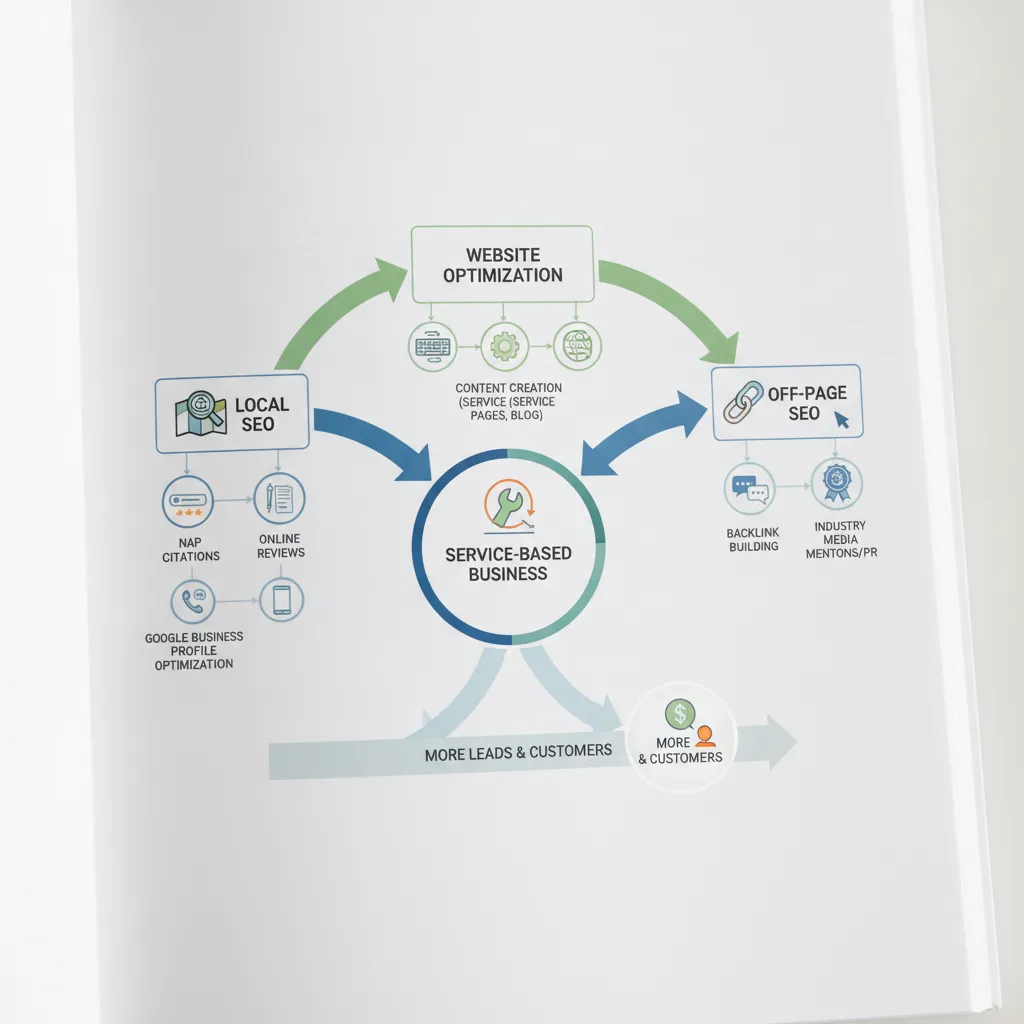
That goal is fundamentally different from e-commerce SEO, which optimizes product pages, shopping feeds, and cart flows. Service businesses have no SKUs to index and no checkout button to optimize. Their three core pillars are local signals (Google Business Profile, citations, and reviews), service-page authority, and trust and reputation, none of which map cleanly onto a product catalog strategy.
"Local search is the most direct revenue channel available to service businesses — when someone searches for a plumber or a lawyer near them, they are ready to buy, not just browse." — Greg Gifford, Vice President of Search at SearchLab Digital
Is SEO Dead or Evolving in 2026, and How Does That Affect Service Providers?
Organic local search is a direct revenue driver, not a vanity metric. According to BrightLocal's Local Consumer Review Survey, 76% of people who search for a local service visit or contact that business within 24 hours, a conversion window that paid ads rarely match at the same cost.
Search behavior is shifting, not disappearing. Google's AI Overviews now answer many informational queries without a click, but service queries, "best HVAC company near me," "emergency locksmith Chicago", still route to the local pack and Maps results. That makes local SEO the highest-use channel a service business can invest in right now.
How AI and Google's SGE Have Changed Rankings for Service Businesses
AI answer engines are now a second discovery layer that service businesses cannot ignore. ChatGPT, Perplexity, and Gemini increasingly cite local businesses when answering recommendation queries, but only businesses with strong structured data, consistent citations, and visible review signals make those responses.
A plumbing company with no schema markup and 12 unverified reviews will not appear when a user asks Perplexity for "the best-rated plumber in Denver." A competitor with structured data, 200 Google reviews, and a well-optimized Google Business Profile will. The technical signals that feed AI recommendations overlap significantly with traditional local SEO, which means getting the fundamentals right now pays dividends across both Google and AI-driven search.
"The businesses winning in AI-generated recommendations are the same ones that have invested in structured data, consistent citations, and authoritative reviews — the fundamentals of local SEO have never mattered more." — Joy Hawkins, Founder of Sterling Sky and Local Search Expert
How to Build a Local SEO Foundation That Actually Drives Leads
For service-based businesses, local SEO starts with three actions: claiming your Google Business Profile, standardizing your business name and contact details across directories, and building location-specific pages.
How to Optimize Your Google Business Profile and Local Citations for Maximum Visibility
Your Google Business Profile (GBP) is the single highest-return local SEO action available to service businesses. Complete every field, business description, service categories, hours, and service areas, then upload geo-tagged photos weekly and post updates at least twice a month to stay active in the local 3-pack.
Choose service-specific categories, not just a broad one. A plumbing company should select "Plumber" as its primary category and add secondary categories like "Drainage service" and "Water heater repair contractor", each category signals relevance for a different set of search queries.
NAP consistency, your exact business Name, Address, and Phone number, must match across every directory: Yelp, Angi, the Better Business Bureau, and any industry-specific listing sites [2]. A single mismatched phone number or abbreviated street address is enough to suppress your local rankings because Google cross-references these sources to verify your business is legitimate.
Reviews are both a ranking factor and a conversion signal. Businesses with 50 or more Google reviews and a 4.5-star average or higher appear in the local 3-pack significantly more often [2]. Build a post-service workflow, an automated SMS or email sent within 24 hours of job completion, to collect reviews consistently rather than sporadically.
When implementing seo for service based businesses, the following Google Business Profile elements deserve priority attention:
- Business description: Include your primary service keywords and the cities you serve
- Service categories: Select a precise primary category and all relevant secondary categories
- Photos: Upload geo-tagged images of your work weekly to signal active management
- Posts: Publish updates at least twice per month to maintain local pack visibility
- Q&A section: Seed common questions and answer them yourself before customers ask
- Review responses: Reply to every review within 48 hours to signal active management to Google
Service Area Targeting When You Operate Across Multiple Locations
One of the most common mistakes in SEO for service based businesses is listing every city served on a single page. Instead, create a dedicated landing page for each city or region you serve, each with unique content, local schema markup, and an embedded Google Map for that location.
Use Google Search Console to identify which city-modifier queries, "HVAC repair Austin," "landscaping company Round Rock", you already rank for. Those rankings tell you where you have existing authority; build adjacent location pages from there to capture nearby markets systematically rather than guessing.
If you have no physical storefront, set your service area in GBP rather than hiding your address. Google surfaces service-area businesses in local results when the profile is complete and the corresponding location pages on your site reinforce the same geographic signals.
SEO vs. Paid Ads: Which Delivers Better ROI for Service Businesses?
For most service businesses, SEO delivers a lower cost-per-lead and lasting returns; paid ads deliver speed but zero residual value once the budget stops.
Google Ads for high-intent service keywords average $15–$80 per click depending on industry. Legal and home services sit at the top of that range. A plumbing company spending $3,000/month on Google Ads typically generates 30–40 leads, a cost-per-lead of $75–$100. The moment that budget pauses, the phone stops ringing.
That's the core difference: paid ads are rented visibility. SEO is owned visibility. Content and citations built in month 3 still generate leads in month 18, with no additional spend required.
Real Case Studies: Specific Lead and Cost-Per-Lead Metrics for Service Businesses
A residential HVAC company that committed to local SEO over 12 months moved from page 3 to the Google local 3-pack. Inbound leads grew from roughly 8 per month to 55 per month. Once the content and Google Business Profile work was complete, cost-per-lead dropped below $18, compared to $75–$100 for the same leads via paid search.
Paid ads do win on two fronts: speed (leads can arrive in week 1) and targeting precision. The practical strategy for most service businesses is to run paid ads for immediate cash flow while seo for service based businesses builds the long-term asset underneath. One funds the business today; the other reduces what you need to spend tomorrow. According to Shawn the SEO Geek's proven growth strategies for service businesses, combining both channels during the early months of an SEO campaign consistently outperforms either channel used in isolation.
How to Track and Measure SEO Results to Prove ROI
Three tools cover the basics without any custom setup. Google Search Console shows impressions and clicks by query, so you can see exactly which service keywords drive traffic. Google Business Profile Insights tracks call clicks and direction requests, direct signals that local SEO is producing real actions. A UTM-tagged contact form (e.g., ?utm_source=organic&utm_medium=search) attributes form submissions to organic search inside Google Analytics.
Together, these three data points let you calculate a real cost-per-lead for SEO and compare it directly against what you're paying per lead through Google Ads or Facebook Ads, no guesswork required.
How SEO Strategy Differs by Service Industry
SEO for service based businesses is not one-size-fits-all — the tactics that win for a plumber differ sharply from those that work for a law firm or B2B consultant.
SEO for Law Firms vs. Plumbers vs. Consultants: What Changes and What Stays the Same
Law firm pages fall under Google's YMYL (Your Money or Your Life) category, which means they face the highest E-E-A-T scrutiny of any service vertical. Attorney bio pages must include bar credentials, case results, and backlinks from legal directories such as Avvo, Justia, and FindLaw, these signals are non-negotiable for competitive rankings.
Plumbers, electricians, and HVAC companies have a different primary goal: owning the local pack. Google Guaranteed and Local Services Ads complement organic SEO here by placing the business above standard results. Review velocity, earning new reviews consistently, matters more in trades than in professional services because Google weights recency heavily in local pack rankings.
Consultants and B2B service firms need a different keyword strategy entirely. They target problem-aware queries like "how to reduce SaaS churn" rather than local intent terms, and they build branded search volume through long-form guides and LinkedIn-linked articles that earn backlinks from industry publications.
Franchise and multi-location service brands should use a parent-plus-child page architecture, one authoritative domain with individual location pages, rather than separate domains per location. Separate domains split link equity; a single domain consolidates it.
The U.S. Small Business Administration also recommends that service businesses maintain a consistent and trustworthy online presence as a core component of their digital strategy, reinforcing why citation accuracy and reputation management are foundational, not optional.
Reputation Management and Reviews as an Active SEO Strategy
Responding to every Google review, positive and negative, within 48 hours signals active management to Google and directly improves local pack rankings. This is an SEO strategy, not just a PR courtesy.
Negative review suppression through fresh positive review generation outperforms removal requests in almost every case. Removal requests rarely succeed; a steady flow of new five-star reviews pushes lower-rated ones down in both visibility and average score.
Tools and AI Strategies Service Businesses Should Use to Stay Ahead of Algorithm Changes
A lean tool stack, Google Search Console, a local rank tracker, and one competitor analysis platform, covers most of what seo for service based businesses requires.
Can ChatGPT and AI Tools Actually Help with SEO, or Are They Just Hype?
AI tools are genuinely useful for specific, bounded tasks. ChatGPT and Claude can draft service page copy, generate FAQ schema markup, and produce local keyword variants in minutes, work that previously took hours.
The catch: raw AI output lacks the first-person experience and specific credentials that Google's E-E-A-T guidelines reward. Before publishing anything AI-generated, add real project details, named credentials, and client outcomes. Without those signals, the content reads as thin, and Google's Helpful Content criteria penalize exactly that.
For AI search visibility specifically, the signals that get your business cited by ChatGPT, Perplexity, and Gemini overlap heavily with local pack fundamentals: LocalBusiness schema with service types and service areas, a well-maintained Google Business Profile, and consistent brand mentions across authoritative directories. A platform like Moonrank automates the technical side of this, implementing schema markup, structured data, and citation signals daily at $99/month, without requiring you to touch a line of code.
For citation and local rank tracking, BrightLocal or Whitespark handle the local layer. Semrush or Ahrefs cover competitor gap analysis. Combined with Google Search Console, which is free, your total tool spend stays under $150/month.
"For service businesses, the gap between showing up and being invisible in local search often comes down to three things: a complete Google Business Profile, consistent NAP data across directories, and a steady stream of genuine customer reviews." — Darren Shaw, Founder of Whitespark and Local SEO Authority
How to Adapt Your SEO Strategy After a Google Algorithm Update
Google releases 3–4 core updates per year, and the fastest diagnostic tool is already in your account. Open Search Console and compare impressions and clicks for the 28 days before versus after the update rollout date. Drops concentrated on service pages almost always signal thin content or weak E-E-A-T, not a technical crawl issue.
Once you identify which pages lost visibility, audit the lowest-traffic ones first. Add author credentials, real project photos, specific service details, and customer testimonials. These additions directly address what Google's Helpful Content system looks for, evidence that a real expert with real experience wrote the page.
Avoid spreading effort across every page at once. Fix the weakest pages thoroughly, monitor Search Console for recovery over the following 4–6 weeks, then move to the next tier. The Schema.org LocalBusiness markup documentation provides the technical reference for implementing structured data correctly on every service page, which is a critical step in recovering from content-related ranking drops.

Frequently Asked Questions
How long does SEO take to generate leads for a service business?
Most service businesses see measurable lead increases from SEO within 3 to 6 months, though competitive markets can take 9 to 12 months for significant results. Early wins, like ranking for long-tail, low-competition keywords, often appear within 6 to 8 weeks of publishing optimized service pages. The timeline depends heavily on your domain's existing authority, how consistently you publish content, and how well your technical foundation is set up. Businesses that publish content daily close that gap faster than those updating their site once a quarter.
Do service businesses with no physical storefront still rank in local search?
Yes, Google allows service-area businesses (SABs) to rank in local search without a public address by specifying the geographic areas they serve in their Google Business Profile. A plumber who works across three counties but operates from a home address can hide that address and still appear in the local pack for searches in those counties. The key is accurate service-area configuration in your GBP, consistent NAP data across directories, and location-specific content on your website.
How many service pages should a service business have on its website?
Build one dedicated page per distinct service you offer, and one per major geographic area you target, if local search matters to your business. A landscaping company serving five cities should have at least five location pages and separate pages for lawn care, tree trimming, and irrigation. Combining multiple services onto a single page dilutes keyword relevance and makes it harder for both search engines and prospective clients to understand exactly what you do.
What's the most important ranking factor for service businesses in 2026?
Demonstrated expertise and trust signals, including authoritative content, verified reviews, and consistent citations, carry the most weight for service businesses in 2026. Google's Helpful Content system and E-E-A-T guidelines (Experience, Expertise, Authoritativeness, Trustworthiness) increasingly favor businesses that prove their credentials through detailed service content, named authors, and third-party validation. Beyond Google, AI search engines like ChatGPT and Perplexity now surface businesses based on structured data and citation quality, making technical optimization a second critical layer alongside content.
What are the biggest mistakes to avoid when implementing SEO for service based businesses?
The most damaging mistakes in seo for service based businesses include using duplicate content across location pages, neglecting your Google Business Profile after initial setup, ignoring review generation, and targeting keywords that are too broad or too competitive for your domain authority. Many service businesses also make the mistake of combining multiple services on a single page rather than creating dedicated pages for each offering, which dilutes keyword relevance and reduces the chance of ranking for specific, high-intent queries.

Conclusion
SEO for service based businesses is not one tactic, it's a stack of connected signals: accurate local listings, dedicated service pages built around specific search intent, technical markup that AI engines can parse, and a consistent stream of content that builds authority over time. Three things matter most right now: get your Google Business Profile fully configured with correct service areas, create a separate page for every service and location combination you want to rank for, and start building the structured data signals that AI search engines like ChatGPT and Perplexity use to recommend businesses to their users.
If publishing daily content and managing technical optimization manually isn't realistic for your business, Moonrank automates both, tracking your visibility across AI search engines and publishing optimized content every day for $99/month. Start with the free 3-day trial to see where your business currently stands in AI search results.
Sources & References
- Local SEO for Service Businesses: How to Build Search Engine Trust
- BrightLocal Local Consumer Review Survey
- SEO for Service Based Business: Proven Growth Strategies — Shawn The SEO Geek
- Schema.org LocalBusiness Markup Documentation
Recommended Articles
Explore more from our content library: