The Complete Guide to AI Search Engines in 2026
Discover how AI search engines like ChatGPT, Gemini, and Perplexity work, why they matter for your business, and how to get recommended by them in 2026.

| Key Insight | Explanation |
|---|---|
| AI search engines use natural language processing | Unlike traditional search, they understand conversational questions and return synthesized answers, not just a list of links. |
| The top platforms are ChatGPT, Gemini, Claude, and Perplexity | Each uses different ranking signals, which means businesses need to optimize specifically for AI recommendation logic. |
| Traditional SEO alone isn't enough | AI engines evaluate structured data, citations, and content authority — not just keyword density and backlinks. |
| GEO and AEO are the new optimization disciplines | Generative Engine Optimization (GEO) and Answer Engine Optimization (AEO) are purpose-built for AI search visibility. |
| SMBs are the most exposed to AI search disruption | Small businesses without dedicated SEO resources risk being invisible on AI platforms while competitors get recommended. |
| Automation makes AI optimization accessible at $99/month | Tools like Moonrank handle daily content, technical optimization, and visibility tracking without any manual effort required. |
Understanding this approach is essential. A customer pulls out their phone and asks ChatGPT for the best coffee shop near their office. Your café is two blocks away. But ChatGPT recommends a competitor. That moment is happening millions of times a day — and most small business owners have no idea it's costing them customers. this approach are now a primary discovery channel, and whether your business shows up in their answers depends on signals that have nothing to do with your Google ranking.
this are search tools powered by artificial intelligence technologies, including natural language processing (NLP), machine learning (ML), and large language models (LLMs), that generate synthesized, conversational answers rather than returning a simple list of links. They understand intent. They reason across sources. And they recommend specific businesses, products, and services by name.
This guide explains exactly how these platforms work, which ones matter most in 2026, why your business visibility depends on them, and what you can do right now to start appearing in their recommendations.
What Are AI Search Engines?
it are platforms that use large language models and natural language processing to understand queries, retrieve relevant information, and generate direct answers — replacing the traditional list of blue links with a conversational, synthesized response.
The Core Definition
According to IBM, "an AI search engine is a search tool powered by artificial intelligence technologies including natural language processing (NLP), machine learning (ML) and large language models" [1]. That's the technical baseline. But the practical reality is more significant: these tools don't just find pages, they read them, synthesize them, and form opinions about which sources to trust and recommend.
Traditional search engines like Google index pages and rank them based on signals like backlinks and keyword relevance. this method go further. They interpret the meaning behind a question, cross-reference multiple sources, and produce a single coherent answer — often with a specific brand or business recommendation embedded in it.
How AI Search Differs from Traditional Search
The distinction matters enormously for businesses. As the North Carolina Bar Association notes, "search engines like Google, generative AI applications like ChatGPT, and automation tools serve distinct purposes and have different capabilities" [2]. The key difference isn't just the interface — it's the underlying logic for deciding what to surface.
- Traditional search: Returns a ranked list of URLs based on crawl data, backlinks, and keyword signals
- AI search: Generates a synthesized answer that may cite sources, recommend businesses, or provide step-by-step guidance
- User intent: AI search handles conversational, multi-part questions that traditional search struggles with
- Business impact: Being recommended by an AI engine often means a direct, named mention — not just a link on page two
The shift is real and accelerating. Perplexity reported over 100 million weekly queries by late 2024, and that number has continued climbing into 2026. Google itself has integrated AI Overviews and AI Mode into its core search product [3]. The era of AI-first search isn't coming — it's here.
Pro Tip: Don't think of AI search engines as a replacement for Google. Think of them as an additional discovery layer where your business either gets recommended or gets ignored. You need to optimize for both.
How AI Search Engines Work
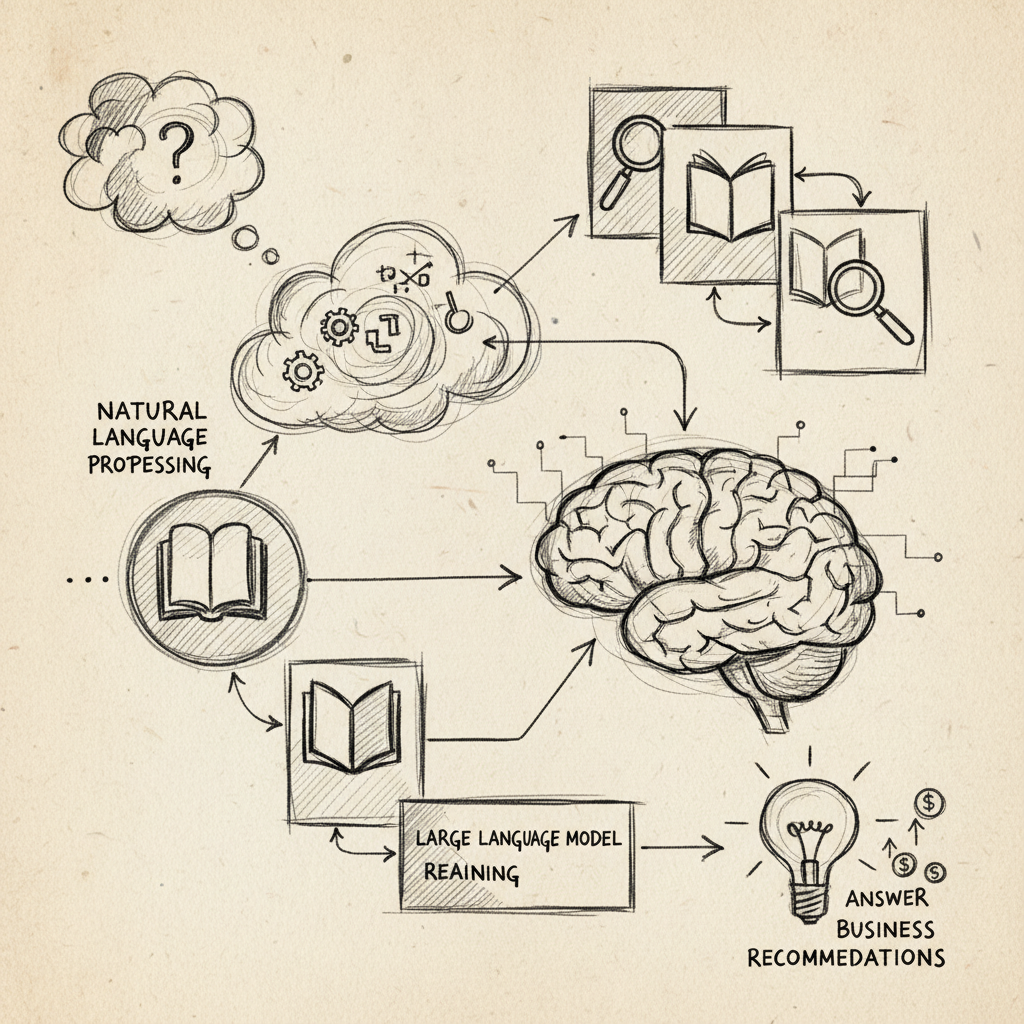
this strategy process queries through a pipeline of NLP, retrieval mechanisms, and LLM reasoning — ultimately deciding which businesses, sources, and facts are trustworthy enough to include in a generated answer.
The Technical Pipeline
Understanding the mechanics helps you optimize for them. Here's how a typical AI search engine processes a query:
- Query interpretation: The system uses NLP to parse the user's intent, not just their keywords. "Best Italian restaurant downtown that's good for a business lunch" is understood as a multi-criteria recommendation request.
- Retrieval: The engine pulls relevant content from its index or live web crawl. This is where your website's structured data, schema markup (the machine-readable code that tells AI engines exactly what your business does), and llms.txt files (configuration files that signal to LLM crawlers how to interpret your site) become critical.
- Ranking and trust scoring: The LLM evaluates sources for authority, consistency, and citation frequency. A business mentioned across multiple trusted sources scores higher.
- Answer generation: The model synthesizes a response, selecting which businesses or facts to include based on confidence and relevance.
- Citation selection: Some platforms (Perplexity, in particular) surface explicit source links alongside their answers.
What Signals AI Engines Use to Rank Businesses
Research published in PMC (National Library of Medicine) compared traditional search engines and generative AI tools across accuracy and relevance metrics, finding that both Google and Gemini performed strongly but using different underlying logic [4]. AI engines weight signals that traditional SEO often ignores.
- Structured data and schema markup: Tells AI crawlers exactly what your business is, what it sells, and where it operates
- Content freshness: Daily or frequent content signals that a business is active and authoritative
- Citation consistency: Being mentioned by name across multiple credible sources builds trust
- Conversational content: Pages that answer questions directly (like FAQ sections) are more likely to be extracted
- Entity clarity: Clear, consistent mentions of your business name, location, and category across the web
Pro Tip: Structured data isn't optional for AI search visibility — it's the foundation. If your site doesn't have schema markup implemented correctly, AI engines can't reliably understand what your business does, which means they won't confidently recommend it.
Top AI Search Engines to Know in 2026
As of 2026, the leading this approach are ChatGPT Search, Google Gemini, Perplexity AI, Claude, and Microsoft Copilot — each with distinct strengths, user bases, and recommendation logic that businesses need to understand separately.
Platform Comparison
PCMag's 2026 roundup confirmed that ChatGPT, Copilot, and Gemini have "successfully made AI chatbots mainstream, serving as viable alternatives to traditional search" [5]. Zapier's analysis similarly identified Perplexity as offering "the best AI search experience" for research and citation-backed answers [6].
| Platform | Best For | Key Strength | SMB Visibility Priority |
|---|---|---|---|
| ChatGPT Search | General queries, product recommendations | Largest user base, conversational depth | Very High |
| Google Gemini | Google-integrated queries, local search | Deep Google index integration, AI Overviews | Very High |
| Perplexity AI | Research, citation-backed answers | Explicit source citations, real-time web access | High |
| Claude (Anthropic) | Long-form reasoning, nuanced queries | Strong document comprehension and analysis | Growing |
| Microsoft Copilot | Enterprise and productivity queries | Bing index integration, Office ecosystem | Moderate |
Emerging Platforms Worth Watching
Beyond the big five, platforms like Grok, DeepSeek, and You.com are gaining traction in specific niches [7]. Rank Math's 2026 roundup highlights Grok for real-time social data and DeepSeek for technically oriented queries [8]. IMD's analysis of the top AI-powered search engines also flags Brave Search as a privacy-focused alternative that's growing its user base [9].
For most SMBs, the priority should be ChatGPT, Gemini, Perplexity, and Claude. These four platforms account for the vast majority of AI-driven business discovery queries as of 2026.
Why AI Search Engines Matter for Your Business
this now directly influence purchase decisions, local business discovery, and B2B vendor selection — making visibility on these platforms as commercially important as a Google first-page ranking once was.
The Business Case for AI Search Visibility
The numbers tell the story. According to SparkToro and widely cited industry research, roughly 40% of Google searches already return zero clicks as users shift toward AI-generated answers. Consumers aren't just browsing results anymore — they're asking for recommendations and acting on the first answer they receive.
A local service business owner recently described the shift clearly: a customer told them they'd found a competitor through Perplexity when searching for "best [service] in [city]" — despite the owner having a well-optimized Google Business Profile. The business wasn't invisible on Google. It was invisible to the AI layer sitting on top of it.
This is the core problem. Traditional SEO (Search Engine Optimization) gets you ranked on Google. But it use different signals to decide who to recommend. Optimizing for them requires a separate discipline: GEO (Generative Engine Optimization) and AEO (Answer Engine Optimization), which focus on how AI systems understand, trust, and cite your content.
Pros and Cons of Prioritizing AI Search Optimization
- Pro: AI recommendations carry high trust — users treat them as curated expert advice, not ads
- Pro: Early movers in AI search optimization face less competition than in traditional SEO
- Pro: A single strong AI mention can drive sustained referral traffic across multiple queries
- Con: Results aren't instant — building AI trust signals takes consistent effort over weeks
- Con: AI engine ranking logic isn't fully transparent, requiring ongoing monitoring
- Con: Optimizing for multiple platforms simultaneously is complex without automation
The upside outweighs the complexity, especially for SMBs. At Moonrank, we've found that businesses that start optimizing for AI search visibility within their first 30 days of focused effort begin appearing in ChatGPT and Perplexity recommendations for their core category queries — often before their larger competitors have made any moves at all.
Common Mistakes Businesses Make with AI Search
Most businesses lose AI search visibility not because they're doing something wrong, but because they're doing nothing at all — assuming their existing SEO strategy covers AI platforms when it doesn't.
The Most Costly Misconceptions
A common mistake is treating this method as just another version of Google. They're not. Google's crawler scores links and keywords. ChatGPT's retrieval system scores trustworthiness, entity clarity, and content that directly answers questions. Doing traditional SEO and expecting AI visibility is like optimizing your storefront window display and wondering why your phone isn't ringing.
Here are the most frequent errors businesses make:
- No structured data: Skipping schema markup means AI engines can't reliably parse what your business does, where it operates, or what it offers
- Inconsistent entity mentions: If your business name, address, and category appear differently across your website, social profiles, and directories, AI engines lose confidence in your identity
- Stale content: Publishing a blog post once a quarter signals low authority. AI engines favor businesses that demonstrate consistent, current expertise
- No FAQ or Q&A content: AI engines extract direct answers from pages. If your site doesn't answer questions in a structured way, you won't be extracted
- Ignoring llms.txt: This configuration file tells LLM crawlers how to interpret your site. Leaving it out is like not having a robots.txt — the crawler guesses, and guesses wrong
- Assuming Google rank equals AI rank: Being on page one of Google does not guarantee any visibility on ChatGPT, Gemini, or Perplexity
One Pitfall That Catches Even Experienced Marketers
One pitfall to watch for: optimizing for a single AI platform. Each engine uses slightly different retrieval logic. Perplexity emphasizes real-time citations and source diversity. ChatGPT weights training data authority and structured content. Gemini integrates deeply with Google's own knowledge graph. A strategy that only targets one of these will leave significant visibility on the table.
From experience working with SMBs across multiple categories, the businesses that struggle most are those that invested heavily in traditional SEO and assumed the transition to AI search would be automatic. It isn't. The signals are different. The optimization work is different. And the results, when done correctly, are measurably better than waiting for Google to do the work for you.
Best Practices for Getting Recommended in 2026
Getting recommended by this strategy in 2026 requires a combination of technical optimization, consistent content output, and active visibility monitoring — all three working together, not in isolation.
The GEO/AEO Framework for SMBs
Industry analysts increasingly point to GEO (Generative Engine Optimization) as the structured methodology for AI search visibility. The framework has three pillars: technical signals, content authority, and citation building. Here's how to execute each one:
- Implement schema markup: Add structured data to every key page — business type, location, services, reviews, and FAQs. This is the single highest-impact technical action for AI search visibility.
- Configure llms.txt: Create and maintain an llms.txt file that explicitly tells LLM crawlers which pages are authoritative and how to interpret your business category.
- Publish content daily (or as frequently as possible): AI engines favor businesses with a consistent content signal. A daily publishing cadence — even short, focused articles — dramatically outperforms monthly blog posts.
- Answer questions directly: Structure your content around the questions your customers actually ask. Use H2 and H3 headings that mirror real queries. Include FAQ sections on key pages.
- Build citation consistency: Ensure your business name, address, phone number, and category are identical across all directories, your website, and social profiles.
- Track your AI visibility: Monitor how ChatGPT, Gemini, Claude, and Perplexity respond to queries in your category. If you're not appearing, you need to know — and you need to know which signals to fix.
The Cost Reality for SMBs
Traditional SEO agencies charge $3,000 or more per month for this kind of optimization work. That's a barrier most small businesses can't clear. The good news is that automation has changed the equation entirely.
Our team at Moonrank recommends a fully automated approach: daily content generation, technical optimization (schema markup, llms.txt, structured data, citation building), and AI visibility tracking across ChatGPT, Gemini, Claude, and Perplexity — all running on autopilot for $99 a month. You provide the business context once during onboarding. The system does the rest.
Pro Tip: Don't wait until you notice a competitor being recommended by ChatGPT to start optimizing. By then, they've already built weeks or months of trust signals with the AI engine. Start tracking your AI visibility now — even if the results look thin today, the data tells you exactly where to focus.
Sources & References
- IBM, "What Is an AI Search Engine?", 2024
- North Carolina Bar Association, "The Difference Between Search Engines, Generative AI, and Automation Tools", 2023
- Google, "AI in Search", 2026
- PMC / National Library of Medicine, "How Traditional Search Engines Outperform Artificial Intelligence (AI)", 2025
- PCMag, "The Best AI Search Engines We've Tested for 2026", 2026
- Zapier, "The 4 Best AI Search Engines", 2025
- DigitalOcean, "6 Best AI Search Engines in 2025", 2025
- Rank Math, "9 Best AI Search Engines You Need to Try", 2026
- IMD, "Top 5 AI Search Engines and Why They're Successful", 2025
- National Centre for AI (Jisc), "AI Tools: Search Tools", 2025

Frequently Asked Questions
1. What are AI search engines, and how are they different from Google?
this approach use large language models and natural language processing to generate synthesized, conversational answers rather than returning a ranked list of links. Google returns URLs; this like ChatGPT, Gemini, and Perplexity return direct answers — often recommending specific businesses or products by name. The ranking logic is fundamentally different, which means traditional SEO doesn't automatically translate to AI search visibility.
2. Which AI search engines should my business prioritize?
As of 2026, the four platforms with the highest commercial impact for SMBs are ChatGPT Search, Google Gemini, Perplexity AI, and Claude. ChatGPT and Gemini have the largest user bases. Perplexity is particularly influential for research-style queries with explicit citations. Claude is growing fast in professional and B2B contexts. Optimizing for all four simultaneously gives you the broadest coverage.
3. Are there free AI search engines I can use for my own research?
Yes. ChatGPT, Gemini, Perplexity, and Claude all offer free tiers with meaningful functionality. Perplexity's free version provides citation-backed answers with real-time web access. Google Gemini is integrated directly into Google Search at no cost. For business research and competitive analysis, these free versions are genuinely useful starting points.
4. How do AI search engines decide which businesses to recommend?
it evaluate a combination of structured data (schema markup), content authority (how consistently and clearly your site answers relevant questions), citation frequency (how often credible sources mention your business by name), and entity clarity (consistent business name, location, and category across the web). Businesses with strong signals across all four dimensions are significantly more likely to be recommended.
5. Does my Google ranking affect my visibility on AI search engines?
Partially. Google Gemini integrates with Google's index, so strong Google SEO does help with Gemini visibility. But ChatGPT, Perplexity, and Claude use their own retrieval systems and training data, which don't directly mirror Google rankings. A business can rank on page one of Google and still be invisible on these platforms — and vice versa. Results vary depending on your specific category and competitive landscape.
6. What is GEO, and how does it relate to AI search optimization?
GEO stands for Generative Engine Optimization — the practice of optimizing your content and technical setup specifically for this method rather than traditional crawlers. It includes implementing schema markup, configuring llms.txt files, publishing answer-focused content consistently, and building citation authority across trusted sources. GEO is the AI-era counterpart to traditional SEO, and it's the framework that determines whether AI engines recommend your business.
7. How long does it take to start appearing in AI search recommendations?
Results vary based on your starting point, niche competitiveness, and the consistency of your optimization effort. In practice, businesses that implement strong structured data, publish content consistently, and build citation signals typically begin seeing AI search mentions within 30 to 60 days. Businesses that automate the entire process — content, technical fixes, and tracking — tend to see faster, more consistent results than those taking a manual approach.
8. Can a small business realistically compete on AI search engines against larger brands?
Yes — and this is one of the most compelling aspects of AI search optimization for SMBs. AI engines prioritize relevance, specificity, and trustworthiness over raw domain authority or ad spend. A local restaurant with excellent structured data, consistent content, and strong citation signals can outrank a national chain for local recommendation queries. Early movers in AI search optimization have a genuine advantage, because most competitors haven't started yet.
Getting Your Business Recommended by AI Search Engines
this strategy aren't a future trend to prepare for. They're the current reality for how millions of customers discover businesses, make purchase decisions, and find local services. ChatGPT, Gemini, Claude, and Perplexity are actively recommending businesses every second — and the businesses they recommend are the ones that have done the technical and content work to earn that trust.
The good news for SMBs: this is still an early-mover market. Most of your competitors haven't optimized for AI search visibility yet. That gap won't last forever.
Moonrank was built specifically for this moment. For $99 a month, it handles daily content publishing, schema markup, llms.txt configuration, citation building, and AI visibility tracking across ChatGPT, Gemini, Claude, and Perplexity — all automatically, with no manual work required after onboarding. That's the full GEO stack for a fraction of what traditional agencies charge. Start your free 3-day trial at www.moonrank.ai and see where your business stands across this approach today.
Recommended Articles
Explore more from our content library: