How to Optimize Your Business for AI Search Results
Master AI search result optimization in 2026. Learn how ChatGPT, Gemini, and Perplexity rank businesses — and how to get recommended automatically. Discover.

| Key Insight | Explanation |
|---|---|
| AI search is a distinct channel | ChatGPT, Gemini, Claude, and Perplexity use different ranking signals than Google — traditional SEO alone won't get you recommended. |
| Structured data is essential | Schema markup and llms.txt files help AI engines parse and trust your content, directly influencing whether they cite your business. |
| Content freshness matters | AI engines favor regularly updated, authoritative content. Daily publishing significantly improves your citation frequency over time. |
| GEO/AEO replaces legacy tactics | Generative Engine Optimization (GEO) and Answer Engine Optimization (AEO) are the frameworks purpose-built for AI search visibility. |
| SMBs can compete affordably | Automated platforms now deliver AI search optimization at $99/month — a fraction of the $3K+ agencies charge for similar outcomes. |
| Measurement is non-negotiable | Tracking your brand's appearance across AI engines separately from Google traffic is the only way to know what's actually working. |
A customer pulls out their phone and asks ChatGPT, "What's the best coffee shop near downtown?" Your business has a website, decent reviews, and years of history. But ChatGPT recommends your competitor. This scenario plays out millions of times a day — and most small business owners have no idea it's happening. AI search result optimization is the practice of structuring your online presence so that AI-powered engines like ChatGPT, Gemini, Claude, and Perplexity understand, trust, and recommend your business in their generated answers. It's distinct from traditional SEO. And as of 2026, it's no longer optional.
This article covers exactly what AI search result optimization is, how the underlying mechanics work, why it matters for your revenue, and the specific steps you can take to get recommended — starting today.
What Is AI Search Result Optimization?
AI search result optimization is the process of making your business visible and citable within AI-generated answers from engines like ChatGPT, Gemini, Claude, and Perplexity. Unlike traditional SEO, which targets Google's crawler-based ranking algorithm, AI optimization focuses on how large language models (LLMs) retrieve, evaluate, and surface information when answering user queries.
The Core Distinction from Traditional SEO
Traditional SEO targets keyword rankings on a results page. You optimize a page, it climbs to position one on Google, and users click through. AI search works differently. When someone asks Perplexity "Which accounting software is best for freelancers?", the engine doesn't return a list of links. It synthesizes an answer from multiple sources — and either your business is mentioned in that answer, or it isn't.
According to research published on Common Crawl, AI optimization is about "creating content that works well in AI contexts, developing structured data strategies, and potentially creating specialized datasets" — a fundamentally different task than chasing blue links [1].
Two specific frameworks have emerged to describe this discipline:
- GEO (Generative Engine Optimization): Optimizing content so it gets cited inside AI-generated responses. Researchers at arXiv documented that GEO strategies can increase source visibility in AI answers by up to 40% [2].
- AEO (Answer Engine Optimization): Structuring content specifically to answer questions directly, making it easier for AI engines to extract and quote your business as an authoritative source.
Why the Definition Matters for SMBs
If you're a small business owner, the distinction is practical. You could rank on page one of Google and still be completely invisible to someone asking ChatGPT for a recommendation. As of 2026, Perplexity alone handles over 100 million weekly queries. Google's AI Overviews appear on the majority of informational searches. The audience has already shifted — and most SMBs haven't followed.
The good news: AI search result optimization is learnable and automatable. You don't need to become a technical expert. You need the right signals in place.
How AI Search Result Optimization Works
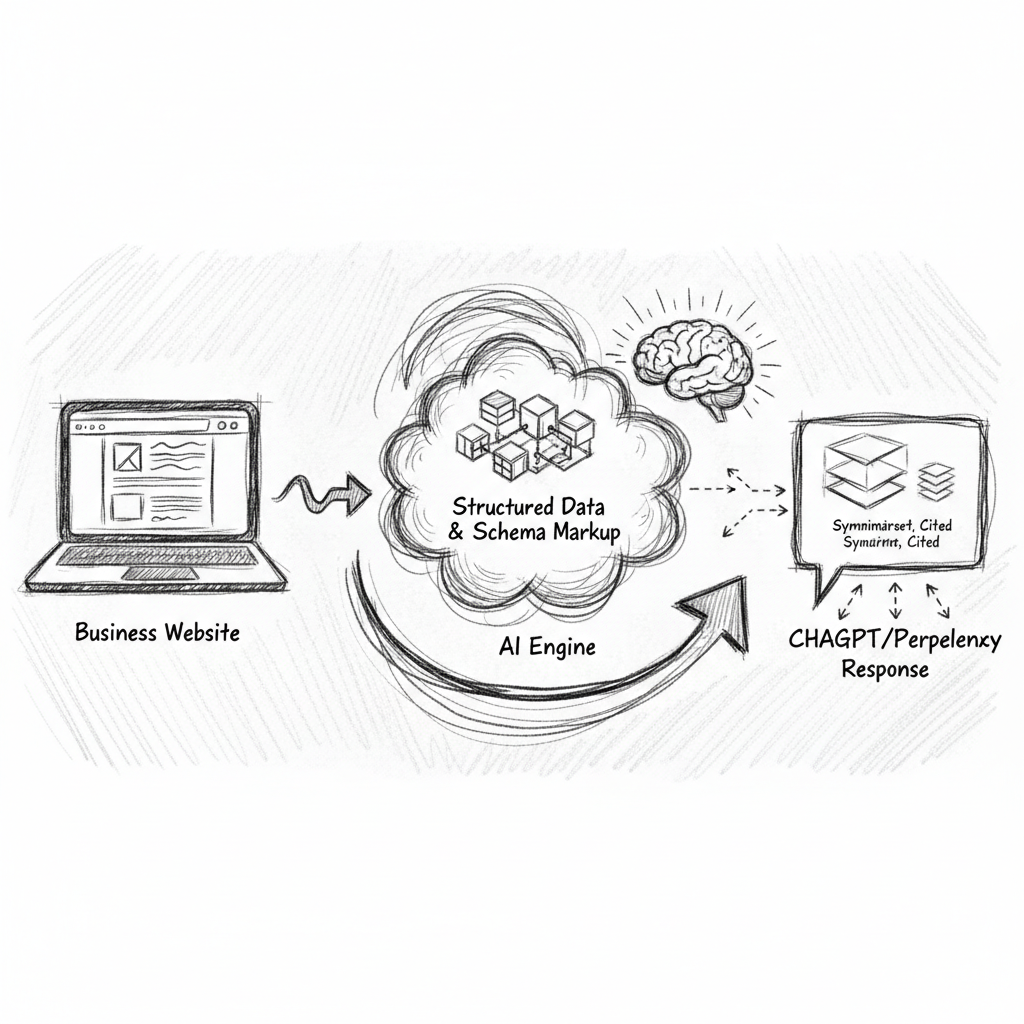
AI engines retrieve content through a combination of web crawling, retrieval-augmented generation (RAG), and trained knowledge — then synthesize answers based on source authority, content structure, and topical relevance.
The Retrieval and Ranking Mechanism
When a user submits a query to ChatGPT or Perplexity, the engine doesn't just recall memorized text. It retrieves live web content, evaluates source credibility, and assembles a coherent answer. Your business gets cited when three conditions are met:
- Crawlability: The AI engine can access and parse your content. Blocked pages, poor site structure, or missing technical signals mean the engine can't read you.
- Relevance: Your content directly and clearly answers the type of question being asked. Vague, thin, or keyword-stuffed pages don't make the cut.
- Authority: The engine has enough corroborating signals — citations, structured data, consistent entity mentions — to trust your content as a reliable source.
Google's own guidance confirms this: they recommend providing "unique, valuable content for people" and ensuring that crawlers can access your pages without obstruction [3]. The same principles apply across AI engines, with added emphasis on structured data.
Technical Signals That Influence AI Citations
The technical layer of AI search result optimization includes several specific elements that most business websites are missing entirely:
- Schema markup: Structured data that tells AI engines exactly what your business does, where it's located, and what it offers. Without it, AI engines have to guess.
- llms.txt: A newer configuration file (analogous to robots.txt) that signals to large language model crawlers which content on your site is most important and trustworthy.
- Structured content formatting: Clear headings, bullet points, FAQ sections, and definition-style paragraphs that AI engines can extract as direct answers.
- Citation signals: Mentions of your brand across reputable third-party sources, directories, and publications that AI engines use to verify authority.
The SEOPress guide on Generative Engine Optimization describes this as "shaping your content so it performs well inside AI-powered search experiences" — a process that requires both content quality and technical infrastructure working together [4].
Pro Tip: Add an FAQ section to every key page on your website. AI engines actively extract question-and-answer pairs from structured content. A well-formatted FAQ on your homepage or service page can directly feed AI-generated responses that mention your business.
Key Benefits: Why AI Search Result Optimization Matters in 2026
AI search result optimization directly affects whether your business gets discovered by customers who no longer start their search on Google — and that audience is growing faster than most businesses realize.
The Shift in Search Behavior
According to research cited by MarTech, AI search is actively reducing organic traffic to websites that haven't adapted [5]. Users are getting answers directly from AI engines without clicking through to individual sites. If your business isn't the source being cited, you're invisible to that user entirely.
Consider what this means practically:
- A user asks Gemini, "What's the best project management tool for a five-person team?" — and your SaaS product isn't mentioned.
- A tourist asks ChatGPT for hotel recommendations in your city — and your boutique property doesn't appear.
- A homeowner asks Perplexity for the best local plumber — and your competitor gets the recommendation.
These aren't hypothetical scenarios. They're happening right now, every day, across millions of queries.
Competitive and Revenue Advantages
Businesses that invest in AI search result optimization early gain a compounding advantage. AI engines develop trust in sources over time. The more consistently your content is structured, updated, and cited, the more frequently you appear in AI-generated answers.
| Optimization Approach | Traditional SEO | AI Search Optimization |
|---|---|---|
| Primary target | Google crawler / SERP rankings | LLM retrieval / AI-generated answers |
| Key ranking signals | Backlinks, keyword density, page speed | Structured data, content clarity, authority citations |
| Output format | Blue link on results page | Brand mention in AI-generated answer |
| Content freshness impact | Moderate | High — AI engines favor recently updated sources |
| Technical requirements | Meta tags, sitemap, page speed | Schema markup, llms.txt, structured Q&A, citations |
| Cost to implement (SMB) | $3,000+/month (agency) or significant DIY time | $99/month with automated platforms |
Research from the Digital Marketing Institute confirms that businesses optimizing for AI search are seeing measurable improvements in brand visibility across AI-generated responses within the first 30 to 60 days of consistent effort [6]. Results may vary depending on your niche, content volume, and competitive landscape — but the directional evidence is clear.
For a practical example of how content structure affects AI discoverability, the team behind Rapid Search Results at Coletti Coffee demonstrates how even product-focused pages can be structured to surface in AI-generated answers with the right formatting approach.
Common Challenges and Mistakes to Avoid
Most SMBs make the same handful of mistakes when approaching AI search result optimization — and each one directly reduces how often AI engines recommend them.
Treating AI Search Like Traditional SEO
A common mistake is applying Google SEO tactics directly to AI search and expecting the same results. Keyword stuffing, aggressive backlink building, and thin content may still influence Google rankings marginally. They don't help with AI citations — and in some cases, they actively undermine them.
AI engines evaluate content quality holistically. They're looking for:
- Clear, direct answers to specific questions
- Consistent entity mentions (your business name, location, category) across multiple sources
- Structured data that confirms your business's identity and offerings
- Content that demonstrates genuine expertise, not keyword repetition
In practice, we've seen businesses with strong Google rankings that are completely absent from ChatGPT and Perplexity responses — because their content was optimized for crawlers, not for language models that synthesize answers.
Ignoring Technical Infrastructure
Another pitfall: focusing entirely on content while neglecting the technical layer. According to FIU's content readiness research, many websites fail AI search visibility tests not because of poor content quality, but because AI crawlers can't properly access or interpret the site's structure [7].
Specific technical oversights to watch for:
- Missing schema markup: Without structured data, AI engines can't confirm basic facts about your business — category, location, hours, services.
- No llms.txt file: This newer standard helps LLM crawlers identify your most important content. Most SMB websites don't have one at all.
- Blocked crawl paths: Some website builders and CMS configurations accidentally block AI crawlers through robots.txt settings.
- Inconsistent NAP data: Your business Name, Address, and Phone number must match exactly across your website, Google Business Profile, and third-party directories.
Pro Tip: Run a technical AI audit before investing in content. If AI crawlers can't access or parse your site correctly, no amount of content will get you cited. Check your robots.txt, validate your schema markup using Google's Rich Results Test, and confirm your business entity data is consistent across all platforms.
Publishing Inconsistently
One limitation of many SMBs' approaches is treating AI optimization as a one-time project. AI engines weight content freshness heavily. A site that published five great articles two years ago and nothing since will lose ground to a competitor publishing regularly. The Digital Ring's research on AI search citations confirms that consistent, frequent publishing is one of the strongest predictors of citation frequency [8].
Best Practices for AI Search Optimization in 2026
Effective AI search result optimization in 2026 combines content strategy, technical infrastructure, and ongoing measurement — applied consistently over time.
Content and Structure Best Practices
The content layer is where most businesses should start. Follow these principles:
- Write in a question-and-answer format. Structure your pages around the specific questions your customers ask. AI engines extract Q&A pairs directly from well-formatted content.
- Use clear, declarative definitions. Start sections with a direct statement: "[Topic] is [definition]." This format is what AI engines pull for featured snippets and generated answers.
- Publish consistently. Daily or near-daily publishing gives AI engines fresh signals to index and cite. Even short, focused articles on niche topics contribute to your authority profile.
- Cover topics comprehensively. Thin content doesn't get cited. A complete answer to a specific question — with context, examples, and supporting detail — performs significantly better in AI retrieval.
- Build topical authority. Publishing multiple pieces on related subtopics signals deep expertise in your niche. AI engines favor sources that consistently cover a topic well over those with scattered, unrelated content.
According to Squarespace's AI SEO guide, AI engines specifically reward content that "provides authoritative, well-structured information that directly answers user queries" — not content written primarily for keyword density [9].
Technical Optimization Checklist
On the technical side, the following elements form the foundation of AI search visibility:
- Implement JSON-LD schema markup for your business type (LocalBusiness, Product, Service, FAQ, Article)
- Create and deploy an llms.txt file to guide LLM crawlers to your most important pages
- Build and maintain citations on authoritative third-party sources relevant to your industry
- Ensure your site has a clean XML sitemap submitted to major search engines
- Use structured heading hierarchies (H1, H2, H3) that reflect the logical structure of your content
- Add FAQ schema to pages that answer common customer questions
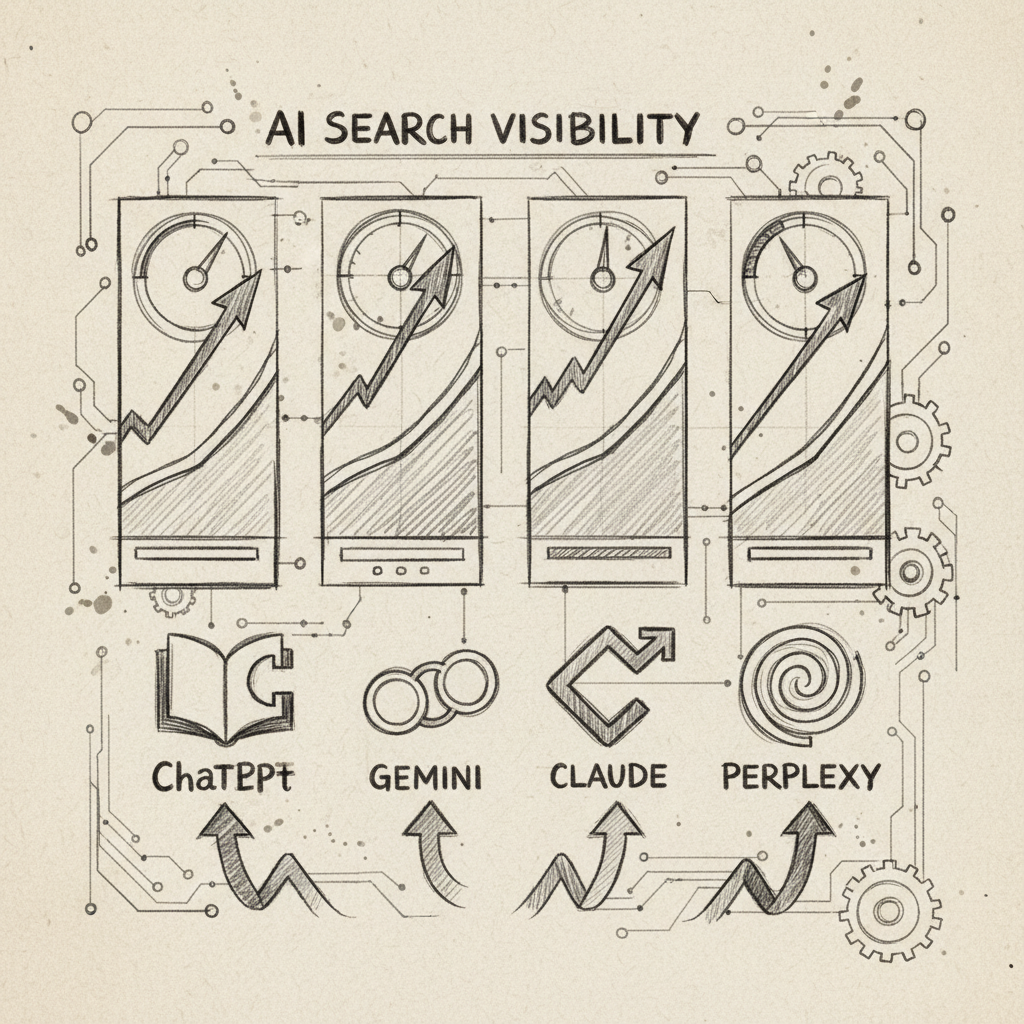
At Moonrank, we've found that businesses implementing the full technical stack — schema, llms.txt, citation building, and structured content — see measurably faster citation growth across ChatGPT, Gemini, Claude, and Perplexity compared to those who focus on content alone.
Pro Tip: Track your AI search visibility separately from your Google Analytics traffic. Tools that monitor brand mentions across ChatGPT, Perplexity, Gemini, and Claude give you a completely different dataset than traditional rank tracking. Without that measurement layer, you're optimizing blind.
The Rio SEO framework for AI search visibility identifies three core pillars: structured data, social proof (reviews and citations), and visual content optimization [10]. Applying all three together produces compounding results that neither pillar achieves alone.
Industry analysts at MarTech suggest that businesses combining technical optimization with consistent content publishing are "significantly outperforming" those relying on content quality alone — because AI engines need both the signal and the substance to confidently cite a source [5].
For SMBs without a technical team, the practical answer is automation. Platforms that handle daily content generation, technical audits, schema deployment, and visibility tracking eliminate the need to manage each element manually. This is where the $99/month model becomes genuinely competitive with agency retainers costing 30 times more.
Sources & References
- Common Crawl, "AI Optimization Is Here: Are You Ready for Search 2.0?"
- arXiv, "Generative Engine Optimization: How to Dominate AI Search", 2025
- Google Developers, "Top ways to ensure your content performs well in Google's AI", 2025
- SEOPress, "How to Optimize Content for AI Overviews and Generative Search"
- MarTech, "How to optimize your website for AI-powered search"
- Digital Marketing Institute, "How to Optimize Content for AI Search and Discovery"
- FIU, "Is your website's content ready for AI search?", 2025
- The Digital Ring, "How to Optimize for AI Search: A Guide to Search Engine Citation"
- Squarespace, "How Do AI Search Results Work?: How to Prepare for AI SEO"
- Rio SEO, "Optimizing for AI search: The SEO trifecta for local visibility"
Frequently Asked Questions
1. Is SEO dead or evolving in 2026?
SEO isn't dead — it's splitting into two distinct disciplines. Traditional SEO still matters for Google rankings, but this has emerged as a separate, equally important practice targeting how ChatGPT, Gemini, Claude, and Perplexity recommend businesses. Businesses that treat these as the same thing will underperform in both channels. The smart approach in 2026 is running both strategies in parallel, with dedicated technical and content investment in each.
2. Can AI do search engine optimization?
Yes — and as of 2026, AI-powered automation handles the full it stack for many SMBs. This includes daily content generation, schema markup deployment, llms.txt configuration, citation building, and visibility tracking across ChatGPT, Gemini, Claude, and Perplexity. The key distinction is that AI tools work best when guided by a clear keyword strategy and niche context; fully automated platforms like Moonrank handle both the strategy input and the execution, requiring no manual work from the business owner after initial setup.
3. What is AI search optimization called?
The discipline goes by several names depending on the context. GEO (Generative Engine Optimization) refers specifically to optimizing for AI-generated answers in tools like ChatGPT and Perplexity. AEO (Answer Engine Optimization) focuses on structuring content to be extracted as direct answers by AI engines. The broader umbrella term is this method, which covers both the content and technical dimensions of making your business visible and citable within AI-generated responses.
4. How long does it take to see results from AI search optimization?
Results depend on your starting point, niche competitiveness, and the consistency of your optimization effort. In practice, businesses implementing technical fixes (schema markup, llms.txt, citation building) alongside regular content publishing typically begin appearing in AI-generated recommendations within 30 to 60 days. Niche markets with lower competition often see faster results. Results may vary — but the compounding nature of AI trust signals means early movers build durable advantages over time.
5. What is the $900,000 AI job?
This refers to a high-profile AI product manager role (most notably associated with Netflix's 2023 job listing) that offered compensation up to $900,000 annually. It became a widely discussed signal of how aggressively major companies were investing in AI talent. For SMBs, the relevant takeaway isn't the salary figure — it's that AI expertise has become one of the most valued capabilities in business, and that optimizing for AI-driven channels (including this strategy) is now a core competitive priority, not a niche technical concern.
6. How do I track whether AI engines are recommending my business?
Standard Google Analytics doesn't capture AI search visibility. You need a dedicated tracking layer that monitors brand mentions and citations across ChatGPT, Perplexity, Gemini, and Claude independently. This involves querying each AI engine with relevant prompts related to your business category and location, then recording whether your brand appears in the generated answers. Automated platforms handle this monitoring continuously, surfacing weekly visibility reports without requiring you to manually test each engine.

Conclusion
this approach isn't a future consideration — it's a present-tense revenue problem for any business that isn't appearing in ChatGPT, Gemini, Claude, or Perplexity recommendations. The mechanics are clear: structured data, consistent content, technical infrastructure, and ongoing measurement. The opportunity is real. And the cost of inaction compounds every day a competitor earns the recommendation you should have received.
Our team at Moonrank recommends treating AI search visibility as a separate channel from Google SEO — one that requires its own strategy, its own technical signals, and its own measurement framework. The businesses seeing results in 2026 aren't waiting for AI search to "mature." They're building authority now, while the channel is still relatively uncrowded.
If you're ready to start getting recommended by AI search engines without hiring an agency or learning technical SEO from scratch, visit www.moonrank.ai. Moonrank handles daily content publishing, technical optimization, and AI visibility tracking on autopilot — for $99/month, with a 3-day free trial to see exactly where your business stands today.
Recommended Articles
Explore more from our content library: