Build a Winning AI-First Content Strategy in 2026
Master the AI first content strategy your business needs in 2026. Learn how to get recommended by ChatGPT, Gemini, and Perplexity with proven tactics.

| Key Insight | Explanation |
|---|---|
| AI search is a distinct channel | ChatGPT, Gemini, Claude, and Perplexity use different ranking signals than Google. Traditional SEO alone won't get you recommended. |
| Structure matters more than volume | AI engines extract answers from well-structured, semantically clear content. Schema markup and structured data are non-negotiable. |
| Consistency beats one-off publishing | Daily or weekly fresh content signals authority to AI systems, building the trust that drives recommendations over time. |
| Technical optimization is the foundation | llms.txt configuration, citation building, and structured data help AI systems parse and trust your brand's content accurately. |
| Visibility tracking closes the loop | You can't improve what you don't measure. Monitoring how AI engines mention your brand reveals gaps and opportunities. |
| Automation makes it sustainable | SMBs without dedicated marketing teams can compete by automating content generation, publishing, and technical optimization. |
Your potential customers are asking ChatGPT, Gemini, and Perplexity for recommendations right now. The question is whether your business shows up in those answers. An AI first content strategy is the system that determines whether you do. It's no longer enough to rank on page one of Google. AI search engines have become a primary discovery channel, and they operate on completely different logic.
An AI first content strategy is a comprehensive approach to planning, creating, structuring, and distributing content so that AI-powered search engines can accurately understand, trust, and recommend your business. It treats artificial intelligence as the core operating layer of your content engine, not a bolt-on tool. It matters because, as of 2026, AI search engines like ChatGPT and Perplexity collectively handle billions of queries per month, and brands that aren't structurally visible to these systems are losing customers they never even knew they missed.
This guide covers what an AI-first content strategy actually is, how it works mechanically, the benefits it delivers, the mistakes most SMBs make, and the specific best practices that separate brands that get recommended from brands that get ignored. This is particularly relevant for AI first content strategy.
What Is an AI-First Content Strategy?: AI first content strategy
An AI-first content strategy is a structured system for creating and distributing content that prioritizes visibility within AI-powered search engines like ChatGPT, Gemini, Claude, and Perplexity, going beyond traditional SEO to optimize for how large language models retrieve and recommend information.
Defining the Concept Precisely
The current top-ranking definition describes an AI-first content strategy as a system that "treats artificial intelligence as the operational backbone of your entire content engine." That's a reasonable starting point, but it understates a critical distinction. The strategy isn't just about using AI to produce content faster. It's about making your content structurally legible to AI retrieval systems so they cite, quote, and recommend your brand in response to user queries.
Two related disciplines underpin this approach:
- GEO (Generative Engine Optimization): optimizing content for retrieval by generative AI systems like ChatGPT and Gemini, which synthesize answers from multiple sources rather than listing links.
- AEO (Answer Engine Optimization): structuring content so that AI-powered answer engines extract and surface your specific information as a direct response to user questions.
According to research published by LLM CMS, "AI models need structured data, semantic clarity, and content that is explicitly organized around questions and answers" [1]. That's a fundamentally different requirement from what most businesses built their content around in the Google-first era. When considering AI first content strategy, this point stands out.
Why This Matters in 2026
AI search isn't a future trend. It's a present-tense distribution channel. Industry analysts at Candyspace note that generative engine optimization has become essential for any brand serious about organic discovery in 2026 [2]. The businesses that treat AI search as a secondary concern are already ceding ground to competitors who don't.
The stakes are especially high for SMBs. A local restaurant owner or Shopify store operator doesn't have a PR team generating the citation signals that large brands accumulate naturally. An intentional AI-first content strategy is how they level that playing field.
| Traditional SEO Focus | AI-First Content Strategy Focus |
|---|---|
| Keyword density and backlink volume | Semantic clarity and structured data signals |
| Google crawler readability | LLM retrieval and citation accuracy |
| Page rank and SERP position | Brand mentions in AI-generated answers |
| Periodic content updates | Consistent daily publishing cadence |
| Meta tags and title optimization | Schema markup, llms.txt, and citation building |
How an AI-First Content Strategy Works
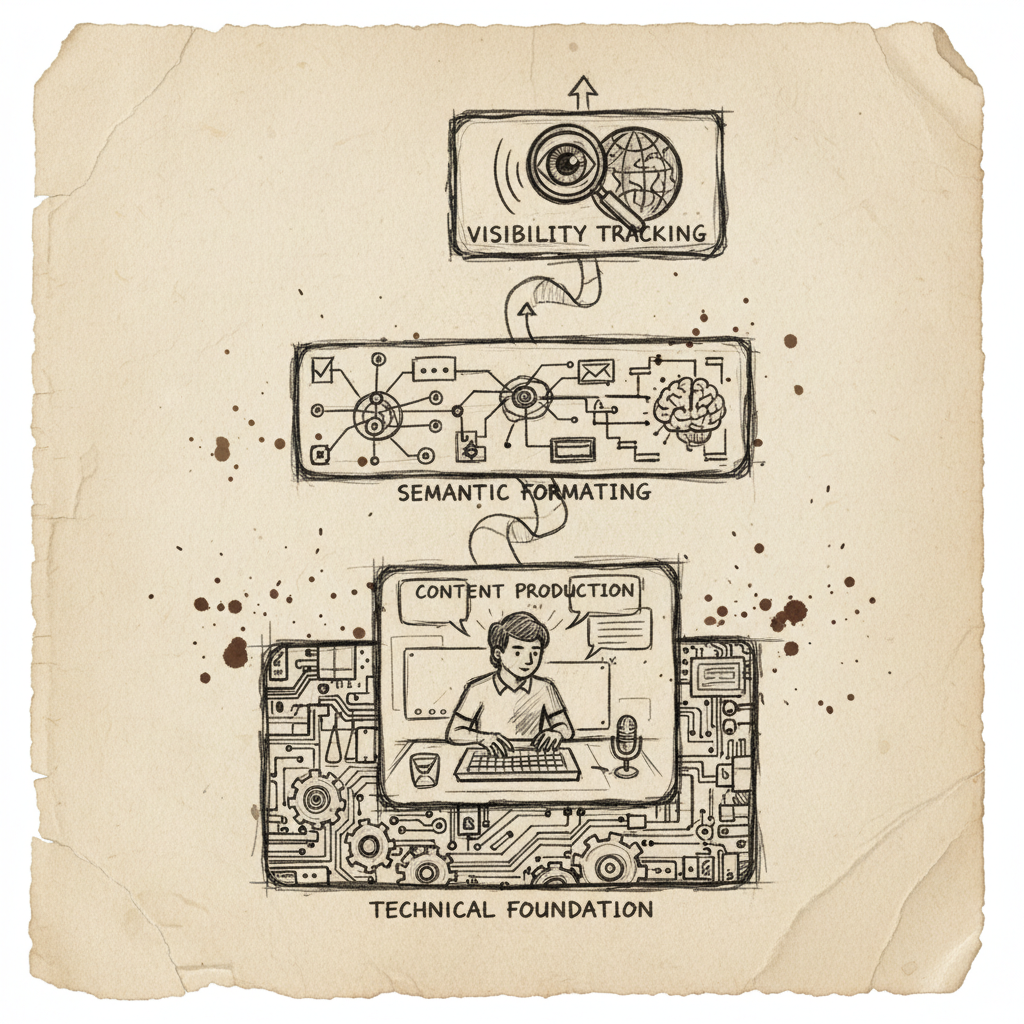
An AI-first content strategy works by combining four interconnected components: technical infrastructure that makes your site machine-readable, consistent content publishing that builds topical authority, structured formatting that enables AI extraction, and ongoing visibility tracking that measures whether AI engines are actually recommending your brand.
The Four-Layer Architecture
Think of your AI-first content strategy as a stack, not a checklist. Each layer supports the ones above it. For those exploring AI first content strategy, this matters.
- Technical foundation: This includes schema markup (the structured data that tells AI engines exactly what your business does), llms.txt configuration (a file that explicitly instructs large language model crawlers how to index your site), citation building, and structured data implementation. Without this layer, AI systems may misidentify your business category or skip your content entirely.
- Content production: Daily or near-daily publishing of semantically rich, question-answering content. AI engines favor sources that consistently address the queries their users ask. A single well-optimized page isn't enough. You need a sustained publishing cadence that signals topical authority over time.
- Semantic formatting: Content must be structured so AI systems can extract discrete answers. This means clear H2 and H3 headings phrased as questions, short direct-answer paragraphs, bullet lists for multi-part information, and FAQ sections that mirror the exact language users type into AI search engines.
- Visibility tracking: Monitoring how ChatGPT, Gemini, Claude, and Perplexity actually mention your brand in response to relevant queries. This closes the feedback loop and reveals which content types and topics drive AI recommendations.
Arkansas State University's digital media program notes that "artificial intelligence is reshaping the media landscape by coordinating, automating, optimizing, integrating and simplifying workflows" [3], which reflects exactly why automation has become central to executing this strategy at scale.
How AI Engines Actually Retrieve Content
Large language models don't crawl and rank pages the way Google's algorithm does. They retrieve content based on semantic relevance, source credibility signals, and structural clarity. According to Bradley Bartlett's analysis, "an AI content strategy defines how AI fits into your workflow, what success looks like, and where humans stay in control" [4]. That's the right framing: strategy drives the system, and the system drives the output.
From experience working with SMBs in this space, the businesses that get recommended fastest are those that make their content explicitly answer specific questions, not those that produce the most generic long-form content. Precision beats volume.
Pro Tip: Structure every piece of content around a specific question your target customer would ask an AI engine. Start with the direct answer in the first two sentences, then support it with detail. AI systems are far more likely to extract and cite content that follows this pattern.
For teams looking to streamline the operational side of content workflows, resources like How To Supercharge Your Digital Marketing Agency With ClickUp offer practical frameworks for managing multi-channel content pipelines without adding headcount. This directly impacts AI first content strategy outcomes.
Key Benefits of an AI-First Content Strategy
An AI-first content strategy delivers compounding visibility in AI search engines, reduces long-term content production costs, and positions your brand as the trusted source AI systems cite when users ask for recommendations in your category.
Visibility Where Your Customers Now Search
The most direct benefit is showing up where your customers actually are. Research from Aprimo indicates that AI-driven content strategies "streamline creation, boost engagement, and future-proof marketing" [5] by aligning content production with how modern users discover information. As of 2026, a growing share of product, service, and local business discovery happens inside AI chat interfaces, not traditional search results pages.
- ChatGPT, Gemini, Claude, and Perplexity collectively handle hundreds of millions of queries per week.
- Users who find businesses through AI recommendations tend to have higher purchase intent than those who find them through generic search results.
- AI search recommendations carry an implicit trust signal: the AI "chose" this business, which increases click-through and conversion rates.
Compounding Authority Over Time
Unlike paid advertising, which stops the moment you stop paying, an AI-first content strategy builds cumulative authority. Each piece of well-structured content adds to the semantic footprint that AI engines associate with your brand. Orbit Media's research on AI-driven content strategies confirms that consistent, targeted publishing "boosts engagement" and compounds topical authority over time [6].
A practical example: an independent hotel in Austin that publishes daily content answering questions like "best boutique hotel near South Congress" or "what to do in Austin with kids" builds a semantic association with those queries inside AI systems. After 60 to 90 days of consistent publishing, those AI systems start recommending the hotel when users ask those exact questions. This is particularly relevant for AI first content strategy.
The cost advantage is equally significant. Traditional SEO agencies typically charge $3,000 or more per month for comparable services. An automated AI-first content strategy, like the one Moonrank delivers for $99/month, produces the same daily publishing cadence and technical optimization at a fraction of that cost.
Pro Tip: Track your brand's mention frequency in ChatGPT, Gemini, Claude, and Perplexity separately. Each engine has different retrieval patterns. A business might appear consistently in Perplexity but rarely in Gemini, which points to specific content gaps you can close with targeted publishing.
Common Challenges and Mistakes to Avoid
The most common mistake businesses make with an AI-first content strategy is treating it as a traditional SEO project with AI tools bolted on, rather than building a system specifically designed for how large language models retrieve and evaluate content.
Structural and Technical Pitfalls
In practice, the technical layer trips up most SMBs. Schema markup (the structured data that tells AI engines exactly what your business does) is frequently missing, misconfigured, or outdated. llms.txt files, which explicitly instruct LLM crawlers how to index your site, are present on fewer than 5% of SMB websites as of 2026. Without these signals, AI systems either misclassify your business or skip it in favor of competitors whose content is more machine-readable.
- Missing schema markup: AI engines can't accurately identify your business type, location, or service offerings without structured data.
- No llms.txt file: LLM crawlers receive no explicit guidance on how to interpret or prioritize your content.
- Inconsistent NAP data: Name, address, and phone number inconsistencies across the web confuse AI systems trying to verify your business identity.
- Generic content: Content that doesn't answer specific questions gets deprioritized by AI retrieval systems that are explicitly looking for precise answers.
Strategic Misconceptions
A common mistake is assuming that high Google rankings automatically translate to AI search visibility. They don't. As Infinite Media Resources explains, an AI/LLM-first content strategy must be "built to help your business appear in AI Overviews, LLM responses, and natural-language search" [7], which requires a distinct set of signals from traditional SEO. When considering AI first content strategy, this point stands out.
Another pitfall: publishing content in bursts rather than consistently. AI systems build trust in sources that publish regularly. A business that publishes 20 articles in one week and nothing for the next two months sends mixed authority signals. Consistency is the mechanism, not volume.
From experience working with SMB owners, one pattern appears repeatedly: businesses invest in content creation but neglect visibility tracking. Without monitoring how ChatGPT, Gemini, Claude, and Perplexity actually mention your brand, you're flying blind. You might be producing good content that simply isn't being retrieved for the queries that matter most to your business.
Pro Tip: Before publishing any piece of content, ask: "Could an AI engine extract a direct, standalone answer to a specific user question from this page?" If the answer is no, restructure the content before publishing. Add a clear question as a heading, follow it with a 2-3 sentence direct answer, then support with detail.
Best Practices for 2026
The highest-impact AI-first content strategy practices in 2026 combine daily structured content publishing, complete technical optimization across schema markup and llms.txt, question-driven content architecture, and systematic tracking of brand mentions across ChatGPT, Gemini, Claude, and Perplexity.
Content Architecture and Publishing Cadence
Structure every piece of content around a specific user intent. The Orbit Media framework for AI-driven content emphasizes targeting, persona creation, and content gap identification as the foundation of any effective AI content strategy [6]. Apply that same logic here. For those exploring AI first content strategy, this matters.
- Map your queries: Identify the specific questions your target customers ask AI engines about your product, service, or category. Use these as your content briefs.
- Write direct-answer openings: Every piece of content should open with a 40-60 word direct answer to the implied question. This is the paragraph AI systems are most likely to extract and cite.
- Use H2 and H3 headings as questions: AI engines match heading text to user queries. "How does X work?" outperforms "About X" every time.
- Include FAQ sections: These directly mirror the question-answer pattern that AI engines use to generate responses.
- Publish consistently: Daily publishing is the gold standard. Weekly is the minimum for meaningful authority accumulation.
Technical Optimization Checklist
The Kellogg School of Management's executive program on AI-first marketing strategy emphasizes "connected workflows" and "intelligent systems" as the structural requirement for sustainable AI visibility [8]. On the technical side, that translates to:
- Implement schema markup for your business type (Organization, LocalBusiness, Product, or Service as appropriate).
- Create and maintain an llms.txt file that explicitly describes your business, its offerings, and how LLM crawlers should interpret your content.
- Build consistent citations across authoritative directories and industry publications.
- Use structured data for FAQs, how-to content, and product specifications.
- Ensure your NAP (name, address, phone) data is consistent across all online properties.
- Monitor and track AI visibility across ChatGPT, Gemini, Claude, and Perplexity with dedicated tracking tools.
At Moonrank, we've found that businesses that implement all five technical signals alongside a consistent publishing cadence typically start appearing in AI search recommendations within 30 to 60 days. Results vary based on niche competitiveness and starting baseline, but the pattern holds across industries.
The Media Copilot analysis of AI-first content strategies highlights that "distinctive voices" and "consistent reading habits" are what separate brands that build durable AI visibility from those that see only short-term spikes [9]. Consistency, specificity, and structural clarity are the three levers that matter most.
| Practice | Impact on AI Visibility | Difficulty Without Automation |
|---|---|---|
| Daily content publishing | High | Very High |
| Schema markup implementation | High | High (requires technical skill) |
| llms.txt configuration | High | High (requires technical skill) |
| Question-driven content architecture | Medium-High | Medium |
| AI visibility tracking | Medium (enables iteration) | Very High (manual monitoring) |
| Citation and NAP consistency | Medium | Medium |
Sources & References
- LLM CMS, "Building an AI-First Content Strategy: Architecture Decisions We Made," 2026
- Candyspace, "GEO in 2025: The AI-First Content Strategy," 2025
- Arkansas State University, "AI Content Strategy & Digital Media Management Explained," 2026
- Bradley Bartlett, "The New Rule of AI-Smart Content? Strategy First, Automation Second," 2025
- Aprimo, "AI-Driven Content Strategy: The Future of Marketing Innovation," 2025
- Orbit Media, "The AI-Driven Content Strategy: 6 Powerful Prompts for Content Marketing," 2025
- Infinite Media Resources, "AI/LLM-First Content Strategy: Build Content Made for AI Search," 2026
- Kellogg School of Management, "AI-First Marketing Strategy: Executing Intelligent Systems for Growth," 2026
- The Media Copilot, "What an AI-First Content Strategy Looks Like," 2025
Frequently Asked Questions
1. What is an AI-first content strategy in simple terms?
An AI first content strategy is a system for creating and structuring content so that AI-powered search engines like ChatGPT, Gemini, Claude, and Perplexity can accurately understand, trust, and recommend your business. It goes beyond traditional SEO by optimizing for how large language models retrieve information, not just how Google crawlers index pages. The goal is to appear in AI-generated answers when potential customers ask for recommendations in your category.
2. How is an AI-first content strategy different from traditional SEO?
Traditional SEO focuses on keyword density, backlink volume, and Google crawler signals. An AI-first content strategy focuses on semantic clarity, structured data, schema markup, and question-driven content architecture. Traditional SEO aims for page-one rankings in Google search results. An AI-first approach aims for brand mentions in AI-generated answers across ChatGPT, Gemini, Claude, and Perplexity. The two approaches overlap but require different technical and content decisions. This directly impacts AI first content strategy outcomes.
3. How long does it take to see results from an AI-first content strategy?
Most businesses start seeing measurable AI search visibility improvements within 30 to 90 days, provided they publish consistently and implement the full technical stack (schema markup, llms.txt, structured data). Results depend on niche competitiveness, starting baseline, and publishing frequency. Daily publishing consistently outperforms weekly publishing in terms of authority accumulation speed. Tracking tools that monitor brand mentions across AI engines help you verify progress and identify gaps early.
4. Do I need technical skills to implement an AI-first content strategy?
The technical components (schema markup, llms.txt configuration, structured data implementation) do require specialized knowledge if you're doing them manually. Most SMB owners don't have that skill set, which is why automation platforms that handle the technical layer alongside content generation have become the practical path for businesses without dedicated marketing teams. The content strategy and question-driven architecture decisions don't require technical skills, but the infrastructure does.
5. What role does llms.txt play in an AI-first content strategy?
llms.txt is a configuration file that explicitly instructs large language model crawlers how to interpret and index your site's content. Think of it as a direct communication channel between your website and AI systems. It tells LLM crawlers what your business does, what your content covers, and how they should categorize and trust your information. As of 2026, fewer than 5% of SMB websites have a properly configured llms.txt file, making it one of the highest-impact technical optimizations available for AI search visibility.
6. Can an AI-first content strategy work for local businesses, not just online brands?
Yes, and local businesses may benefit most. When someone asks ChatGPT or Perplexity "best Italian restaurant near downtown Denver" or "top-rated plumber in Austin," AI engines pull from structured local business data, consistent NAP citations, and content that directly addresses those location-specific queries. Local businesses that implement LocalBusiness schema markup, maintain citation consistency, and publish location-relevant content are well-positioned to capture AI search recommendations in their area.
7. How do I measure whether my AI-first content strategy is working?
The primary metric is brand mention frequency across AI engines: how often does ChatGPT, Gemini, Claude, or Perplexity recommend your business when users ask relevant queries? Secondary metrics include the accuracy of those mentions (does the AI describe your business correctly?) and the query types that trigger recommendations. Dedicated AI visibility tracking tools monitor these signals automatically. Without this tracking layer, you have no reliable feedback loop for improving your strategy.
8. What content formats work best for AI search visibility?
Question-and-answer content, structured how-to guides, comparison articles, and FAQ pages consistently outperform generic long-form content for AI search visibility. These formats mirror the query patterns AI engines receive and make it easy for LLMs to extract discrete, citable answers. Short direct-answer paragraphs (40-60 words) at the start of each section are particularly effective, as they match the format AI engines prefer when generating responses to user questions.

Conclusion
An AI first content strategy isn't optional for businesses that want to stay visible in 2026. It's the infrastructure that determines whether AI engines recommend you or your competitors when customers ask for exactly what you offer. The businesses winning in AI search right now aren't necessarily the biggest or the best-funded. They're the ones that publish consistently, structure their content for machine readability, and track their visibility across ChatGPT, Gemini, Claude, and Perplexity with the same discipline they once applied to Google rankings.
The good news is that this doesn't require a $3,000-per-month agency or a full-time content team. The technical foundation, daily publishing cadence, and visibility tracking that define an effective AI-first content strategy can run on autopilot. That's exactly what Moonrank is built to deliver: automated daily content generation, complete technical optimization (schema markup, llms.txt, structured data), and AI visibility tracking across all four major AI search engines, for $99/month.
Your competitors are already showing up in AI search recommendations. Visit www.moonrank.ai to start your free 3-day trial and put your business on the map where customers are actually searching.
Recommended Articles
Explore more from our content library: