Get Your Business Into Google AI Overviews
Learn how to show up in Google AI Overviews with proven tactics for content, structure, and technical SEO. Practical steps for SMBs in 2026. Discover essential.
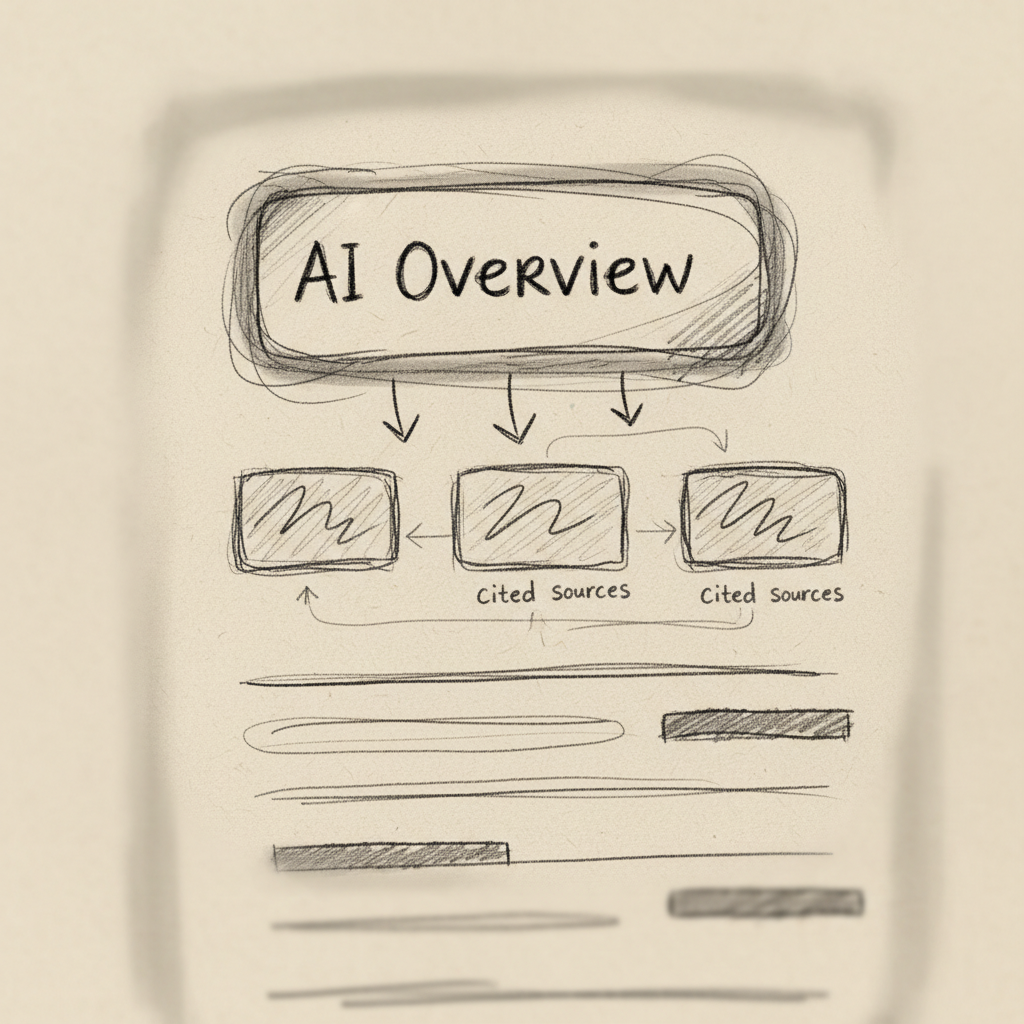
| Key Insight | Explanation |
|---|---|
| Answer-first content wins | Google's AI pulls direct, concise answers. Pages that bury the point rarely get cited in AI Overviews. |
| Traditional ranking still matters | AI Overviews predominantly source content from pages already ranking in the top 10 organic results. |
| Structured data accelerates inclusion | Schema markup and structured data help AI systems parse and trust your content faster than plain text alone. |
| AI search is a distinct channel | ChatGPT, Gemini, Claude, and Perplexity use different ranking signals than Google's traditional crawler. |
| Consistency drives compounding visibility | Daily fresh content signals authority to AI engines, increasing citation frequency over time. |
| SMBs can compete without agencies | Automated tools like Moonrank make AI search optimization accessible at $99/month versus $3K+ agency retainers. |
Knowing how to show up in Google AI Overviews is one of the most important visibility questions a business owner can ask right now. Google AI Overviews (the AI-generated summaries that appear above traditional search results) now appear for hundreds of millions of queries every day, and the brands cited inside them capture attention before anyone scrolls to the organic links below [1]. This article explains exactly what AI Overviews are, how Google decides which content to pull, and the specific steps you can take to get your business featured. You'll also learn how the same principles extend to ChatGPT, Gemini, Claude, and Perplexity, and why building for all AI search channels at once is the smarter play for any SMB in 2026.
What Are Google AI Overviews?
Google AI Overviews are AI-generated answer summaries displayed at the top of Google Search results pages, synthesizing information from multiple web sources to answer a user's query directly [2]. This is particularly relevant for how to show up in Google AI Overviews.
Definition and Context
Launched broadly in 2024 and significantly expanded through 2025 and into 2026, AI Overviews represent Google's most visible integration of large language model (LLM) technology into its core product [3]. They appear above the standard "ten blue links" for a wide range of queries, particularly informational and question-based searches.
The feature works by crawling indexed web content, identifying the most relevant and trustworthy passages, and synthesizing a response. Crucially, Google links back to the source pages, meaning inclusion in an AI Overview can drive meaningful referral traffic even when users don't scroll further [2].
Why AI Overviews Matter for Your Business
Research from Search Engine Land indicates that AI Overviews appear for roughly 15-20% of all Google queries as of 2026, with that share growing fastest in product research, how-to, and local service categories [4]. These are exactly the queries where your potential customers are making decisions.
Being cited in an AI Overview positions your brand as an authoritative source before the user even sees your website. Not being cited means a competitor's content answers the question instead. The stakes are straightforward.
- AI Overviews appear above all organic results, commanding the highest visual attention on the page
- Cited sources receive a credibility signal that traditional ranking alone doesn't provide
- Informational, how-to, and comparison queries trigger AI Overviews most frequently
- Local and product-category searches are increasingly generating AI Overview responses
- Users can expand the overview and follow source links directly to your site [1]
Pro Tip: Check which of your target queries currently trigger AI Overviews by searching them in an incognito window. Any query showing an AI Overview box is an immediate optimization target. Prioritize these over queries that only return standard organic results.
How Google AI Overviews Select Content
Google's AI Overview system selects content primarily from pages that already rank well organically, then applies additional filters for relevance, clarity, and trustworthiness [5].
The Selection Mechanics
According to Google Search Central, AI features like AI Overviews are powered by the same fundamental indexing and ranking infrastructure as standard search [5]. If your page isn't indexed and ranking, it won't be considered for inclusion. That's the baseline requirement.
Beyond ranking, Google's systems evaluate whether a page's content directly and clearly answers the query at hand. Pages that match the user's search intent with a precise, well-structured answer are far more likely to be pulled than pages that cover a topic broadly without a focused answer [6].
Industry analysts at Search Engine Land describe the selection logic this way: "AI Overviews pull clear, direct answers. If your page takes 800 words to reach the point, it usually gets skipped." [4] That observation, echoed consistently across SEO practitioner communities, points to a single core principle: answer first, elaborate second.
Signals Google Uses to Evaluate Content
| Signal | What It Means | How to Optimize |
|---|---|---|
| Organic ranking | Page must rank in top results for the query | Build domain authority, earn backlinks, optimize on-page SEO |
| Content clarity | Direct answer appears early in the content | Use answer-first structure, concise opening paragraphs |
| E-E-A-T signals | Experience, Expertise, Authoritativeness, Trustworthiness | Author credentials, citations, factual accuracy |
| Structured data | Schema markup helps AI parse content entities | Implement FAQ, HowTo, Article, and LocalBusiness schema |
| Page speed & Core Web Vitals | Technical health signals page quality | Optimize load time, LCP, CLS, and FID scores |
How to Show Up in Google AI Overviews: Content Strategy for 2026
To show up in Google AI Overviews, your content must directly answer specific queries, be structured for easy extraction, and come from a page that already earns Google's trust through ranking and authority signals [6].
Build Answer-First Content
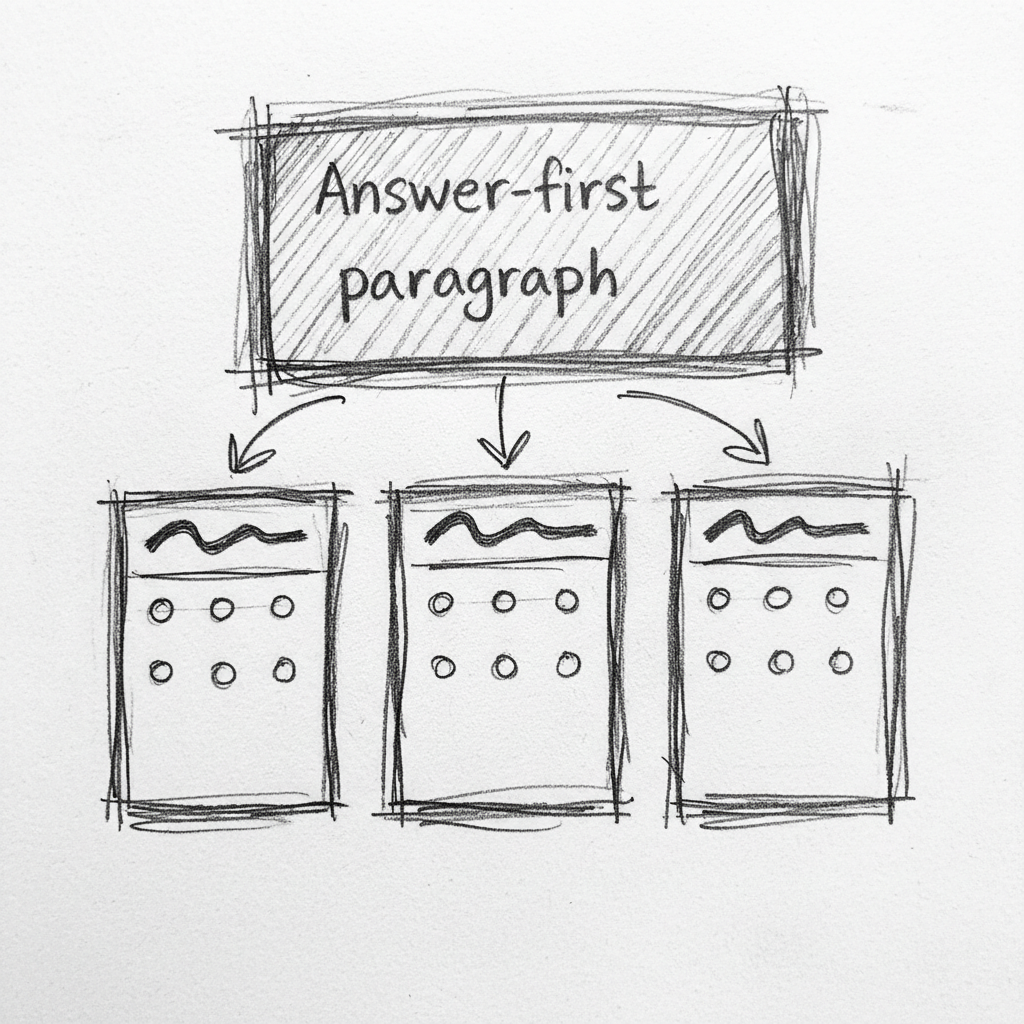
The single most effective change you can make is restructuring your content to lead with the answer. This mirrors the Inverted Pyramid model used in journalism: the most important information comes first, supporting detail follows.
- Identify the exact question your target audience types into Google (use Google's "People Also Ask" boxes and autocomplete as your research tools)
- Write a 40-60 word direct answer in the first paragraph of the relevant page or blog post, using the question's keywords naturally
- Follow with supporting detail in subsequent paragraphs, using H2 and H3 subheadings to organize topics
- Use bullet points and numbered lists to present steps, comparisons, or grouped facts — these formats are significantly easier for AI to extract cleanly
- Close each section with a concise summary sentence that reinforces the core answer
A useful framework here is the BLUF method (Bottom Line Up Front), borrowed from military communications. State your conclusion before your reasoning. AI systems, like busy readers, reward this structure [7].
Target Informational and Long-Tail Keywords
AI Overviews trigger most reliably for informational queries, not transactional ones. Queries beginning with "how," "what," "why," "best," and "can I" are your primary targets [4].
- Long-tail keywords (4+ words) generate AI Overviews more consistently than broad, competitive head terms
- Question-format keywords (e.g., "what is the best accounting software for freelancers") closely mirror how AI Overviews are triggered
- Local intent queries ("best coffee shop in [city]") increasingly generate AI Overview responses, making them high-value for local businesses
- Comparison queries ("X vs Y") are a growing trigger category as of 2026
From experience working with SMB content strategies, the businesses that gain AI Overview citations fastest are those that create dedicated pages or posts for each specific question their customers ask, rather than cramming multiple questions into a single generic page. When considering how to show up in Google AI Overviews, this point stands out.
Pro Tip: Use Google's "People Also Ask" (PAA) feature as a free content brief generator. Every PAA question for your target keyword is a potential AI Overview trigger. Create a dedicated blog post or FAQ entry answering each one clearly and concisely.
Technical Optimization That Signals Trust to AI
Technical optimization, including schema markup (structured data that tells AI engines exactly what your business does) and proper page structure, directly improves your eligibility for AI Overview inclusion [5].
Schema Markup and Structured Data
Schema markup is the most actionable technical lever most SMBs haven't pulled yet. It communicates your content's meaning to Google's AI systems in a machine-readable format, reducing ambiguity about what your page is about.
The schema types most relevant to AI Overview inclusion include:
- FAQPage schema: Marks up question-and-answer content so AI systems can directly extract Q&A pairs
- HowTo schema: Structures step-by-step guides in a format AI engines parse reliably
- Article schema: Signals content type, author credentials, and publication date
- LocalBusiness schema: Critical for any business with a physical location or local service area
- Product and Review schema: Relevant for e-commerce businesses seeking inclusion in product-related AI Overviews
According to Q-Tech's analysis of AI Overview behavior, pages with properly implemented structured data are significantly more likely to be parsed and cited by AI systems than equivalent pages without it [7].
Technical Health Signals
Beyond schema, Google's AI systems inherit the same technical quality signals as traditional search ranking. Pages that load slowly, have poor Core Web Vitals scores, or contain crawl errors are deprioritized [5].
- Ensure your Largest Contentful Paint (LCP) is under 2.5 seconds
- Fix any crawl errors visible in Google Search Console
- Use HTTPS; unsecured pages face a trust penalty across both traditional and AI search
- Implement an llms.txt file (a configuration signal specifically for LLM crawlers) to help AI engines understand your site's structure and permissions
- Build clean internal linking so AI crawlers can navigate your content hierarchy logically
At Moonrank, we've found that SMBs often have the right content but lose AI Overview citations due to fixable technical issues — slow load times, missing schema, or crawl blocks that prevent Google's systems from fully reading their pages. These are solvable problems that don't require an agency.
Common Mistakes That Keep You Out of AI Overviews
The most common reason businesses don't show up in Google AI Overviews isn't bad content — it's content that's structured in ways AI systems can't easily extract from [6].
Content and Structure Mistakes
A common mistake is writing long-form content that buries the answer deep in the body. If your blog post spends the first 600 words on background context before answering the actual question, Google's AI will likely pull from a competitor's page that answers the question in paragraph one.
- Burying the answer: Lead with the answer, not the preamble
- Thin content: Pages under 300 words rarely provide enough substance for AI to synthesize a useful response
- Keyword stuffing: Overusing target keywords signals low quality to both traditional and AI ranking systems
- Ignoring E-E-A-T: Content without clear authorship, citations, or factual grounding scores poorly on trustworthiness signals
- Neglecting updates: Outdated content (especially for topics where facts change) gets deprioritized by AI systems that favor freshness
Technical and Strategic Mistakes
One pitfall to watch for: optimizing only for AI Overviews while neglecting traditional organic ranking. Because AI Overviews source from top-ranking pages, ignoring conventional SEO fundamentals undermines your AI visibility at the same time.
- Blocking Googlebot or AI crawlers in your robots.txt file (this prevents indexing entirely)
- Missing or incorrect schema markup that confuses rather than clarifies your content's meaning
- Targeting only broad, high-competition keywords instead of specific, question-format queries that actually trigger AI Overviews
- Publishing content inconsistently, which limits the authority signals that accumulate over time
- Focusing exclusively on Google while ignoring ChatGPT, Gemini, Claude, and Perplexity, which now collectively handle billions of queries weekly
Pro Tip: Run a quick audit: search your top 5 target queries in Google and check whether an AI Overview appears. If it does, read the cited sources carefully. Notice how they're structured. That's your content template. Model your pages to match that structure, then differentiate with deeper, more accurate information.
Best Practices for AI Overview Visibility in 2026
The most effective approach to AI Overview visibility in 2026 combines consistent content production, technical precision, and multi-platform thinking — treating AI search engines as a distinct distribution channel, not an afterthought to traditional SEO [4].
Content and Publishing Best Practices
Consistency is underrated. Publishing one strong article per week builds more cumulative authority than publishing ten articles in a single month and then going quiet. AI systems, like Google's traditional ranking algorithms, reward sites that demonstrate ongoing expertise and freshness.
- Publish dedicated pages for each question your customers ask, rather than combining multiple questions on a single page
- Use clear H2 and H3 headings phrased as questions (e.g., "How does X work?" or "What is the best Y for Z?") to signal Q&A structure to AI systems
- Include a summary or key takeaways section at the top of longer articles — AI systems often pull from these for Overview responses
- Cite authoritative sources within your content; this strengthens E-E-A-T signals and mirrors the citation behavior AI systems themselves use
- Update existing high-ranking pages regularly rather than only creating new content
Multi-Platform AI Visibility Strategy
Google AI Overviews are one piece of a larger picture. As of 2026, ChatGPT, Gemini, Claude, and Perplexity collectively handle search volumes that rival Google's for many categories. Optimizing for AI Overviews and AI search broadly requires the same foundational approach: clear, authoritative, well-structured content backed by solid technical infrastructure [8].
Our team at Moonrank recommends treating AI search optimization (also called Generative Engine Optimization, or GEO, and Answer Engine Optimization, or AEO) as a unified strategy rather than a Google-only tactic. The content and technical signals that earn Google AI Overview citations are largely the same signals that earn recommendations from ChatGPT and Perplexity. For those exploring how to show up in Google AI Overviews, this matters.
| AI Platform | Primary Signal | Key Optimization Action |
|---|---|---|
| Google AI Overviews | Organic ranking + content clarity | Answer-first structure, schema markup, E-E-A-T |
| ChatGPT (with search) | Indexed web content + brand mentions | Citation building, authoritative content, llms.txt |
| Gemini | Google index + structured data | Schema markup, Google Business Profile, content freshness |
| Perplexity | Real-time web crawl + source authority | Consistent publishing, clear factual content, strong domain trust |
| Claude (with search) | Indexed content + trustworthiness signals | E-E-A-T compliance, factual accuracy, structured content |
For most SMBs, the practical challenge isn't knowing what to do — it's having the time and resources to do it consistently. That's precisely the gap that automated AI search optimization tools address. Rather than paying an agency $3,000 or more per month to manage this manually, platforms built specifically for AI search visibility can handle daily content publishing, technical optimization, and cross-platform tracking automatically.

Sources & References
- Google Support, "Find information in faster & easier ways with AI Overviews in Google Search," 2026
- Google Search, "AI Overviews: Search anything, effortlessly," 2026
- AVID Open Access, "Using AI Mode Within Google Search," 2026
- Search Engine Land, "AI SEO: How to be visible in Google AI Overviews, chatbots, LLMs," 2026
- Google Search Central, "AI Features and Your Website," 2026
- La Teva Web, "How to appear in Google AI Overviews?," 2026
- Q-Tech, "Everything You Need to Know About Google's AI Overview," 2026
- MarTech, "How to influence Google's AI Overviews," 2026
- DreamHost, "How To Show Up in Google AI Overviews (Step-by-Step Guide)," 2026
- Google Business Support, "How Can I Get My Business Listed in Google AI Search/AI Overviews?," 2026
Frequently Asked Questions
1. How do I enable the AI feature in Google Search?
Google AI Overviews appear automatically in standard Google Search for eligible queries — no special activation is required for most users. If you want access to Google's expanded "AI Mode" (a deeper conversational interface), go to Search Labs (labs.google.com/search) while signed into your Google account, and toggle on AI Mode. On mobile, open Google Search, enter a question, and look for the "AI Mode" tab below the search bar. AI Overviews themselves are visible to all signed-in and signed-out users in supported regions as of 2026 [3].
2. Why is Google AI Overview not showing up for my searches?
AI Overviews don't trigger for every query. Google's systems only generate them when the AI response is judged to add value beyond standard results — typically for informational, how-to, or research-oriented queries [5]. Transactional queries ("buy running shoes size 10") and navigational queries ("Facebook login") rarely trigger AI Overviews. If you're not seeing them, try rephrasing your search as a question. Also confirm you're not in a region or account setting where AI features have been restricted.
3. Does ranking on page one guarantee inclusion in AI Overviews?
Ranking well is necessary but not sufficient. Google's AI Overview system selects from top-ranking pages, but also filters for content clarity, direct answer structure, and E-E-A-T signals [6]. A page ranking #3 with a clear, concise answer may be cited over a page ranking #1 that buries its answer in lengthy preamble. Focus on both ranking and content structure simultaneously to maximize your chances of appearing in AI Overviews.
4. How do I know if my website is being cited in AI Overviews?
Google Search Console provides some visibility into AI Overview impressions and clicks, though as of 2026 the reporting is still maturing. The most direct method is manually searching your target queries in Google and checking whether your domain appears in the cited sources beneath the AI Overview box. For systematic tracking across Google, ChatGPT, Gemini, Claude, and Perplexity, dedicated AI search visibility tools automate this monitoring and report on citation frequency over time, giving you a clearer picture of your overall AI search footprint.
5. Can I opt out of having my content used in Google AI Overviews?
Yes. You can use the nosnippet meta tag or the max-snippet robots directive to prevent Google from using your content in AI Overviews and featured snippets [5]. However, opting out means losing the visibility and traffic benefits that AI Overview citations provide. For most businesses, the better strategy is to optimize for inclusion rather than exclusion. One limitation worth noting: opting out of AI Overviews does not affect how other AI platforms like ChatGPT or Perplexity use your publicly indexed content.
6. How long does it take to show up in Google AI Overviews?
Results vary depending on your current domain authority, content quality, and how competitive your target queries are. In practice, businesses that restructure existing high-ranking pages for answer-first content can see AI Overview citations within a few weeks. Building visibility from scratch on a newer domain typically takes 2-4 months of consistent content production and technical optimization. Consistency matters more than any single piece of content — AI systems reward sites that demonstrate sustained expertise over time [9].
7. Is optimizing for Google AI Overviews different from optimizing for ChatGPT or Perplexity?
The fundamentals overlap significantly. All AI search platforms — Google AI Overviews, ChatGPT, Gemini, Claude, and Perplexity — favor content that is clear, authoritative, well-structured, and factually accurate. The technical differences lie in specifics: Google heavily weights its own indexing and ranking signals, while Perplexity runs its own real-time crawl and ChatGPT blends indexed content with its training data. Implementing schema markup, llms.txt configuration, and consistent citation building covers the technical requirements across all platforms simultaneously [8].
Conclusion
Getting your business to show up in Google AI Overviews comes down to three fundamentals: content that answers questions directly, technical infrastructure that helps AI systems read and trust your pages, and consistent publishing that builds authority over time. None of these require a large budget or a technical team. They require a clear strategy and the discipline to execute it consistently.
The businesses winning AI search visibility in 2026 aren't necessarily the ones with the biggest marketing budgets. They're the ones whose content is structured for extraction, whose technical signals are clean, and who publish regularly enough that AI engines treat them as reliable sources. That's an achievable standard for any SMB willing to prioritize it.
If you're ready to stop guessing and start appearing, Moonrank automates the entire process: daily content publishing, technical AI optimization (schema markup, llms.txt, structured data), and visibility tracking across Google AI Overviews, ChatGPT, Gemini, Claude, and Perplexity. At $99/month with a 3-day free trial, it's the practical alternative to paying an agency $3,000 or more to do the same work manually. Visit www.moonrank.ai to see how your business currently appears in AI search, and start building the visibility your competitors are already chasing.
Recommended Articles
Explore more from our content library: