Voice Search Optimization: A Complete 2026 Guide
Master voice search optimization in 2026. Learn proven strategies, tools, and best practices to get your business found by AI-powered voice assistants.

| Key Insight | Explanation |
|---|---|
| Voice queries are conversational | People speak in full sentences and questions, not keyword fragments — so your content must match that natural language pattern. |
| Featured snippets drive voice answers | Voice assistants typically read aloud the featured snippet (position zero) result, making snippet optimization a top priority. |
| Local intent dominates voice search | A large share of voice queries include "near me" or location signals, making local SEO and Google Business Profile critical. |
| Schema markup is non-negotiable | Structured data (schema markup) helps both traditional voice assistants and AI engines parse and trust your business information. |
| AI search is the next frontier | ChatGPT, Gemini, Claude, and Perplexity now answer voice-style questions directly — requiring a new layer of AI-specific optimization. |
| Speed and mobile matter | Most voice searches happen on mobile devices, so page speed and mobile-friendliness are foundational technical requirements. |
Voice search optimization is no longer a niche tactic reserved for enterprise brands with big budgets. As of 2026, it's a core requirement for any business that wants to be found. this is the practice of tailoring your website's content, structure, and technical setup so it surfaces when people use voice-enabled devices to ask questions. It relies on natural language processing, featured snippets, and structured data. It matters because AI-powered assistants now answer billions of queries daily, and only the most optimized businesses get recommended.
The shift has accelerated faster than most predicted. Over 1 billion voice searches happen every month [1], and that number keeps climbing as smart speakers, mobile assistants, and AI chat interfaces become the default way people find local businesses, product recommendations, and quick answers. If your business isn't showing up in those responses, your competitors are.
This guide covers everything you need to know: how voice search actually works, why it matters for your revenue, the most common mistakes businesses make, and the specific tactics that move the needle in 2026.
What Is Voice Search Optimization?
it is the process of structuring your content and technical setup to rank in spoken queries from devices like smartphones, smart speakers, and AI assistants. It targets conversational language, question-based queries, and local intent signals.
The Core Definition
Traditional SEO targets typed queries. this method targets spoken ones. The difference sounds small, but it changes almost everything about how you write content, structure pages, and handle technical signals.
When someone types into Google, they might enter "best pizza NYC." When they speak, they say "Hey Google, what's the best pizza place near me open right now?" That full-sentence, conversational format is what this strategy prepares your site to answer [2].
The practice sits at the intersection of several disciplines:
- Natural language processing (NLP) — the technology AI and voice assistants use to understand spoken queries
- Featured snippet optimization — targeting position zero, the result voice assistants most often read aloud
- Local SEO — optimizing for "near me" and location-based voice queries
- Schema markup — structured data that tells search engines and AI engines exactly what your business does
- Page speed and mobile optimization — because most voice searches happen on mobile devices
Why Voice Search Is Different from Regular SEO
Voice queries tend to be longer, more conversational, and more likely to include question words like "who," "what," "where," "when," and "how" [3]. They also skew heavily toward local intent. Research from the Digital Marketing Institute indicates that roughly 58% of consumers use voice search to find local business information [4].
The stakes are also different. In typed search, you compete for positions 1 through 10 on a results page. In voice search, there's typically one answer. Either your business gets recommended, or it doesn't. That winner-take-all dynamic makes optimization more urgent.
Pro Tip: Start your voice search optimization audit by searching your own business category as a spoken question on your phone. Listen to what comes back. That's your benchmark — and your competition.
How Voice Search Optimization Works
this approach works by aligning your content with the natural language patterns, intent signals, and technical requirements that voice assistants use to select and deliver answers.
The Technical Pipeline Behind Voice Answers
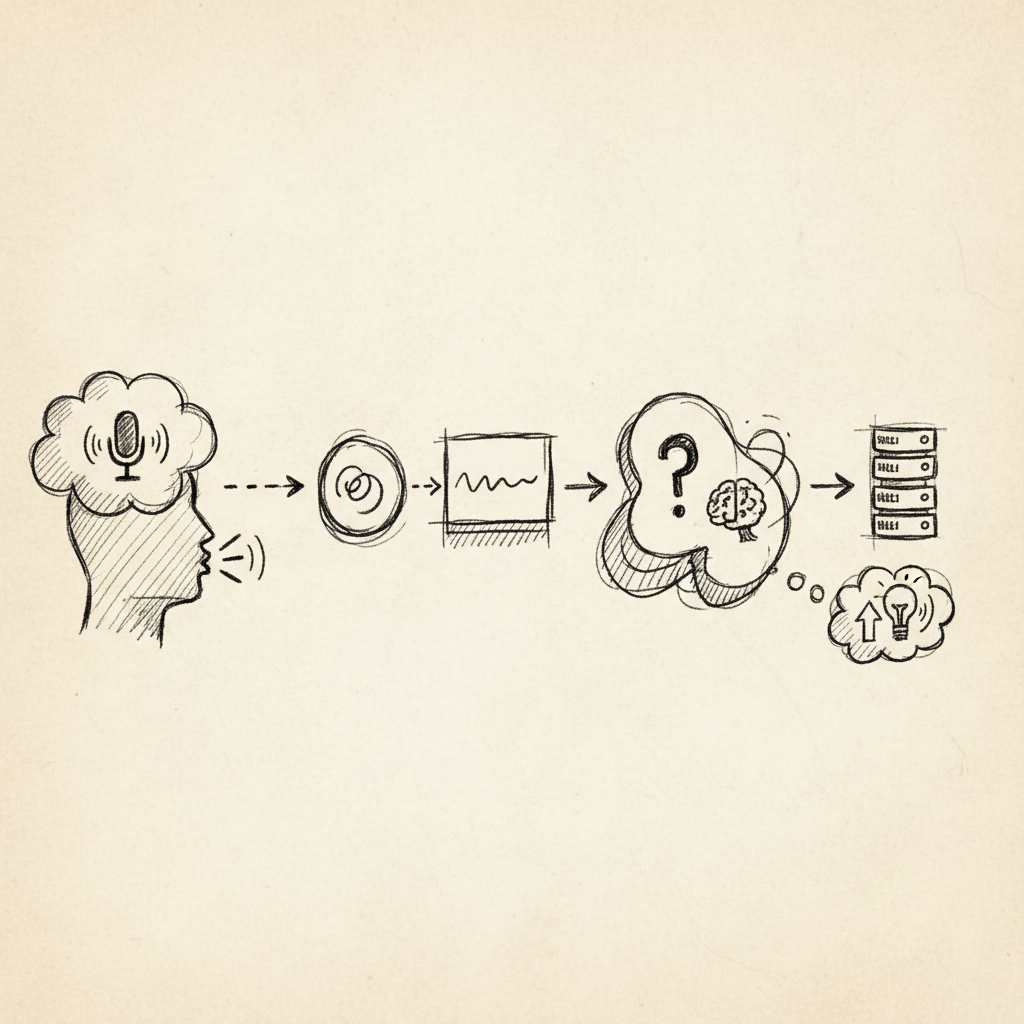
When someone asks a voice assistant a question, a multi-step process happens in milliseconds:
- Speech recognition — the device converts spoken words into text
- Query interpretation — NLP models parse the intent behind the words
- Source retrieval — the engine searches indexed content for the most relevant, authoritative answer
- Answer selection — the system picks the clearest, most concise response (often from a featured snippet or structured data source)
- Voice delivery — the answer is read aloud to the user
Your job as a business owner is to make your content the obvious choice at steps 3 and 4. That means writing in clear, direct language, structuring answers so they're easily extractable, and ensuring your technical signals (schema markup, site speed, mobile usability) don't disqualify you before you even compete [5].
How AI Search Engines Fit In
As of 2026, voice search isn't just about Google Assistant and Siri anymore. ChatGPT, Gemini, Claude, and Perplexity now handle enormous volumes of voice-style conversational queries. These AI engines use different ranking signals than traditional search — they weight content authority, citation patterns, structured data, and topical depth differently than a keyword-based crawler does.
Research published in IEEE Xplore confirms that NLP and conversational AI relevance are reshaping how SEO must be approached [6]. Businesses that optimize only for Google's traditional crawler are leaving AI-sourced traffic on the table.
This is where tools like Moonrank add a distinct layer. While traditional SEO tools track Google rankings, Moonrank tracks how your business appears across ChatGPT, Gemini, Claude, and Perplexity simultaneously — giving you visibility into the AI search channels that voice queries increasingly flow through.
For a practical example of how rapid AI-driven search results can surface local businesses, the approach used by Rapid Search Results at Coletti Coffee illustrates how even small brands can prioritize AI-ready content to appear in voice and AI-generated recommendations.
Pro Tip: Structure at least one paragraph per page as a direct Q&A pair — lead with the question as a heading, then answer it in 40-60 words. AI engines and voice assistants extract these pairs directly for spoken responses.
Key Benefits of Voice Search Optimization
this delivers measurable advantages across local visibility, featured snippet capture, and AI engine discoverability — all of which translate directly into more customers finding your business.
Visibility and Traffic Advantages
The most immediate benefit is showing up where your customers already are. Voice search usage is highest among mobile users conducting local queries — and those users have high purchase intent. Someone asking "where can I buy running shoes near me" is much closer to a transaction than someone casually browsing a blog.
Key benefits include:
- Featured snippet capture — voice assistants pull answers from position zero, so ranking there drives both typed and spoken traffic [7]
- Local search dominance — optimized local listings and schema markup make your business the default answer for nearby queries
- AI engine recommendations — well-structured, authoritative content gets cited by ChatGPT, Gemini, and Perplexity in their conversational answers
- Accessibility improvements — voice-optimized content is clearer and more structured, benefiting all users including those with disabilities [8]
- Competitive separation — most SMBs haven't invested in voice optimization, so early movers capture significant market share
Business Impact by the Numbers
| Metric | Impact | Source |
|---|---|---|
| Monthly voice searches | Over 1 billion globally | The HOTH |
| Local business voice queries | ~58% of consumers use voice for local info | Digital Marketing Institute |
| Featured snippet voice use | Primary source for voice answers | Search Engine Journal |
| AI search weekly queries | Perplexity alone: 100M+ weekly | Industry reports, 2024 |
| Voice search growth trend | Accelerating with AI assistant adoption | Semrush |
From experience working with SMB clients, the businesses that see the fastest gains from it are local service providers — restaurants, hotels, specialty retail — where "near me" queries are frequent and purchase intent is high. The optimization pays back quickly because the competition for voice-delivered answers in local niches is still surprisingly thin.
Common Challenges and Mistakes
The most common this method mistakes involve treating it like traditional SEO — using keyword-stuffed content, ignoring structured data, and neglecting mobile performance.
Pitfalls That Hurt Voice Rankings
A common mistake is writing content for typed queries and assuming it will work for voice. It won't. Voice queries are longer, more conversational, and question-driven. Content that answers "best coffee shop" won't surface for "what's the best coffee shop open near me on Sunday morning?"
Other frequent pitfalls include:
- Ignoring schema markup — without structured data, AI engines and voice assistants can't reliably parse your business name, hours, location, or services [9]
- Slow page speed — Google's PageSpeed benchmarks penalize slow sites in mobile rankings, and most voice searches happen on mobile
- Thin or vague content — voice assistants need a clear, concise answer to extract. Fluffy content with no direct answers gets skipped
- Neglecting Google Business Profile — for local voice queries, an incomplete or unverified profile is an automatic disqualifier
- Targeting only short-tail keywords — voice queries average 5-7 words. Optimizing only for 1-2 word terms misses the entire voice search format [10]
- Ignoring AI search engines — many businesses optimize for Google voice results but don't consider how ChatGPT or Gemini handle the same question
The AI Search Blind Spot
One pitfall to watch for in 2026 specifically: businesses assume that ranking well on Google automatically means they'll be recommended by AI engines. That's not accurate. ChatGPT, Gemini, Claude, and Perplexity use different signals — they weight content authority, citation patterns, and structured data in ways that differ meaningfully from Google's crawler logic.
At Moonrank, we've found that businesses with solid Google rankings often have near-zero visibility in AI engine recommendations until they specifically address the technical signals those engines rely on: schema markup (the structured data that tells AI engines exactly what your business does), llms.txt configuration (a file that guides large language model crawlers), and citation building across authoritative sources.
Pro Tip: Run a voice search audit before you optimize. Ask your top 10 business-related questions aloud on Google, Siri, and Perplexity. Track which answers come up, who provides them, and what format those answers use. That's your optimization roadmap.
Best Practices for Voice Search Optimization in 2026
The most effective this strategy strategy in 2026 combines conversational content, technical structured data, local SEO fundamentals, and AI engine-specific visibility signals.
Content and Keyword Strategy
this approach starts with language. Your content needs to match how people actually speak, not how they type. That means:
- Use long-tail, question-based keywords — phrases like "how do I," "what is the best," "where can I find," and "which [product] is right for me" [11]
- Write FAQ sections on every key page — these directly mirror the question-answer format that voice assistants extract
- Target featured snippets deliberately — format answers in 40-60 word paragraphs, use numbered lists for processes, and use tables for comparisons
- Match conversational tone — write the way your customers speak, not the way a technical document reads
- Cover question words systematically — for each topic, create content that answers who, what, where, when, why, and how
Technical and Local Optimization
Content alone isn't enough. The technical layer is what separates businesses that occasionally appear in voice results from those that consistently dominate them [12].
Key technical priorities:
- Implement schema markup — use LocalBusiness, FAQPage, Product, and HowTo schema types relevant to your business
- Optimize page speed — target a Largest Contentful Paint (LCP) under 2.5 seconds on mobile
- Claim and complete your Google Business Profile — include accurate hours, categories, photos, and regular posts
- Build local citations — consistent NAP (name, address, phone) data across directories strengthens local voice authority
- Configure llms.txt — this file signals to large language model crawlers how to interpret and trust your site's content
- Ensure HTTPS — voice assistants strongly prefer secure sites when selecting answers
- Optimize for mobile-first indexing — Google indexes the mobile version of your site first, and voice searches are predominantly mobile
Industry analysts at Search Engine Journal note that businesses combining featured snippet optimization with robust local schema see the strongest voice search performance gains [13]. The combination creates multiple entry points for voice assistants to surface your content.
For SMBs that don't have the time or technical expertise to handle schema markup, llms.txt configuration, and daily content production manually, Moonrank automates the entire stack. The platform publishes fresh SEO content to your site every day, handles all technical AI optimization, and tracks your visibility across ChatGPT, Gemini, Claude, and Perplexity — all for $99/month, compared to the $3,000+ monthly cost of a traditional SEO agency.
Sources & References
- The HOTH, "Voice Search SEO Optimization," 2026
- Simplilearn, "Voice Search Optimization: Your Key to Top Search Rankings," 2026
- Search Engine Journal, "Voice Search SEO: 9 Practical Tips For Businesses," 2026
- Digital Marketing Institute, "A Guide to Voice Search Optimization," 2026
- Pyxl, "What Is Voice Search Optimization? A Guide for Modern Marketers," 2026
- IEEE Xplore, "SEO Strategies in the Age of Voice Search: Integrating Tools for NLP and Conversational AI," 2026
- Semrush, "Voice Search Optimization: 6 Tips to Improve Your Results," 2026
- Bureau of Internet Accessibility, "Voice Search Optimization: How Accessibility Enhances VSO," 2026
- Midriff Info Solution, "How to Prepare for Voice Search Optimization," 2026
- NBH, "Hey Google, What is Voice Search Optimisation? Here's 7 Voice SEO Strategies," 2026
- Online Marketing Institute, "4 Tips to Optimize Your SEO For Voice Search," 2026
- VoiceSEO, "Voice SEO: Top Voice Search Optimization Agency," 2026
- Search Engine Journal, "Voice Search SEO: Featured Snippet and Local Schema Strategies," 2026
Frequently Asked Questions
1. Is voice search optimization worth it?
this is absolutely worth it for most businesses, particularly those with local intent — restaurants, retail shops, service providers, and hotels. Voice queries carry high purchase intent, and the competition for voice-delivered answers is still lower than for traditional typed results. For content that isn't locally focused, the optimization tactics (featured snippets, conversational language, structured data) overlap heavily with general SEO best practices anyway, so the effort pays dividends across both channels. Results will vary by niche, but there's no scenario where well-structured, fast, schema-marked content hurts your visibility.
2. Is SEO dead or evolving in 2026?
SEO is evolving rapidly, not dying. As of 2026, the field has expanded beyond Google rankings to include AI engine optimization (AEO) and generative engine optimization (GEO) — the practices that determine whether ChatGPT, Gemini, Claude, and Perplexity recommend your business in their conversational answers. Traditional keyword ranking still matters, but it's now one layer of a broader visibility strategy that includes structured data, citation authority, and AI-readable content architecture. Businesses that treat SEO as static will fall behind; those that adapt to the AI search era will gain significant ground.
3. How do you optimize for voice search?
Effective it combines several tactics working together. Start by rewriting key pages to answer specific questions in natural, conversational language — use question-based headings and 40-60 word direct answers that voice assistants can extract. Implement schema markup (LocalBusiness, FAQPage, HowTo) to give AI engines structured signals about your business. Optimize your Google Business Profile for local queries, ensure your site loads in under 2.5 seconds on mobile, and build consistent citations across directories. Finally, track your visibility across AI engines like Perplexity and ChatGPT, not just Google, since those platforms increasingly handle voice-style queries.
4. What tools help with voice search optimization?
Several tools support different aspects of this method. Google Search Console helps identify which queries drive traffic and where featured snippets exist. Semrush and Ahrefs surface long-tail, conversational keyword opportunities. Schema markup validators (Google's Rich Results Test) confirm your structured data is correctly implemented. For AI engine visibility specifically — tracking how your brand appears in ChatGPT, Gemini, Claude, and Perplexity — Moonrank provides dedicated monitoring and automated optimization at $99/month, covering the AI search layer that traditional SEO tools don't address.
5. How does voice search differ from AI search engines like ChatGPT?
Traditional voice search (Google Assistant, Siri, Alexa) typically retrieves a featured snippet or local listing from an indexed results page. AI search engines like ChatGPT, Gemini, Claude, and Perplexity generate synthesized answers by drawing on multiple sources, weighting content authority, citation patterns, and structured data signals differently. Both respond to conversational, question-format queries — but AI engines require an additional layer of optimization: schema markup, llms.txt configuration, and consistent citation building across authoritative sources. Optimizing for both channels is the complete voice and AI search strategy for 2026.
6. How long does voice search optimization take to show results?
Results timelines vary depending on your starting point, niche competitiveness, and how comprehensively you implement changes. In practice, technical fixes like schema markup and page speed improvements can influence local voice results within 2-4 weeks. Featured snippet optimization typically takes 4-8 weeks to show measurable movement. AI engine visibility — appearing in ChatGPT or Perplexity recommendations — can shift faster when authoritative content and structured data are in place, sometimes within the first 30 days of consistent optimization effort.


Conclusion
this strategy has moved from optional to essential. The businesses that show up in voice results and AI engine recommendations in 2026 are the ones that invested in conversational content, structured data, and local SEO fundamentals — not the ones waiting to see how the technology "settles."
The good news is that the core tactics are clear and actionable. Write content that answers real questions in natural language. Implement schema markup so AI engines can parse your business accurately. Optimize your local presence. And extend your visibility strategy beyond Google to include ChatGPT, Gemini, Claude, and Perplexity — the AI engines that now handle enormous volumes of voice-style queries every day.
For SMBs that don't have the time or technical resources to execute all of this manually, Moonrank handles the entire stack automatically. Daily SEO content, technical AI optimization, and AI search visibility tracking across all four major AI engines — all running on autopilot for $99/month. That's this approach and AI search visibility combined, at a fraction of what agencies charge. Visit www.moonrank.ai to start your free 3-day trial.
Recommended Articles
Explore more from our content library: