AI Search Index Freshness: Update Frequency
AI search index freshness refers to how current the data in a search index is — how quickly new, updated, or deleted documents are reflected in search...

AI search index freshness refers to how current the data in a search index is, how quickly new, updated, or deleted documents are reflected in search results. For AI-powered search systems like Azure AI Search, Elasticsearch, or retrieval-augmented generation (RAG) pipelines, stale indexes directly degrade answer quality: ChatGPT, Perplexity, and Gemini all rely on retrieval layers that can only surface what the index actually contains. Fresher indexes mean more accurate, trustworthy results.
What Is AI Search Index Freshness and Why Does It Matter?
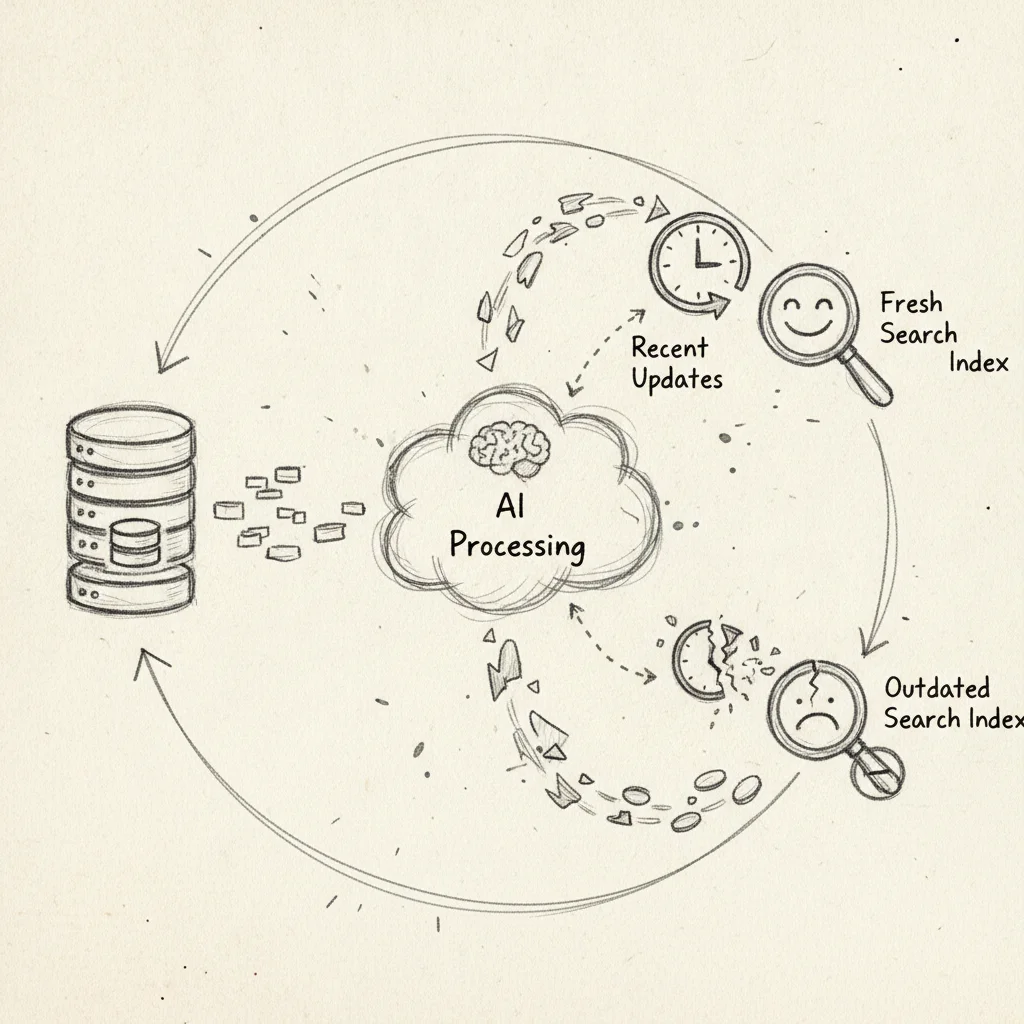
Index freshness is the lag between a document change, create, update, or delete, and that change becoming queryable in the search index, measured in seconds, minutes, or hours.
That lag sounds like a technical footnote, but for AI-powered search it determines whether a customer gets a correct answer or a confidently wrong one. A product catalog updated at 9 AM that isn't indexed until 2 PM means six hours of stale prices and out-of-stock items surfaced to real buyers, with no visible error message to signal the problem.
AI search index freshness is not just a performance metric. It is a trust and accuracy signal that systems like ChatGPT, Perplexity, and Gemini weigh when deciding whether to cite or recommend your content at all.
How AI Search Indexes Differ from Classic Search Indexes
In classic keyword search, a stale index mostly hurts ranking signals, an older document might score lower on recency but still return the right text. The user can read it and judge for themselves.
AI and vector search work differently. When a document changes, its embedding, the numerical representation the model uses to understand meaning, must be regenerated and re-indexed. If that hasn't happened, the retrieval layer feeds the language model outdated chunks. The model then produces a factually wrong answer with full confidence, citing your content as the source.
The gap matters because there is no "close enough" in retrieval-augmented generation (RAG). A stale chunk doesn't just rank lower, it actively misleads the model generating the final response.
What Agentic Retrieval Is and How Freshness Affects It
Agentic retrieval describes AI agents that autonomously query a search index across multiple steps to complete a task, booking a flight, comparing product specs, or drafting a sourced report.
Azure AI Search's agentic retrieval model [2] connects agents and LLMs to enterprise and web content so they can use multi-source signals to produce grounded answers. Each step in that reasoning chain depends on the previous result being accurate.
A stale index at step one cascades. If the agent retrieves an outdated inventory count in the first query, every downstream decision, availability check, price calculation, fulfillment estimate, inherits that error. The final output can be completely wrong even though each individual reasoning step was technically sound.
This is why businesses publishing frequent updates, new blog posts, revised pricing pages, updated product descriptions, need their content indexed within minutes, not hours. The longer the lag, the more likely an AI agent or a RAG pipeline returns an answer that damages customer trust and, ultimately, your brand's credibility with AI search engines.
How to Keep an AI Search Index Fresh and Up to Date
Maintaining AI search index freshness requires choosing the right update mechanism, decay model, and platform settings for your content type and update frequency.
Three Core Update Mechanisms
Production systems use three distinct approaches to keep indexed content current. Each suits a different operational context.
- Push (API-driven): Your application sends changes directly to the search index via API the moment a document is created or modified. This delivers near-real-time freshness but requires engineering effort to instrument every write path. Pinecone's upsert API handles this pattern well, accepting vector updates with sub-second latency.
- Pull / Indexer scheduling: The search platform polls a data source on a defined schedule and re-indexes any changed documents. Azure AI Search indexers support a minimum polling interval of 5 minutes. Elasticsearch's
refresh_intervalsetting, defaulting to 1 second but tunable per index, controls how quickly new data becomes searchable after ingestion. - Event-driven triggers: A document change fires a webhook that starts re-indexing automatically. This combines the immediacy of push with the decoupled architecture of pull, making it well-suited for e-commerce catalogs where price or inventory changes must propagate within seconds.
Freshness Decay Algorithms and Temporal Weighting Strategies
Decay algorithms reduce a document's relevance score as it ages, ensuring stale content does not outrank newer material on time-sensitive queries.
- Exponential decay: The freshness score halves every N days. Best for news and social content where recency matters most in the first 24–72 hours.
- Linear decay: Score drops at a constant rate per day. Appropriate for product catalogs where a 30-day-old listing is only modestly less relevant than a 5-day-old one.
- Step-function decay: Score drops sharply at defined thresholds, for example, full score for 0–90 days, then a steep cut. Legal and compliance documents often use this model because a document is either within its review cycle or it is not.
Azure AI Search scoring profiles implement temporal weighting through the freshnessScoringFunction, which accepts a boostingDuration parameter, an ISO 8601 duration value, to boost documents published within a defined window. A setting of P30D boosts anything published in the last 30 days, letting you tune recency bias without rewriting ranking logic.
Implementing Freshness in RAG Systems with Large Document Collections
For retrieval-augmented generation (RAG) systems managing 100,000 or more chunks, re-embedding an entire document corpus on every update is computationally prohibitive.
Chunked re-indexing solves this: the system identifies which specific chunks changed, by comparing content hashes or modification timestamps, and re-embeds only those chunks rather than the full document. In typical deployments, this reduces compute cost by up to 80% compared to full re-indexing runs.
Tools like Moonrank apply a similar principle at the content layer: rather than rebuilding an entire site's technical optimization from scratch, the platform targets the specific signals, schema markup, structured data, citations, that have drifted or gone stale, keeping AI search index freshness without redundant processing overhead.
How Index Freshness Impacts Search Relevance and Ranking
AI search index freshness directly determines whether AI-generated answers are factually accurate, stale indexes produce errors at 3–5x the rate of frequently refreshed ones.
Research on RAG (Retrieval-Augmented Generation) pipelines shows that indexes with more than 24 hours of staleness generate factual errors at roughly 3–5x the rate of indexes refreshed every 15 minutes. The effect is sharpest in fast-moving domains: e-commerce product availability, financial data, and news, where a document that was accurate yesterday can actively mislead an AI model today.
Freshness also changes how relevance scores are calculated. A highly relevant but outdated document can be outranked by a slightly less relevant but current one when freshness boosting is applied, and that trade-off is usually correct. A product page showing a discontinued price is less useful to a user than a slightly less keyword-dense page with today's inventory, regardless of what BM25 or vector similarity scores say in isolation.
For AI answer engines like Perplexity, this dynamic is especially consequential. Stale content chunks that contradict current facts are actively deprioritized during retrieval. If your content isn't fresh enough to be cited, it doesn't appear in the answer, full stop.
Using Text-Weighted Fields and Scoring Functions to Boost Freshness
Azure AI Search's scoring profiles let you assign higher weights to fields like title or summary [1], so freshness boosts apply proportionally to the parts of a document that carry the most semantic weight, not just body text that may be buried in retrieval.
The freshnessScoringFunction [1] takes four concrete parameters:
- fieldName, a
DateTimeOffsetfield that records when the document was last updated - boostingDuration, an ISO 8601 duration (e.g.,
P30Dfor 30 days) that defines the window during which the boost applies - boost, a numeric multiplier applied to the base relevance score
- interpolation, controls how the boost decays:
linear,quadratic, orconstant[1]
Choosing quadratic interpolation, for example, means very recent documents receive a steep boost that drops off quickly, useful for news or pricing data. Linear decay suits content like product guides, where freshness matters but doesn't expire abruptly.
For SMBs publishing content through a tool like Moonrank, this is exactly why daily automated publishing matters: each new piece resets the freshness clock, keeping your content inside the boosting window where AI retrieval systems are most likely to surface it.
Real-Time Indexing vs. Batch Updates: Trade-offs and Tuning
Real-time indexing delivers the freshest AI search index freshness possible, but it costs 40–60% more in compute and storage than hourly batch jobs.
Cost Differences Between Real-Time and Batch Freshness Strategies
That cost premium exists because every document write in Azure AI Search or Elasticsearch triggers index segment merges and embedding recalculations, operations that stack up fast under continuous load. Batch jobs consolidate those operations into a single pass, keeping infrastructure costs predictable.
Batch updates also make rollbacks straightforward. If a bulk product update corrupts pricing data, you revert to the previous snapshot rather than hunting down hundreds of individual real-time writes. For content on a known schedule, weekly blog posts, monthly catalog updates, nightly database syncs, batch indexing is the right default.
A practical way to choose between the two is a three-tier freshness SLA framework based on acceptable staleness:
- Tier 1, Real-time (<1 min): live inventory, breaking news, stock prices
- Tier 2, Near-real-time (<15 min): support documentation, pricing pages, product availability
- Tier 3, Batch (hourly/daily): evergreen articles, FAQs, category descriptions
Classifying every content type into one of these tiers before building your pipeline prevents over-engineering Tier 3 content with Tier 1 infrastructure, a common source of unnecessary spend.
Best Tuning Practices for Balancing Freshness and System Performance
One high-impact tuning move from Azure AI Search documentation [1]: set refresh_interval to -1 during bulk indexing to disable automatic segment refreshes, then re-enable it once the batch completes. This single change can cut bulk indexing time by 30–50% [1] because the engine stops rebuilding searchable segments mid-job.
For teams running mixed workloads, a hybrid strategy handles both ends of the spectrum. Use event-driven real-time indexing for Tier 1 and Tier 2 document types, and scheduled batch jobs for the long tail of evergreen content. The critical implementation detail is a priority queue, without one, a large nightly batch job can block real-time updates from processing, defeating the purpose of the split architecture entirely.
The goal is matching indexing frequency to business impact, not maximizing freshness across the board. Most SMB content catalogs contain fewer than a dozen document types that genuinely require sub-minute updates; everything else belongs in a cost-efficient batch lane.
How Freshness Strategies Compare Across AI Search Platforms
Each major AI search platform handles index freshness differently, Azure AI Search offers the most built-in tooling, while Elasticsearch, Pinecone, and Weaviate require progressively more custom configuration.
Elasticsearch, Pinecone, Weaviate, and Azure AI Search: Freshness Feature Comparison
Azure AI Search gives teams the most out-of-the-box control over AI search index freshness. Its indexer framework includes native change-detection policies, High Watermark for incremental updates and Soft Delete for tombstoning removed documents, plus a freshnessScoringFunction built directly into scoring profiles [1]. Indexers run on a minimum 5-minute schedule and connect natively to Azure Blob Storage, SQL Database, and Cosmos DB [2]. Teams that need freshness scoring without writing custom query logic should start here.
Elasticsearch defaults to a refresh_interval of 1 second, making it near-real-time out of the box. That interval is tunable per index, set it to -1 to disable refreshes during bulk ingestion, then restore it afterward. Elasticsearch has no native freshness scoring function; teams implement time-decay by wrapping queries in function_score with gauss or exp decay functions applied to a date field. It is the right choice when you need fine-grained decay control at scale.
Pinecone is a vector-only store. Its upsert API pushes vector-level updates in near-real-time, but there is no built-in freshness scoring. Teams encode recency as metadata, a Unix timestamp field, for example, and enforce freshness through query-time filters. It suits pure semantic search workloads where scoring complexity lives outside the index.
Weaviate supports both vector and BM25 hybrid search, with autoSchema and batch import APIs handling updates in near-real-time. Freshness boosting requires custom where filters or module-level configuration; consistency guarantees vary depending on replication setup. It is a strong fit for hybrid retrieval pipelines that need freshness enforced at the filter layer rather than through a dedicated scoring function.
| Platform | Default refresh speed | Native freshness scoring | Best for |
|---|---|---|---|
| Azure AI Search | 5-minute minimum schedule | Yes, freshnessScoringFunction |
Out-of-the-box freshness with minimal config |
| Elasticsearch | 1-second refresh_interval |
No, custom function_score required |
Fine-grained decay control at scale |
| Pinecone | Near-real-time via upsert | No, metadata filtering only | Pure vector search with external freshness logic |
| Weaviate | Near-real-time (replication-dependent) | No, custom where filters |
Hybrid retrieval with filter-layer freshness |
Frequently Asked Questions
What is a good default refresh interval for an AI search index?
There is no single correct interval, the right cadence depends on how quickly your source data changes. News and product inventory typically need hourly or daily re-indexing, while evergreen content can tolerate weekly or monthly cycles. A practical starting point: audit your highest-traffic document types, measure how often their underlying data changes, and set refresh intervals to match. Stale product pages or outdated pricing are the fastest way to lose citation trust with engines like Perplexity and Gemini.
Does index freshness affect how often ChatGPT or Perplexity cites my content?
Yes, AI engines actively favor recently updated, consistently available content when selecting sources to cite. Perplexity, which reported over 100 million weekly queries by late 2024, retrieves live web content and weights recency as a ranking signal. ChatGPT's browsing-enabled mode behaves similarly. If your pages carry outdated timestamps or stale structured data, retrieval systems are more likely to pass over your content in favor of a competitor whose index signals freshness and authority.
How do you detect which documents in a large index have gone stale?
Compare each document's lastModified timestamp against a freshness threshold you define, any document older than that threshold is a stale candidate. Beyond timestamps, track query-level signals: documents that consistently return low relevance scores or generate zero clicks despite high impression volume often reflect outdated content. Azure AI Search's scoring profiles let you apply date-based decay functions to numeric date fields [1], which surfaces stale documents automatically as their scores drop relative to fresher entries.
Can you apply different freshness strategies to different document types within the same index?
Yes, most enterprise search platforms, including Azure AI Search, support multiple scoring profiles within a single index [1], letting you assign aggressive freshness decay to time-sensitive documents (news, pricing pages) while applying a lighter decay curve to stable reference content. You invoke the appropriate profile at query time based on document type or content category. This prevents evergreen content from being penalized simply because it hasn't been edited recently.

Conclusion
AI search index freshness is not a background maintenance task, it is a direct input to whether ChatGPT, Gemini, Claude, or Perplexity surfaces your content or a competitor's. Three actions matter most: align your re-indexing cadence to how quickly each document type actually changes, apply freshness decay functions to time-sensitive content so stale pages lose rank automatically, and publish new structured content consistently so AI engines see an active, trustworthy source.
That last point is where most SMBs fall short, not because they disagree with the logic, but because daily publishing is hard to sustain manually. Moonrank automates exactly that: daily content generation, schema markup, and AI visibility tracking across ChatGPT, Gemini, Claude, and Perplexity for $99/month. Start a 3-day free trial at moonrank.ai and see where your brand currently stands in AI search results.
Sources & References
- Add Scoring Profiles - Azure AI Search | Microsoft Learn
- Introduction to Azure AI Search - Azure AI Search | Microsoft Learn
Recommended Articles
Explore more from our content library: