A Guide to LLM SEO for Getting Cited by AI Search Engines
LLM SEO helps AI engines like ChatGPT, Gemini, and Perplexity recommend and cite your business, instead of only chasing Google rankings. Learn how it works.

LLM SEO is the practice of optimizing your content so AI search engines like ChatGPT, Gemini, and Perplexity recommend and cite your business, instead of only chasing Google rankings. It differs from traditional SEO because LLMs don't rank ten blue links; they synthesize one answer from a handful of sources, favoring clear structure, direct answers, and content that reads well when pulled out of context. For SMBs, this means writing to be quoted, not just clicked, and understanding llm seo is quickly becoming as important as understanding Google's ranking factors ever were.
What Is LLM SEO and How Does It Differ From Traditional Google SEO?
Google SEO fights for a click on a results page; llm seo fights to be the sentence an AI model repeats back to a customer who never clicks at all. That's the structural split, and it changes almost everything about how you write.
Google's results page is a menu, ten blue links, a map pack, maybe a featured snippet, and the searcher picks one. An AI answer from ChatGPT or Perplexity skips the menu. It reads a handful of sources, decides which ones sound most authoritative and well-structured, and hands the user one synthesized answer. If your restaurant, Shopify store, or SaaS product isn't one of the sources pulled into that answer, you don't just rank lower, you disappear from the conversation entirely.
Why Does LLM SEO Matter for SMBs in 2026 When Google Still Dominates Search?
Google still sends most website traffic today, but AI answers are becoming the first touchpoint before a click ever happens, which means losing visibility there costs you customers Google's traffic numbers never reveal. A shopper who asks ChatGPT "best hiking boots for wide feet" and gets three brand names has already narrowed the field before opening a browser. If your brand isn't one of those three, Google traffic numbers won't show you the customer you lost, they'll just show a search that never happened on your site at all. That's the quiet risk: your Google Analytics dashboard looks stable while your actual consideration-stage visibility erodes. LLM SEO matters now precisely because this shift is happening ahead of the traffic data, not after it.
How Do LLM Training Data Cutoffs Affect Your Content's Citation Likelihood?
Large language models train on data up to a fixed date, so a business that launched, rebranded, or published its best content after that cutoff may be invisible to a model until it refreshes its training or retrieves live web results. This is why freshness signals and technical readability matter as much as writing quality, a model relying on retrieval (like Perplexity or ChatGPT's browsing mode) needs your site structured so it can find, parse, and trust newer content fast. Schema markup, an llms.txt file, and consistent citations across the web all help close that gap between what happened on your site and what the model currently knows.
None of this replaces good SEO fundamentals, both approaches reward clear, well-organized, authoritative content. Where they diverge is formatting for extraction, the citation signals models weigh, and how much freshness matters. Moonrank builds its daily content generation and technical audits around exactly this gap, keeping schema, llms.txt, and citation signals current so AI models have a reason to pull your business into the answer.
How Does Entity Recognition Play Into LLM SEO Success?
AI models build an internal map of entities, businesses, people, places, and products, and how they relate to each other across the web. A business that shows up consistently across its own site, review platforms, directories, and social profiles is easier for a model to confirm as a real, trustworthy entity worth citing. Inconsistent naming or fragmented information makes that confirmation harder, and models tend to favor the safer, more verifiable option when building an answer.
How Do AI Search Engines Find and Cite Your Content?
AI search engines cite content two ways: pulling facts from what the model already learned during training, or fetching live web pages through a retrieval step at the moment you ask a question. Understanding this split is the foundation of llm seo, because each path rewards a different kind of optimization.
A model's training knowledge is frozen at whatever cutoff date its builders used. Ask ChatGPT about something that happened after that date, and it either says it doesn't know or triggers a browsing tool that goes out and searches the live web. Perplexity works this way by default, every answer involves a real-time retrieval step, similar to how a search engine fetches results, except the model then reads those pages and writes a summary with citations. That's why a page that didn't exist last month can still show up in a Perplexity answer today, while it might take a base model's next training run to "know" about it natively.
Once a page gets retrieved, the model has to decide what to quote. This is where answer placement matters more than most business owners expect. LLMs scan for a direct answer near the top of the page, the first two or three sentences, rather than digging through a 400-word origin story before getting to the point. A blog post that opens with "Founded in 2015, our journey began..." loses to a competitor that opens with the actual answer to the reader's question. This is standard practice in llm seo work: front-load the answer, then explain.
Which Content Formats Do LLMs Prefer to Cite?
LLMs cite tables, numbered lists, Q&A blocks, and clearly labeled sections more often because these formats isolate a single fact and make it easy to lift without misquoting it.
A table row that says "Shipping time: 3-5 business days" is unambiguous. A paragraph that buries that same fact in the middle of a sentence about company history is not. Structured formats reduce the risk of the model quoting something out of context, which makes them the safer, and more frequently chosen, source material.
How Do LLM Indexing Cycles Differ From Google's Crawling and Freshness Rules?
Google recrawls sites on its own recurring schedule and updates rankings continuously as it finds new pages and links. LLMs don't follow one unified rule. Some, like Perplexity, retrieve content in real time on every query. Others depend on periodic model retraining, meaning a page published today might not factor into an answer until the next training cycle ships, which could be months away. This gap is one reason Moonrank's approach, publishing fresh, structured content daily and keeping technical signals like schema markup and llms.txt current, matters for staying visible across both retrieval-based and training-based AI search engines at once.
What Role Does Off-Site Content Play in LLM Citations?
AI models don't just read your website, they cross-reference mentions across review sites, forums, news coverage, and directories to decide how much to trust a claim. A business mentioned consistently and favorably across multiple independent sources builds a stronger citation profile than one relying solely on its own homepage copy. This is why off-site presence, not just on-site optimization, increasingly factors into whether a model treats your business as a credible answer.

What Content Changes Actually Improve LLM Visibility?
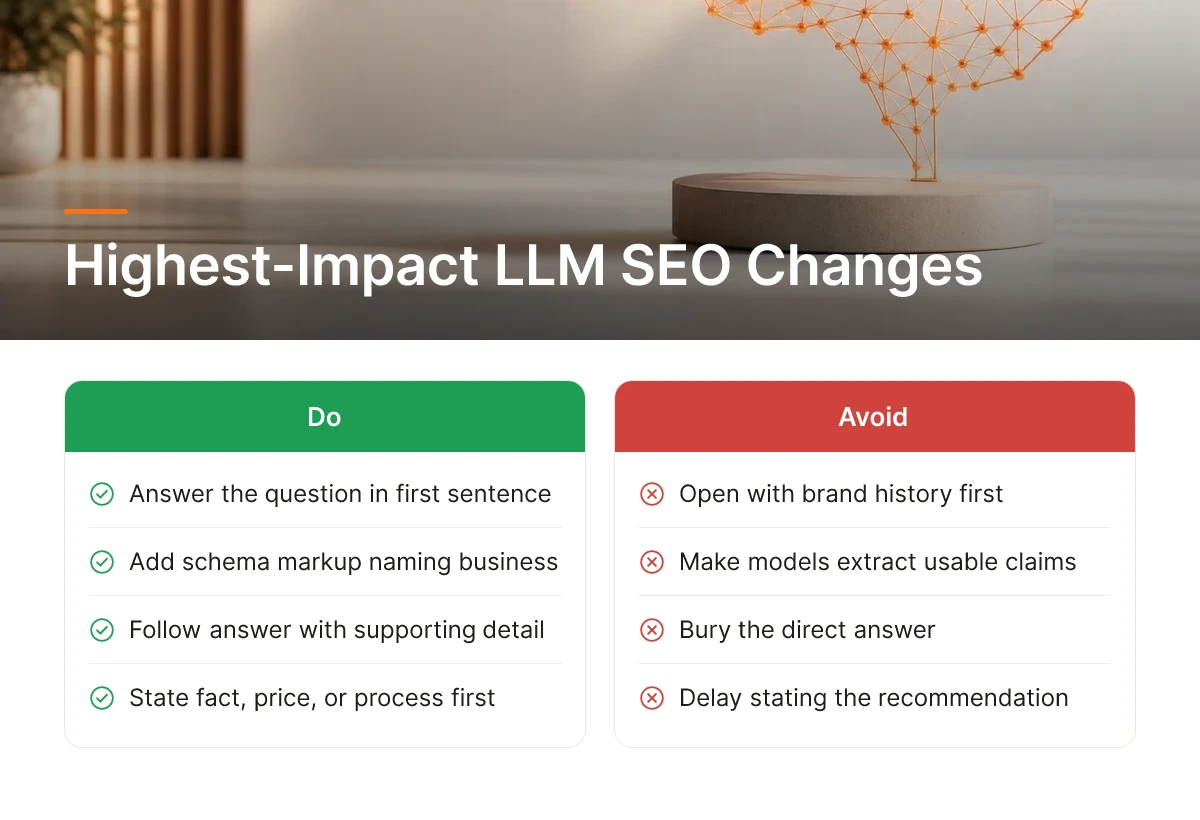
The highest-impact llm seo change is rewriting your opening paragraphs to answer the reader's question in the first sentence, then adding schema markup that names your business explicitly. Everything else builds on those two moves.
AI engines pull answers from text that reads like an answer. A paragraph that opens with three sentences of brand history before getting to the point rarely gets quoted, because the model has to work to extract a usable claim. Put the direct answer first: state the fact, the price range, the process step, or the recommendation in sentence one. Follow with supporting detail, context, and caveats. This mirrors how Perplexity and ChatGPT construct their own answers, a claim up front, evidence after, so content structured the same way is easier to lift and cite.
What HTML Markup and Schema Changes Improve LLM Citation Rates?
Schema markup is structured code added to your page that tells AI engines exactly what your business does, where it operates, and what questions it answers, without them having to guess from prose alone.
- FAQ schema wraps question-and-answer pairs in code that flags them as discrete, citable units. It tells the AI engine "here is a self-contained answer to a specific question," which is precisely the format these tools prefer to quote.
- Organization schema declares your business name, address, phone number, and category in a machine-readable format. It removes ambiguity, the AI engine doesn't have to infer that "we" in paragraph three refers to a bakery in Austin; the schema says so directly.
- Product or LocalBusiness schema (depending on your business type) lists specific offerings, price tiers, and service areas in structured fields rather than buried in marketing copy.
None of this replaces good writing. Schema tells the engine what your content means; the prose still has to say it clearly. This is one reason Moonrank builds llms.txt configuration and schema implementation into its automated technical audit, most SMB site owners have never touched a schema file and shouldn't need to.
What Does a Before-and-After LLM-Optimized Section Look Like?
Here's a typical vague opening paragraph, the kind found on most small business "About" or service pages:
"At Bella's Kitchen, we believe great food brings people together. Our passion for quality ingredients and warm hospitality has made us a favorite gathering spot for the community."
Nothing here is false, but nothing here is quotable either, no name recognition anchor, no location, no specific claim. Restructured for llm seo:
Q: What kind of restaurant is Bella's Kitchen?
A: Bella's Kitchen is an Italian restaurant in Denver, Colorado, specializing in wood-fired pizza and handmade pasta. The restaurant seats 60 guests and has operated in the Highlands neighborhood since 2016.
The second version names the business, the location, and the specific offering explicitly in text, not implied through logo or context. AI engines match entities by name, location, and category; a page that only says "we" and "our neighborhood" gives the model nothing concrete to cite or cross-reference against other mentions of the business online.
Making these changes manually across dozens of pages is doable on a tight budget but slow, and most owners stop after the homepage. Automated tools that publish restructured, schema-tagged content daily cost more than a spreadsheet and some free time, but they cover the whole site instead of one page, a tradeoff worth weighing against how many hours a restructuring project would actually take.
How Should Product and Service Pages Be Restructured for LLM SEO?
Product and service pages benefit from leading with a specific, factual summary: what the product does, who it's for, and what makes it distinct, before any lifestyle or brand-voice copy. Pair that summary with structured fields like specifications, service areas, or included features listed as bullet points rather than paragraphs. This gives an AI model a clean set of facts to extract, rather than forcing it to infer specifics from marketing language.
How Do You Measure LLM SEO Performance?
You measure llm seo by tracking citation frequency, brand mention rate, and recommendation share in AI answers, not impressions or click-through rate.
Traditional SEO gives you a dashboard full of numbers: impressions, clicks, average position, bounce rate. None of those exist inside a ChatGPT conversation. When someone asks Perplexity "best project management software for a 10-person team" and your product gets named, there's no impression logged anywhere in Google Search Console. That's the core measurement problem with llm seo, the events that matter happen inside a chat window you don't control and can't instrument the way you instrument a website.
What Are the Key LLM SEO Metrics and How Do You Track Them?
The three metrics that matter most are citation frequency (how often an AI engine references your site as a source), brand mention rate (how often your business name shows up in relevant answers, cited or not), and recommendation share (how often you appear versus named competitors when someone asks for a shortlist). Track these by running the same category questions across ChatGPT, Gemini, Claude, and Perplexity and logging the results in a spreadsheet, did your brand appear, was it cited with a link, and where did it rank relative to competitors.
The practical method is direct: type the questions your customers would actually ask. A boutique hotel owner might ask "best boutique hotels in Charleston for a weekend trip." A B2B SaaS founder might ask "top alternatives to [category leader] for small teams." Run five to ten of these prompts, screenshot the answers, and note which businesses get named and which get linked as sources. Repeat the same prompts weekly or biweekly to catch shifts, AI engines update their retrieval and ranking behavior often enough that a business absent in September can appear by November, or vice versa.
Click-through data alone understates what's happening here. A user who gets a satisfying, cited answer inside ChatGPT often never clicks through to your site at all, the AI has already answered the question. That means your Google Analytics traffic can look flat or declining even while your actual brand visibility in AI search is climbing. Visibility and traffic are now separate signals, and llm seo performance has to be tracked as its own line item, not folded into existing web analytics.
Manual prompt logging works for a business running a handful of checks a month. Once you're tracking visibility across four AI engines and dozens of category keywords weekly, that process turns into a part-time job. This is where a dedicated monitoring layer, the kind built into Moonrank's AI search visibility tracking, replaces the spreadsheet, showing citation and recommendation trends over time without the owner running a single prompt by hand.
How Often Should You Re-Check Your LLM SEO Performance?
Weekly checks catch shifts fast enough to matter; monthly checks are the minimum for staying aware of major changes. Because AI models update retrieval behavior and, less frequently, their underlying training, a business that looked strong in one check can quietly lose visibility a few weeks later without any obvious cause. Treating llm seo monitoring as a recurring habit, rather than a one-time audit, is what actually keeps a business inside AI answers over time.
What Common LLM SEO Mistakes Do SMBs Make?
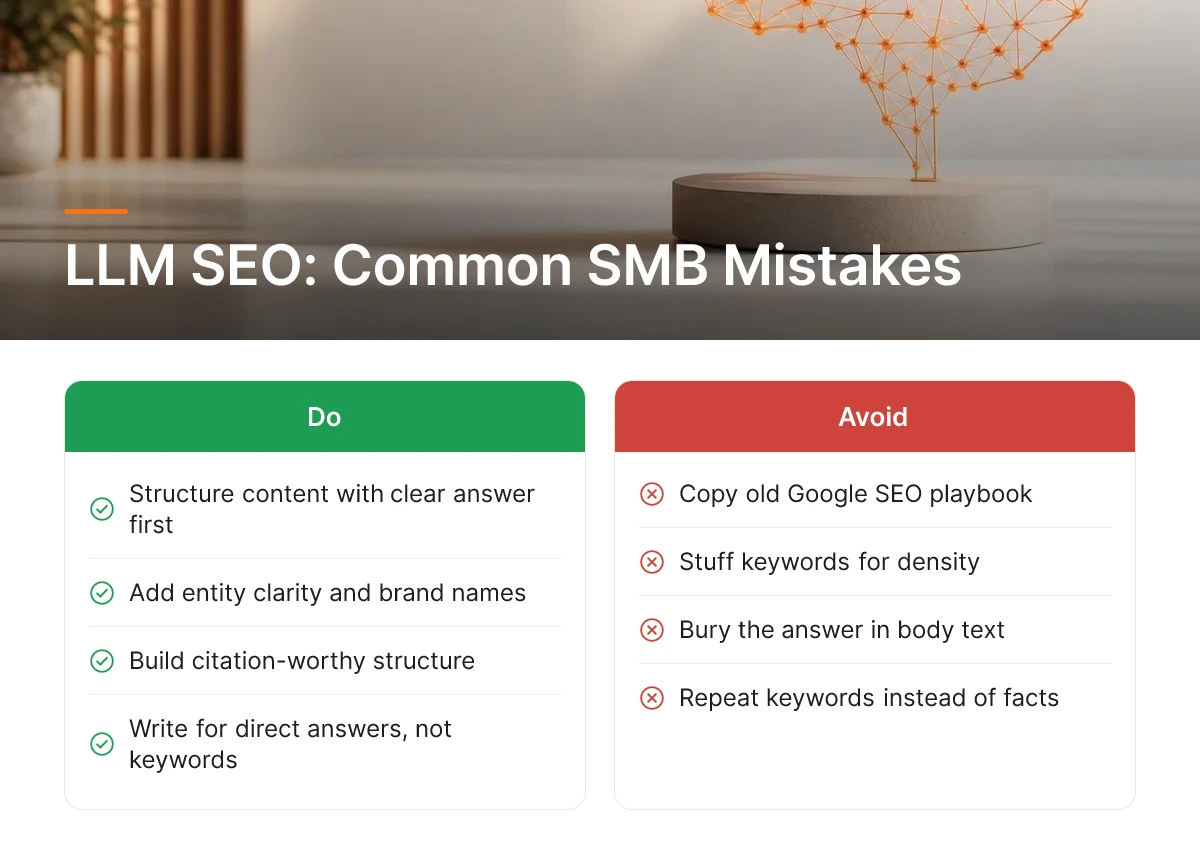
Most SMBs fail at llm seo because they copy their old Google playbook instead of restructuring content for direct answers, entity clarity, and citation-worthy structure.
The first mistake is assuming llm seo is just SEO with a new name. Keyword-stuffed blog posts written to rank on Google rarely work in AI search, because ChatGPT, Gemini, and Perplexity aren't scanning for keyword density, they're extracting facts to answer a question directly. A page built around "best hiking boots Denver" repeated five times gives an AI model nothing to quote. A page structured with a clear answer in the first two sentences, followed by specifics, brand names, prices, comparisons, gives the model something worth citing.
The second mistake is inconsistent entity information. If your business name, address, or service description varies across your website, Google Business Profile, and directory listings, AI models struggle to confirm you're a real, verifiable business, and they tend to default to competitors with cleaner data. A restaurant listed as "Tony's Pizza" on its homepage but "Tony's Pizzeria & Bar" on Yelp creates exactly the kind of ambiguity that keeps a business out of recommendations.
How Can SMBs Avoid Wasting Time on Tactics That Don't Work for AI Search Engines?
Fix the foundation once instead of chasing each AI platform separately. New AI search tools launch every few months, and it's tempting to optimize for each one individually. But the underlying fix is the same across all of them: clean entity data, structured content, and clear answer formatting. Solve that once and every model that crawls your site benefits, rather than spending weeks reverse-engineering Perplexity's quirks this month and Claude's next month.
The last mistake is never checking what AI tools actually say about the business. Owners will spend hours on content but never ask ChatGPT "who's the best [service] in [city]" to see if they show up at all. Without that check, blind spots, wrong pricing, outdated hours, a competitor mentioned instead of you, persist for months unnoticed. Moonrank's AI search visibility tracking exists specifically to close this gap, monitoring how a business appears across ChatGPT, Claude, Perplexity, and Gemini so problems get caught in days, not quarters.
Is It a Mistake to Ignore Negative or Outdated Mentions Online?
Yes, outdated or negative mentions left unaddressed can shape how an AI model describes a business long after the underlying issue is fixed. If old reviews, discontinued products, or former pricing still circulate across the web, a model may surface that stale information as fact. Actively publishing current, accurate content and encouraging fresh reviews helps push outdated signals out of the mix over time.
Frequently Asked Questions
Does LLM SEO replace the need for traditional Google SEO?
No, LLM SEO adds to Google SEO rather than replacing it, most AI engines still pull from indexed, well-ranked web content. Perplexity and ChatGPT both cite pages that already rank well on Google, so strong technical SEO remains a foundation. What changes is the layer on top: structured data, clear answer-style formatting, and citation building that help AI models parse and trust your content specifically.
How long does it take to see results from LLM SEO changes?
Most businesses start seeing citation changes within four to eight weeks, though full visibility shifts can take longer. AI models refresh their retrieval sources on different schedules than Google's crawler, so results appear unevenly across ChatGPT, Gemini, and Perplexity. Consistent daily content and technical fixes compound faster than one-time changes.
Can small businesses compete with larger brands for AI citations?
Yes, small businesses often compete better in AI search than in traditional Google rankings, especially for niche or local queries. AI engines favor clear, specific, well-structured answers over domain authority alone, so a boutique hotel or specialty retailer with precise content can get cited ahead of a national chain with vaguer pages. Consistency and technical readability matter more than backlink count here.
Do I need structured data on every page for LLM SEO to work?
No, but priority pages, product pages, service descriptions, and FAQs, benefit most from structured data. Schema markup and an llms.txt file help AI engines understand what your business does and trust the information. Focus effort on pages most likely to answer a customer's actual question first.
Should SMBs hire an agency or handle LLM SEO in-house?
Either can work, depending on available time and technical comfort. In-house teams with someone willing to learn schema markup and monitor AI answers regularly can manage it, especially for a smaller site. Businesses without that bandwidth often turn to automated tools or agencies that handle technical audits, content restructuring, and visibility tracking as an ongoing service rather than a one-time project.
Conclusion
Getting recommended by ChatGPT, Gemini, and Perplexity comes down to three things: technical readability (schema markup, llms.txt), consistent content that directly answers customer questions, and ongoing visibility tracking to see what's actually working. Waiting on a quarterly SEO agency report no longer fits how fast AI search moves.
Start by checking how your business currently appears when someone asks an AI engine for a recommendation in your category, if you don't show up, that's your starting point, not a footnote. Moonrank runs that audit, publishes the daily content, and tracks the results automatically at a straightforward monthly rate.
Recommended Articles
Explore more from our content library: