A Practical Guide to Choosing AI Search Optimization Tools
Learn how AI search optimization tools help SMBs track citations, structure content, and get recommended by ChatGPT, Gemini, and Perplexity.
Understanding ai search optimization tools is essential. SMBs can optimize for AI search engines like ChatGPT, Gemini, and Perplexity using tools that track AI-generated citations, structure content with schema markup and llms.txt files, and monitor how often a brand gets recommended in AI answers. These tools fall into three categories: AI visibility trackers (showing when and how your brand appears in AI responses), content structuring platforms (formatting pages so AI engines can parse and cite them), and combined platforms that automate both. The right mix depends on whether you need monitoring, content production, or both.
What Are AI Search Optimization Tools and Why Do SMBs Need Them Now?
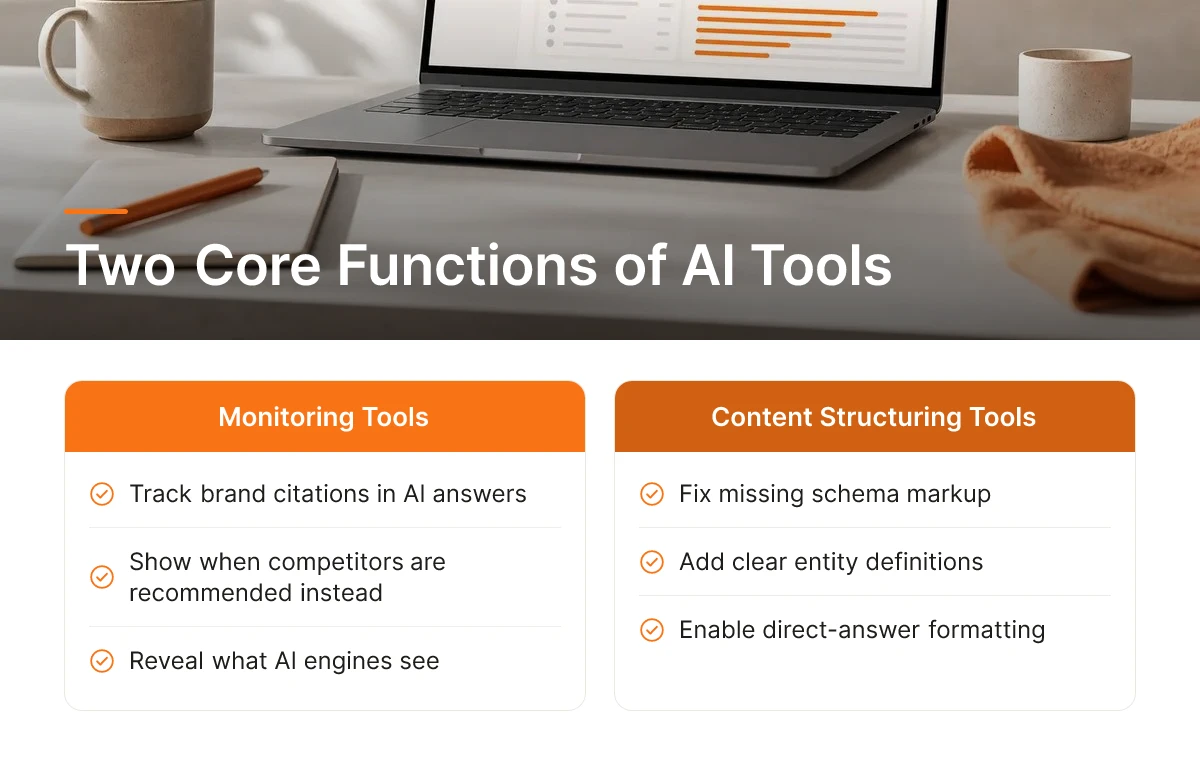
AI search optimization tools split into two functions: some track when and how a brand gets cited inside AI answers, others help build the content that earns those citations in the first place. A handful of platforms, including Moonrank, try to do both at once.
The distinction matters because they solve different problems. A monitoring tool tells you that ChatGPT recommended a competitor instead of you when someone asked for "the best hiking boots under $150." A content structuring tool fixes the underlying reason your page wasn't the one cited, missing schema markup, no clear entity definition, no direct-answer formatting a language model can lift and quote. Buying only one half of the stack leaves a gap: you either know you have a visibility problem without a way to fix it, or you're publishing content with no way to confirm it's working.
Why Is AI Search Visibility Becoming Important for SMBs Right Now?
Buyers increasingly get their answer inside ChatGPT, Gemini, Claude, or Perplexity and never click through to a website at all, which means being the cited source now matters more than ranking on a results page. Roughly 40% of Google searches already return zero clicks as users shift toward AI-generated answers, and Perplexity alone reported over 100 million weekly queries by late 2024 [2], a scale that turns AI answers into a real distribution channel, not a side experiment. For SMBs, the window is narrower than it is for large brands. Enterprises publish thousands of pages, so any single page's absence from an AI engine's index barely registers. A boutique hotel or a five-person SaaS company might have thirty pages total, each one carries outsized weight in whether an AI model finds, trusts, and cites the business at all. Miss the formatting on a handful of key pages and there's little else for the model to draw on.
What Technical and Content Changes Are Needed to Appear in AI Search Results?
Appearing in AI answers requires structured data, clearly defined entities, direct-answer formatting, and machine-readable files like llms.txt that tell AI crawlers what a site contains and how to interpret it. Schema markup labels a business's products, services, and location in a format machines parse reliably, rather than requiring an AI model to infer that information from paragraph text. Direct-answer formatting means writing the sentence a model can quote wholesale, rather than burying the answer under three paragraphs of preamble. None of this is manual work most business owners have time for, which is the gap AI search optimization tools exist to close, automating the technical fixes and content production that used to require a developer and a content writer working in tandem.
How Do AI Engines Decide Which Sources to Recommend?
AI engines pull answers from indexed content that is easy to parse, then cross-check the facts against multiple sources before quoting or recommending a business by name.
That process starts with retrieval, not ranking in the Google sense. Large language models and the retrieval systems behind ChatGPT, Gemini, and Perplexity search an index of crawled pages for passages that answer the query directly. Pages structured with clear headings, defined entities (business name, location, service, price tier), and direct-answer sentences get pulled into that retrieval set far more often than pages built around narrative brand storytelling. This is the mechanical layer that any of the ai search optimization tools on the market are ultimately trying to influence, not a ranking algorithm, but a selection-and-verification pipeline. For a broader look at how these platforms compare, see this overview of top AI visibility tools.
What Ranking Factors Matter Most When AI Engines Choose Sources to Cite?
Consistency and citability decide most of the outcome. AI engines weigh how uniform a business's facts are across its own site, directory listings, review platforms, and third-party mentions, matching hours, addresses, pricing tiers, and service descriptions build a trust signal that a single well-written page cannot replicate alone.
Citation-worthy content also looks different from content written to persuade a human reader through a sales funnel. A page optimized for traditional ranking might use long paragraphs, emotional framing, and calls to action. A page that gets quoted inside an AI answer tends to state a fact in one unambiguous sentence: "Our standard installation takes 3 business days" reads as extractable; "We pride ourselves on fast, reliable service" does not. Concise, quotable, fact-first copy gets pulled into generated answers more often than persuasive long-form copy, even when the long-form page ranks well in traditional search.
How Do AI Hallucinations and Accuracy Issues Affect Which Sources Get Recommended?
Hallucination risk pushes AI engines toward sources that reduce ambiguity, because vague or figurative language raises the odds of a misquote. When a model has to infer meaning from marketing language rather than read a plain statement, it introduces error, and AI systems are tuned to avoid citing sources that create that risk. Businesses that write in plain, literal terms about what they do, where, and for how much get selected more consistently than those relying on tone and metaphor.
This selection mechanism connects directly to how models get trained on data in the first place and how search quality scoring evaluates a source once it's in the index, both covered earlier in this piece for readers who want the fuller technical picture.
Which AI Search Optimization Tools and Platforms Should SMBs Use?
Most SMBs need three things: a way to see where they're mentioned, a way to fix how AI engines read their site, and a way to keep publishing content those engines can cite. Few tools do all three well, so knowing which category you're buying matters more than any single feature list.
The market for ai search optimization tools breaks into three functional groups. The first is citation and visibility monitoring, dashboards that track how often ChatGPT, Gemini, Claude, and Perplexity mention your brand, and in what context. The second is content structuring and schema automation, tools that generate or fix the structured data, schema markup, and llms.txt files that help AI crawlers parse your site correctly. The third is full-stack platforms that combine monitoring with automated publishing, closing the loop between "here's your gap" and "here's the content that fixes it."
Cost tiers roughly track that functional split. Budget-friendly tools tend to offer visibility reporting only, useful for diagnosis but not for fixing anything. Mid-range tools usually add schema automation or basic content recommendations, requiring a separate writer or agency to act on them. Premium and enterprise platforms bundle monitoring, technical fixes, and publishing into one system, which is where the per-tool cost drops relative to hiring an agency to do the same work manually. For more information, see Search Engine Optimization.
How Do You Compare AI Visibility Platforms by Features and Results Delivered?
Ask three questions before buying: does it track citations across multiple AI engines, does it automate the technical fixes those engines reward, and does it publish content or just hand you a report. A tool that only monitors Perplexity, for instance, misses the fact that ChatGPT and Gemini often draw from different source sets [1]. A platform that flags missing schema markup but doesn't implement it just shifts the work back onto you or a developer.
Moonrank was built around that gap, it tracks visibility across ChatGPT, Gemini, Claude, and Perplexity, then automates the schema markup, llms.txt configuration, and daily content publishing needed to close what it finds, rather than stopping at a diagnostic report.
What Does a Step-by-Step Workflow Look Like for Adding AI Search Optimization to Your SEO Stack?
AI visibility tools should sit alongside your existing analytics and content stack, not replace it. Google Analytics still tells you what happens after a click; an AI visibility platform tells you whether you're being recommended before that click ever happens.
- Audit current visibility. Find out whether ChatGPT, Gemini, Claude, and Perplexity mention your business at all, and how competitors compare.
- Fix structural gaps. Add or correct schema markup, llms.txt, and citation-worthy data so AI crawlers can parse and trust your content.
- Publish citation-friendly content. Keep adding pages structured around the specific questions customers ask AI engines, not just Google keywords.
- Monitor and iterate. Recheck visibility monthly and adjust, this isn't a one-time setup, since AI engines re-crawl and re-rank continuously.
The traditional SEO industry framed this as a wholesale replacement of old tactics with new ones [2]. In practice, it's an addition: keep your existing SEO stack running and layer AI-specific tracking and technical fixes on top of it.
How Do You Measure Whether AI Search Optimization Is Working?
Track four numbers: how often you're cited across AI engines, your share of voice against named competitors, referral traffic tagged from AI platforms, and whether the AI's description of your business is accurate.
Keyword-rank tracking, the backbone of traditional SEO, doesn't translate to AI search. There's no position-one slot to chase, an AI engine either mentions your business in its answer or it doesn't, and it often names three or four businesses in the same response with no ranking implied. What matters is appearance frequency: how often ChatGPT, Gemini, Claude, or Perplexity surface your name when someone asks a relevant question in your category, not where you'd rank on a results page that no longer exists in that context.
What ROI Metrics Should SMBs Track When Investing in AI Search Optimization Tools?
Four metrics matter more than any others when you're evaluating ai search optimization tools. Citation frequency tells you how often your business gets named in AI-generated answers for queries tied to your niche. Share of voice compares that frequency against two or three named competitors, if a rival shows up in 8 out of 10 relevant prompts and you show up in 2, that gap is your opportunity. Referral traffic from AI platforms, sessions tagged as coming from chatgpt.com, perplexity.ai, or similar, shows whether citations convert to visits. Brand mention accuracy checks whether the AI describes your hours, location, and offerings correctly, since a wrong address in a ChatGPT answer costs you the customer before they ever click.
How Do You Benchmark AI Search Visibility Gains Against Tool and Implementation Cost?
Start by measuring where you stand before you change anything. Run 15-20 realistic customer queries, "best [your category] in [your city]," "top [your niche] brands", across the major AI engines and log how often you appear versus competitors. That baseline is your reference point. After adopting a tool, rerun the same queries monthly and track the change in citation frequency and share of voice against the cost tier you chose, whether that's a budget-friendly automated platform like Moonrank or a premium managed service.
To connect visibility to revenue, watch for direct-traffic spikes and inquiry volume that line up with when your optimization work started. If bookings or sales tick up in the weeks after your citation frequency rises, that correlation, paired with tagged AI referral data, is the clearest attribution signal available today.
AI Search Optimization vs Traditional Google SEO: What's the Difference?
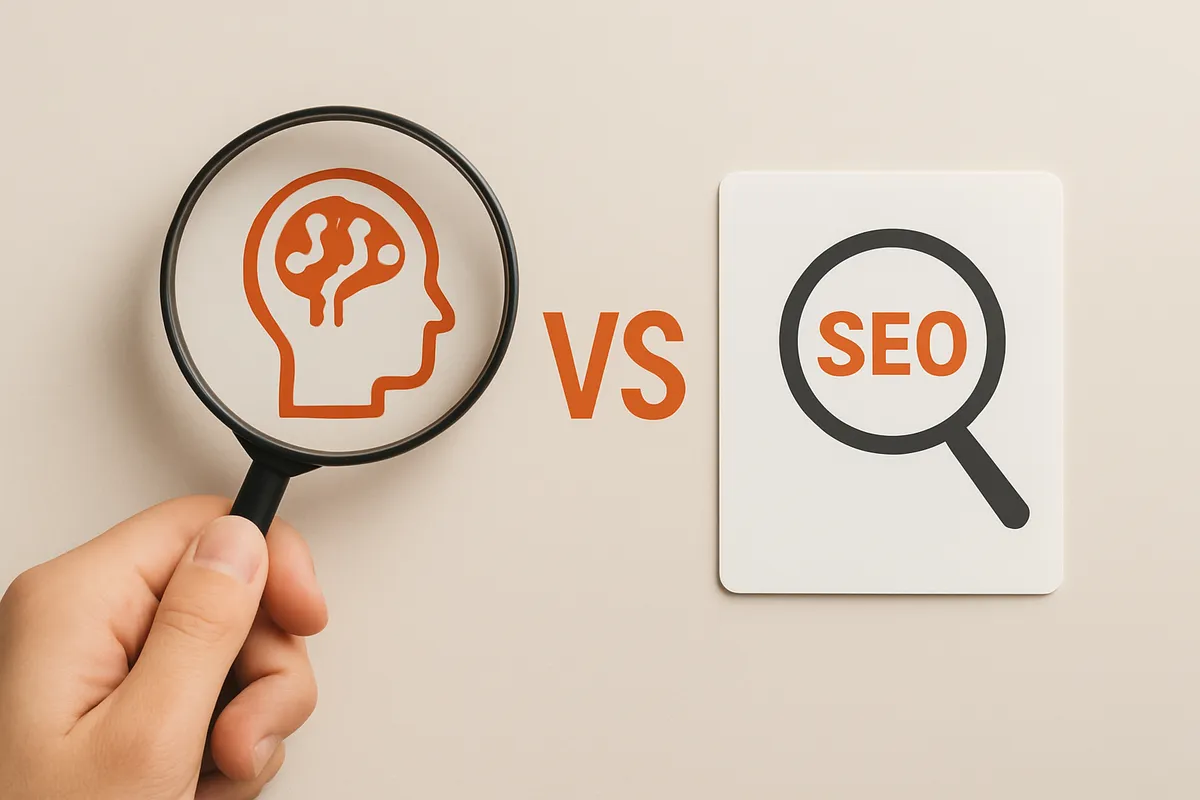
Traditional SEO chases a ranked position and a click; AI search optimization aims to become the fact an AI engine cites in its answer, with no click at all.
That distinction changes what "winning" looks like. A top-three Google ranking still sends a visitor to your site. Getting cited by ChatGPT or Perplexity means a customer gets your business name, hours, or pricing folded directly into the answer, they may never visit your homepage before they call or buy. Both outcomes drive revenue, but they're measured differently, and a business tracking only click-through traffic will miss the second channel entirely.
The two disciplines share more foundation than most owners assume. Clear site structure, accurate business information, and content organized around real questions help both a Google crawler and an AI retrieval system understand what you do. Fast-loading pages, clean HTML, and consistent entity signals, your business name, address, and category stated the same way everywhere, serve Google's index and an AI model's training or retrieval pass simultaneously. Most of the technical groundwork isn't wasted effort split between two goals; it's shared infrastructure.
Where they split is in what earns the top spot. Backlink volume, long a core lever in Google rankings, carries less weight in whether an AI engine chooses to cite you [2]. AI systems favor content that states facts plainly and matches those facts consistently across your site, reviews, and third-party listings, a direct-answer paragraph beats a keyword-stuffed page every time. This breakdown of AI search optimization strategies covers several of these tactics in more depth.
Can You Optimize for Both AI Search Engines and Google at the Same Time?
Yes, the two can run in parallel without competing for the same budget or the same piece of content.
A well-structured product page with clear schema markup and a direct-answer summary near the top serves a Google featured snippet and an AI citation at once. Treating them as rival priorities usually means a business ends up under-investing in both.
Which Optimization Approach Should SMBs Prioritize First?
Start where your inquiries already come from. If most current leads trace back to Google search, keep that engine funded while adding AI-readiness on top rather than replacing it.
If customers increasingly mention they "asked ChatGPT" before contacting you, or a competitor is showing up in AI answers where you're absent, that's the signal to weight new spend toward AI search optimization tools instead of another round of backlink building. Moonrank's daily content publishing and technical audit, schema markup, llms.txt, structured data, are built to run underneath both efforts at once, so the choice isn't either/or.
Frequently Asked Questions
Do AI search optimization tools replace the need for traditional SEO tools?
No, they work alongside traditional SEO rather than replacing it. Google still drives significant traffic, and technical fundamentals like site speed, mobile usability, and clean indexing matter for both Google and AI crawlers. AI search optimization tools add a layer on top, structured data, citation building, and visibility tracking across ChatGPT, Gemini, and Perplexity, that traditional SEO platforms weren't built to handle.
How long does it take to see results from AI search optimization efforts?
Most businesses start seeing measurable citation activity within 4 to 8 weeks of consistent technical and content work. AI models refresh their training and retrieval sources on different schedules, so visibility often improves gradually rather than overnight. Consistent daily publishing tends to compound faster than one-off content pushes.
Can a small business handle AI search optimization without hiring an agency?
Yes, especially with automated platforms designed specifically for non-technical owners. The hardest parts, schema markup, llms.txt configuration, and daily content publishing, used to require either technical skill or an agency retainer. Moonrank handles all three automatically at a budget-friendly price point, which is why solo founders and Shopify store owners increasingly skip agencies entirely and run this in-house.
What's the biggest mistake SMBs make when trying to get cited by AI engines?
The biggest mistake is treating AI visibility as a one-time technical fix instead of an ongoing process. Adding schema markup once or publishing a handful of blog posts won't sustain citations, because AI engines favor sources that show consistent authority and freshness over time. Businesses that stop after the initial setup usually see visibility fade within a few months.
Do AI search optimization tools work for businesses without a large existing website?
Yes, in fact smaller sites can benefit disproportionately because every page carries more weight in a limited index. A business with a lean, well-structured site, clear schema, direct-answer copy, and consistent business details, can often out-cite a much larger competitor whose pages are harder for an AI engine to parse and trust.
Conclusion
AI search optimization tools succeed or fail on three things: technical readability (schema markup, llms.txt), consistent content publishing, and ongoing visibility tracking across ChatGPT, Gemini, Claude, and Perplexity. Piecing these together with separate tools or a slow agency retainer costs time most SMB owners don't have and money most can't justify.
The practical next step is to check where your business currently stands: ask ChatGPT or Perplexity a question a customer would ask about your industry and see if you show up at all. If you don't, that gap is exactly what Moonrank was built to close, visit moonrank.ai and start the 3-day free trial.
Sources & References
- How do you rank in AI? Top AI Visibility Tools Overview
- AI Search Optimization Services: 8 Powerful Strategies That Boost SEO Visibility - The Exceptional Plan
Recommended Articles
Explore more from our content library: