Get Your Website Noticed by AI Search Engines (GEO)
To get your website noticed by AI search engines, you need Generative Engine Optimization (GEO) — structuring content so ChatGPT, Gemini, Claude, and...

Understanding Get Your Website Noticed by AI Search Engines (GEO) is essential. To get your website noticed by AI search engines, you need Generative Engine Optimization (GEO), structuring content so ChatGPT, Gemini, Claude, and Perplexity can easily extract, trust, and cite it in their answers. Unlike traditional SEO, which chases rankings on a results page, GEO focuses on being quoted directly inside an AI-generated response. That means clear answers up front, structured data, and content organized around the specific questions your customers ask. Both approaches rely on technical fundamentals like crawlability and authority, but GEO rewards clarity and directness over keyword density.
What Is GEO and How Does It Differ From Traditional SEO?
Generative Engine Optimization (GEO) is the practice of structuring your content so AI models can pull it out, trust it, and quote it directly in their answers. Traditional SEO chases a ranking position on a results page; GEO chases a citation inside the answer itself, a fundamentally different finish line.
When someone asks ChatGPT "best project management tool for a 10-person team" or Perplexity "which hotel in Austin has the best rooftop bar," the AI doesn't hand back ten blue links. It synthesizes an answer and names two or three sources. If your business isn't one of them, you don't exist in that conversation at all. That's the entire premise behind efforts to Get Your Website Noticed by AI Search Engines (GEO) rather than just chase another spot on page one of Google.
Is GEO Just SEO Rebranded, or Are the Strategies Fundamentally Different?
GEO overlaps with SEO but runs on a different selection mechanism, AI models reward content they can lift cleanly, not content with the most backlinks or keyword repetition.
A page stuffed with keywords and padded with 2,000 words of preamble might still rank on Google through sheer authority signals. An AI model skips right past it looking for a direct, self-contained answer it can extract without editing. Google's own guidance confirms that generative features still depend on core ranking and quality systems [2], but the extraction layer on top rewards a different kind of writing: short, direct, well-labeled answers that stand on their own.
Why Should SMBs Care About AI Search Visibility When Google Still Dominates?
Google still sends most web traffic today, but a growing share of buyer research now starts and ends inside an AI answer with no click at all.
Perplexity alone was handling over 100 million weekly queries by late 2024 [5], and that volume keeps growing as more buyers default to asking an AI assistant instead of scrolling search results. An ecommerce shop or B2B SaaS company that looks fine in Google Search Console can still be invisible in these conversations, because AI citation depends on different signals. Waiting until Google traffic visibly drops is waiting too long, the businesses showing up in AI answers today are building a lead that's hard to close later.
Crawlable pages, fast load times, and genuine topical authority still matter for both approaches, GEO doesn't throw out SEO fundamentals, it adds a citation-focused layer on top. That shared foundation is exactly where Moonrank operates: it handles the technical groundwork, schema markup, llms.txt configuration, structured data, alongside daily content built to be extracted and quoted, not just ranked.
How Do AI Search Engines Like ChatGPT and Perplexity Find and Recommend Websites?
AI search engines blend three mechanisms, standing web crawls, retrieval-augmented generation (RAG), and live search plugins, to decide what your site is about and whether it deserves a mention.
None of these engines work from a single static database. ChatGPT's browsing mode, Perplexity's index, and Google AI Mode all pull fresh pages at query time, then feed relevant snippets into the model alongside what it already learned during training [2]. That means a page published yesterday can show up in an answer today, but only if the crawler can reach it and parse it cleanly. Getting Your Website Noticed by AI Search Engines (GEO) starts with making sure the crawl itself succeeds before any ranking logic even applies.
What Technical Factors Do AI Crawlers Prioritize?
Structured data and schema markup tell an AI engine exactly what entity a page represents, a product, a local business, a how-to guide, without forcing the model to guess from prose alone [1][3]. Organization schema, FAQ schema, and product schema act like labels on a filing cabinet: the crawler doesn't have to read every drawer to know what's inside.
Clean HTML matters just as much. Dense marketing copy wrapped in nested divs, auto-playing carousels, or paragraph-long sentences is harder for a model to extract a clean quote from than a page with a direct answer in the first two sentences, followed by clear H2s and H3s [1]. Answer-first formatting, stating the conclusion, then the supporting detail, mirrors how these engines already summarize content, so it's more likely to be lifted verbatim into a response. For an ecommerce store or a B2B SaaS documentation page, this is often the difference between being the cited source and being invisible in the answer entirely.
How Does Citation Behavior Differ Across ChatGPT, Perplexity, Claude, and Google AI Mode?
Citation behavior is not uniform: some platforms lean heavily on live web search for current, sourced answers, while others draw more on what the model absorbed during pretraining and cite less consistently [1][2]. Perplexity and Google AI Mode tend to show their sourcing more visibly, since real-time retrieval is central to how they construct an answer [2]. ChatGPT and Claude blend browsing with trained knowledge, which means a strong web presence improves your odds but doesn't guarantee a citation the way it might on a search-first tool.
Authoritative mentions across the web, directories, press coverage, review sites, industry roundups, reinforce the trust signals these engines look for when deciding which source to quote [3]. Consistent business information (same name, address, pricing tier, and description everywhere it appears) reduces the chance a model picks a competitor simply because their details looked more reliable.
Moonrank handles the technical side of this automatically, schema markup, llms.txt configuration, and citation building, so a business owner doesn't need to understand crawler mechanics to benefit from them.

What Specific Optimizations Should You Make to Get Cited by AI Search Engines?
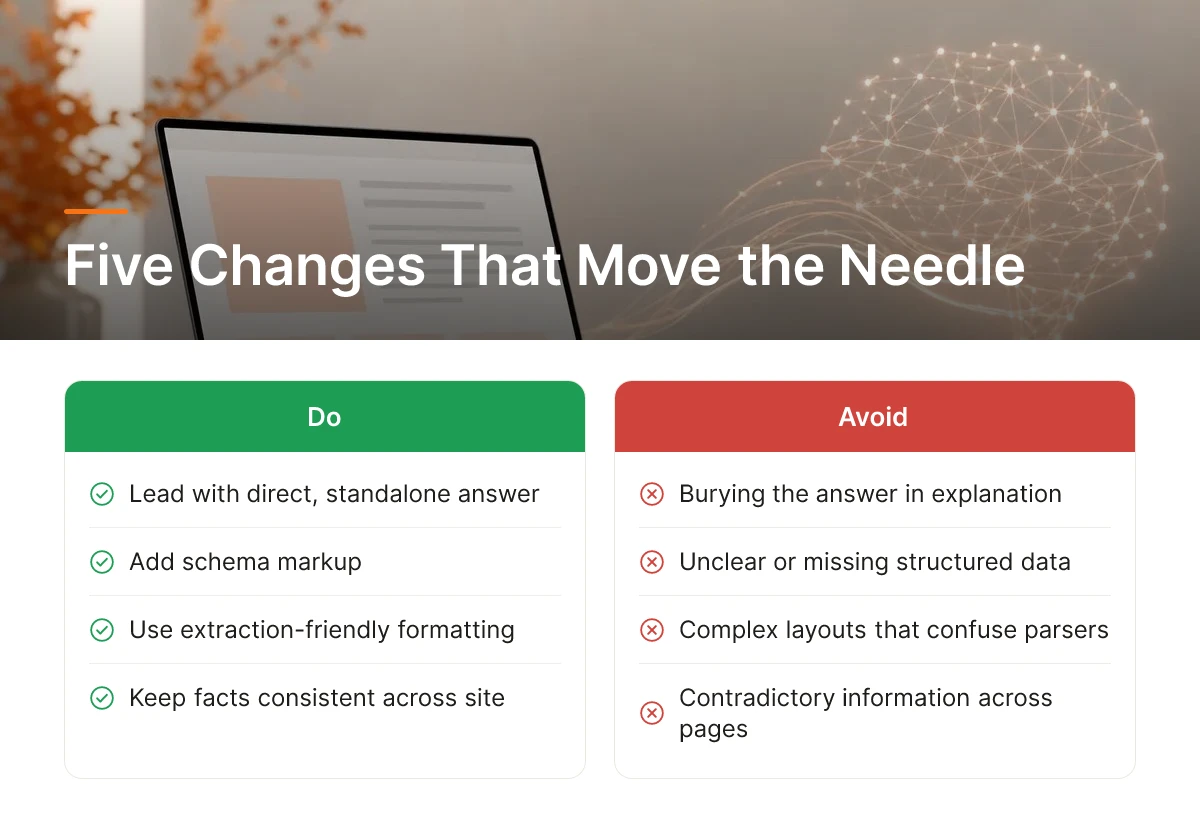
Five changes move the needle most: answer-first structure, schema markup, extraction-friendly formatting, the SEO fundamentals that still hold, and consistent facts across your site. Together, these form the practical core of Get Your Website Noticed by AI Search Engines (GEO), the rest is refinement.
What Content Structure and Formatting Actually Drives AI Citations?
Lead every page and section with a direct, standalone answer before you explain the reasoning behind it. AI engines pull the sentence that answers the question most cleanly, and that sentence is far more likely to get quoted if it sits at the top of the section instead of buried under three paragraphs of setup [1].
Formatting choices matter almost as much as the words themselves. Research into what drives AI citations points to a few consistent patterns: short paragraphs, descriptive subheadings that mirror real questions, bullet lists for multi-part answers, and clear, one-sentence definitions of key terms [1]. If a competitor's FAQ page answers "what does this cost" in a single clean sentence and yours takes a full paragraph, the competitor's sentence is the one that gets extracted.
Think of each page as a set of self-contained answers rather than one long narrative. A Shopify store's shipping policy page, for example, should state the return window and shipping cost in the first line of each section, not after a paragraph of brand story.
Which Foundational SEO Practices Still Apply to GEO, and Which Don't?
Site speed, mobile usability, and a clear site architecture still carry weight, because AI crawlers rely on the same technical access points traditional search engines use [2]. Google's own guidance confirms that foundational SEO practices remain relevant to generative AI search since these features are built on the same core ranking and quality systems [2].
What loses relevance is the keyword-stuffing playbook: heavy keyword density, exact-match anchor text, and link-building for its own sake don't carry the same weight when a model is synthesizing an answer rather than matching a query string [1]. AI systems care more about whether a page states a clear fact than whether that fact is repeated five times.
Schema markup is where technical SEO and GEO overlap most directly. Organization schema tells an AI system who you are and what you do; FAQ schema labels your question-and-answer content so it can be lifted directly into a response; Product schema states price, availability, and specifications in a format machines parse without guessing. Moonrank builds this structured data automatically as part of its technical audit, alongside llms.txt configuration, so a business owner never has to touch a schema generator.
Finally, keep facts consistent everywhere they appear, your address, hours, pricing tier, and claims about your product. AI models weigh agreement across sources as a trust signal, and a mismatch between your homepage and your Google Business Profile can quietly cost you a citation.
How Do You Measure Whether Your GEO Efforts Are Working?
You measure GEO progress by logging how often your brand appears in AI answers over time, tracking referral traffic patterns from AI platforms, and watching assisted conversions rather than last-click data alone.
Unlike Google rankings, there's no dashboard showing your "position" in a ChatGPT answer. You have to build your own measurement habit, and it takes more manual effort than checking a rank tracker once a week.
What Metrics and Tools Should You Use to Track AI Search Visibility?
Start with manual prompting. Ask ChatGPT, Perplexity, Gemini, and Claude the exact questions your customers would ask, "best project management software for small teams" or "boutique hotels in Charleston with rooftop bars", and log whether your business appears, how it's described, and which competitors show up instead. Run the same prompts weekly or biweekly so you can spot trends rather than one-off results, since AI answers shift based on model updates and the sources each engine pulls from at query time [1]. Second, check referral traffic in your analytics tool. AI platforms increasingly show up as identifiable referral sources, traffic tagged from chatgpt.com, perplexity.ai, or similar domains, so filter your existing analytics setup for these patterns rather than assuming all your traffic is organic search [1]. It won't capture everything, since many AI answers don't include clickable links at all, but it's a real signal worth isolating.
Manually running this across four platforms, multiple prompts, and recurring intervals is tedious at scale, which is why dedicated AI visibility tracking tools exist as their own category now. Moonrank builds this tracking in as a core function, monitoring how your business appears across ChatGPT, Gemini, Claude, and Perplexity automatically, so you're not reconstructing the process by hand every week.
How Do You Calculate ROI From AI Recommendations Versus Traditional Search?
Attribution is genuinely harder here than with traditional search. A customer might ask ChatGPT for a recommendation, note your name, close the chat, and type your URL directly into their browser two days later, showing up in your analytics as direct traffic with zero trace back to the AI conversation that actually drove the decision.
Because of this, lean on assisted conversion thinking rather than last-click attribution alone. Track upticks in branded search volume, direct traffic, and overall conversions in the weeks after you improve your AI visibility, and treat correlation across those signals as your evidence rather than expecting a clean, attributable click path.
Before changing anything, set a baseline: run your prompt list today, record the results, and compare again in a month. Get Your Website Noticed by AI Search Engines (GEO) is a slow-moving target compared to Google rankings, so without a starting point, you can't tell whether new content and technical fixes actually moved the needle.
Can You Optimize for Both GEO and Traditional SEO at the Same Time?
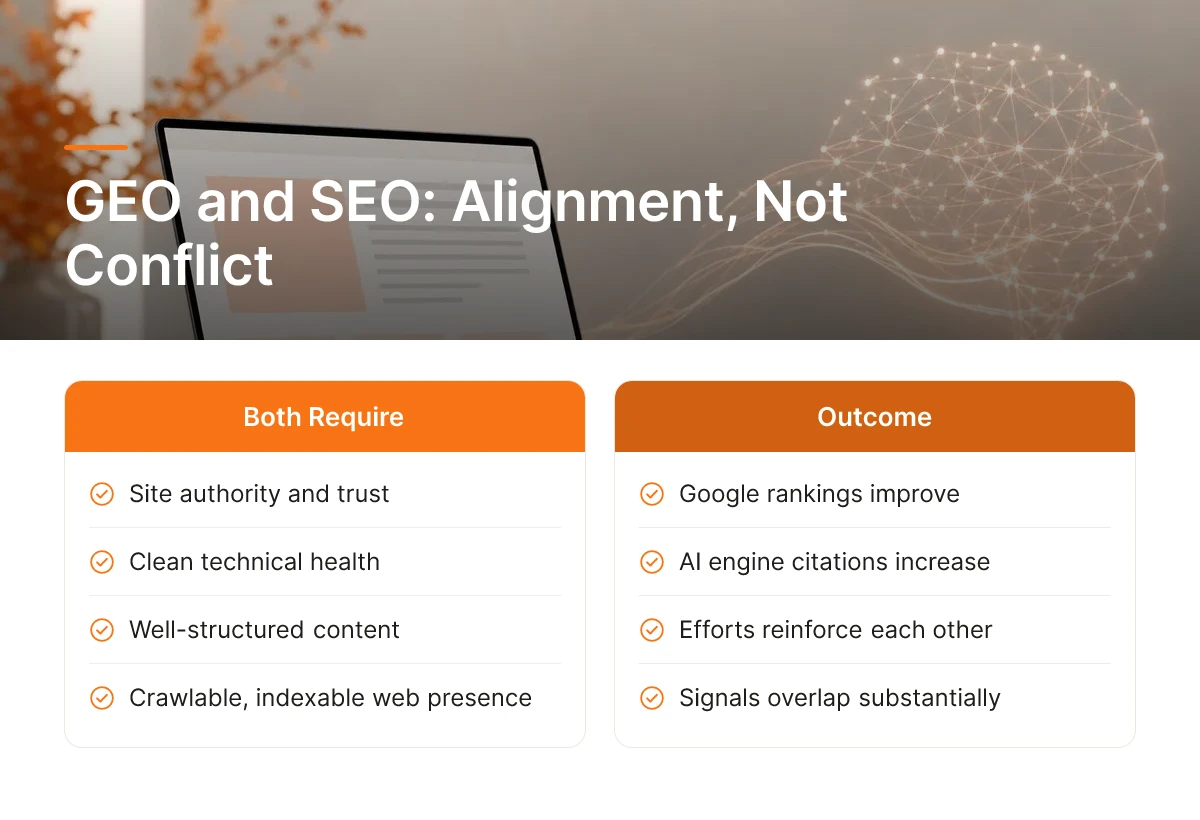
Yes, GEO and SEO draw on the same underlying signals, so Get Your Website Noticed by AI Search Engines (GEO) efforts and classic Google rankings improve together more often than they compete.
Do GEO and SEO Strategies Conflict, or Do They Reinforce Each Other?
AI search engines still rely on the crawlable, indexable web to find and verify information, which means the fundamentals that earn Google rankings, site authority, clean technical health, well-structured content, also feed what AI engines cite [3]. Google itself confirms this overlap, stating plainly that core SEO best practices remain relevant to generative AI features because those features sit on top of the same ranking and quality systems [2]. A fast, well-organized, authoritative site gives both systems something to work with.
The two approaches do pull apart at the content level. Traditional SEO often rewards long-form pages built around keyword variations and comprehensive coverage of a topic. GEO favors tighter, answer-first sections that state a conclusion in the first sentence and let an AI model lift it cleanly into a response [1]. A product page written for keyword density might bury the actual answer, price, availability, comparison, under three paragraphs of preamble that an AI engine skips over entirely.
What's the Priority Order If You Have Limited Resources for Both?
For an e-commerce store or B2B SaaS team without a dedicated SEO staff, sequencing matters more than trying to do everything at once.
- Fix technical fundamentals first. Crawlability, page speed, and mobile usability affect how both Google and AI crawlers access your site at all.
- Restructure top-performing pages for answer-first clarity. Take the pages already driving traffic or conversions and rewrite the opening of each section to answer the implied question directly.
- Expand structured data last. Schema markup and an llms.txt file help AI systems parse what your business sells and why it's trustworthy, but they matter less if the underlying content isn't already clear.
Cost trade-offs follow the same logic. Budget-friendly automated tools can handle daily publishing and technical cleanup continuously, while premium full-service agencies charge more for strategy work a small team may not need yet. Choosing between them comes down to how much hands-on customization your niche actually requires.
Moonrank was built around this exact overlap, tracking visibility across ChatGPT, Gemini, Claude, and Perplexity while handling the technical optimization and daily content publishing that support both GEO and conventional SEO at once, with no manual work after setup. If you're weighing where to start, explore www.moonrank.ai to see how an automated approach covers both fronts without the agency price tag.
Frequently Asked Questions
Does GEO replace the need for traditional SEO entirely?
No, GEO builds on SEO rather than replacing it, since AI search engines still rely on crawlable, well-structured sites to find your content [2]. Google's own guidance confirms that foundational SEO practices remain relevant for generative AI features [2]. Think of GEO as an added layer: the technical and content signals that help AI engines understand, trust, and cite your business specifically.
How long does it take to see results from GEO efforts?
Most businesses see early signals within weeks, but durable AI citations typically take a few months to build. AI engines need to recrawl and re-evaluate your site, and trust signals like citations and structured data compound over time rather than appearing overnight. Consistent daily publishing tends to accelerate this compared to one-off content pushes.
Do small businesses need to worry about AI search visibility yet?
Yes, AI search has moved from experimental to mainstream, with Perplexity alone reporting over 100 million weekly queries by late 2024 [research context]. For a local restaurant, boutique hotel, or Shopify store, that means potential customers are already asking ChatGPT or Perplexity for recommendations in your category. If your site isn't optimized to be read and cited by these engines, a competitor is likely filling that gap instead.
Can I use the same content for GEO and SEO, or do I need separate pages?
You can generally use the same core content for both, since clear, well-organized pages serve human readers, Google, and AI engines alike. The difference is emphasis: GEO rewards direct answers, structured data, and citable facts, while SEO still values keyword targeting and backlinks. Moonrank's daily content generation builds pages designed to satisfy both from the start, so you don't need to maintain two separate content tracks.
What industries benefit most from GEO right now?
Ecommerce stores, B2B SaaS companies, cybersecurity vendors, and hotels see some of the clearest early GEO gains. These industries face frequent "best of" and comparison-style queries, exactly the format AI engines answer by citing specific brands. Local and hospitality businesses also benefit because AI recommendations often substitute for traditional local search.
Conclusion
Getting noticed by AI search engines comes down to three things: a site AI systems can actually crawl and parse, content structured around direct answers rather than keyword stuffing, and consistent technical signals like schema markup and llms.txt that build trust over time. None of this is a one-time fix, it's an ongoing process that most SMB owners don't have hours each week to manage manually.
That's the gap Moonrank was built to close, running daily content publishing and technical optimization automatically for $99/month. Start with a 3-day free trial at moonrank.ai and see where your business currently stands across ChatGPT, Gemini, Claude, and Perplexity.
Sources & References
- Get Your Website Noticed by AI Search Engines (GEO)
- Google's Guide to Optimizing for Generative AI Features on Google Search | Google Search Central | Documentation | Google for Developers
- SEO and GEO (AI-Search) Website Optimization | Smart Marketing Biz
- Best GEO Tools for AI Search Optimization
Recommended Articles
Explore more from our content library: